Arts & Entertainment Community Environment
Art brings heart to environmental protection — and stormwater?
Liz Racine has been around the water for her entire life. A self-described “artsy-fartsy kid,” the young marine scientist remembers interspersing her time on family vacations to the Florida Keys and fishing trips to Canada’s Vancouver Island with as much aquatic art as she could muster. As an adult, now working as Harbor WildWatch’s operations manager, that hasn’t changed.
“I feel like I’m always drawn to [the water]. I’ve got a couple of paintings hanging up in my house right now,” Racine said, a smile in her voice. “They’re all big ones, like a manatee, a shark, some fish. It’s kind of funny — my fiancé always kind of makes fun of me. He’s like, ‘As long as it’s got fish on it, you’ll get it.’”
Racine is one of three artists Harbor WildWatch commissioned to create four pieces of sidewalk art around city storm drains. The works are one component of a three-part stormwater awareness project the organization co-created with the City of Gig Harbor.
Lindsey Stover, the organization’s executive director, said the project simultaneously helps people understand the impact stormwater runoff has on the environment and keeps water health top of mind, regardless of what they are doing outside.
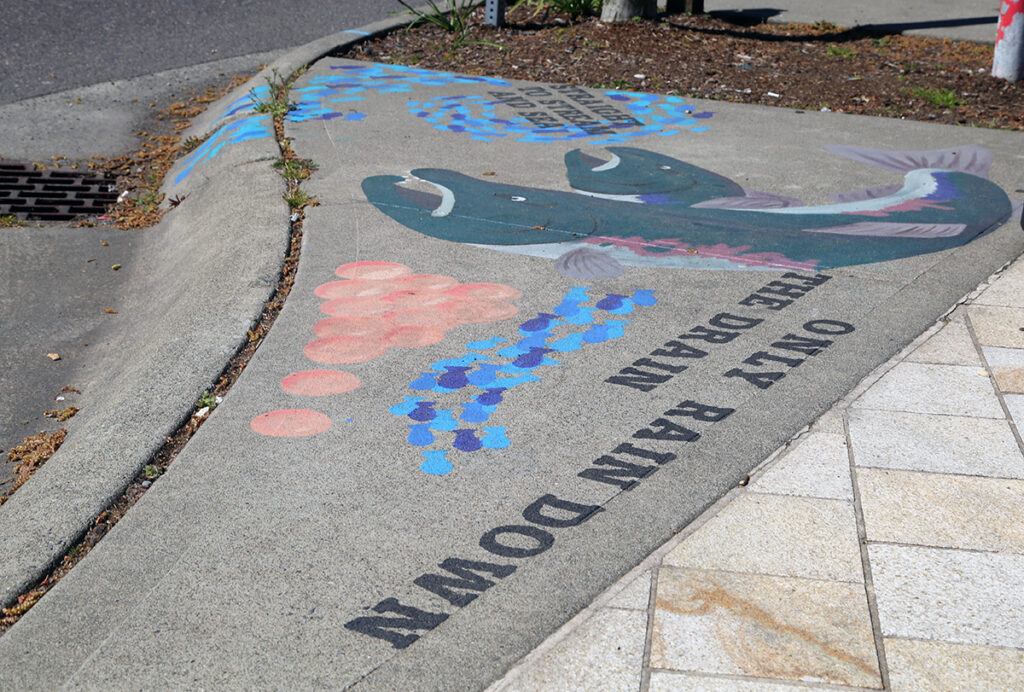
Probably the most visible work is Liz Racine’s painting on Harborview Drive near Skansie Brothers Park. Photo by Vince Dice
On the ground? Into the Sound.
“It gets into everything, right?” Stover said of stormwater. “Pet waste, bacteria … that can do all sorts of things in the environment, but it makes it unsafe for people and animals to recreate. People love being on the water, whether it’s on their boats or they’re kayaking or paddleboarding or just swimming when it’s warmer out, or their animals might go swimming — things like that.”
Runoff — like oils and other fluids, as well as tire dust — can have further detrimental effects, Stover said. These pollutants harm eelgrass and bull kelp beds, both of which are nurseries for ecologically important species. That includes some that human beings also eat, like Dungeness crab, red rock crab, and several salmon species.
“We want to keep those contaminants out of the waterways, not only for the benefit of people recreating, but also people eating bivalve shellfish,” Stover continued. “Obviously, they’re taking in the water and filtering, and so they’re holding onto that bacteria and those contaminants, and it makes it unsafe for [humans] to eat.”
Biggest source of pollution
Michael Abboud, Gig Harbor National Pollutant Discharge Elimination System coordinator, said the city and Harbor WildWatch have partnered on stormwater education for years.
“According to the Department of Ecology and the best available science, stormwater runoff is the biggest contributor of pollution in Puget Sound, which is the lifeblood of our region, our environment, and our economy,” Abboud said in an email. “If we can be good stewards of our water resources, they can sustain us for generations. If we aren’t good stewards, we can start to lose what makes our region unique, attractive, and productive. Raising public awareness is just about not taking that for granted and the murals are a reminder for what’s at stake.”
Abboud initiated the project and identified locations for the sidewalk art.
“Many cities have done similar projects,” Abboud said. “But I first became aware of them from Kitsap County, who we also collaborate with for stormwater education and outreach.”
Abboud also took inspiration from where he lives in Tacoma. He particularly loves a mural on the sidewalk of Sixth Avenue and South Oakes Street “and wanted to bring it [the concept] to Gig Harbor. I was able to take some lessons learned from those projects, including the preference for sidewalk instead of the street and picking the right locations. The art itself was entirely driven by Harbor WildWatch and the artists’ visions.”
Public education
In addition to the commissioned art pieces, Harbor WildWatch organized 20 workshops at local schools, using a Plinko-style game to teach students about what stormwater runoff does to the environment. Teaching children environmental responsibility when they are young is crucial, Stover said.
“By the time they become adults and they’re making household decisions and all that, we want them to understand how their individual decisions impact stormwater and contaminate stormwater,” Stover explained.
The third piece of the project will be coming to a Gig Harbor Farmers’ Market near you: Harbor WildWatch has converted the game into a small exhibit for its booth at the market this summer.
Public art
Along with Racine, Perry Hamilton and Kat Barlow also created art for the project. Hamilton works at the Point Defiance Zoo & Aquarium in Tacoma, while Barlow interns for Pierce County as a water quality specialist. Barlow also interned with Harbor WildWatch from October 2022 until July 2025.
Racine’s work can be found above the storm drain at 3211 Harborview Drive. It’s a small piece showing how whatever goes into the water affects the chum salmon who faithfully return to local waters every year.
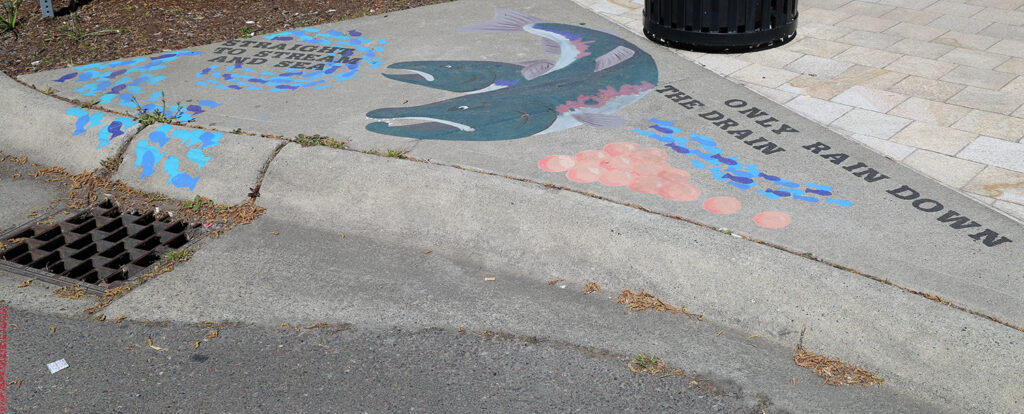
Liz Racine’s storm drain art near Skansie Brothers Park emphasizes the importance of runoff to the health of chum salmon. Photo by Vince Dice
“They’re just so stunning in their breeding colors, and so I was like, ‘Those guys are sick! I’m going to paint those guys,’” Racine said of the chum salmon and her mural. “And then having that additional little school of fish showing that not only are we affecting the chum salmon, which are so close — literally physically — but all the other fish as well.”
Racine said her favorite detail on the piece is one she wasn’t sure was going to look good at the time: The teeth on the male chum salmon.
“They’re also called ‘Dog Salmon,’ sometimes, just because they’ve got those great big, almost like canine teeth in their mouth,” Racine said, describing chum salmon. “That’s another morphology that they’re using to attract those females, but they’ll also use it to fight off other males. And when you’re thinking of salmon, yes, they are predatory fish, but you’re not often thinking of them having like these great big, crazy teeth that you might think of as being more like a shark or like some crazy river monster or something like that.”
Art as inspiration
Even though people can look up from her piece and see the sound right in front of them, Racine hopes that her work still inspires them to think more deeply about their everyday actions that can affect water health, and how connected everyone is to the Sound and the ocean.
“I was just thinking about on my drive in to work today that folks used to think that the solution to pollution was dilution because the ocean just seems so big, so vast — how … could anything that I do impact that absolutely massive environment? And the unfortunate fact is it does a lot. I’m hoping that people … if they walk by my piece and there’s a candy wrapper or something like sitting on the grate right next to it, they’ll take the second to pick that up and put that in the trashcan right there instead of maybe walking by like they would have before.”
More than fish
When she’s not working at Point Defiance, Hamilton volunteers with Harbor WildWatch. Like Racine, she is a lifelong artist. Hamilton created two pieces for this project. For her first piece, Hamilton said, she immediately thought of the giant Pacific octopus.
“I wanted to pick something that is what we call a charismatic megafauna. That’s going to be one of your animals that people have that heart-to-heart connection with, and can really identify and go, ‘I want to protect that,’” Hamilton explained. The aquarium also recently got a new octopus, whom she helps train and visitors can see. “I thought it would be really fun, and it’s immediately identifiable. If you see an octopus, you know it’s an octopus.”
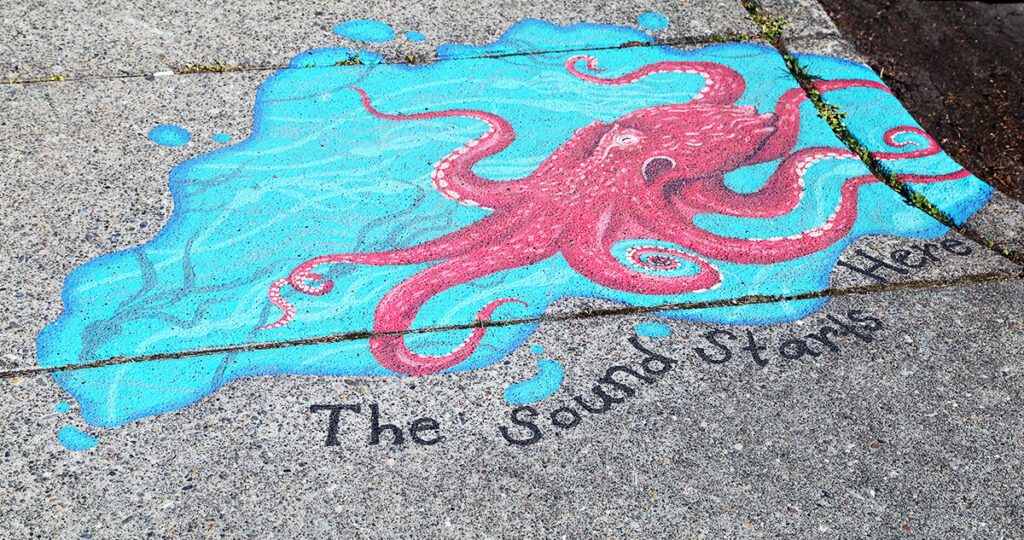
Perry Hamilton created this work for a stormdrain near the corner of Harborview and North Harborview drives. Photo by Vince Dice
Hamilton is especially proud of the octopus’s suckers, because she tried to make them look as realistic as possible.
That piece is also located at 8714 N. Harborview Drive — and if pedestrians look closely, they can see Hamilton’s signature hidden in the painting (though this reporter will not reveal where).
A river runs through it
Hamilton’s second piece is also at 8714 N. Harborview Drive. It depicts a river of chum salmon throughout their different life stages.
Her favorite part of that piece is the fish’s alevin stage — still little babies, with their egg sacs attached. The little fish live off the yolk of those egg sacs, using them as food. They stay close to their redd (nest), until the sac is gone and the little ones are big enough to swim to the surface.
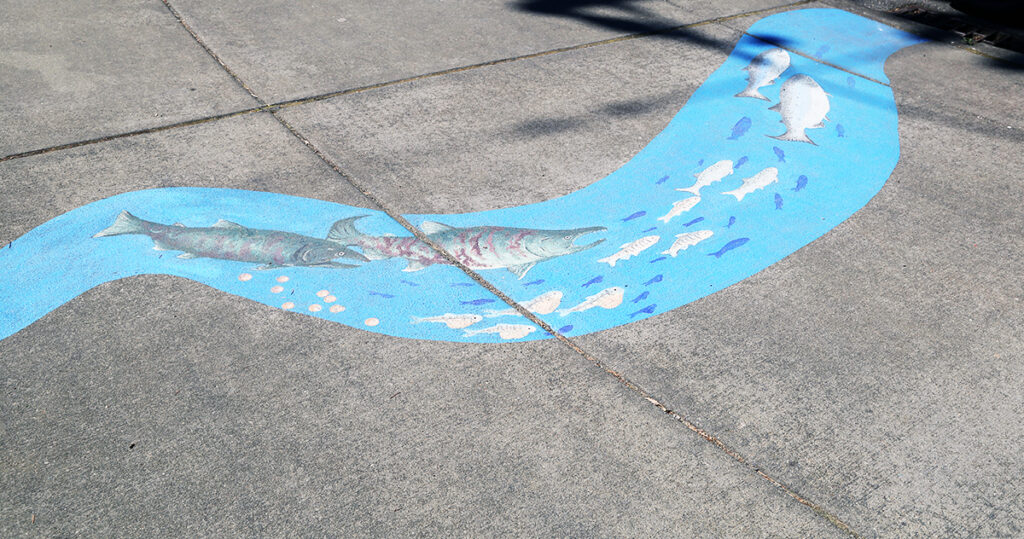
A whole creek’s worth of fish swim toward a stormdrain in this work by Liz Racine near Harbor History Museum. Photo by Vince Dice
“They are just the cutest little things,” Hamilton said. “They have that big yolk sac attached to their body, and they have these dopey eyes. They’re just the cutest little creatures. I love that stage.”
This particular piece comes with a cute little story, too. As Hamilton was in the middle of painting her salmon mural, a little boy approached her.
“He had painted me a little mini salmon, and had given that to me,” Hamilton shared. “So that was a really meaningful thing — already, it’s only been here for a day and someone has connected with it.”
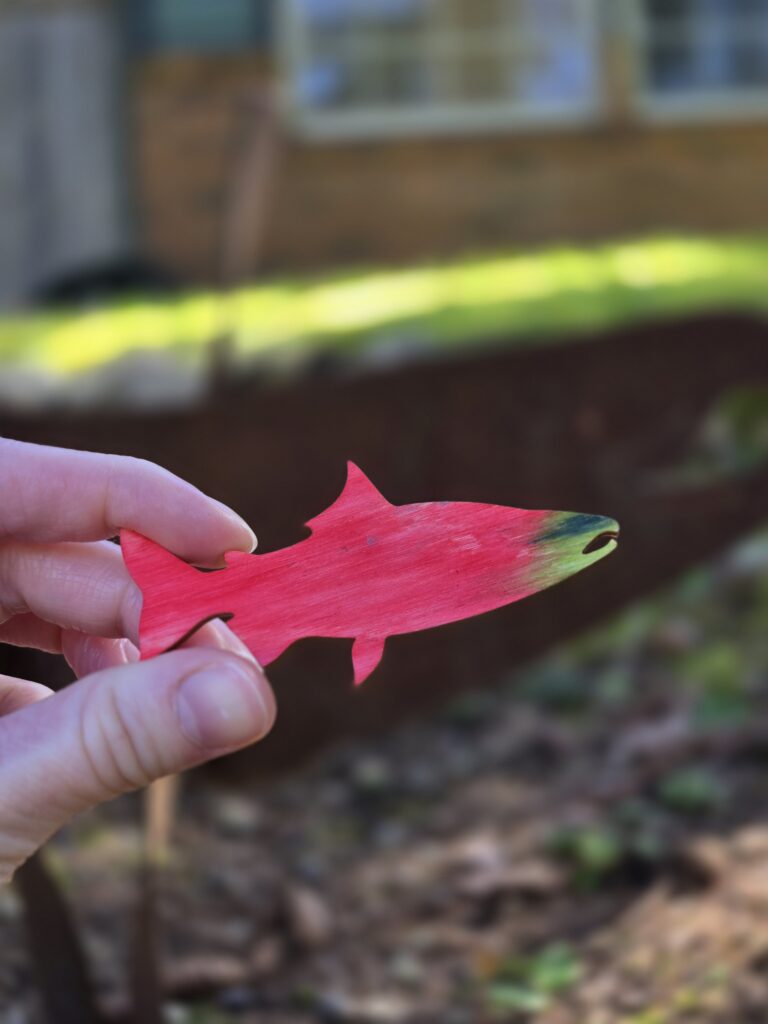
A child who watched Perry Hamilton creating storm drain art handed this tiny salmon to her.
Otter-ly adorable — and “Otter-ly Important”
While Gig Harbor Now was unable to connect with Barlow about her work, Harbor WildWatch’s website gives a brief description of her piece, titled, “Otter-ly Important — Only Rain Down The Drain.” It’s the only one that features mammals: Otters, who, in Barlow’s piece, frolic amid different kinds of kelp. Barlow’s mural is located at 4021 Harborview Drive.
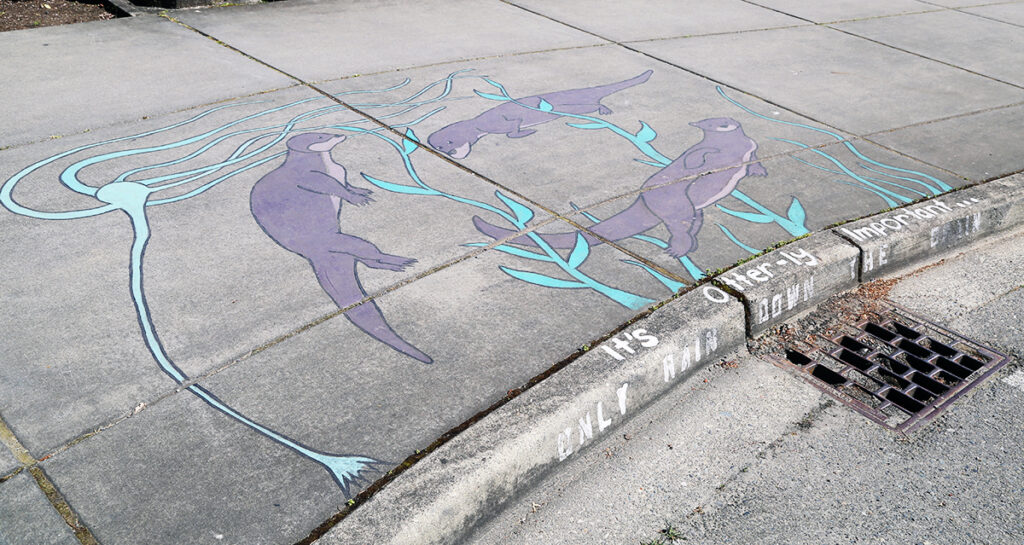
Kat Barlow created the otters that swim up from this storm drain on Harborview Drive near the entrance to Austin Park at txʷaalqəł estuary. Photo by Vince Dice
“While working in Gig Harbor, I often spotted otters scurrying along the bay; they always sparked wonder and whimsy,” Barlow writes on the storm drain project page. “This piece connects everyday water quality actions to the animals that make Gig Harbor unique.”
Art for awareness and action
Racine, Hamilton, and Abboud routinely hear positive feedback and compliments from people who see the art. Many who walk by stop to take pictures.
Abboud feels strongly that art is vital to meeting people on a personal level. It can help make otherwise nebulous issues, like water health and stormwater runoff, more concrete and immediate.
“I think the human touch is vital to reaching people’s hearts. It turns the message into a community asset. In a lot of ways, our civil infrastructure is ‘invisible’ and is designed to be so,” Abboud said. “Art pulls your attention back to our built environment and connects it with the natural environment. It forces you to ‘see’ it again in a new light. I also think artists themselves appreciate a unique and visible canvas to work on.”
Both he and Stover said that they will meet later this month to discuss asking the city to extend the project through this year into next, because of its success. If it’s viable to extend the project, they would like to include more storm drain art. Abboud added that he would also like to see regular paint touch-ups of the existing murals.
“This kind of art is intended to be somewhat ephemeral but it would be nice if it lasted at least a couple years,” he said. “Also, although it’s difficult to measure the impact of campaigns like this, I hope to pull together some metrics for evaluating its effectiveness.”
He also highlighted the city’s call for members of the public to get involved in ecological conservation and stewardship. Anyone who has suggestions or who wants to get involved in protecting the environment can check out the area’s various programs and contact the city here.
Picking the artists
This past project cycle was on a tight timeline and didn’t allow for calls for artists, Stover said, so Harbor WildWatch asked artists it already knew to create work. Because “we feel that it’s really important to pay people for their labor, especially artists,” Stover said, Harbor WildWatch paid Racine, Hamilton, and Barlow for the commissions. It would work the same way with any local artist whom the organization and city commissioned to create art in any potential expansion of the project.
Stover said that the mini-exhibit is on display at the Marine Life Center, and that Harbor WildWatch hopes to move it to City Hall for display, pending city approval.
“They have those glass cases where they display different information,” she said, “so [we’d like] to adapt it to that small space so that people coming in City Hall will also get that education.”