
Community
Gig Harbor Now and Then | An eyewitness account of the aftermath of a tragedy
The previous Gig Harbor Now and Then column brought up the subject of one of Gig Harbor’s prominent commercial buildings. It’s the one straight off the north end of Pioneer Way, across Harborview Drive. The masonry-faced structure was built in 1930 as the Novak building. The question asked of the building is:

Community Sponsor
Community stories are made possible in part by Peninsula Light Co, a proud sponsor of Gig Harbor Now.
Why does the exterior masonry on the street end not match the rest of the building?
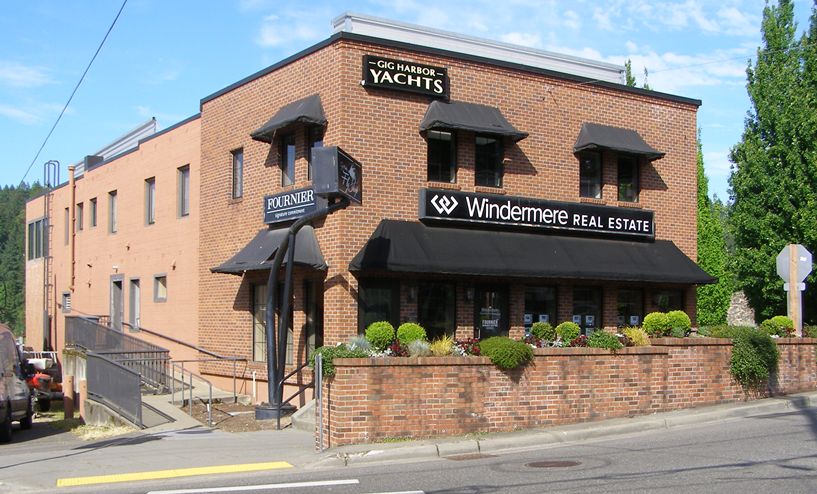
The mis-matched masonry on the Novak Building.
Answer: The street end was rebuilt after a truck crashed into it.
The question garnered zero response from readers. The likelihood is that no one managed to get through 1,300 words on the topic of truck transmissions, so didn’t see the question of local history at the end. I knew that column wouldn’t be popular, but I felt it was an appropriate introduction to today’s column.
For 37 years, the popular story has been that the truck that crashed into the building lost its brakes. That’s not exactly what happened. The real story involves the truck’s transmission, as this column will explain.
Introduction
The Novak building in Gig Harbor has had a pretty tough life. In 1937, it was completely gutted by fire. It was partially demolished to extract a dump truck that plowed into it in 1989, and years later a small car crashed through the same wall.
Today’s column will focus on the immediate aftermath of the 1989 truck accident. I spent three days there, helping to clean up the mess. This will serve as my eyewitness account of the after-the-crash events (for whatever that’s worth).
Gary Lodholm provided the video stills used in this story. He was one of the early responders to the accident, called in with several other Peninsula Light Co. employees to disconnect the power to the building so recovery of the truck could begin. Gary took video of the scene with his new VHS camera, and recorded some of the television news coverage on the same tape.
He gave me the tape in 2024. I had it converted to a DVD, and David Moore converted that into an MP4, from which I took the screenshots. After this story runs on Gig Harbor Now, I will donate the original tape and the digital file to the Harbor History Museum.
The Harbor Inn Dump Truck Crash, Day 1
In the late morning of March 28, 1989, a tandem-axle Kenworth dump truck, fully loaded with small-diameter firewood logs, came down the steep hill of Pioneer Way in Gig Harbor out of control. It crashed through the front wall of what was then the Harbor Inn Restaurant, killing a 27-year-old waitress and her unborn child. Two other employees and the truck driver were also injured.
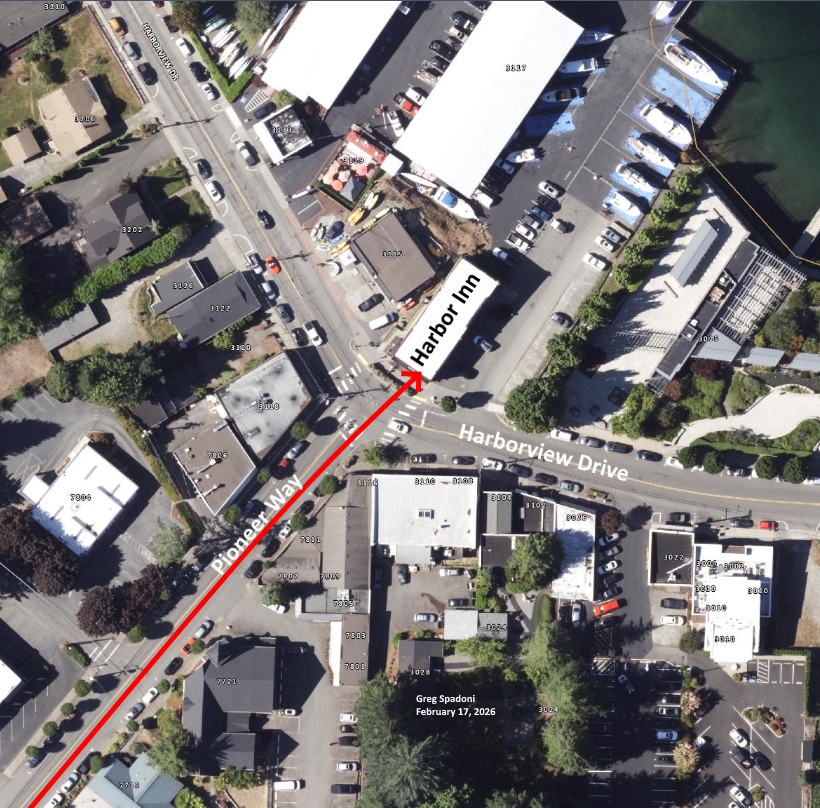
On March 28, 1989, a runaway dump truck crashed through the front wall of the Harbor Inn Restaurant in Gig Harbor. Pierce County Assessor-Treasurer aerial base map.
John Spadoni and I, both employees of local road construction company Spadoni Brothers, Inc., had been out of town that morning. We were caught in the resulting traffic snarl coming back into Gig Harbor in the afternoon.
The intersection of Pioneer Way and Harborview Drive was completely closed, causing massive backups on both streets. Not knowing what had happened, we parked somewhere near Rosedale Street and walked to the intersection to see what was going on. A sizable crowd of people had gathered as close to the Harbor Inn as police barricades would allow.
The front of the building had a giant hole to the right of the entry door. We couldn’t see the dump truck, because it fell through the ground floor into the basement. The floor of the second story had collapsed on top of it.
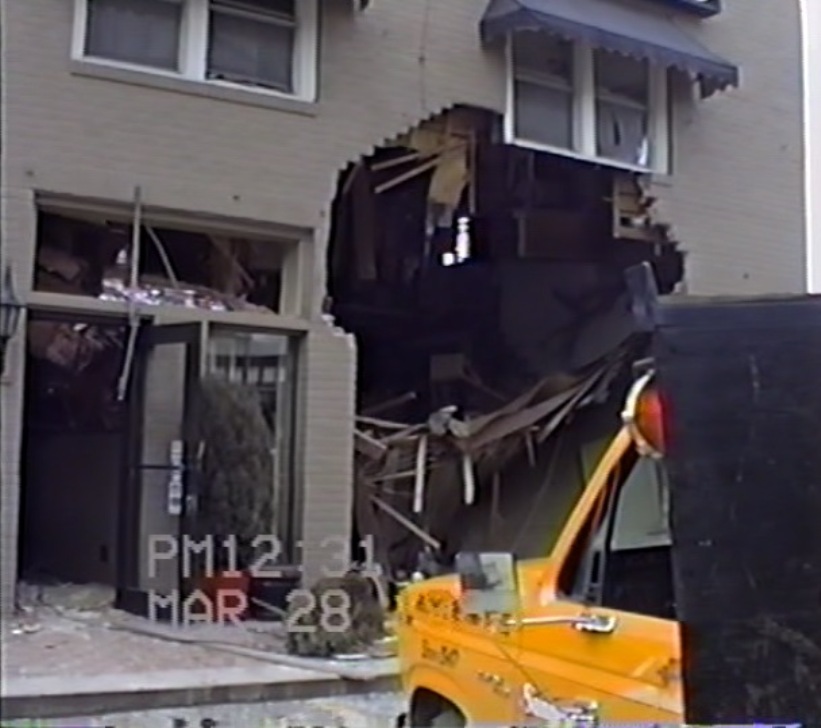
The dump truck could not be seen through the giant hole in the wall because it fell through the floor into the basement, and was covered with debris from the second floor. Video screen shot provided by Gary Lodholm.
A yellow Sunnen crane with a tall boom and a clamshell bucket was parked on the east side of the building. It was taking bites off the top of the street end of the building, then dropping the debris into the street and the gravel parking lot beside it.
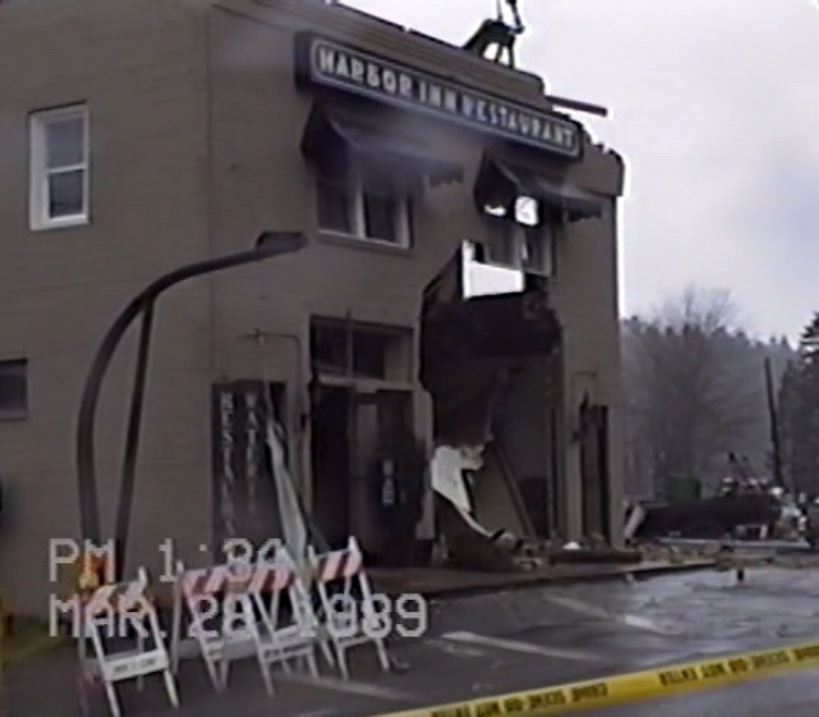
To reach the dump truck, the part of the building above it needed to be removed. Video screen shot provided by Gary Lodholm.
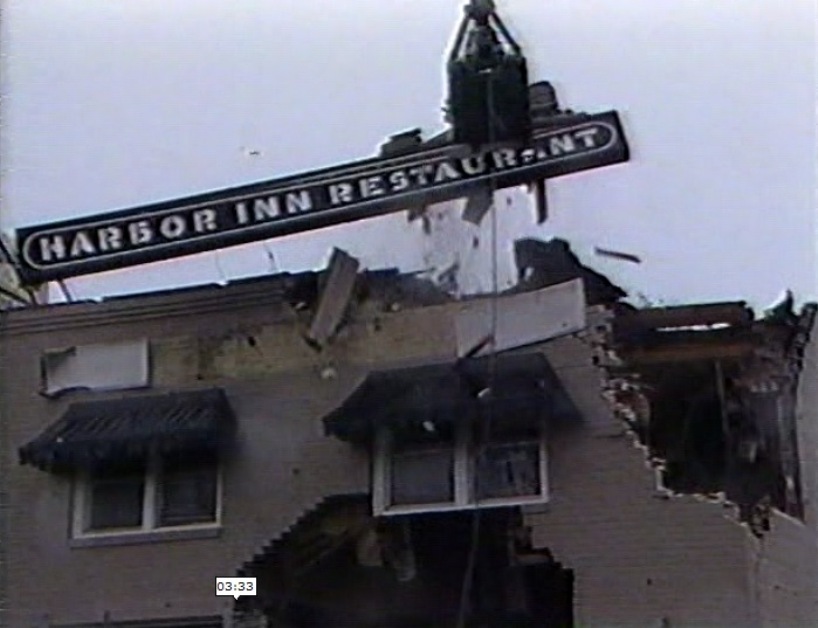
The Harbor Inn Restaurant sign was an early casualty of the partial dismantling of the building. Video screen shot provided by Gary Lodholm.
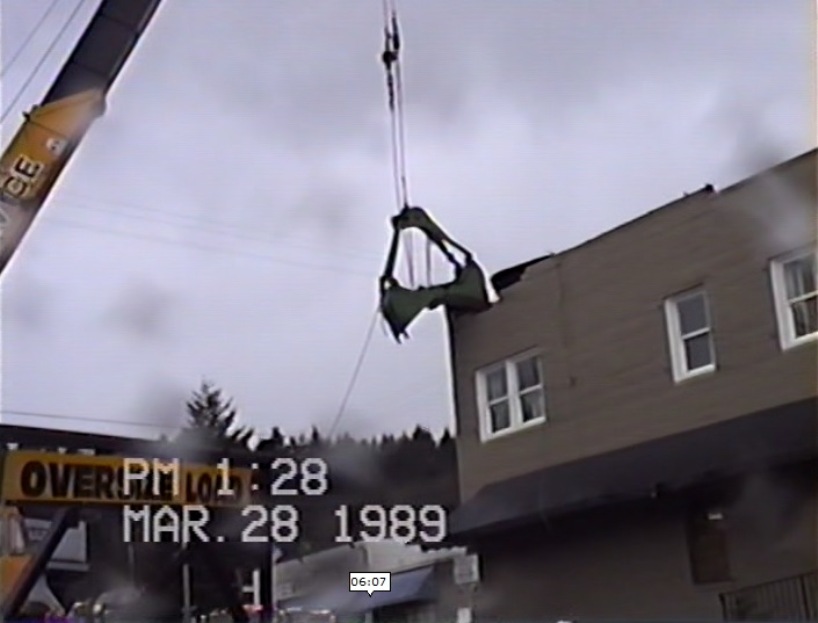
Video screen shot provided by Gary Lodholm.
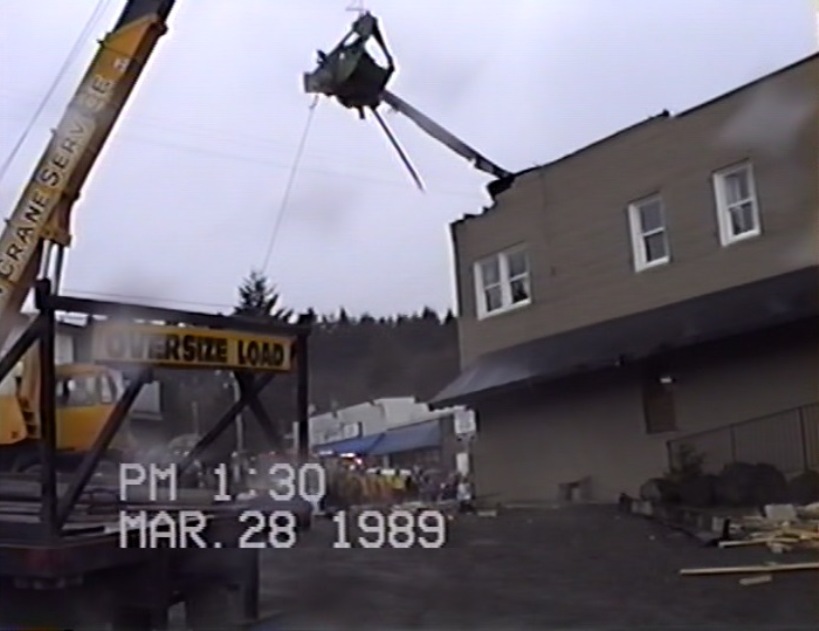
Video screen shot provided by Gary Lodholm.
Someone in the crowd — I don’t recall if we knew them or not — told us a truck had come down the steep hill of Pioneer Way out of control and crashed through the front of the building. I’m sure I wasn’t the only one to think that it had been a miracle it hadn’t happened before. With the death of Shawn Sharee Henderson, the miracle was no more.
Equipment shortage
We weren’t there but a couple minutes before John noticed that the crane was the only piece of equipment on the site. The growing pile of building debris would have to be moved at some point to make room for more, and the crane wasn’t going to do it.
The city of Gig Harbor didn’t have anything larger than a backhoe, which was too small to move that size of a pile. John said to me, “Let’s find somebody from the city and see if they need another machine here.”
We had barely started back toward John’s pickup truck when we spotted Dave Brereton, of the city’s public works department. He’s the one we would’ve sought out, given a choice, and there he was. He was always calm, always knew what was going on, always gave us straight answers. I, for one, always preferred dealing with Dave.
I don’t recall if Dave had to check with anyone else, but it couldn’t have been more than a very few minutes before he told us yes, bring one of Spadoni Brothers’ road construction machines down to help.
John and I agreed that Spadoni’s 125-B Michigan, at 39,000 pounds their biggest rubber-tired loader, was the right one for the job. He drove me to Spadoni’s nearest gravel pit, on 96th Street off of Burnham Drive, where the loader was parked.
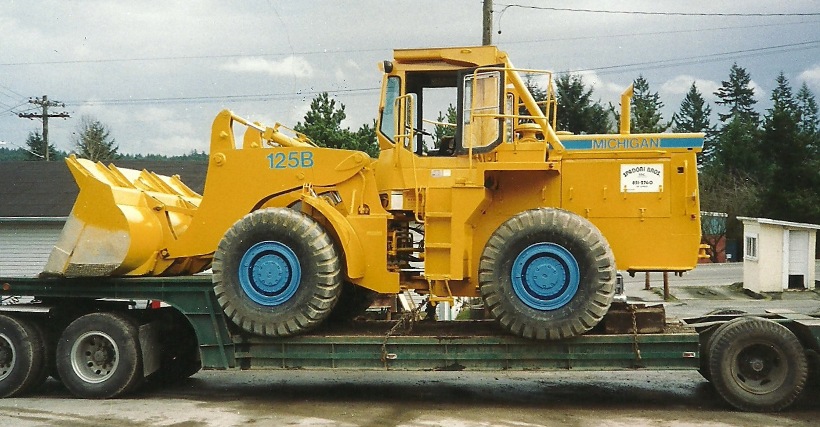
Spadoni Brothers’ 125-B Michigan loader was the right machine for the job. Photo by Barry Chunn.
Driving an oversized piece of machinery on public streets can be tricky. At nine feet, eight inches wide, it was more than a full foot wider than the biggest trucks, and being an articulated loader (which means it bent in the middle to steer), it became a lot wider than that when it was turning. However, one of the advantages is that when they see you coming, cars give you a wide berth.
The passage of time takes away a lot of details, so I can only surmise that to get to the intersection of Pioneer Way and Harborview Drive, I had to drive the loader in the oncoming lane to get past the backed-up traffic.
By the time I got to the site with the loader, the crane had moved to the middle of Harborview Drive. I parked on the west side of the building, in front of what is today the Gig Harbor Fly Shop.
Not a lot of conversation required
Construction sites are often busy with workers from various companies, doing a variety of different things. One group normally doesn’t talk to another unless they’ll be working together. It’s just not necessary, because everyone knows their job, and they do it.
Although technically it was a deconstruction site, it worked the same way at the Harbor Inn. I don’t recall if anyone gave me any kind of instructions, and I don’t remember ever talking to the crane operator or the Fire District 5 crew that had been there since minutes after the crash. The Washington State Patrol was in charge, but generally it’s the machine operators who decide how to do the work.
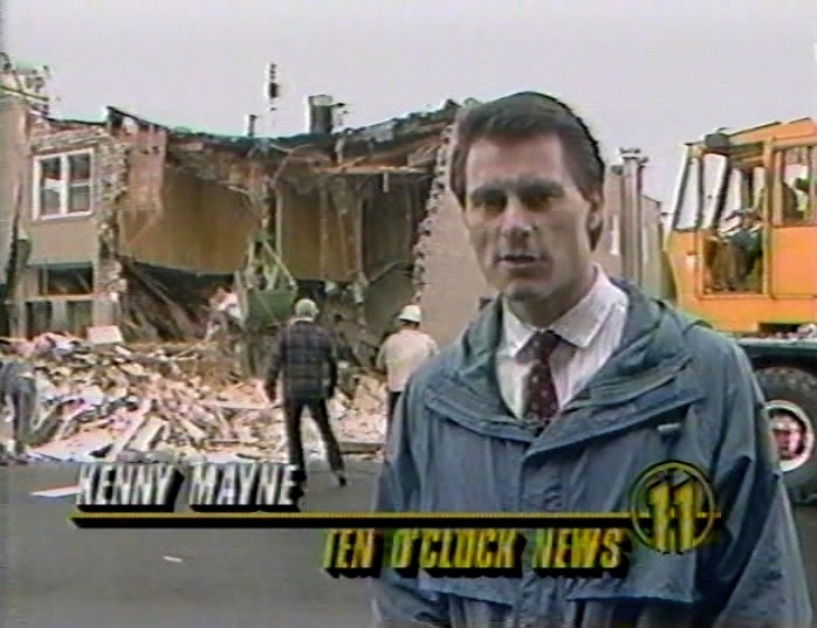
A good portion of the street end of the building had been removed when Channel 11’s Ten O’clock News filmed a report on the crash. (Reporter Kenny Mayne became a national figure when he moved to ESPN to cover sports.) Video screen shot provided by Gary Lodholm.
Mostly a waiting game
From mid- to late-afternoon, I mostly sat in the loader, watching the crane demolish both stories on the street end of the building, one small bite at a time, in order to reach the dump truck in the basement. That gave me time to notice the crowd of onlookers on the two sidewalks on the far side of the intersection growing as the day progressed. It was pretty big by nightfall. The weather probably contributed to the growth of the crowd. The intermittent rain that had fallen during the morning and early afternoon had stopped by the time I arrived with the loader. The next two days were dry as well.
The predominant sound at the site was the somewhat high-pitched exhaust roar of the crane’s two-cycle Detroit Diesel engine.
The crane would dump the debris in the middle of the intersection and I would use the loader to push it off the street and pile it just short of where The Russell Family Foundation building is today. (The nearest part of that property was a vacant lot at the time with brush and small trees on it.) I probably didn’t move the pile in the street more than twice an hour. Progress was very slow. The crane operator had to be careful not to destroy more of the building than was necessary to remove the truck, and not to damage the truck any more than it already was.
Although the truck could not be seen through the gaping hole in the front wall, its right front tire and fender were showing through the open doorway on the east basement wall.
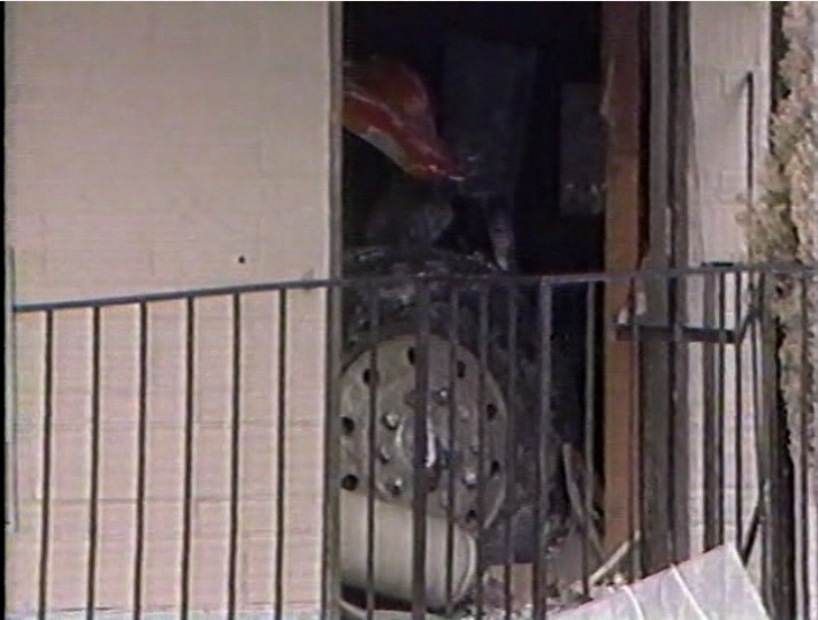
Accessible only to those of us working at the site, the right front tire and fender of the dump truck could be seen in the basement through a side door. Video screen shot provided by Gary Lodholm.
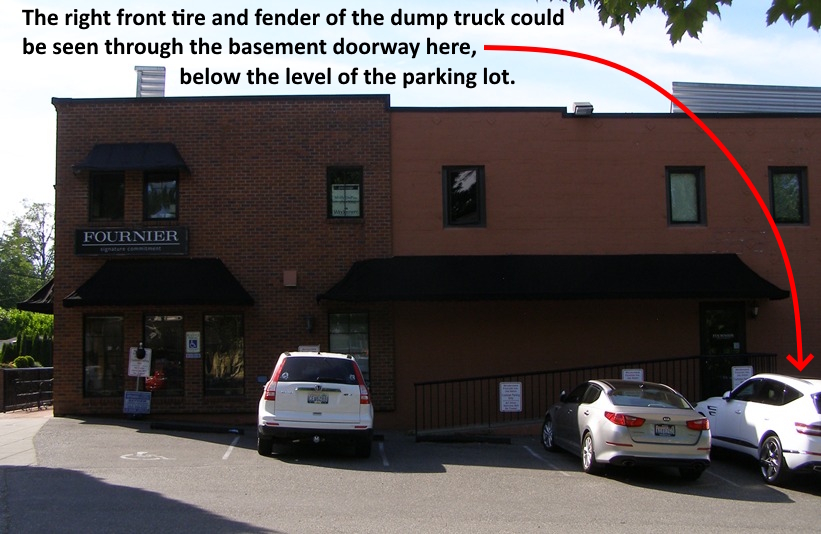
Photo by Greg Spadoni
Loose nails and other hazards
After each time I pushed the debris pile off the street, I walked around the loader, pulling nails, large and small, from each of the five-foot-tall tires with a pair of pliers.
Day turned to night, and the work continued under floodlights set up by Fire District 5.
A handful of volunteer firefighters were on the scene, some having been there earlier in the day, others arriving after work from their regular jobs. The ones who had been there earlier, before I arrived, had already put in a lot of hours of very hard work. As first responders, they, in support of the professional firefighters, had painstakingly picked their way through the rubble inside the building, making sure all the victims had been accounted for.
Violent accident scenes are frequently plagued by a lack of information. Often, the only way to be sure that there are no more victims to be found is to thoroughly search the scene. When that involves twisted, collapsed rubble, the going is slow and difficult. In that work, the volunteer firefighters were invaluable in their role of supporting the professionals.
That initial hard work was finished before I arrived at the scene with the loader. Because the volunteer firefighters didn’t have much, if anything, to do while the crane was pulling debris out of the building, that afternoon and evening they mostly served as a hazard on the job site.
They were continually in my way, milling around, chatting with each other, paying no attention to the moving machine, oblivious to the fact that in such a large piece of equipment, I couldn’t see them when they would stand mere feet behind or beside the loader, and that I could run them over, smashing them into flatted goo without even feeling it. They obviously had more confidence in my ability to not run them over than I did.
I suppose I should’ve climbed down and asked them nicely to go find someplace else to loiter, but because it was already a pretty intense scene, and some of them had already done a lot of hard work, I didn’t want to cause any friction. And it wasn’t their fault they wouldn’t have much more to do until the next day. But heads up, guys — the fire department is supposed to be all about safety.
Working with professional firefighters is always a breeze. They know their stuff, and they know how to keep themselves and others safe. Why the professionals there weren’t keeping tabs on the volunteers, I don’t know.
Caught unawares
After dark, when the air was getting uncomfortably cold, I, for one, was getting hungry. I hadn’t anticipated working long past dinner time, so hadn’t brought any food with me, and wasn’t able to go buy something to eat.
The State Patrol had passed the word that none of the workers could leave the site until the dump truck was out of the building. It was a fatal accident scene, and the State Patrol doesn’t cut any corners with their investigations. The biggest piece of evidence, the wrecked truck, would be towed to an impound lot before it could be further damaged or tampered with.
Around the same time, Spadoni Brothers were asked to send two dump trucks to the site. The logs in the crashed truck would be loaded into the Spadoni trucks for immediate weighing. The State Patrol wanted to know if the crashed truck had been overloaded.
The crowd of spectators steadily shrank as the night went on. Nothing dramatic was happening, and they, too, must’ve been getting cold and hungry.
It was pretty late in the evening when enough of the building had been removed that the back of the truck could finally be seen. In the dump box was a big, oversized load of small-diameter firewood logs hanging several feet out of the back. Softwood logs are far lighter in weight than gravel, so to get the maximum legal load of logs, it’s common to remove the tailgate from a dump truck and haul logs several feet longer than the dump bed. I’ve done it many times, and even so, I don’t think I ever hauled a load of logs that was as heavy as a load of gravel.
Before pulling the truck out of the basement, the crane, with its clam bucket, slowly picked almost all of the logs out of the truck and loaded them into the two Spadoni dump trucks. Kevin Meyer drove one and Wally Minor probably drove the other.
A perpetual false assumption
The story circulating among the crowd and in newspaper and television reports that night, the next day, and ever since, was that the truck lost its brakes going down the steepest part of Pioneer Way. Being a long-time dump truck driver myself, I flat-out didn’t believe it.
I thought it was overwhelmingly likely that the driver missed a downshift while double-clutching and was unable to get the transmission back into gear on such a steep hill. The following year, witnesses at the resulting jury trial testified that they “heard the driver trying to force the truck into gear to slow it down,” according to The News Tribune (April 19, 1990). What they heard was a fruitless grinding of gears. The driver had, in fact, missed a shift.
Had the driver not missed a shift — and if he had been in the proper low gear — engine compression, coupled with an engine brake — if it had one — would have brought the truck down the hill without having to use more than a light touch on the brakes, if at all. But after a missed shift, with the transmission trapped in neutral, the loaded truck gained speed so quickly on such a steep grade that it would’ve been a strain on fully functional brakes to stop it. Not all its brakes were functional, however, so there was no hope of bringing the truck to a stop before it collided with something.
Some brakes worked, some didn’t
The State Patrol had called in a big wrecker to pull the dump truck out of the building. As the winch slowly pulled the truck backwards, up and out of the basement, the spring brakes (parking brakes on trucks with air brakes) were set on one of the two drive axles, proving that the footbrakes were still functional on that axle. (The footbrakes and parking brakes are the same brakes; they are simply actuated differently.)
The wheels on that axle were not turning; they skidded over the top of the basement wall. However, the brakes on the other drive axle were not set. Those wheels turned.
Some tandem-axle trucks don’t have parking brakes on both drive axles. I couldn’t see from where I was sitting in the loader if both drive axles had parking brakes (by the size of the compressed air cans that operate them), so the fact that the brakes were not locked on one axle didn’t prove anything at the time.
What did prove something is when State Patrol Trooper James Sammons inspected the brakes on the rear axles and discovered that they were inoperable on one of the two. He found rust on the inside of the brake drums, which proved they hadn’t worked at all in a long time.
Had the driver not missed a shift near the top of the hill, the brakes on one drive axle alone would’ve been enough to control the truck’s speed in a low gear.
The truck ran away because the driver missed a downshift, leaving the transmission trapped in neutral. With a loaded truck on that steep of a hill, it was impossible to get the transmission back into gear. The faulty brakes were a factor only after he missed the shift. Without the missed shift, the crash would not have happened.
Even so, the truck should not have been on the road with the brakes on one of the rear axles inoperable. That truck was a rolling danger, which the crash proved.
Something familiar
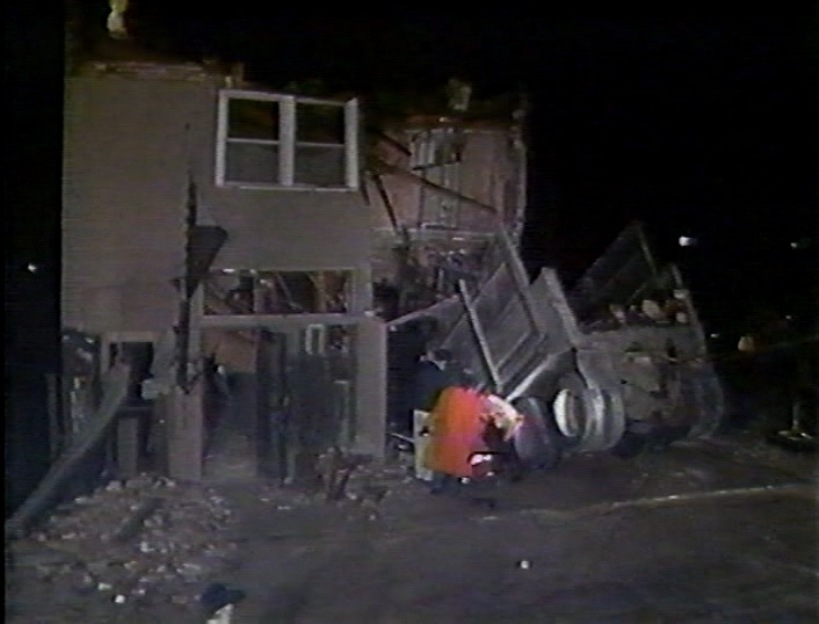
Video screen shot provided by Gary Lodholm.
As the wrecker winched the wreck further out of the building, I recognized the truck. I had seen it within the previous week or so crossing the Narrows Bridge, heading toward Gig Harbor as I was driving a dump truck into Tacoma. I had noticed it only because it had a very odd set of sideboards on the dump box. They were made out of sheet steel instead of the traditional wood planks, and extended much higher than normal sideboards, giving the dump box extra capacity. As when it crashed into the Harbor Inn, it was carrying firewood logs when I saw it crossing the bridge.
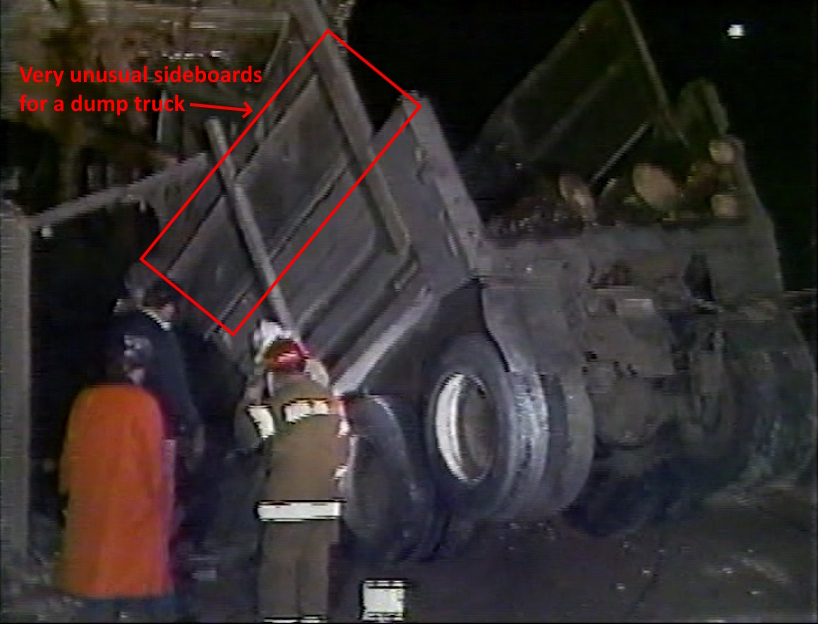
When the truck was pulled from the basement of the Harbor Inn, I recognized it by the very unusual sideboards on the dump box. Video screen shot provided by Gary Lodholm.
The end of a very long day
Most of the big crowd that had been watching from across the street had long since gone home, so missed the retrieval of the truck from the basement. The Channel 11 film crew remained until the truck was out of the building, sending video back to their broadcast studio.
With the wrecked dump truck back on the street, the salvage job was done. The last of the truck’s logs were loaded into the two Spadoni dump trucks. The State Patrol directed Kevin and Wally to drive to the truck scales on Highway 16 for weighing.
In a peculiar move, the State Patrol weighed the loaded trucks but didn’t weigh them empty. To calculate the weight of the logs, they used the gross (loaded) weight, and simply asked the drivers what their trucks’ tare (empty) weight was. The net result was very close, but may have been off by a few hundred pounds or so, depending on how much gravel or cold asphalt was stuck in the front corners of the boxes, how much diesel was in the fuel tanks, and by how much the tailgates weighed. The tailgates had been removed for the loading of the long logs, and it’s highly unlikely that either driver had ever weighed his truck with the tailgate off.
After the weighing, Kevin and Wally drove out to Spadoni Brothers’ asphalt plant in Crescent Valley and dumped the logs.
It was shortly before midnight when the State Patrol allowed the rest of us workers to go home. The TV film crew packed up and left. I stayed until shortly after midnight, making one more round of pulling nails from the big loader tires. When I finished, I think it was Mark Kimura, in one of Gig Harbor’s police cars, who gave me a ride back to my car at Spadoni Brothers’ equipment yard at the southwest corner of Stinson Avenue and Rosedale Street. By the time I got there, Kevin and Wally had already gone home. With my 16-hour day done, I needed food.
Next time
The conclusion to the Harbor Inn Dump Truck Crash will be posted on May 4. It will detail the next two days of cleanup at the Harbor Inn.
Greg Spadoni, April 20, 2026
Greg Spadoni of Olalla has had more access to local history than most life-long residents. During 25 years in road construction working for the Spadoni Brothers, his first cousins, twice removed, he traveled to every corner of the Gig Harbor and Key Peninsulas, taking note of many abandoned buildings, overgrown farms, and roads that no longer had a destination. Through his current association with the Harbor History Museum in Gig Harbor as the unofficial Chief (and only) Assistant to Linda McCowen, the Museum’s primary photo archive volunteer, he regularly studies the area’s largest collection of visual history. Combined with the print history available at the museum and online, he has uncovered countless stories of long-forgotten local people and events.