
Arts & Entertainment Community Education Environment
Harbor WildWatch volunteers learn the art and science of seaweed
Did you know that we humans have microalgae and macro algae — what you, dear reader, might know as seaweed or kelp — to thank for at least half the oxygen on the planet?
Well, neither did this reporter. Nor did she know the myriad facts Harbor WildWatch’s education director, Rachel Easton, shared with attendees at the marine life and conservation organization’s seaweed pressing activity, a special event for the organization’s volunteers on April 18.
Seaweed diversity
Easton showed volunteers several kinds of seaweed, nearly all of which were native, save for the Sargassum. As the name suggests, the seaweed originated in the Sargasso Sea, but climate change’s effects on currents means that the algae shows up in other places. Fortunately, it doesn’t outcompete native species, but it can cause “huge problems” when it washes up at beach resorts.
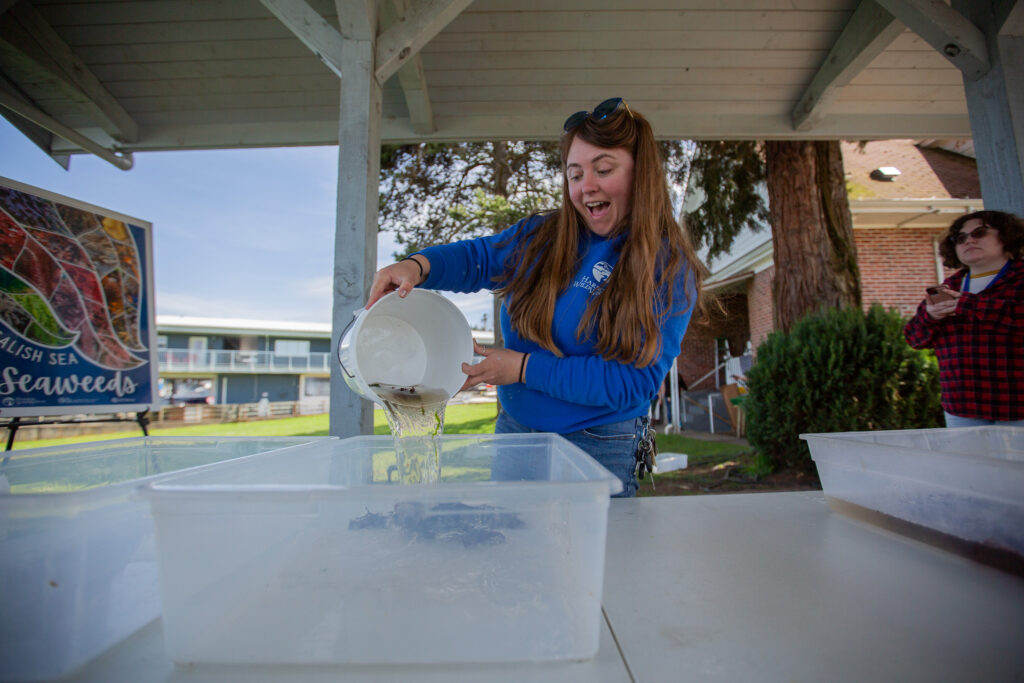
Stena Troyer, Harbor WildWatch’s science director, pours seaweed into a tray at the Skansie Brothers Park pavilion during Harbor WildWatch’s seaweed pressing event on April 18, 2026. Photo by Carolyn Bick. © Carolyn Bick
“People want to go on vacation and hang out on the beautiful beach. And then tons and tons and tons — billions of tons of disgusting, rotten, squishy, gross seaweed clogs up the beach. They will use bulldozers to plow it away from the shore,” Easton explained. “And then it just goes back into the sea — and then washes up on somebody else’s beach. What a concept. We have to battle algae.”
Though all are macroalgae, a variety of seaweeds grow in water and they all behave differently. For instance, rockweed reproduces via male and female spores. (Rockweed is also known as popweed, thanks to the bladders that are the eco-friendly version of bubble wrap — and, like bubble wrap, are impossible not to pop.)
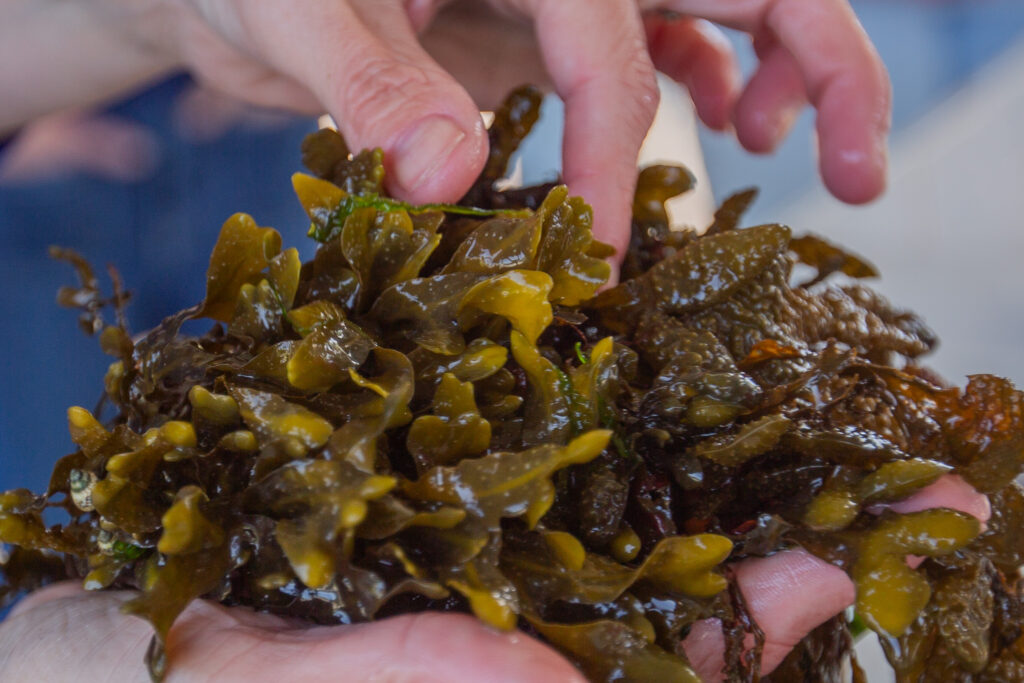
Harbor WildWatch’s education director, Rachel Easton, holds up rockweed — also known as popweed, thanks to its poppable bladders — to show attendees the seaweed’s little bladders. Photo by Carolyn Bick. © Carolyn Bick
The “mobile sperm and eggs that find each other in the water column and then unite and make a little child that becomes this,” Easton said, holding up a clump of Rockweed.
“It’s interesting and unique. There’s some implications for how we do kelp conservation… because it’s an every year kind of thing. Most kelps are annual — they grow and die within a single season, and if they don’t drop those spores, no one can help them. The spores don’t travel too far,” she explained.
“And so that makes [conservation] complicated. Luckily for us, human scientists have figured out a way to hack it,” she continued. “We can do it in a lab. … What they’ll do is they actually spawn them onto … a biodegradable rope, and they just sort of lay it out and all the eggs and sperm settle on the rope. And then they can take the rope and just staple it to the sea floor. And then — ta-da! Kelp grows from that. And it’s super cool.”
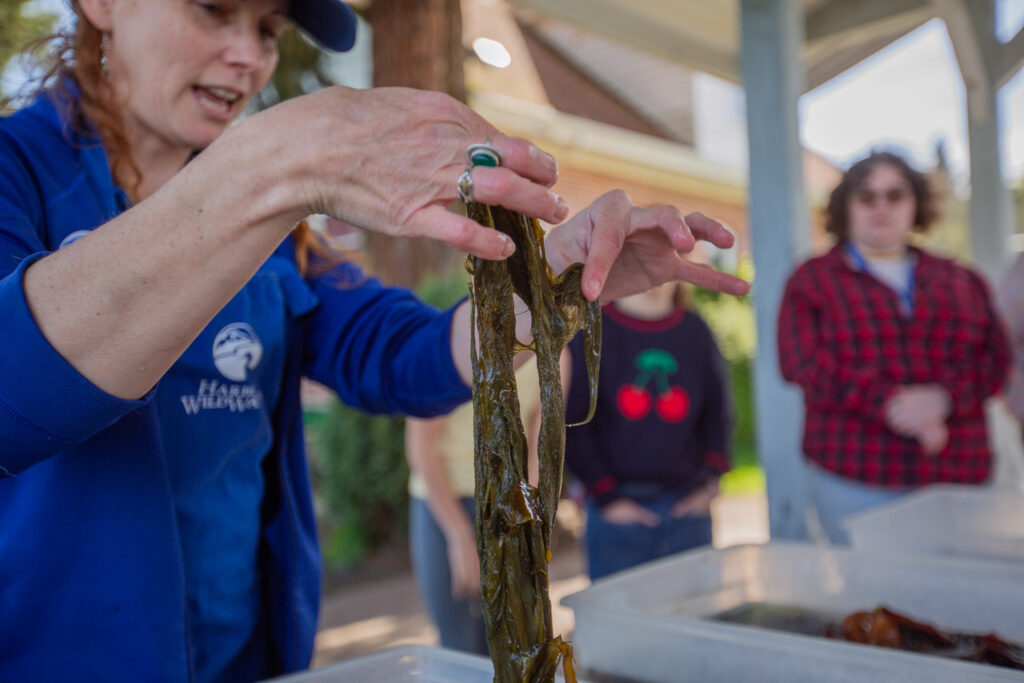
Rachel Easton, Harbor WildWatch’s education director, shows attendees what acid kelp looks like out of the water. Photo by Carolyn Bick. © Carolyn Bick
She also briefly held up acid kelp, which secretes sulfuric acid when under stress. Stressors can include low tide, hot temperatures, grazers’ attempts to eat them, and “people touching it a whole bunch,” Easton said. The secretion helps to defend them unwanted touch, but it’s also “self-destructive,” Easton said.
“It stings my skin if I hold it in my hand,” Easton said. “It’s like vinegar. If you put your hand in vinegar, you can feel it. But it’s sulfuric acid, so it’s a strong acid.”
Pressing
Pressing seaweed is both the same as and different than pressing flowers. Unlike flowers, it’s helpful to arrange the seaweed with the help of a little water and a paintbrush. It’s best to do it on watercolor paper, which (as one might expect) is designed to hold water.
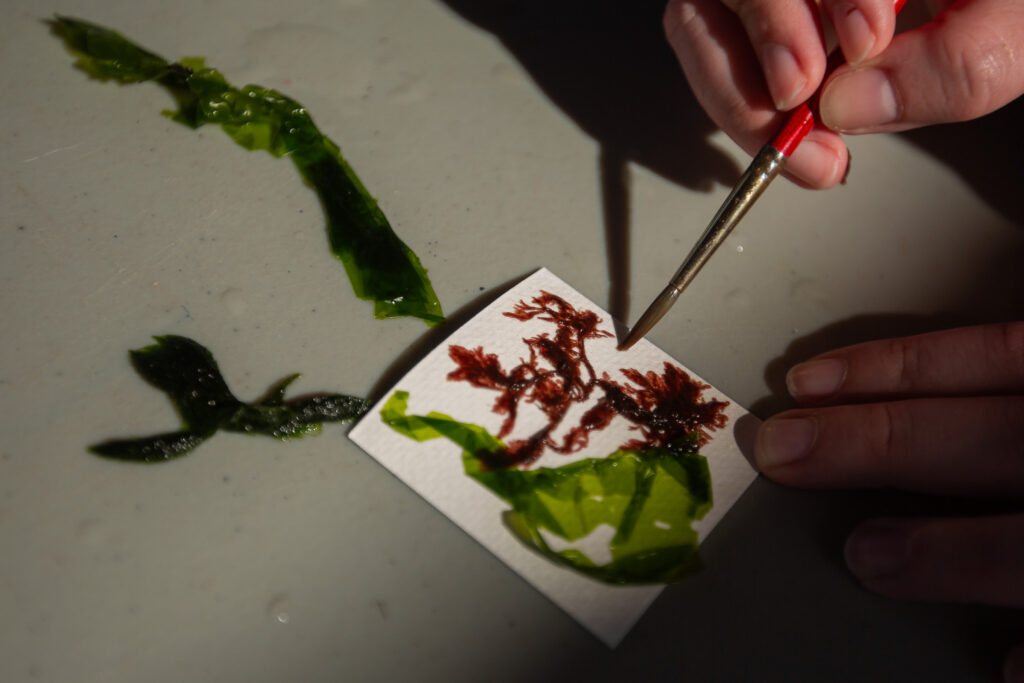
Kaylee Wallace uses a paintbrush to move around seaweed for a miniature seaweed pressing, during Harbor WildWatch’s seaweed pressing event on April 18, 2026. Photo by Carolyn Bick. © Carolyn Bick
Stena Troyer, the organization’s science director, has pressed seaweed for about a decade, and offered attendees some helpful tips.
“You can manipulate it to be like, ‘I’m going to make this look more like a little octopus.’
I’ll curl its tentacles around,” Troyer said, as she demonstrated how to move a piece of seaweed around a piece of wet watercolor paper. “Seaweed pressing is a lot of petting. You kind of pet it into the paper.”
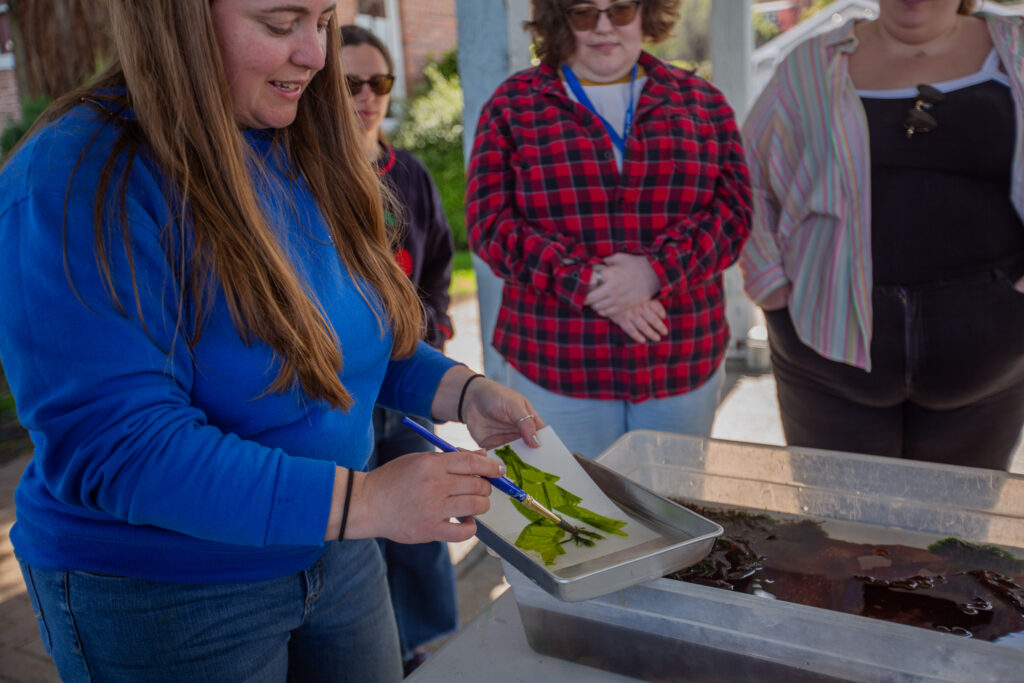
Stena Troyer, Harbor WildWatch’s science director, demonstrates how to arrange seaweed for pressing, during Harbor WildWatch’s seaweed pressing event on April 18, 2026. Photo by Carolyn Bick. © Carolyn Bick
The seaweed will also “reanimate” if submerged. The water acts as a helper to move them around the paper.
“You can just kind of like make a little puddle on your paper, and then get your seaweed into position. Or if you’re like, ‘Okay, I need to speed that up a little bit,’ use that water,” Troyer continued. “You might do a completely flat piece. I think it looks really cool when there’s kind of some of that folding happening.”
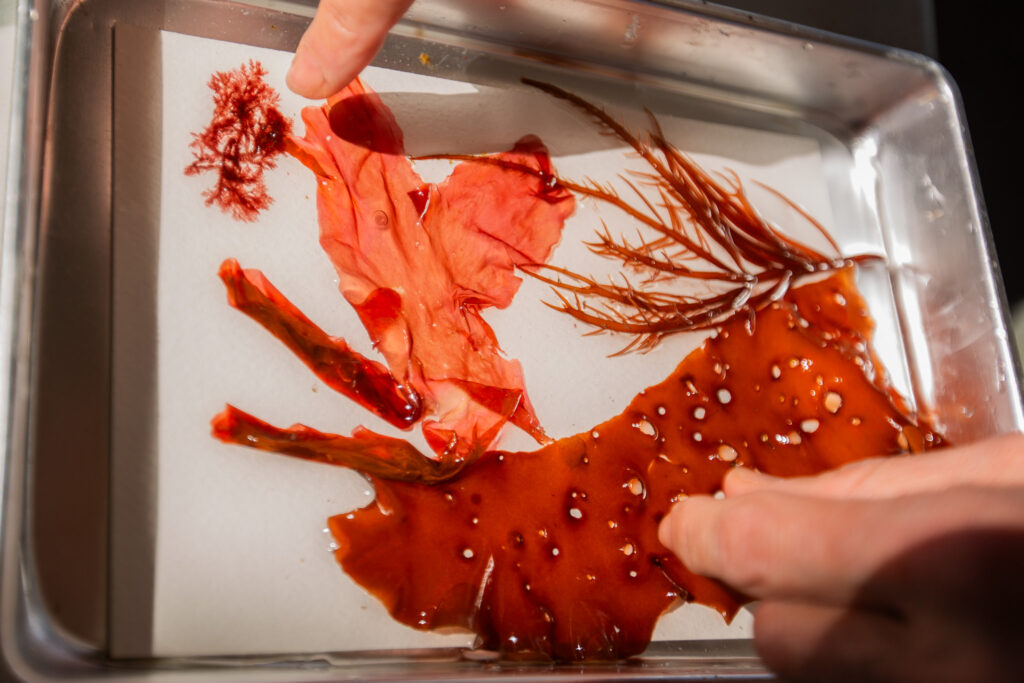
Paula Mendes arranges seaweed for pressing, during Harbor WildWatch’s seaweed pressing event on April 18, 2026. Photo by Carolyn Bick. © Carolyn Bick
When Troyer finished, she held up her piece for attendees to see.
“It can be as simple as this,” Troyer said. “You’re like, ‘Oh, I’m done!’”
Fortunately, attendees didn’t have to figure out what to do with, as Troyer put it, their “dripping masterpieces.” Harbor WildWatch took care of the drying process.
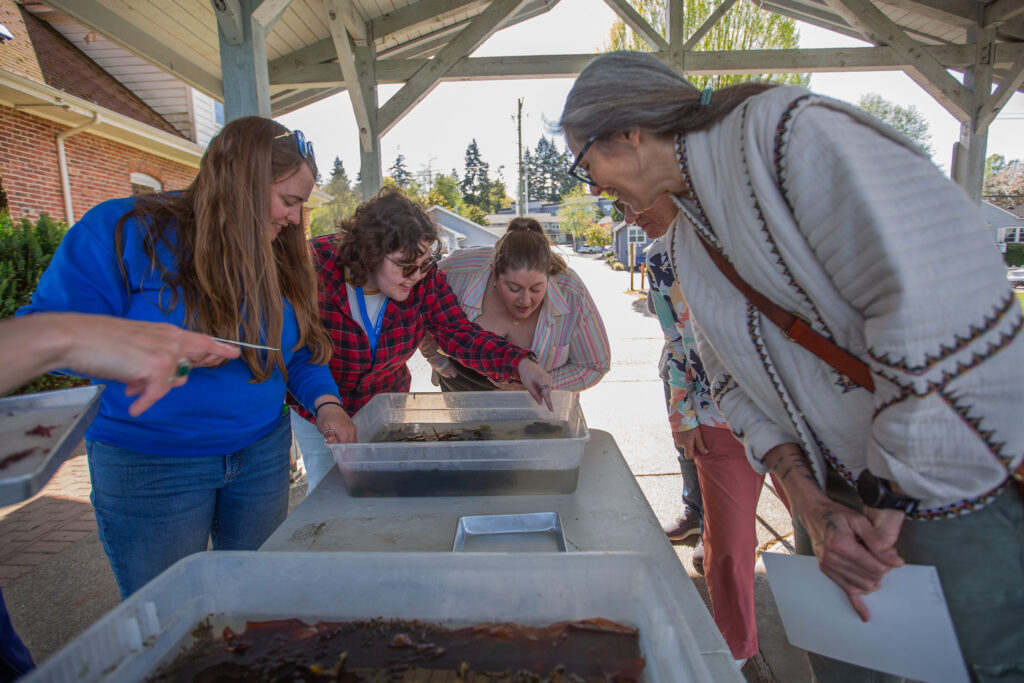
Attendees look at little aquatic bugs skimming around seaweed in a tub, during Harbor WildWatch’s seaweed pressing event on April 18, 2026. Photo by Carolyn Bick. © Carolyn Bick