
Business Community Government Transportation
Study recommends metering on west side of Canterwood roundabout if apartment projects proceed
A roundabout on Canterwood Boulevard could be metered to slow the pace of traffic entering from Burnham Drive on its west side, if the city acts on a recommendation the Public Works Department will present at a Gig Harbor City Council study session on Thursday, April 30.
The proposal to add traffic signaling at the roundabout comes from a just-completed study on the intersection, which handles vehicles from Burnham Drive, Borgen Boulevard, Canterwood Boulevard and Highway 16.
Gig Harbor commissioned the study from consultants David Evans and Associates in February. Leaders hoped it would help diagnose and pre-empt future “operational failure” at the roundabout due to traffic from proposed new multifamily projects along Canterwood Boulevard.
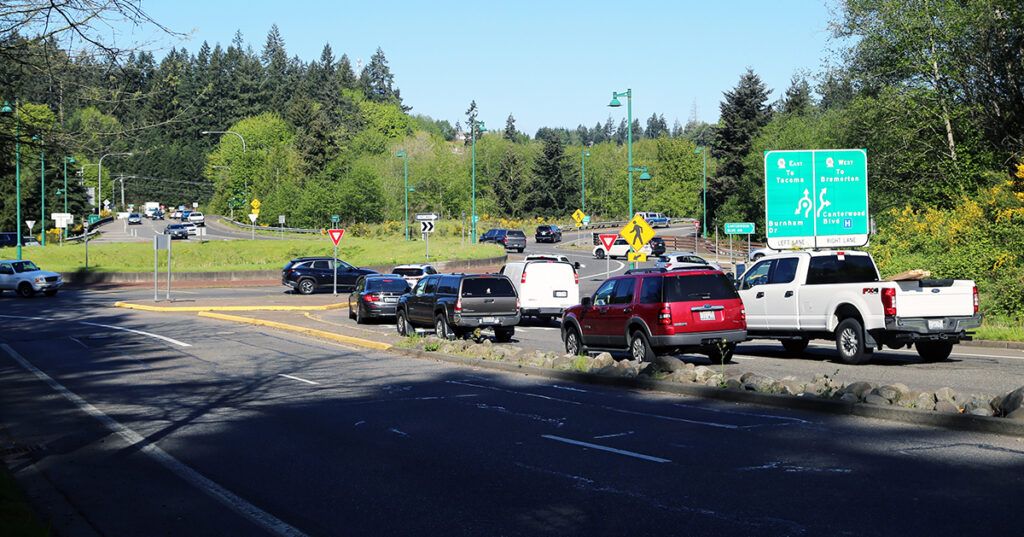
The roundabout linking Canterwood Boulevard, Burnham Drive, Borgen Boulevard and Highway 16 in Gig Harbor. A consultant hired by the city suggested metering the eastbound lane of Burnham. Photo by Vince Dice
Proposed apartments
The three apartment development projects include Rush Companies’ Trailside, with 120 apartments just north of city limits; and its Gig Harbor North Annex, with 108 dwelling units within Gig Harbor and closer to the roundabout.
The study removed a development called Canterwood Commercial Center from the city’s traffic model because its permit applications expired. But it added Vista Residential Partners’ proposed Gig Harbor Vista Apartments, with 156 apartments, at the same site. In December 2025, that developer paid to hold a pre-application conference to discuss development requirements with city officials.
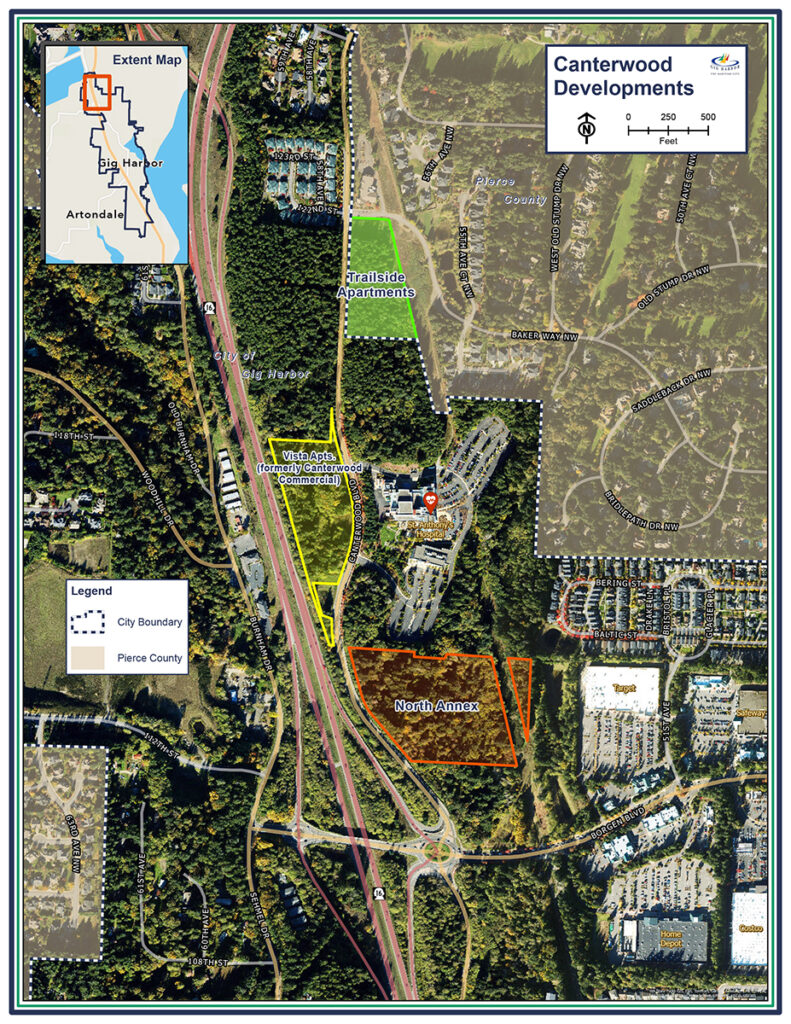
A map included with the agenda for Thursday’s Gig Harbor City Council meeting shows proposed housing projects near the Canterwood roundabout.
However, a representative of Vista Residential Partners recently said it will not pursue the project on Canterwood Boulevard.
If the City Council acts on the recommendation, it will add the metering project to the city’s 2027-2032 Six-Year Transportation Improvement Program (TIP). The TIP is a list of projects the city intends to construct during that time period.
A traffic fail
How does an intersection fail? The city applies this term when drivers face an average delay of 55 seconds or longer while navigating a roundabout during peak hours.
The study concluded that such a failure would occur under what officials termed a “worst case what-if-scenario.” The scenario involves all three new multifamily projects being built nearby and generating traffic within the next six years, with no enhancements to tame congestion within the roundabout.
If improvements aren’t made and the apartments are built, average delay would rise to 57 seconds. That’s two seconds longer than the threshold for failure, according to a memo to Mayor Mary Barber and the City Council from Public Works Director Jeff Langhelm and Community Development Director Eric Baker.
The expected pain would be significantly worse in some parts of the multi-leg roundabout, the study concluded.
The modeling predicts drivers exiting westbound Highway 16 into the roundabout would typically be delayed 82.8 seconds. Those heading into the intersection from Borgen Boulevard would wait 94.8 seconds on average.
Metering would reduce delay
To avoid these unacceptably long delays, the consultants recommended that the city “signalize the eastbound approach to the intersection” in the event that all three apartment projects gain approval. A diagram included in the study shows this signal located on eastbound Burnham Drive, near where vehicles flow into the Canterwood Boulevard roundabout.
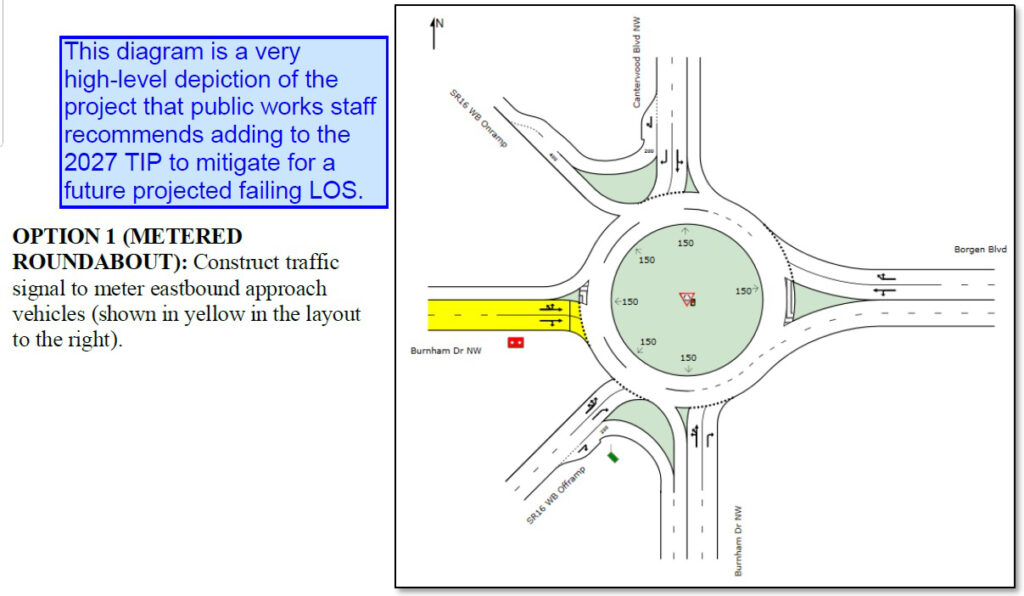
If the three proposed apartment projects on Canterwood Boulevard gain approval, the traffic study from consultants David Evans and Associates recommended adding a traffic signal on the west side of the Canterwood Boulevard roundabout, to affect eastbound vehicles on Burnham Drive. Queueing there would “extend back roughly 250 feet from the stop bar of the meter,” but not far enough to interfere with operations in another roundabout that lies to the west. Source: city of Gig Harbor.
This metering would reduce overall delay at the intersection during peak traffic to 9.8 seconds (again, assuming all three apartment projects proceed). Delay at the Highway 16 approach would drop to 12.9 second on average, while drivers entering the roundabout westbound from Borgen Boulevard would experience only an 8.1 second delay.
Adding the signal would increase delay for drivers entering the roundabout eastbound from the signaled approach on Burnham Drive: Their average wait time during the peak hour would rise to 8.9 seconds, from a projected wait time of 4.3 seconds without the signal.
With metering, queuing on eastbound Burnham Drive “is expected to extend back roughly 250 feet from the stop bar of the meter.” But the study concluded this lineup would not reach as far back as the roundabout that lies west of the Canterwood Boulevard roundabout. (The distance between the “circulating lanes” of the two roundabouts is some 680 feet, it notes.)
Recommendation
“Public works staff recommends adding the roundabout metering project” to the six-year TIP and then “continuously monitoring development timelines and intersection [levels of service] at the [Canterwood Boulevard] roundabout to inform design and construction year for the metering project,” Langhelm and Baker said in their memo.
In fact, the “accelerated timeline” of all three projects being built within six years “is not expected by staff,” the memo says. However, the city authorized (at a cost not to exceed $9,500) and performed the study “to confirm with certainty that growth was not overwhelming road infrastructure and planned TIP projects.”
The traffic study also included a separate “Trailside Apartments Model Run” that concluded the Trailside project on its own won’t tip the Canterwood Boulevard roundabout into operational failure.
The City Council’s study session is at 3 p.m. Thursday, April 30. The meeting is open to the public both in-person and via Zoom, and will include the opportunity for public comment.