
Community Government
Historic Preservation Commission discusses incoming affordable housing updates
Recent state mandates on affordable housing will not have a substantial impact on Gig Harbor’s historic preservation efforts, the city’s community development director, Eric Baker, told the Historic Preservation Commission last week.
Members of the commission, a city advisory panel, responded with questions about how those standards might affect issues like traffic and crime.
Baker’s presentation to the commission led to a lengthy back-and-forth about the state’s requirement that local jurisdictions make accommodations to allow more kinds of housing.
The state approved the update in 2024, amid an ongoing housing shortage. The city is bringing its local rules into compliance.
The need for affordable housing
“We have more bedrooms than we have people in the city,” Baker said, noting that Gig Harbor has “a lot of large homes that are occupied by relatively few people.”
Many of those large homes were built over the last 10 to 15 years and most cost upwards of $900,000 to $1 million. Many people who work in Gig Harbor can’t afford to live here, Baker said.
“We aren’t just talking about affordable housing. We’re talking about people who work at the hospital, we’re talking about people who work at the fire department. We’re talking about people who work all around [the area].”
Since those people can’t afford to live in Gig Harbor, they have to commute to jobs here.
“And one of the big concerns that we all run into right now is, ‘Why is traffic so bad?’ Because very few people live in the city, but a lot of people use the city,” Baker said.
Aging in place
He also noted that elders and others who want to downsize from a large home but stay in the community struggle to find smaller housing options.
“So we aren’t just talking about growth,” Baker said. “We’re also talking about how we keep people in our community as they age in place. We are a community where 33% are 65 years old, and more than 55% are over 45 years old. So, we are an older community that needs these types of opportunities.”
He also highlighted that the new statutes require objective design review standards. They also encourage the city to find more ways for property owners to subdivide lots and to provide opportunities for co-living, transitional and supportive housing.
“We need to make sure that our codes are not prohibiting these types of uses from appearing in our jurisdiction, and we cannot apply regulations that are more stringent than we would on a normal house, regardless of whether it’s transitional housing or not,” he said. “All the conditions have to be the same, screening, buffering, parking. You can’t create other limitations.”
And, he said, the state may check in to make sure the city is following these new rules. If the state finds Gig Harbor is non-compliant, he said, the city could lose out on opportunities for certain grants and funding.
So, he said, “there are stakes involved in doing this.”
Historic preservation zone
While the city will change, its historic preservation design manual standards will stay the same, Baker said. The city will also retain its dedicated historic preservation zone.
“One thing I do want to highlight about the design manual changes [the state requires is] there’s nothing in the design manual changes that are required to affect historic preservation,” Baker said. “We can keep our design manual just the way it is today in the historic preservation zone.”
While some zoning might change in the historic preservation district, they would be minor reforms, like setbacks and hardscaping.
“Obviously, you can always petition to have the historic preservation zone expanded,” Baker noted, as he showed commissioners a highlighted map indicating where the city’s historic preservation zone boundaries are located. (Readers can find an interactive map of the city here, and see the Historic District by zooming in closer to the harbor waterfront, choosing Community Development in the drop-down menu on the left, and checking “Historic District”.)
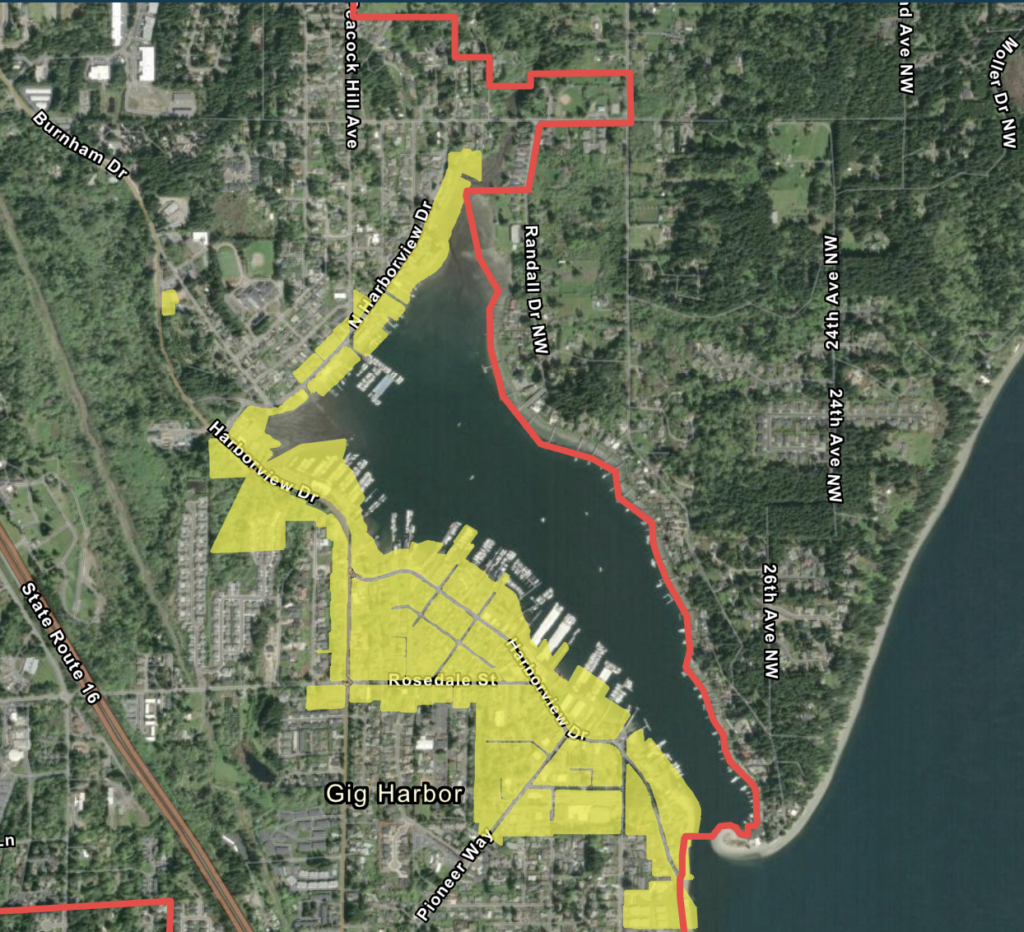
This map shows Gig Harbor’s Historical Preservation Zone, highlighted in yellow.
“Certainly, there are properties throughout the city that qualify as historic properties, even if they’re not in the yellow zone,” commissioner Stephanie Lile noted.
Commission Chair Guy Hoppen said that he thought the city would need to increase the size and scale of the historic preservation zone in order to fully account for the city’s many historic properties. He asked that the city take that into consideration.
Crime concerns
Commissioner Gina Brais said that she sees the state as essentially saying, “‘You’re going to do what we tell you to do or you don’t get any more money.’ That’s how it goes. Mom and dad give you the rules. You don’t listen to the rules — well, then get out of my house.”
She also said that creating affordable housing in the harbor would open the door “for whoever” to live in Gig Harbor.
“To say [we want] our nurses and our firemen — who all make six figures, by the way … to be able to afford to live in our community — yes, of course we do,” Brais said. “I want the people who work at the shops and everything to be able to live here, but they’re not given a priority over other people to be able to live there. … So, technically, we’re not building housing for them. We’re just building a lot more housing for whoever.”
Baker said that Brais was correct that “the market is going to drive what comes forward,” development-wise. But the city has “a series of incentive programs that are available,” including the multifamily tax exemption program, which guarantees 20% of units in a multifamily complex are affordable for 12 years. In exchange, the developer does not have to pay taxes on that building for that same dozen-year period.
Are income and crime linked?
Brais pointed to the cleanliness and safety of the city, which she appeared to suggest will change when the city builds affordable housing.
“We don’t have garbage and homeless [people] and needles and we can feel safe walking. All of us can go outside for a walk. Children can play together and ride bikes outside,” Brais said. “It’s a safe, nice community.”
She asked if the state would increase funding for local police “when our crime will rise, and our safety concerns [rise] for ourselves and our family and our very nice properties that people didn’t have to spend a million-plus on.”
“There’s a lot of us out there that have to pay a lot, everything that we have, just to afford to live in this community because it is clean and nice and safe,” she continued. “And when that changes … we’re all still paying taxes for other people to come in and disrupt our community and start to destroy our community from the heart of it.”
Baker noted that the city is not responsible for actual construction, and that he did not “agree with the premise” that people who already live in the harbor are committing most of the crime in the city. The people who commit a majority of the crime here, he said, “come to the harbor, they commit crimes, and then they leave.”
“So the idea that bringing in the folks who make less money is automatically going to increase crime, I think, statistically, isn’t 100% accurate,” he continued. “It isn’t about less money. It’s about mentality, lifestyle. And I think there are folks who live in our community right now who need mental health services, who need substance abuse services. They live next door.”
Crime in Gig Harbor is decreasing overall and is lower than 10 years ago, according to data Police Chief Tray Federici presented at a city council meeting last August.
Traffic concerns
Brais also pointed to the existing issue of downtown congestion, especially in the warmer months, and said that she was “hearing a lot of contradictory things” especially from the city. One of these things involves the downtown area not being able to handle more traffic.
“Well, all of us that have lived downtown know it’s during the summer, and that’s just because people want to get out. … It’s summer traffic. But my thing is, [the city] says they cannot handle all the traffic, but yet we want to do apartment complexes, which is not adding, like you [Baker] said, a handful of people that move in these few houses,” Brais said. “Now we’re talking about adding 5,200 people. They all have vehicles, right? So now we are technically adding more traffic. So that is really contradictory to say — ‘We can’t withstand a lot of traffic down there anymore, but we want to bring a few more hundred people into the space on top of the ones that already live there.’”
Baker said that he wasn’t going to pretend traffic will be the way it was five years ago, because of the number of people coming to the area. About 13,000 people live inside city limits, but another 10,000 come in to Gig Harbor every day to work, shop and recreate. The city is a regional destination for an area of about 75,000 people.
“And that doesn’t even include the 90-something thousand people who drive through Gig Harbor every day. The reality is, they don’t live here. They are coming in from other places to go to the things that we have,” such as grocery stores, medical care, and shopping centers,” he continued. “And if we aren’t allowing people to live closer to them, we are in a position where we’re pretty much saying everybody’s going to drive here, likely in their single passenger vehicle,” he continued. “There’s going to only be three ways to really get into town if you’re coming from the highway.”