Business Community
Engine transplant in middle of the harbor required surgical precision
A funky flotilla of watercraft in the middle of Gig Harbor on Tuesday became a surgical center for a critical and delicate transplant operation.

Community Sponsor
Community stories are made possible in part by Peninsula Light Co, a proud sponsor of Gig Harbor Now.
The transplant was on a distinctive sailboat, a floating sailing school offering training and adventure for half a dozen would-be transoceanic sailors.
The patient, Koru, is a cruising catamaran measuring 50 feet long and 26 feet wide. It is scheduled to leave Gig Harbor for Hawaii on May 15 with a crew of tuition-paying adult students.

The Koru tied up to a barge carrying a crane, as a tug approaches with its new engine. Photo by Chapin Day
A weighty operation
The organ needing transplant: one of its two 550-pound diesel engines. The surgical team: employees of Gig Harbor Marina and Boatyard and of Marine Floats, a Tacoma firm that specializes in dock installation, maintenance and repair.
The problem: the patient was too fat — in maritime parlance “beamy” — to float in close enough for the boatyard’s shore-based crane truck to perform the heavy lifting required.
The solution: hire a barge carrying a tracked extendable crane from Marine Floats. Done.
The problem with that: difficulties maneuvering a clunky, powerless barge into position near the catamaran’s regular double-wide slip at the marina.
Then someone involved suggested: if we can’t get the crane to the catamaran, let’s get the catamaran to the crane.
So one the tiniest (arguably cutest) little tugs since “Little Toot” towed the crane-toting barge into place. It spent a solitary night Monday anchored in mid-harbor, a rusted, graceless, lifeless hulk.
Cause of death
But early Tuesday morning, a mini-mosquito-fleet swarm — composed of the barge, the tug, various outboard engine-powered dinghies and their respective crews — brought the scene to life as the Koru arrived from its nearby slip to tie up to the barge.
The tug and small boats scurried back and forth between boatyard and barge to get the job done.

The Koru’s new engine is lowered onto a tug boat, which would take it to the catamaran further out in the harbor. Photo courtesy of Kevin Vandervate
The dead engine, dangling from the barge’s crane, emerged through a barely-big-enough hatch at the aft (rear) end of the Koru’s left (port) side hull. Mechanics later told Gig Harbor Now the 50-horsepower Volvo-Penta diesel engine had been slain by an undetected oil pan leak and consequent overheating.
The tiny tug delivered the deceased ashore, then returned with Koru’s shiny new replacement on deck, swathed in a colorful nest of plastic sheeting.
Lofted by the crane, that costly power plant soon swung slowly into place over the open hatch. Mechanics carefully guided it into its new home.
A short while later, the various crews said their respective goodbyes, the vessels involved returned to their homeports, and the makeshift harbor hospital was gone.

A crane lowers Koru’s new engine on Tuesday, May 6. Photo by Chapin Day
Surgery a success
“It all went really quick and really well,” one of mechanics later told GHN while readying installation the requisite mechanical and electrical connections.
Also pleased with the result was Ken Parker, who owns Koru and its school with Renee Evans, whom Parker describes as his partner “in business and life.”
“They were very efficient,” Parker told GHN Wednesday evening, just hours after cranking up the newly installed engine for the first time. “It ran perfectly.”
As described on their website, both Parker and Evans are U.S. Coast Guard-licensed captains with lengthy lists of other qualifications for their maritime business, Koru Expeditions.
Their yacht, a 2004 France-built Soubise Plaisance 50, displays on its hull the name Koru. The “o” is shaped in the form of a Maori symbol based on the young frond of a silver fern, long associated with New Zealand’s cultural identity.
Several sources cite the symbol as representing renewal and the ongoing cycle of life.
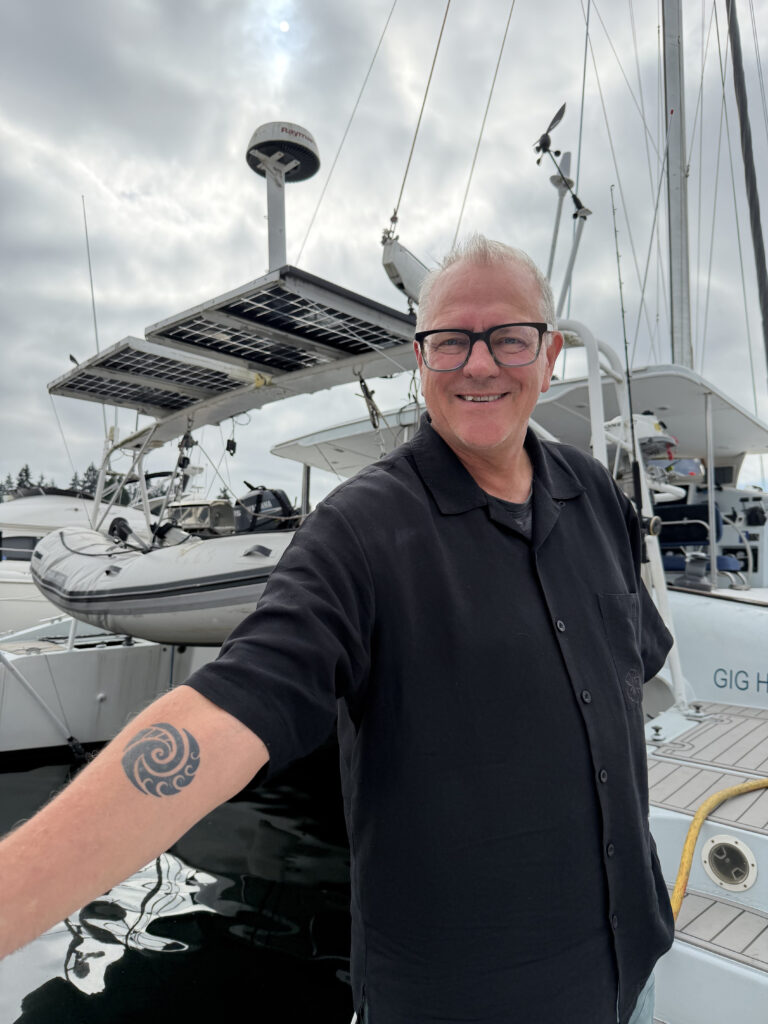
Ken Parker’s tattoo depicts a Maori symbol based on the young frond of a silver fern. Photo by Chapin Day
Appropriately, Parker displays the symbol on his right forearm, an artful tattoo. Formerly a managing tech engineer for the Seattle job search firm Indeed, he was laid off more than three years ago, an event that he says helped him chart a new life.
Departing soon
The May 15 trip is to be the first transoceanic stop in a planned series of similar Pacific voyages over the next few years.
En route to Hawaii, Carter and Evans are to lead a five- or six-person student body — aged late-20s to 70 — who are paying over $8,000 each to sail and learn with them along the way.
So is it five or six?
Five are confirmed now, Carter told us. One berth “is still available,” he added, with a hopeful lilt in his voice. The vocal nuance was wasted on GHN’s intrigued but over-aged and under-financed reporter.