
Community Government Transportation
Does Gig Harbor have a parking problem?
Paid and timed parking were among a suite of options city staff presented at a May 14 study session of the Gig Harbor City Council to spread out public parking during the heavier traffic months, like the summer season.
The good news?
“I personally don’t believe we’re anywhere near needing timed parking or paid parking, unless it’s in very, very isolated areas,” Community Development Director Eric Baker told the council during his presentation on the results of a study of parking patterns around the waterfront.
The study, conducted by consultant Fehr & Peers, looked at on-street parking during the summer in the Downtown, Finholm, Millville, Judson and Harbor History Museum areas, as well as assorted free lots around the waterfront. It showed that drivers struggle to find parking at times during the summer.
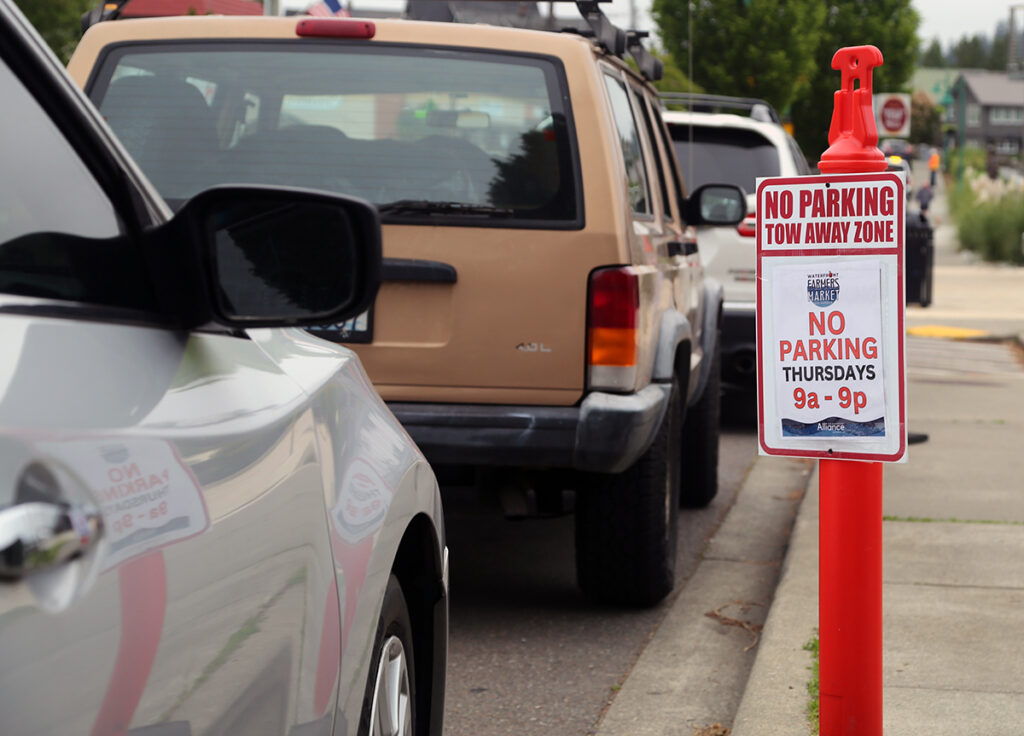
A sign warns of restricted parking near Skansie Brothers Park in Gig Harbor ahead of the Downtown Waterfront Farmers Market. Photo by Vince Dice
Baker presented the council with the study results, as well as a host of recommendations that ranged from sharing parking spaces with area churches and installing bike racks to paid and timed parking and increasing shuttle services.
Summer parking shuffle
Whether Gig Harbor has a parking problem at all, Baker believes, “will still be in the eye of the beholder.”
“If so, what is the nature of the parking problem? Is it just there’s not enough stalls? Is it employees utilizing prime parking?” he said, introducing the study. “Is it that the location of the available parking and the type of available parking is just not what people are looking for?”
The study looked at parking on two peak days: Thursday and Saturday. The Waterfront Farmers Market crowds downtown on summer Thursdays, while out-of-towners spending a day in Gig Harbor may be responsible for Saturday’s increase.
The study found that people tend to park in the Downtown, Judson, and Millville areas. The Finholm area has a medium level of parking and the museum area has a low level of parking.
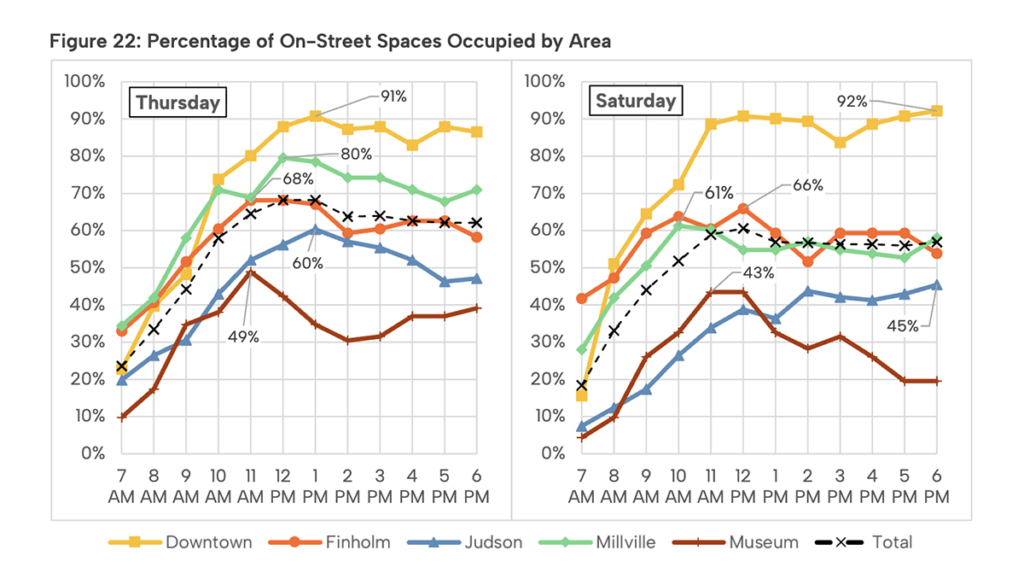
Percentage of parking spots in several districts that are occupied at peak times, according to a recent study.
The study appeared to show that the number of parking spots isn’t the issue, Baker explained. Parking patterns appeared to show that the location of available public parking spots may be creating snags. People are more likely to choose easier parking, based on a variety of factors.
Baker said some people feel uncomfortable parallel parking, if they have to back into a spot, and inclines can pose challenges to people who use assistive devices like walkers.
“So,” he continued, “when we’re looking through various options, regardless of what the numbers are, some of the considerations are these other, more subjective aspects.”
Demand downtown
The study showed that “despite the higher supply of off-street spaces compared to on-street ones, occupancy is much lower for off-street parking,” with 43 of the 78 total parking locations less than 50% occupied at peak hours on Thursday and Saturday. The study also noted more parking activity in the lower downtown area, likely due to demand from Farmer’s Market customers and employee parking in different workplace lots.
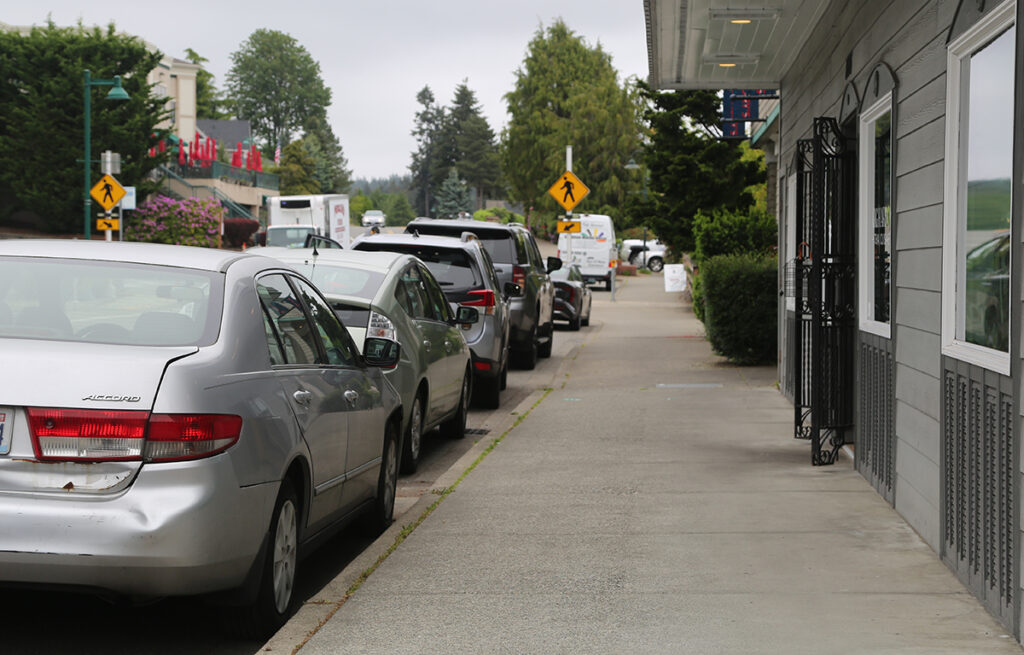
Cars in on-street parking in the Finholm District on Wednesday, May 20. Photo by Vince Dice
Finally, the study noted, “parking lots right next to the waterbody are generally catering to the various marinas, serving members but not the public. Consequently, occupancy in these lots is higher on Saturday than on Thursday, when more people are likely to be working.”
The study also looked at how long people use these parking spots. In the report, paler areas showed shorter occupancy times, while darker areas showed longer occupancy times.
“The good news is a lot of the paler colors are located, to a degree, where we’d like the paler colors to be … on more of the more residential roadways and not necessarily directly in front of the businesses,” Baker said. “So, largely what you’ll see here is that about 75% of the vehicles are parked for less than two hours in most of these parking areas that lend themselves to folks who were shopping, recreating for a short period of time.”
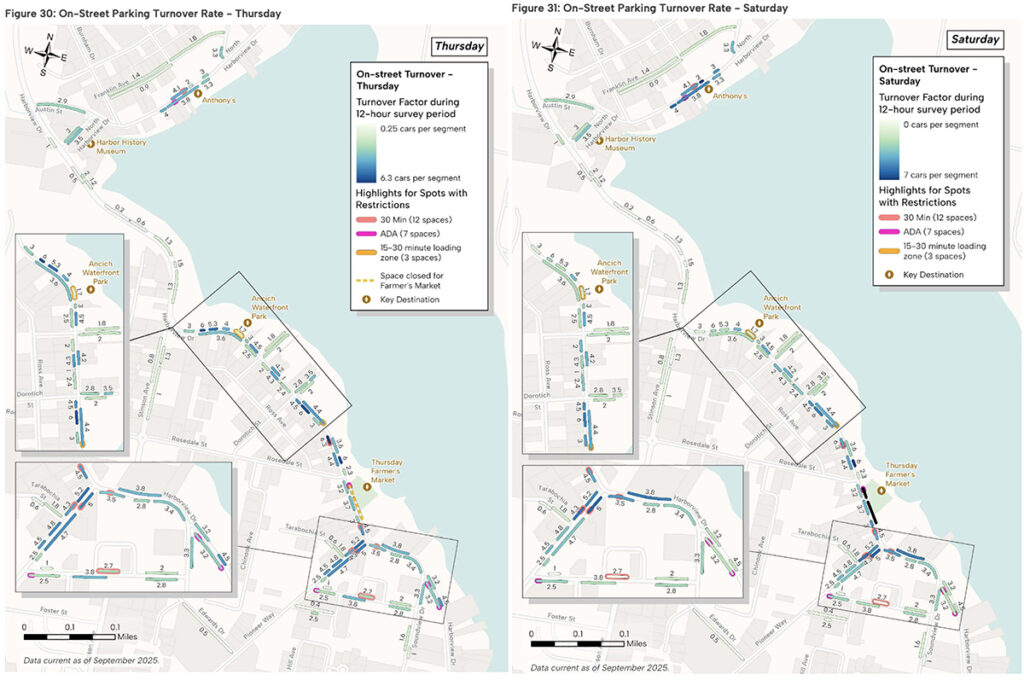
The study examined on-street parking turnover rates on Thursdays and Saturdays in different areas of Gig Harbor.
“There is a good amount of turnaround again on these Thursdays and Saturdays,” Baker continued. “Many spaces are poorly utilized though and have opportunities for coordination. … The off street parking stalls are largely vacant for large chunks of the time, particularly the church parking stalls. Even at peak times, at least 11% of the on street spots are vacant, even in the highest activity areas.”
Possible parking amendments
Baker said that the city and a group of volunteers looked at solutions other jurisdictions have used to encourage spreading out parking. Suggestions included timed and metered parking; partnering with churches and businesses with lots to reduce demand for on-street parking; increasing the number of bike racks and implementing a bike share program; and introducing wayfinding signage to show people where parking is available.
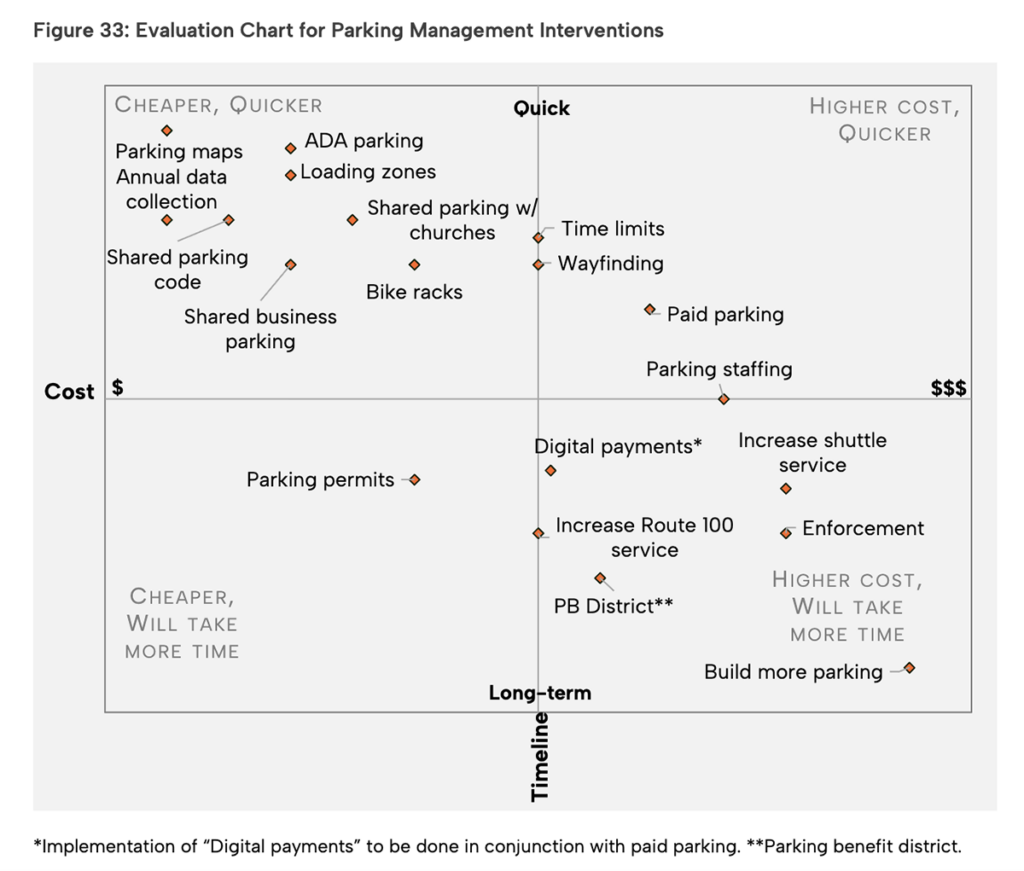
These solutions could be employed in a way that solves other problems, too, Baker said.
“We have people who aren’t comfortable parallel parking and park in the church parking lots in a way that they’re more comfortable with that walk down the hill,” he said. “We are talking about larger lots, greater opportunities that maybe we would want to have some role in that conversation as to what it would be, what would be helpful to make the churches comfortable with opening up their lots on a regular basis.”
He also said that the Gig Harbor Downtown Waterfront Alliance or the Chamber of Commerce could work with businesses to open up parking for periods of time when those areas don’t see peak traffic.
For instance, he said, “you have, say, a bank that’s closed and then you have restaurants. Is it possible to open up some of a … bank’s parking for residents after a certain period of time? What would that take?”
Crosswalk conundrum
Councilmember Emily Stone said she hoped the city could connect the parking conversation with the lack of crosswalks around town, and wondered whether some parking areas were underutilized because of the lack of crosswalks.
“We have only a certain amount of right of way, and ,,, we have almost no ability to purchase more,” Baker said. “So we have to figure out how to fit within the existing framework. And we have bicycle advocates who would like to see bike lanes in various places.”
Councilmember Reid Ekberg said he wanted to see how much it costs the city when cars park and don’t leave for two or three hours.
“If we wanted to go to timed parking downtown, how significant is that cost?” Ekberg said. “I don’t think we should go to paid parking, but I think we should at least take that next step of understanding what the commitment is if we’re gonna do timed parking.”
Bike racks
Councilmember Patrick Ammann said if the city tries timed parking, he would like to see the time limit capped at more than just two hours.
“I would suggest that we go with a higher time limit amount, like four to five hours rather than two hours, simply because we do have a lot of people who go onto the water to kayak. We have events in the summer, like Summer Sounds or the Farmer’s Market that might make a two-hour parking limit kind of stressful,” he said.
He also noted that the city has little to no bike storage.
“I biked through the whole Harbor and I think the closest place to lock up your bike was right by the museum from Skansie,” he said. “So looking into places for people to lock up their bikes I think is really important if we want people to use other forms of transportation, because currently that is just not available.”
He also said that he supported more ADA accommodations, particularly because many people he knows need it.