
Community
Gig Harbor Now and Then | Early logging laws and another local scoundrel
The previous Gig Harbor Now and Then column, on June 1, didn’t have a question of local history. It was not an oversight; I simply ran out of room. This column has two questions, and they’re really good ones. Take a look and see if I’m not right.

Community Sponsor
Community stories are made possible in part by Peninsula Light Co, a proud sponsor of Gig Harbor Now.
State-mandated I.D.
Logging was the first big industry on the Gig Harbor and Key peninsulas. Because it began in the 1850s, the only way to transport logs to mills or other markets was by water.
Moving logs by water involved both age-old and unique problems, which brings us to the setup for this week’s questions of local history.
At first, professional logging in Washington was largely a free-for-all. Like many industries, it eventually reached a point in its development when government regulation began to change the way it was done.
In 1890, a new state law required all logs transported in rafts on the waters of the state west of the Cascade Mountains to be marked for the purpose of identifying the owner. Sawlogs, piles, poles, shingle bolts; every single one had to be marked. This week’s questions are simple.
What kind of identification was specified?
Why was the law enacted?
The answers will appear in the June 29 Gig Harbor Now and Then column.
New business: Another notable scoundrel of the Peninsula
The history of every small community has its share of less-than-stellar personalities, which is a fairly benign way of saying thieves, scoundrels, conmen, philanderers, habitual liars, and sometimes even a murderer or two.
Most of the unsavory characters are usually forgotten after a generation or so, and the few that are not are often miraculously converted by researchers of history into upstanding, courageous, pillar-of-the-community types, simply because only their good deeds have been uncovered.
In Gig Harbor Now and Then No. 50, we told the story of one of those scoundrels, Benjamin Pardee. The following story is a quick profile of one of Gig Harbor’s lesser scoundrels, of note only because of his co-ownership of what is believed to be Gig Harbor’s last shingle mill.
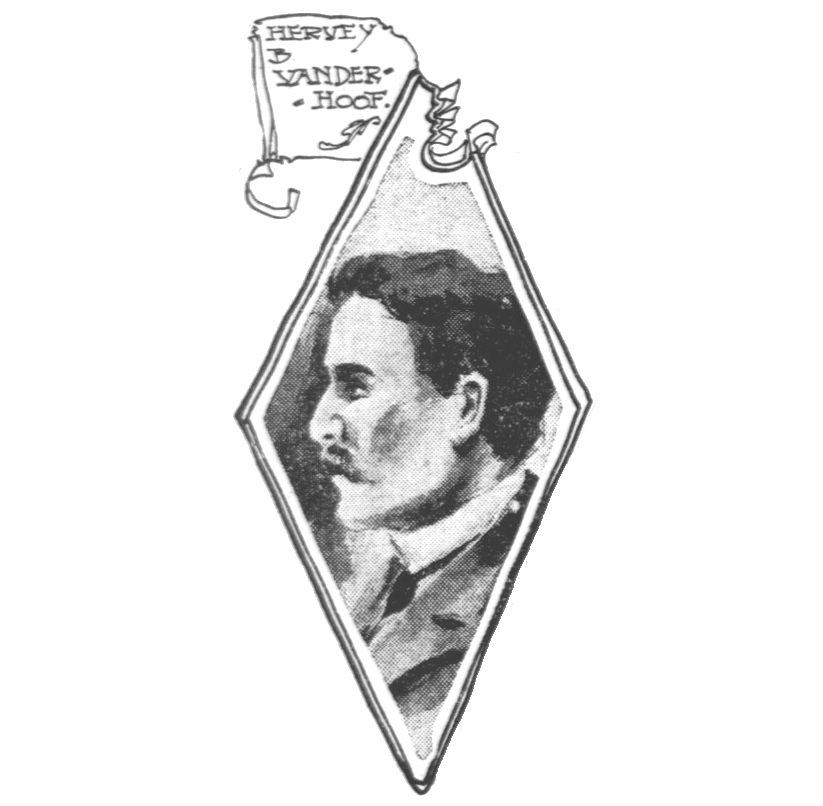
Hervey Vanderhoof
It will probably come as a surprise to many to find out that Gig Harbor’s Skansie Brothers Park has an interesting history that predates Andrew Skansie’s ownership. In front of Andrew’s house (now the offices of Harbor WildWatch), where the Skansie netshed now stands, used to be Gig Harbor’s last known shingle mill. It probably occupied the same building as the Stewart and Aitkin shingle mill of 1893 and ’94, but with different machinery. (The spelling of Aitkin is not certain.)
The Harbor’s last known shingle mill had a short operational life. Initiating production at the beginning of the summer of 1895, it was jointly owned by Joseph B. Mason and Hervey B. Vanderhoof. Vanderhoof bought his half-share of the mill shortly before the opening.
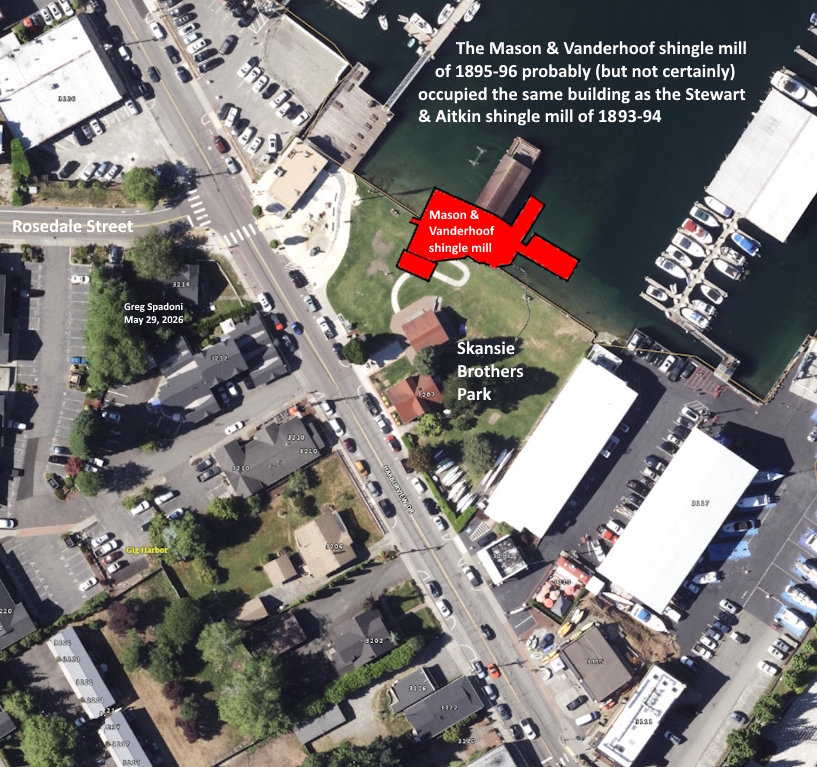
The Mason and Vanderhoof shingle mill may have operated out of the same building as the Stewart and Aitkin shingle mill, which was constructed in 1893. Pierce County Assessor-Treasurer base map.
Vanderhoof entered the shingle business fresh from a failed grocery wholesaling firm in Tacoma. He had high hopes for his new venture, telling The Tacoma Daily News that the Long-Bell Lumber Company of Kansas City, Missouri, would take every shingle the mill could produce. Whether it did or not is unknown, though in any case the mill did not last long. It would come to an inglorious end a year after its opening — as would Vanderhoof, a few short years later.
The search for his story showed that Hervey Brundage Vanderhoof was not a man to whom success came easily, if at all.
Multiple failures on two coasts
Vanderhoof was born in New York in 1858, married Emma Dougliss in 1878, and was in deep financial trouble by 1883. In a Wall Street partnership with his brothers and another man, short-selling stock wiped them out, leaving their company and him personally with a heavy debt.
At least some of that debt hounded him for years. For reasons that aren’t readily apparent, in 1885 a creditor managed to transfer Vanderhoof’s debt responsibility to Hervey’s wife, Emma, and in 1888 filed suit against her in pursuit of his money. How — or if — that matter was settled isn’t known.
The next mention found of Hervey Vanderhoof shows that he had moved to the opposite side of the country, settling in Tacoma. His first known business there involved an agency for the renting of rooms.
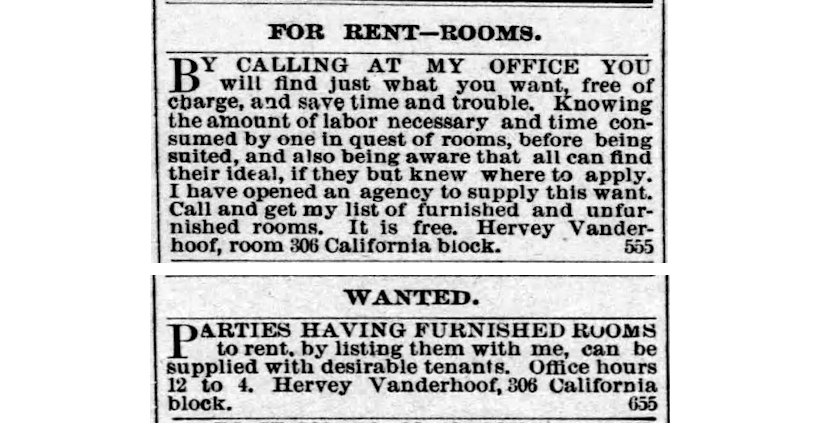
In 1891, Hervey Vanderhoof was trying to make a living as an agent for rental rooms. The Tacoma Daily Ledger, February and March, 1891.
In 1893, Vanderhoof became the secretary and bookkeeper of the Tacoma Grocery Company. He stuck with it until it collapsed into bankruptcy in 1895. He, along with others, was accused of cooking the books, and was prosecuted, but didn’t end up in jail over it.
Two new Pierce County ventures
Seeking a new line of work after the grocery business didn’t work out, he bought into the Gig Harbor shingle business of J.B. Mason.
At about the same time, he joined two other men to start the Washington News Company on Pacific Avenue in Tacoma. Its advertising described the business as “booksellers, news dealers, and stationers.” At first, he manned the store himself.
Both bite the dust
The Gig Harbor shingle mill’s two dry kilns burned down in 1896, with a loss of a million shingles. The news reports mention only J.B. Mason as an owner, so perhaps Vanderhoof’s participation was already over by that time. For his part, Mason sold out his stake in the mill’s machinery (he didn’t own the land) and headed to San Francisco by summer.
There’s no indication the mill ever operated after the fire. The likelihood is that the machinery was moved elsewhere.
The Washington News Company advertised until the summer of 1899, then disappeared. Whether Vanderhoof stayed with it all that time isn’t known.
After a slew of business failures on both coasts, Vanderhoof made his biggest splash in California, for all the wrong reasons.
The Golden State adventure
By late 1899 Vanderhoof had established himself in San Francisco as the manager of a publishing company. In 1901, at the age of 42, he took up residence with a 23-year-old woman from Tacoma, passing her off as his wife while his real spouse was living in the East, as were his two children, a boy, 22, and a girl, 16.
His place of business, the Syndicate Publishing Company, was described in the August 15, 1901, San Francisco Call as “not in a flourishing condition.”
The article with that description was headlined, “REGARD DEATH AS SUSPICIOUS,” with the sub-headline reading, “Hervey B. Vanderhoof, a Publisher, Is Found Dead in His Bed.”
Technically, Vanderhoof wasn’t found in his bed, but on his bed, fully clothed, it was reported. According to the newspaper, his pretend wife, Miss Clara Hess, thought he was going away on business overnight, so went to visit relatives for the evening. After leaving the company of her cousin around 11 p.m., she happened upon two strangers and proceeded to go drinking with them. When the men escorted her home shortly after midnight, she discovered Vanderhoof on the bed, dead.
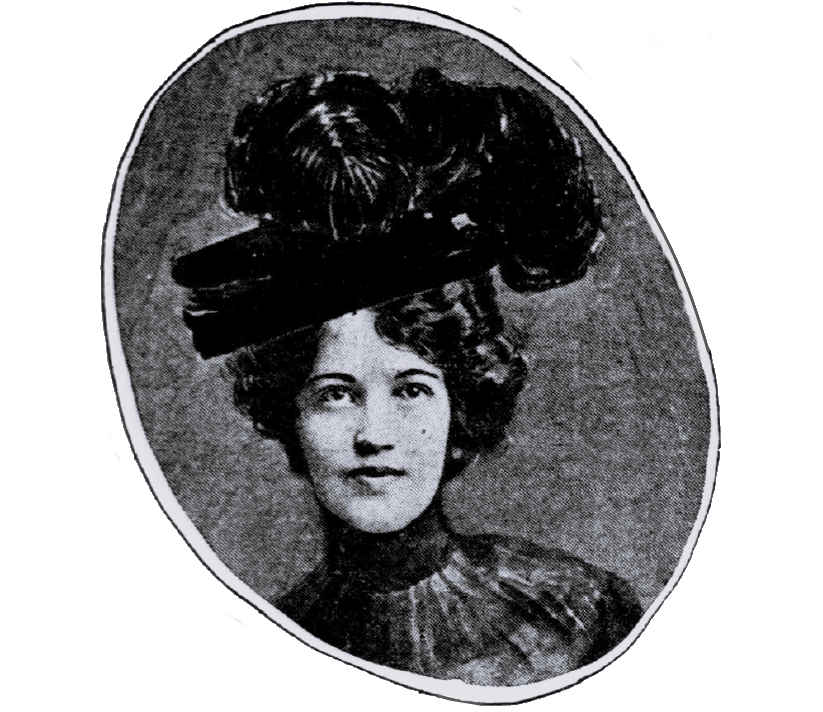
Clara Hess, complete with a fake floofy hat clumsily added to the top of her head by a newspaper artist to make her look more flamboyant. The San Francisco Call Bulletin, August 16, 1901.
While the newspaper saw the circumstances as suspicious, the police did not. The detective in charge of the investigation thought the death was due “entirely to natural causes,” said The Call. The coroner disagreed, ruling that Vanderhoof committed suicide by drinking carbolic acid, a disturbingly common method of self-destruction at the turn of the 20th century.
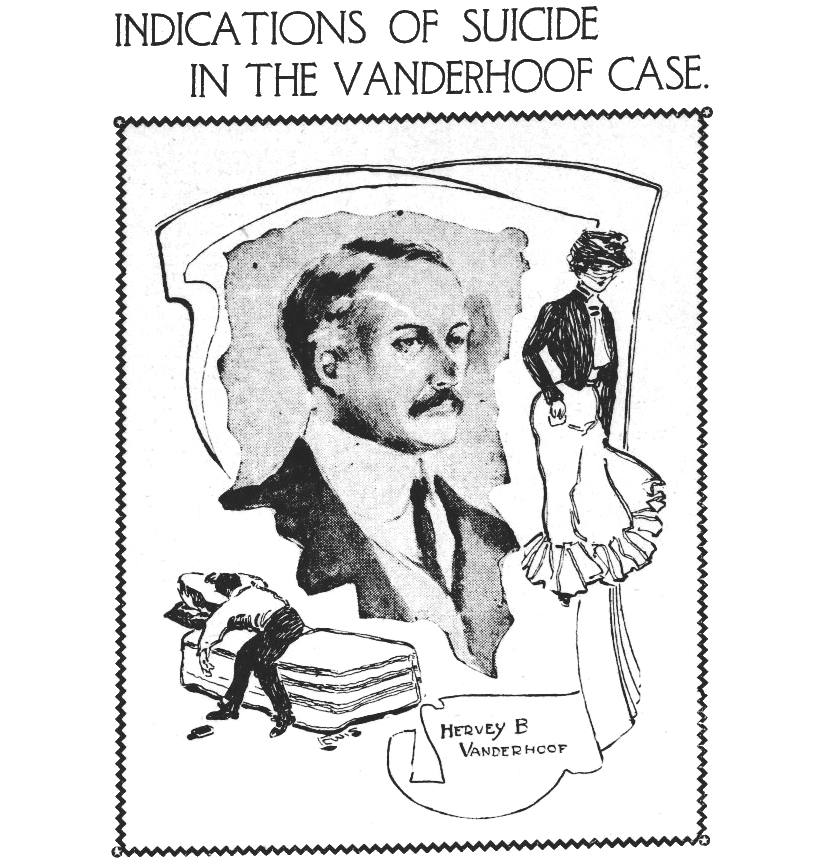
San Francisco Chronicle
On August 16, the San Francisco Call tried its best to portray the story as scandalous, surrounding a studio portrait of the kept woman (complete with a fake, artist-drawn hat on her head) with illustrations of imagined key scenes, some of which were changed to make the account more socially acceptable.
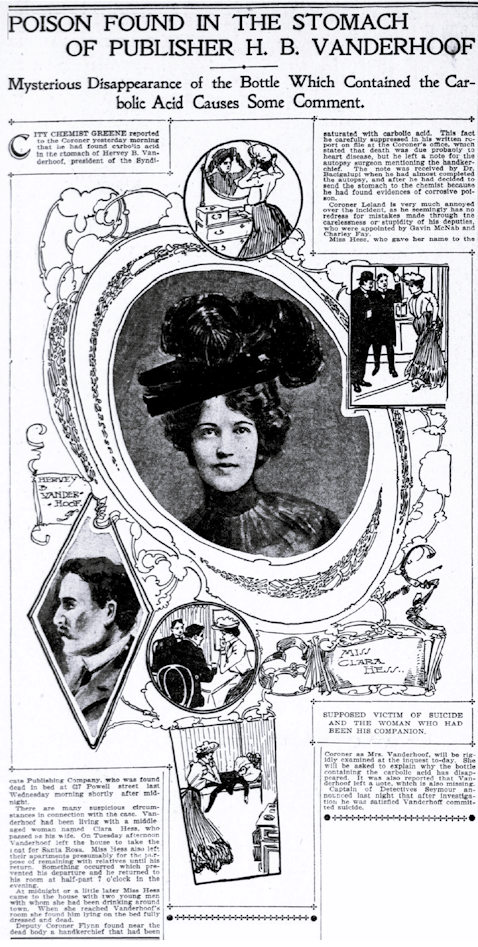
Hervey Vanderhoof, whose self-inflicted demise became fodder for a San Francisco newspaper, had been a co-owner of a shingle mill on what is now the lawn and netshed at Skansie Brothers Park in Gig Harbor. San Francisco Call August 16, 1901.
The coroner’s office, however, was more forgiving of Vanderhoof’s mistress. It turned over to her, rather than the real Mrs. Vanderhoof, “A gold watch and chain, a check for $150 and the dead man’s jewelry.”
Honoring Gig Harbor history
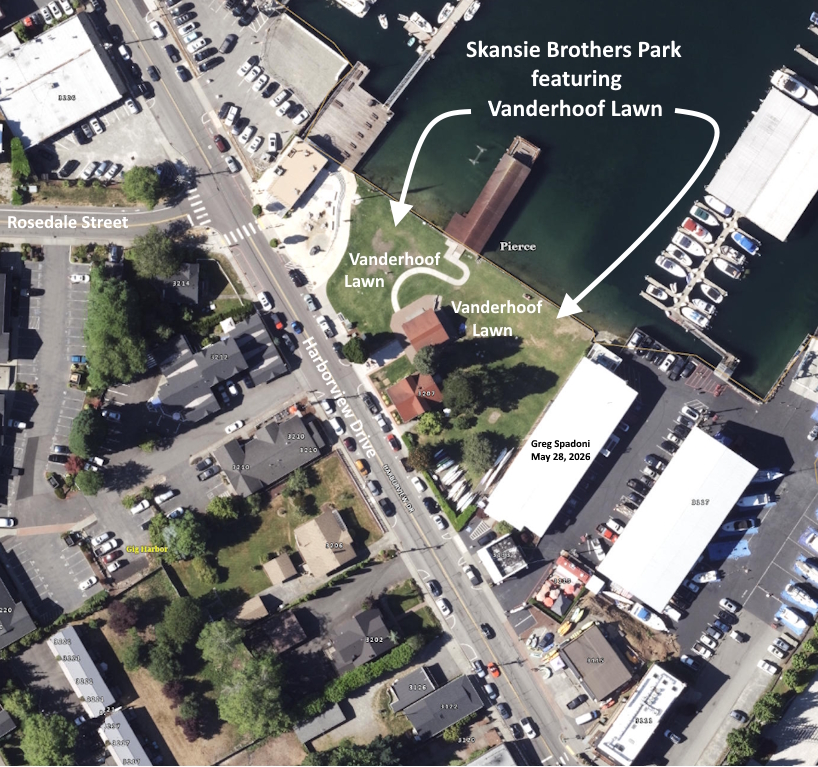
To pay historical tribute to the existence of the Mason & Vanderhoof shingle mill on the property long before Andrew Skansie owned it, I propose that the grass at Skansie Brothers Park be known from today onward as Vanderhoof Lawn.
The name not only acknowledges an important but so-far unrepresented part of Gig Harbor history on the west shore (shingle milling), but also allows for more specific directions to the many events held there throughout each year.
“Where’s the Waterfront Farmer’s Market held every Thursday during the summer?”
Vanderhoof Lawn.
“Where can we sit to enjoy the concerts at Summer Sounds at Skansie?”
On Vanderhoof Lawn.
Where in Gig Harbor are you most likely to step in goose poop?
Vanderhoof Lawn.
It’s specific, it’s useful, it’s brilliant.
Besides, where does goose poop stick when you step on it at Vanderhoof Lawn?
On the bottom of your vanderhooves.
Vanderhoof Lawn, then, it shall be!
Somebody notify the city council. Signs and a plaque need to be ordered.
A column of many benefits
See? This column is more than just educational entertainment. It contributes to the betterment of the community today. And with the naming of Vanderhoof Lawn, it will continue to do so long into the future.
Just proof positive that a local history column doesn’t need to be stuck in the past. The really good ones also keep an eye on the future.
As for the present, always keep an eye on where you step on Vanderhoof Lawn.
Next time
The next Gig Harbor Now and Then column, on June 29, will have the answer to today’s two log identification questions, along with an explanation of the subject.
It will also have a new question of local history, in the form of an old, black and white photograph. It will be the Gig Harbor Now and Then Location of Mystery No. 2.
— Greg Spadoni, June 15, 2026
Surplus notes
Hervey Vanderhoof also had a very recently formed restaurant business — of a sort —at the time of his death. He was the president of the California Restaurant & Bakery Co., incorporated May 25, 1901. The only mention of it I found was an advertisement that ran in Nebraska, of all places. It appears to have been a holding company for the consolidation of restaurants and bakeries, with no stated holdings. The advertisement was simply peddling stock in the company. That it was advertising a half a continent away is probably telling.
Clara Hess appears in two censuses in Tacoma. In 1892, she was listed as 15 years old, born in Iowa, living with her parents Joseph and Mary. That indicated a birth year of 1876 or 1877. In the 1900 federal census, she was 22 years old, born in Iowa, living with the same parents. That indicates a birth year of 1877 or 1878 (1878 appears to be correct, in spite of the 1892 census).
After the death of her fake husband Hervey Vanderhoof, Clara Hess returned to Washington and married wealthy ship broker Surtees Hope, 15 years her senior, in 1902. He died in 1912 of paretic dementia, which is a less scandalous name for syphilis.
Clara Hess Hope next married Cary Wayland, 19 years her junior, in 1925. She died in Seattle of a stroke in 1947. It’s interesting to note that as the informant on her death certificate, her husband, while he did get her parents’ names correct, gave her age as 59 instead of 69, and her year of birth as 1888 instead of 1878. He also had 1888 engraved on her headstone. Did he deliberately falsify her death certificate and headstone — for no apparent reason — or did she lie to him about her age? Which one seems more likely?
Greg Spadoni of Olalla has had more access to local history than most life-long residents. During 25 years in road construction working for the Spadoni Brothers, his first cousins, twice removed, he traveled to every corner of the Gig Harbor and Key Peninsulas, taking note of many abandoned buildings, overgrown farms, and roads that no longer had a destination. Through his current association with the Harbor History Museum in Gig Harbor as the unofficial Chief (and only) Assistant to Linda McCowen, the Museum’s primary photo archive volunteer, he regularly studies the area’s largest collection of visual history. Combined with the print history available at the museum and online, he has uncovered countless stories of long-forgotten local people and events.