
Community Government Health & Wellness
Gig Harbor may join Pierce County-led plan to tackle homelessness
Homelessness in Gig Harbor looks different than homelessness in other areas of Pierce County. This is due to a variety of reasons, including demographics, microclimates, infrastructure and available support programs.
People experiencing homelessness in Gig Harbor often are not as visible as someone in a similar situation in Tacoma. A person experiencing homelessness in Tacoma may be out on the street, while someone experiencing homelessness in Gig Harbor is more likely to sleep in a car or couch-surf.
But relatively out of sight should not mean out of mind.
The city of Gig Harbor is considering joining Pierce County’s Unified Regional Approach to Homelessness (URA), a voluntary, county-led plan to address homelessness. Pierce County Council Chair Jani Hitchen and county Housing and Homelessness policy analyst Mary Connolly presented the URA to the City Council on June 11. Councilmembers expressed a strong desire to join.
Background
The URA is an effort to form a countywide partnership to coordinate responses to homelessness and housing instability, including data collection and resource development.
The URA stems from the county’s 2022 Comprehensive Plan to End Homelessness. The county hired Seattle-based consultant Uncommon Bridges, which convened a group of elected leaders to develop the URA design.
Gig Harbor participated in planning meetings starting with the first URA session in 2024. In late March, Pierce County declared that its work with Uncommon Bridges had reached an earlier-than-expected termination point, and Uncommon Bridges said that it had determined that Pierce County should lead the effort.
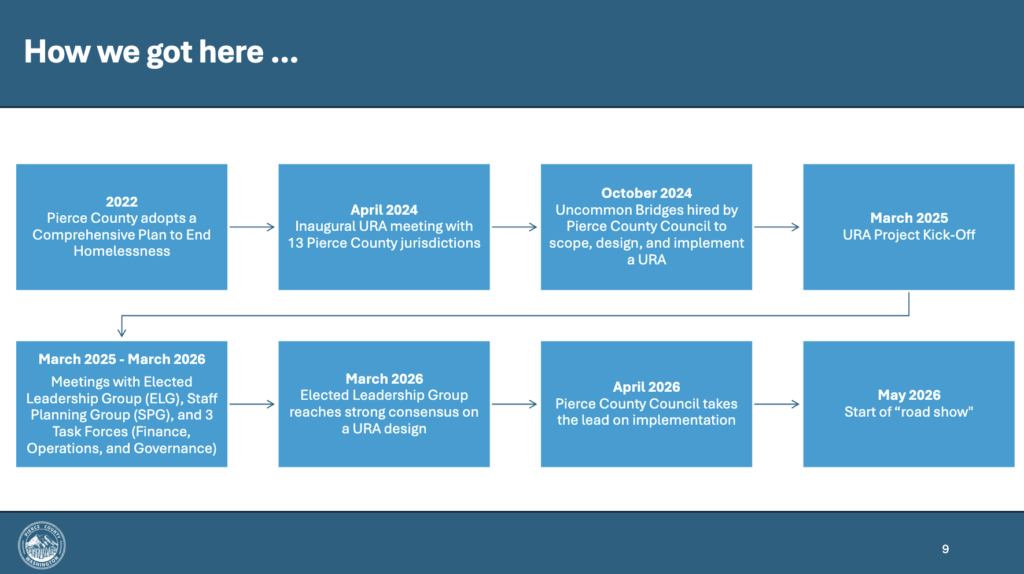
A slide from a presentation about Pierce County’s Unified Regional Approach to Homelessness.
The plan calls for 2 to 3 full-time employees. Participating jurisdictions would pay into the budget, with contributions depending on that jurisdiction’s population. Joining the URA would cost Gig Harbor $5,000 to $9,000 per year, though Connolly noted that “there’s more work to be done about the methodology for this.”
She also added that councilmembers might notice some similarities between the URA and South Sound Housing Affordability Partners (SSHAP), a collaboration among Pierce County cities to create and preserve affordable housing.
She said the difference is that SSHAP focuses on “development and preservation of housing — so that capital piece — whereas this is really focused on the people piece, and services.”
Gig Harbor’s elders are most at risk
Connolly noted that a person can become homeless for a variety of reasons, including job loss or living on a fixed income, foreclosure or rising rent, unexpected medical emergencies, or domestic violence.
City Housing, Health, and Human Services Program Manager Shealynn Smiley said the Gig Harbor population most at risk of experiencing homelessness is those age 65 and older. Seniors form a majority of the city’s low-income population.
“Most often, what we see in Gig Harbor is either someone staying in their car or couch-surfing,” Smiley said.
She noted that it can be a challenge to speak about homelessness within Gig Harbor, because “it’s not as visible as it is in some other areas.” She said that the URA creates a “unique opportunity” for each jurisdiction to address the ways its community experiences homelessness through a cooperative and collaborative — but not a copy-and-paste — model.
The county’s homeless crisis response system served 8,700 people in 2025. Of those people, 65 said they last slept in Gig Harbor.
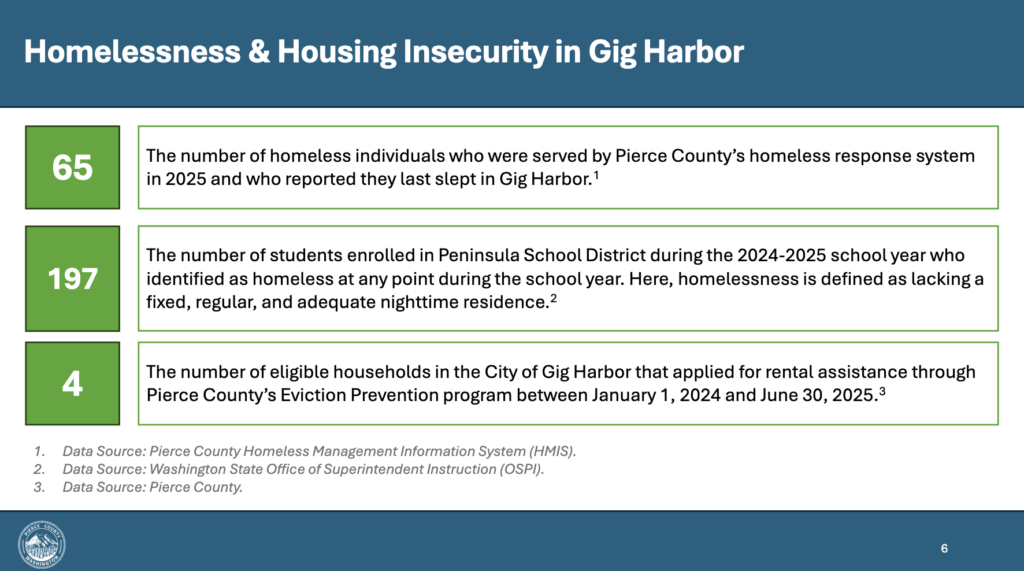
A slide from a presentation about Pierce County’s Unified Regional Approach to Homelessness.
“That number captures where people stayed, but not necessarily their prior address,” Connolly said. She found 20 people who reported that their last permanent address was either 98332 (roughly from Rosedale Street north to the Kitsap County line) or 98335 (the rest of the Gig Harbor Peninsula, minus Fox Island).
Student homelessness
She also emphasized that 197 Peninsula School District students identified themselves as homeless during the 2024-2025 school year.
“This includes children who lack a fixed, regular, and adequate nighttime residence,” she said. “So that includes not only children who are literally homeless or sleeping in a car, but might also be doubled up with another family or something like that.”
These numbers appear to be in line with previous years’ reports of student homelessness, according to the state’s Office of the Superintendent of Public Instruction’s database.
Another KCRHA?
Councilmember Julie Martin raised the issue that Hitchen acknowledged had been asked of her many times in recent months: Will the URA become another King County Regional Homelessness Authority (KCRHA)?
Established as an independent body in 2021, the KCRHA was meant to address the homelessness crisis in King County and the city of Seattle. However, a forensic investigation in April revealed serious financial mismanagement that left at least $8 million in public funds unaccounted for. The investigation showed the agency operated in the red to the tune of around $45 million since July 2025 and that its “negative cash balance” started in December 2023.
The King County Council voted to dissolve the agency on April 28. It also launched an effort to locate and recover the money. The dissolution will take place over 90 to 120 days, in order to transfer existing contracts, so as not to leave people experiencing homelessness without care or help.
Safeguards
Hitchen said that while King County established the KCRHA as an independent organization, the URA would be part of county government.
“Because it’s under Pierce County, it would be subject to Pierce County’s financial controls. … The effort is starting small with one, two, three staff. So the idea is, let’s start small, collaborate small, and then maybe we could see what maybe we can grow, but not starting super big,” she said.
Also unlike the KCRHA, she said, the URA’s mission is not to provide or contract out services. It would support other governments’ approaches and help with coordination.
“So if governments said, ‘Hey, we want help administering services,’ that’s something that the URA could do, but it’s not part of its core mission unless it’s asked of it,” she explained. Also, Hitchen said, the KCRHA was an agreement between Seattle and King County, without including other cities. The Pierce County effort would be different because it would include more jurisdictions.
Planned resources
Hitchen said the URA focuses on ease of access to entry points, no matter where a person is physically located or how they enter the system. The intent is to find resources that can get people “on a path” to housing.
“I can’t possibly build 8,000 shelter beds. It’s not going to happen,” she continued. “But how can I reduce the time that you are spending sleeping in your car? … How do I start getting you into case management so we’re learning your issues?”
This only happens, she said, if URA partners provide services where people in need are already located. She also said that the mission includes homelessness response and prevention, but leaders need to have other discussions regarding how to get people into needed mental health treatment and associated services.
Smiley said much of the communication regarding homelessness resources within Gig Harbor is via word-of-mouth, primarily when she is doing outreach.
A unified approach, she emphasized, would ideally create a more consistent communication and response network.
“I think another thing that we all are very acutely aware of is being across the bridge, there is literally a gap between us and Pierce County,” she said. “We are doing our part for our residents [by showing] that we are a part of this conversation. … The more that we have a voice, the more that the community knows that we’re invested and that we do know about the different resources and we want to be a part of making sure that their tax dollars are also being utilized in our community with resources available.”