
Arts & Entertainment Community News
Memories and music fill a childhood home in Gig Harbor
“It broke me open,” Aaron English said.
Sitting in a Nashville doctor’s office earlier this year, the singer-songwriter unexpectedly found himself in tears while waiting to see his physician.
“It was embarrassing,” English recalled.
A family friend had emailed him a March 17 Gig Harbor Now article that featured his childhood home, the former St. John’s Episcopal Church, and a public concert hosted by the current owner. That article set off a series of phone calls back to Gig Harbor, eventually connecting English with homeowner Lise Kristiansen.
Kristiansen, a pianist, opened the historic church to the public in March out of a love for music, her appreciation for the building’s history and her desire to support local musicians. After the enthusiastic response to the first concert, Kristiansen decided to hold another one.
What she didn’t know was that the next songs performed would come from the voice of a boy who grew up practicing piano in her basement on a humble upright piano clocked by an egg-timer.
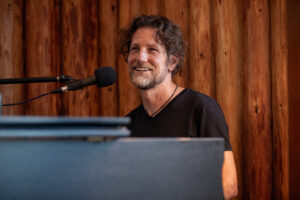
Nashville-based singer/songwriter Aaron English returned to his childhood home in Gig Harbor to share memories and music. Photo by Julie Warrick Ammann
Saturday evening, two chapters from the home’s history came together in a concert celebrating music, memory, and a shared love for the church they both called home.
Dressed in jeans, a black T-shirt and brightly colored tennis shoes, English, 52, sat behind Kristiansen’s grand piano in the same room he learned to walk and talk. Almost two decades had passed since leaving the home. A sweeping picture window overlooking the harbor was the backdrop. On a clear day, Mount Rainier was front and center.
Childhood adventures helped shape one of the iconic design features of the home. A neighborhood boy once shot a BB through the large picture window. The English boys suspected it was one of the Finholms, friends they often played with. When the window was replaced, updated building codes required a different design, forever changing one the home’s defining architectural features.
When English sang, his voice filled the space, reminding the audience there is something reverent about hearing music inside a chapel. From the balcony, now the home’s main bedroom, guests had the best view and acoustics.
‘We loved this house. We loved each other.’
This was the family home for 40 years, English told the crowd, explaining that his parents paid $25,000 for the old church in the 1970s. “And we loved it very much,” he said. “We loved this house. We loved each other. We loved this incredible city.”
Guests, some of them old family friends, were seated on couches and around the dining room table. Standing in the kitchen and hallway, others sipped and snacked on shared drinks and appetizers.
English then listed things you learn in a childhood home.
“How to crawl, walk, talk, read, write, eat solid food, count, type, hold a pencil, hold a fork, whistle, snap your fingers, cross your fingers, cross your eyes, tell stories, tell lies, tie your shoes, button your shirt, use the potty, blow bubbles, play chess, play checkers, play football, play basketball, play baseball, play super Mario brothers, shuck an oyster,” he said.
“That didn’t go too well.”
The audience laughed as he pointed to the sink where he spit the slimy seafood out of his mouth. The last learned skill on his list: “sing.”
He began to sing “The Story of Us.” “How would you tell the story of us? The promises broken, the dreams left to rust,” he sang.
English has spent the past seven years living in Nashville where he writes and performs music internationally. His work has appeared on television programs including “Bones” and “The Daily Show with Trevor Noah,” as well as commercial brands, including Chevrolet, Google and Patagonia.
Inspired by his travels to East Africa, English founded the International Youth Music Project, bringing music education to orphanages, refugee camps and HIV/AIDS community centers.
Growing up with music
The English family had their own soundtrack.
Aaron’s father, John English, was dean at the University of Puget Sound before spending the last years of his career as a professor there. The former Gig Harbor City Councilman filled the house with the music of jazz artists such as Dave Brubeck, Dizzy Gillespie and Gerry Mulligan. Aaron’s mother Marilyn, who once ran a preschool in the basement, preferred soft rock.
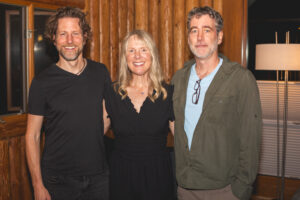
From left, Aaron English, Lise Kristiansen and Doug English. Photo by Julie Warrick Ammann
Downstairs, Aaron’s older brothers, Doug and Joel, played AC/DC, Queen, Kiss, Boston and eventually immersed themselves in the Seattle grunge scene. They once drove to Evergreen State College to see a then-unknown group called Nirvana. Aaron found himself drawn to British artists. “I was kind of the opposite of what my brothers were into,” he said.
Doug flew from his home in California to see the concert. Joel died last year. As Aaron performed, Doug stood quietly beside one of the massive timber walls. His eyes settled on a familiar pattern in the wood. Near a heart-shaped grain was a small indentation. As a child, he had pressed his thumb into the vertical timber. Decades later, he placed his thumb there again, standing in the same spot while listening to his brother sing.
Growing up in an old church wasn’t just a novelty. It came with its own childhood imagination. Aaron recalled a terrifying realization when he was 7.
“I realized I lived in a church,” he said.
He quickly came to the conclusion that “every naughty thing I did was extra bad.”
His older brother Doug had an unusual bedroom. He slept in the bell tower, a multi-level, 8-by-8-foot space accessible by a ladder that hung from the wall in what is now the home’s front entrance.
Cherished spaces, old and new
As Aaron and Doug toured the house before the concert Saturday night, Kristiansen could see the joy they were experiencing as they “rediscovered familiar spaces transformed by time.”
“Watching them reconnect with so many cherished memories reminded me how deeply our childhood homes become part of who we are,” said Kristiansen.
“My parents would be so relieved she (Kristiansen) is the custodian of the house,” said Aaron. “She’s gone out of the way to widen the circle.”
Aaron’s parents sold the family home in 2008, seeking fewer stairs and easier maintenance. The task of oiling the timbers each year became too much for Aaron’s parents. “We were shook,” said Aaron in reaction to his parents’ plan to sell. “How could you do this?” he thought.
Kristiansen understands the childhood grief the English sons felt when losing the only place they knew as home. “As I watched Aaron and Doug walk through the halls of their childhood home, I couldn’t help but think of my own two sons. Like Aaron and Doug, they were heartbroken when I sold the home in Alaska where they grew up so I could move to Gig Harbor.
“I hope that one day my sons will have the same opportunity to walk through the home where they grew up, revisit those memories, and see that while a house may change, the memories never do.”
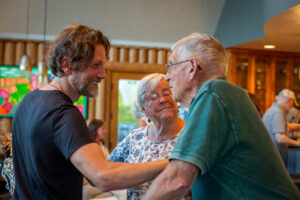
Aaron English, left, greets old friends at a concert in his childhood home in Gig Harbor. Photo by Julie Warrick Ammann
The music of memories
Memories have inspired Aaron’s music. From the tides of the Salish Sea to reflections on his parents. Before performing a new song, “Love Is Still Here,” he explained that it was written for people who are no longer around. “I wrote it thinking about people we miss,” English told the audience. “Specifically, I was thinking about my dad.”
The English brothers lost their father three years ago. The song, Aaron explained, is about the ways loved ones remain present even after they’re gone. “It’s about not just missing him, but hearing him, seeing him everywhere,” he said.
“When I die, I wanna come back as a guitar,” he sang, “so I could play a song to win your heart.”
The evening ended with Kristiansen and English at the piano. English singing beside her, one returning home, and the other opening her home. Before guests departed, Kristiansen presented English with more than $1,400 collected from the audience in support of his work as a musician.
But when the concert was over, there was one more treat for the English brothers. Kristiansen let them spend the night at the home.