
Community
Gig Harbor Now and Then | Pinning down the location of interesting things found in Gig Harbor
In reaction to the Gig Harbor Now and Then column posted on Aug. 24, we received this via social media:

Community Sponsor
Community stories are made possible in part by Peninsula Light Co, a proud sponsor of Gig Harbor Now.
I am a Puyallup Tribal member… . The Tribe has reached out to comment about a recent article you posted that pin points the location of Native American graves/human remains. This information is highly private/protected and protected by the Native American Graves Protection Repatriation Act (NAGPRA.) Please remove this information ASAP.
Taking the story down is the easy part. The difficult part is removing the cached versions that were created when readers accessed the story. In an attempt to eliminate those, we are reposting the story with the information the tribe objected to removed — with the expectation that refreshed cached versions will be overwritten with the new version. The images have been blurred beyond recognition, but the file names of the images have remained the same, also in expectation that refreshed cached versions will overwrite the originals. How well that works remains to be seen, but it’s worth a try. — Greg Spadoni
(Editor’s note: We are confident that nothing we did violates any federal law. However, out of respect for the tribe, we agreed to make these changes. — Vince Dice)
The subject of the previous Gig Harbor Now and Then column was a Gig Harbor neighborhood. In it, I wrote something along the order of, “… the name [of the neighborhood] was, and remains, very appropriate, for a long time ago, some interesting things were discovered on some of the waterfront property in the neighborhood. The neighborhood is not simply near an interesting place, it was part of one.”
Lack of space prevented the inclusion of a description of those things, so today’s main subject will be:
Some interesting things were discovered in a neighborhood at Gig Harbor
Some interesting things found in the neighborhood are from at least three different discoveries. The location of the first has a slight possibility of being elsewhere in Gig Harbor, but the second and third are positively from the neighborhood.
The first discovery was made by Arthur M. Hunt, on his property. The story was picked up by a variety of newspapers around the country, none of which will be reproduced here.
While the exact location in Gig Harbor was not revealed, Arthur Hunt owned 20 lots in the neighborhood at that time, with some of them contiguous. Half the lots were on the waterfront.
Parts of Hunt’s upland lots were well above the high-tide line, so they fit his limited description of the interesting site. But he owned multiple pieces of land on the Peninsula, allowing for the possibility of the something having been found on a different one of his properties. However, the second discovery supports the idea that the something he found was on his group of lots in the neighborhood.

Pierce County Assessor-Treasurer aerial map
Similar settings, different things
The similar settings of the things found by Arthur Hunt and George Savage — under the stumps of very old trees — are compelling. Even more compelling is the fact that they appear to have been found on the very same piece of land. Arthur Hunt sold all 20 of his lots in the neighborhood to George Savage six months before Savage made his own discovery. It was on those same lots that he built an impressive summer home that same year, which is the reason the land was being cleared.
While that is not absolute proof of Hunt’s discovery having been made in the same place, it seems very highly likely.
Another something
One more discovery of things in the neighborhood was reported a few years later. No details of the find were given, nor can we even say what it was.

Pierce County Assessor-Treasurer aerial base map
Other interesting things found locally
… are stories for another day.
Don’t you hate that?
A new question of local history
The idea for this week’s question comes from Carl Campen. As an aside to whatever topic we were discussing at the time, he told me some months ago about multiple houses in Gig Harbor that share something significant in common. He couldn’t recall the exact year when they first came to his attention, but knew it was in the early 1950s.
Last month, I happened to come across a newspaper article about those houses, which pinpointed the year as 1954. After I emailed him the clipping to confirm that it was about the same houses he had described to me, we got together and he pointed out three of them. They are circled on the map below.
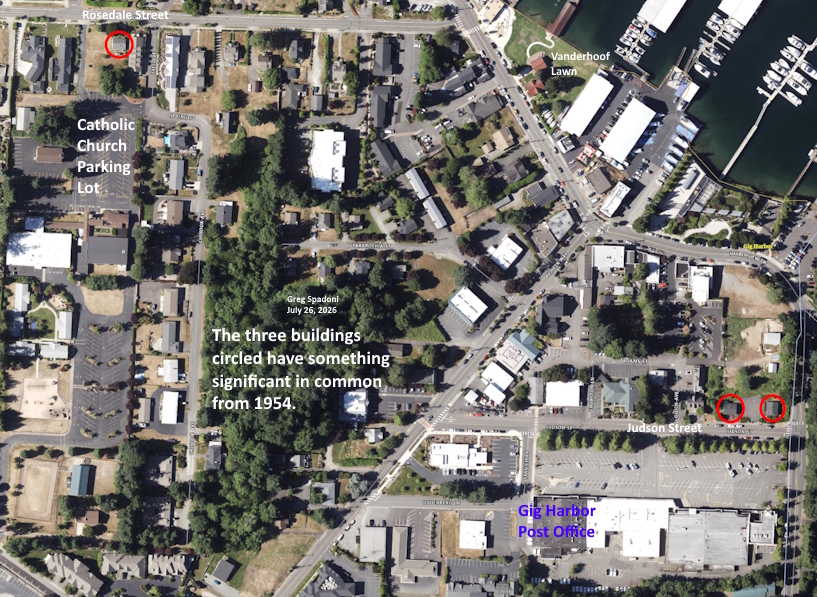
Pierce County Assessor-Treasurer aerial base map.
Carl also showed me where a fourth house used to be, on the northwest corner of Stinson Avenue and Regatta Court. It was torn down a few years ago, and a new house built in its place.
There were originally seven houses in the group that shared something significant in common. I suspect I know where the other three are, and I think they’re all visible in the map above, but without being certain, I won’t speculate.
The seven all had the same owner in 1954, and they all appear to have been 768 square feet, but neither is the answer I’m looking for. They had another significant something in common.
The three houses pointed out in this column were part of a group of seven that shared something significant in common in 1954. What was it?
Hint: 1954 was not the year they were built.
Next time
The Sept. 7 column will have the answer to today’s question of local history, then move on to a new topic. Unless I can come up with something somewhat less boring, the new subject might have something to do with stamp collecting.
Actually, unless I can come up with something less boring, it will have something to do with stamp collecting. A stamp collecting segment is already in the can, waiting to be pasted into an incomplete Gig Harbor Now and Then column. And guess which column is currently incomplete?
Yes, the Sept. 7 one.
Oh, boy, stamp collecting.
Can you sense my enthusiasm?
— Greg Spadoni, August 28, 2026
Greg Spadoni of Olalla has had more access to local history than most life-long residents. During 25 years in road construction working for the Spadoni Brothers, his first cousins, twice removed, he traveled to every corner of the Gig Harbor and Key Peninsulas, taking note of many abandoned buildings, overgrown farms, and roads that no longer had a destination. Through his current association with the Harbor History Museum in Gig Harbor as the unofficial Chief (and only) Assistant to Linda McCowen, the Museum’s primary photo archive volunteer, he regularly studies the area’s largest collection of visual history. Combined with the print history available at the museum and online, he has uncovered countless stories of long-forgotten local people and events.