Community
Gig Harbor Now and Then | Commercial fishermen wanted a new dock. For decades, governments told them, ‘go fish’
Gig Harbor Now reporter Carolyn Bick has been keeping track of the Gig Harbor Commercial Fishing Homeport story. She has reported some incremental progress and a couple of milestones. On Aug. 12, 2026, she covered the latest one, the awarding of a construction contract for the project.

Community Sponsor
Community stories are made possible in part by Peninsula Light Co, a proud sponsor of Gig Harbor Now.
At the end of that piece, she wrote, “Project advocates Guy Hoppen, Gregg Lovrovich, and Erin Babich said in a brief statement that the vote ‘is certainly a milestone in the 14-year Homeport saga and we’re grateful to council for advancing the project to a final phase.’”
The 14 years mentioned in their statement is the amount of time since the city announced in 2012 that the new dock would be built at Ancich Waterfront Park on Harborview Drive. But the homeport saga stretches back WAY farther than that.
Not a recent concept
The idea of a commercial fishing dock in Gig Harbor is nothing new in the 21st century. It goes back almost 100 years. In 1928, the first commercial fishermen’s pier was built, right where the Jerisich Dock is today in Skansie Brothers Park.
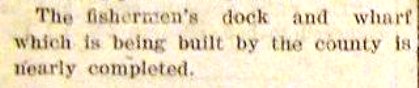
The June 1, 1928, Peninsula Gateway reported that the new fishermen’s dock in Gig Harbor was almost completed.
The fishermen didn’t like it from the beginning. It was too short. It didn’t reach water when the tide was out, making it useful only at medium-to-high tide. With two low tides per day, the dock’s serviceable window was impractically short.
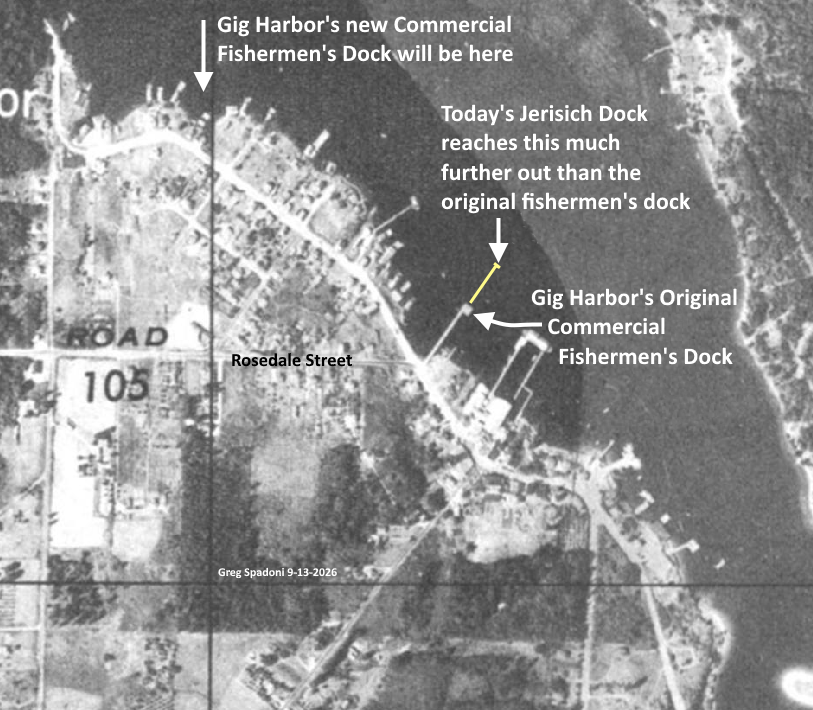
Gig Harbor’s first commercial fishermen’s dock was where Jerisich Dock is today at Skansie Brothers Park. This photo from the early 1940s shows that it was noticeably shorter than Jerisich Dock. Pierce County Assessor-Treasurer aerial base map.
An appeal to reason
In an attempt that was the first of many, Gig Harbor’s fishermen sent three of the fleet’s heavyweights to Tacoma to express their concerns to the Pierce County commissioners in 1930.
Peter Skansie, Pasco Dorotich and Lee Makovich no doubt did their best to convey the importance of having an all-tides dock in Gig Harbor, but nothing positive came from their effort.
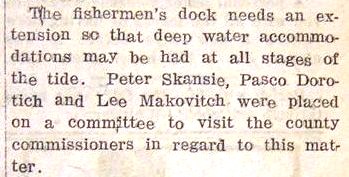
The Peninsula Gateway, March 7, 1930.
Try, try again
The matter got serious again in the 1940s. This time, six local fishermen made their case to the county commissioners. Once again, it was an all-star lineup of the Gig Harbor fleet: Vince Skansie, Pete Skansie, Anton Skansie, Martin Skrivanich, Tony Gilich and Nick Tarabochia. Joined by the chief deputy assessor of Pierce County, they asked for an extension to the dock of at least 70 feet, and 100 feet if possible. What they received was the same as the group of three in 1930: nothing.
After taking the delegation’s concerns under advisement, the commissioners decided only that it was not their responsibility. They said the existing, inadequate dock was the jurisdiction of the Port of Tacoma.
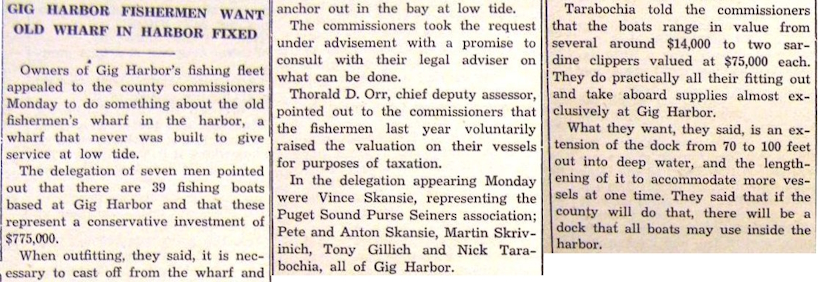
Gig Harbor fishermen wanted the old fishermen’s wharf extended by Pierce County. The Peninsula Gateway, Jan. 28, 1944.
In response to the county commissioners’ inaction, Charles Trombley, the editor of The Peninsula Gateway, weighed in the next month, trying to gin up some interest in the problem with the general public.
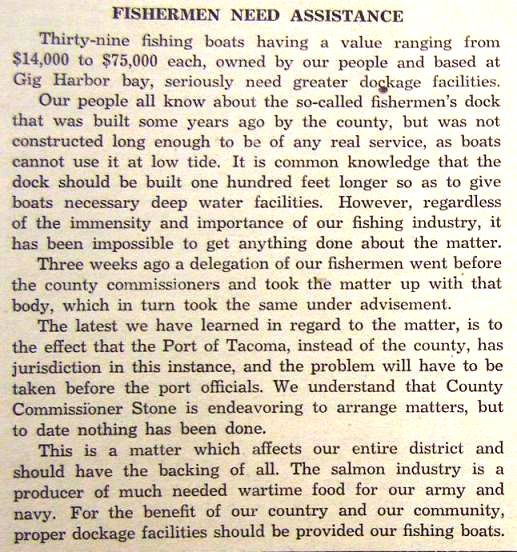
On Feb. 11, 1944, The Peninsula Gateway editor agreed that Gig Harbor fishermen needed a better public dock.
Two years later, the only difference in the dock was it being two years older.
Another attempt with a new angle
Editor Trombley called for a new fishermen’s dock again in 1946, this time using it as part of an argument for incorporating the town. In the June 21 Peninsula Gateway, he wrote, “We need a substantial fishermen’s dock to accommodate our most important and outstanding industry, which has a capital investment of more than a half million dollars and an average yearly income of $100,000. Gig Harbor has needed this improvement for many years, but we will be powerless to do anything about it until we are properly organized. The cost of this improvement can be paid out of our surpluses should we incorporate.”
The town of Gig Harbor did incorporate that year, but the dock was not improved with “surpluses” or any other source of funds during the remainder of the 1940s. In fact, it wasn’t even well maintained.
A new decade, a new push
In 1951, another attempt at improving the fishermen’s dock in Gig Harbor was mounted. It consisted of little more than general talk of building a new facility somewhere in the harbor, referred to as a Boat Haven, complete with spelling capitalization. Financial capitalization was still elusive, however.
On May 25, The Peninsula Gateway said of the new effort: “One of the most important civic meetings to take place in Gig Harbor for some time, was held at the Town Hall, on Wednesday evening … The above mentioned meeting had to do with a Boat Haven, which it is hoped, will be located on our bay.”
Two county commissioners and the county engineer attended the meeting. The Gateway said of the meeting, “The county commissioners have promised to take the initiative from this point on and bring pressure on the Port of Tacoma commissioners, and it is now up to all of us to give them every support possible.”
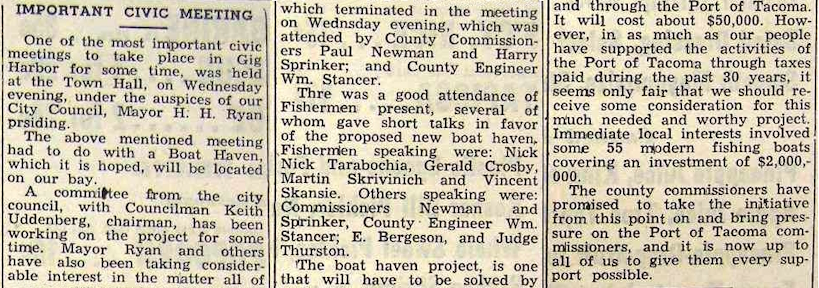
It probably doesn’t take a lot of imagination to figure out what happened as a result of that meeting.
Nothing.
Finally, a plan
The rhetoric changed and a new location was proposed in 1955. But the inaction stayed the same. The idea of building a new Boat Haven on John Galbraith’s waterfront property (where the south half of the Harbor History Museum is now) was mulled over. It had been the location of the Austin (and later Galbraith) lumber mill that had shut down several years earlier.
“Assurances of a small Boat Haven at Gig Harbor as an extension of the Port of Tacoma was gained Tuesday when Tacoma’s port commissioners passed a resolution which gave a green light to the long-time planned project,” The Peninsula Gateway reported. “Specifically, the Gig Harbor small boat haven, which had been provided for in the estimated 1956 budget at a sum of $125,000.00 was formally noted in a resolution which amended the original scheme of harbor improvements by adding ‘construction of a boat haven at Gig Harbor, with necessary buildings, floats, filling and dredging substantially as submitted in original drawings.’”
“Dredging substantially” is a pretty mild description considering how far out the tide goes in that corner of the harbor. It was not a very practical site.
One of the commissioners made a prophetic statement when he said, “… the people must realize that all this just won’t happen tomorrow.”
Or in the next 25,000 tomorrows.
The budgeted $125,000 must’ve been spent elsewhere, for it never made it to Gig Harbor.
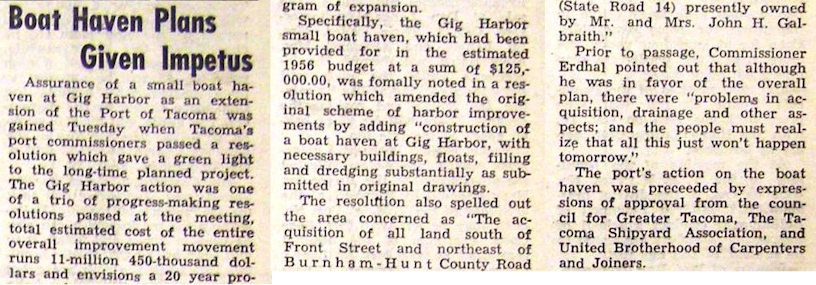
The Peninsula Gateway, Sept. 30, 1955.
With three layers of government — Pierce County, the Port of Tacoma, and the town of Gig Harbor — having taken no tangible action to preserve or improve it, by the end of the 1950s, the old fishermen’s dock at today’s Skansie Brothers Park had deteriorated into uselessness. In fact, it had become a public hazard.
No longer a choice
In 1960, the Gig Harbor town council was forced to act. Not to make improvements, but to hire Spadoni Brothers to remove the first section of the dock from the shore end and the float at the opposite end to prevent public access.

Minutes of the August 11, 1960 Gig Harbor town council meeting.
Gig Harbor’s 1928 fishermen’s dock, which was functionally inadequate from its first day of use, had finally expired. A mere 66 years later, that deficiency is now going to be corrected with the construction of a new, fully functional dock at Ancich Waterfront Park.
So, when Guy Hoppen, Gregg Lovrovich, and Erin Babich expressed their gratitude for the new Commercial Fishing Homeport, they were in effect speaking for every locally-based fisherman and woman of the past either 66 or 98 years. Take your pick.
That’s multi-generational patience.
Strolling through the graveyard
Next month the Gig Harbor Peninsula Historical Society will be giving its second annual local cemetery walking tours. They will be held at the Hales Passage Scandinavian Lutheran Cemetery.
Those of us who need shorter names to remember refer to it as Cromwell Cemetery.
Eight resting souls have been selected for detailed mention on each tour.
For details on how you can join one of the tour groups, which are by reservation only, this website tells you all about it.
Sept. 23
Two days from the posting of this column will be the annual Gig Harbor Now Fundraiser, this year at Kopachuck State Park (Sept. 23). The offer to readers from two weeks ago, to take advantage of the opportunity to attend and yell at me in person for any and all crummy columns I’ve written, still stands. It is obligation-free — but only after you buy a ticket.
Well, I guess that’s an obligation, but as far as I know, it’s the only one.
If you join us and want to find me for a good bawling out, I’ll be the one standing off in the background somewhere, looking like I don’t belong. Tonya Strickland said she’d make me a prominent Yell At Me button to pin on my shirt, so I may be wearing that, but I haven’t seen it yet.
With or without the button, I welcome any and all criticism of this column, but sincerely hope not to encounter any spit-talkers. I don’t think I could stand still for that. I may have to bring an umbrella, just in case.
— Greg Spadoni, September 21, 2026
Greg Spadoni of Olalla has had more access to local history than most life-long residents. During 25 years in road construction working for the Spadoni Brothers, his first cousins, twice removed, he traveled to every corner of the Gig Harbor and Key Peninsulas, taking note of many abandoned buildings, overgrown farms, and roads that no longer had a destination. Through his current association with the Harbor History Museum in Gig Harbor as the unofficial Chief (and only) Assistant to Linda McCowen, the Museum’s primary photo archive volunteer, he regularly studies the area’s largest collection of visual history. Combined with the print history available at the museum and online, he has uncovered countless stories of long-forgotten local people and events.