
Arts & Entertainment Community
‘Man or Mountain’ ponders the final hours of a Northwest legend
Just before the 45th anniversary of the eruption of Mt. St. Helens, Gig Harbor local filmmaker Collin Monda found himself gripped by the need to make a film about Harry R. Truman. Despite repeated warnings in 1980, the 83-year-old Truman would not leave his home beside Spirit Lake, in the shadow of the mountain that was about to blow. Truman died in the eruption — and his death is the one part of his life that no one really knows anything about. So, Monda wondered, what were his final hours like? What was it like — what is it like — to face and accept one’s own death?

Arts & Entertainment Sponsor
Arts & Entertainment stories are made possible in part by the Gig Harbor Film Festival, a proud sponsor of Gig Harbor Now.
In what ended up being a 15-minute film scored by Seattle-based band Massy Ferguson — with whom Monda’s uncle, Adam Monda, plays guitar — Monda examines what Truman’s final hours could have looked like in the film, “Man or Mountain.” The film will have its world premiere at the upcoming Gig Harbor Film Festival, which runs from Sept. 24 through 27. Monda is also the filmmaker behind 2018’s The Trouble With Wolves.
Gig Harbor Now sat down with Monda to talk about the making of the film, whether they really worked with 16 cats, and the underlying messages Monda hopes audiences will take away from the film.
Gig Harbor Now: Did you live here when Mt. St. Helens erupted?
Collin Monda
I was born in Portland, Oregon, five years after it happened, but that north Portland house could see the eruption squarely. Nowadays, if you’re in that neighborhood, you can see the leftover kind of shoulders of the mountain. My parents experienced it.
During my upbringing, we went on a road trip where we saw the Mount St. Helens visitor center, the observatory, and the presentation they give you — this whole film with all this archival [footage]. At the end of the production, they open these curtains, and there is the crater staring right at you. That planted the foundation [for this film].
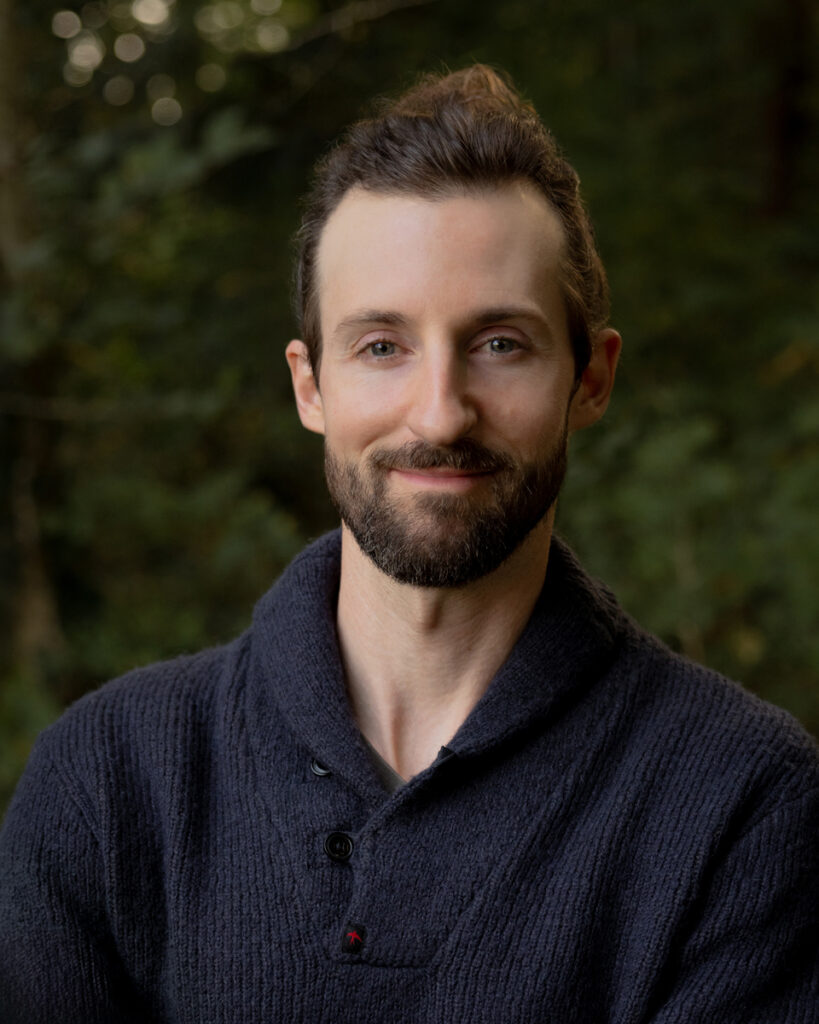
Collin Monda
I can’t believe that it [has] taken as many years as it has … to decide it would be fun to tell the story. But somehow that kind of came unearthed during the 45th anniversary of the eruption — the idea of, “Wasn’t there an older man who refused to evacuate?”
That story, that little hook, was something I started examining. I saw he had 16 cats, and [that] his third wife had passed, and he was still holding it down up there with a broken heart. There was just a lot more complexity than someone who had just defied science and everything and done what was inadvisable and stayed up there. I felt like the headlines were very specific about who he was, but there was so much more to his story.
That brought this project from what was originally a music video treatment to the 15-minute film that it is now.
GHN: That’s actually a really good segue. You mentioned some of his backstory. I was wondering if you’ve woven in any more of his more problematic elements.
Monda
I read all about the two different wives and the total powder keg mismatch of him and Marge, the second wife, and these stunts they would both do. He [threw] her in the lake, and then she dumped a whole pot of soup on him. I think [that marriage was] one of those really strong mismatches that needs to end as soon as they can.
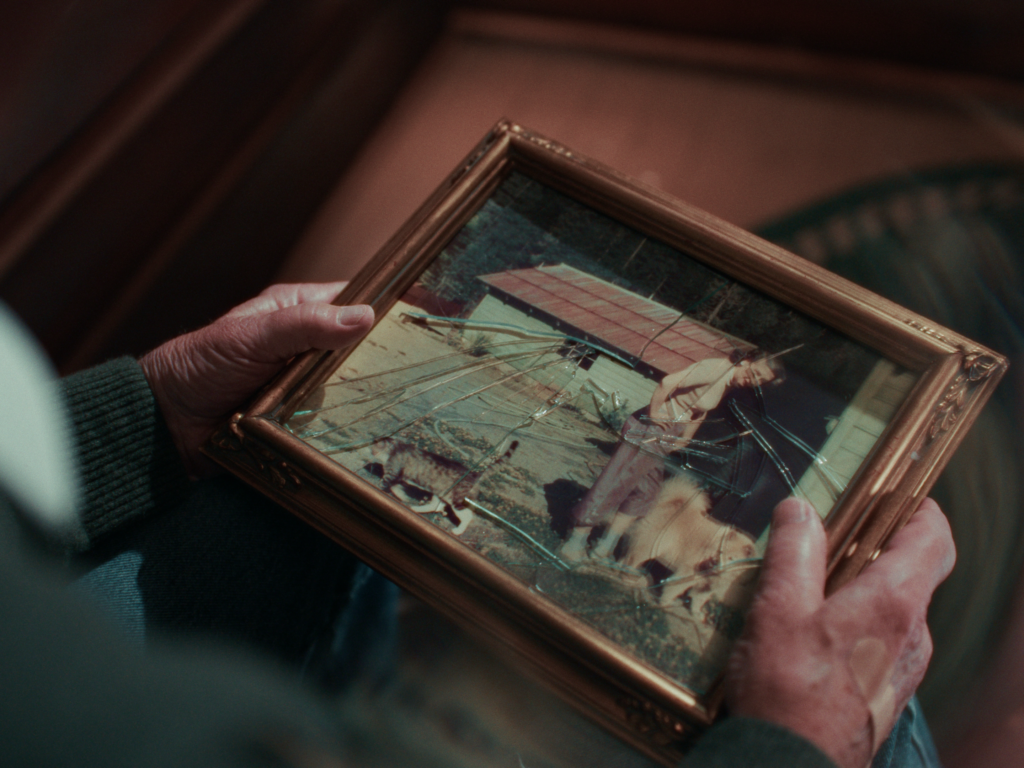
“Man or Mountain” examines Harry R. Truman’s relationship with his third wife, Eddie.
There was the idea that we might be able to bring some of that in, in the flurries of the archival materials. But honestly … getting a sense of those other relationships — so those materials were very difficult to find.
The way [the film] stands now, I think we get a sense of those, but it very much does land more on what would have been up on the walls in the house, what would have just organically been a part of his life at that moment, which is when he really just struck … that perfect chord with his third wife, Eddie, and the relationship they had. We’ve mostly pictures of the two of them together, but we … do play with a flashback of his niece — which is a hybrid of his experiences with two of his different nieces — [in a] scene in which we see him further out from the eruption, and a short temper and a short fuse with her, but then some tenderness as well. …
According to his family, which we talked with — his niece, Shirley, who wrote a great book on him, and his great-niece, Theresa — he was this definite mix of those two things. Definite tenderness for the right people, but shortness, and a favor (toward) animals over people sometimes, when he just couldn’t be bothered with those people.
GHN: How long did it take you to make the film?
Monda
It was designed as a silent film initially [as a music video for Massy Ferguson].
[Creating the film] really started [when we had] some conversations with Massy Ferguson. My uncle [Adam Monda] plays guitar and he’s a songwriter in the band. They had shown me their upcoming album, and we were talking about his love of character-driven, character-study style pieces and great characters in cinema, and I was like, “We should just do one of those. We should come up with something.”
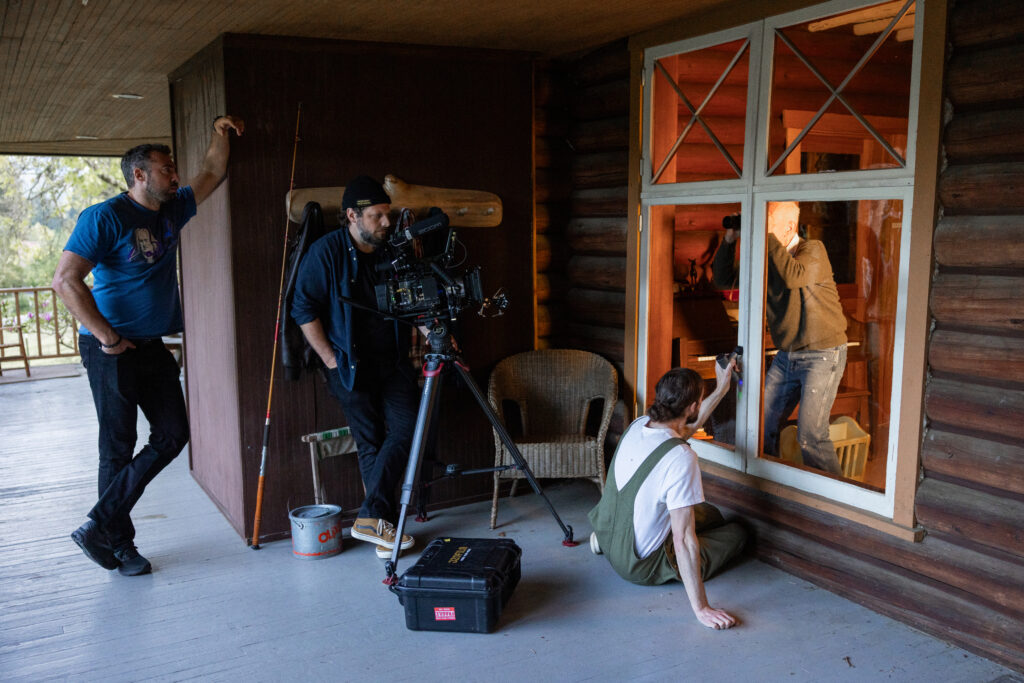
Filming a scene from “Man or Mountain.”
I heard [their upcoming album’s] opening track, “Early in the Morning.” I couldn’t quite tell what had been written about, but it started so slow and so soft, and had this beautiful refrain of, “Some days early in the morning, just lying awake for the blessed dawn,” and the song goes and builds, has a little melancholy through it, and then it just has this big finish with all kinds of discordant guitar feedback. It’s very unexpected, like something big comes crashing in and comes crashing down. You can already hear me describing the arc of what this film is. The shoe is going to drop.
Then, just one day, it just landed for me: Can we tell a Pacific Northwest story that’s like this? What could that be? And it just jumped into my head, [while I was] doing something fairly random around the house: That 83-year-old who refused to evacuate Mount St. Helens. I hadn’t thought of him in a long time.
We started hustling to see if we could raise money, find a location, get everybody on board for a shoot that landed right around the May 18th anniversary, so that seasonally we were correct and accurate.
An incredible wave of things lined up to make this one happen and get to that milestone to shoot it. A lot of that is centered around being in Gig Harbor and the connections that we found in our town that just were a huge wind in our sails for this project.
We were working around Massy Ferguson’s tour schedule. They were going to be in Spain and just doing a lot, so there was one weekend that worked — one Sunday that we could try to pull this together … to do a custom score for the film.
We were able to show the first version of the film in October last year in Gig Harbor to a private group, hosted by our executive producer. Since then we’ve been tightening up things, polishing things, and just felt like we’ve landed in the perfect moment, given all the support from the town, to have a world premiere in Gig Harbor.
GHN: Did you actually get 16 cats for the film?
Monda
We did not. We had four cats total in the film. … Let’s just say that the lodge might have had a certain bouquet to it if we’ve really had that many pets.
We have a play off Harry’s true love of the animals. We have a scene where the niece comes and collects cats and cat carriers, but … a lot of what plays out in the film, in this loneliness for him, is seeing the remains of having cats around. And when we get to the point in the film where we see a flashback, we see it as the niece taking the cats away, trying to get him to leave, one more time. He won’t.
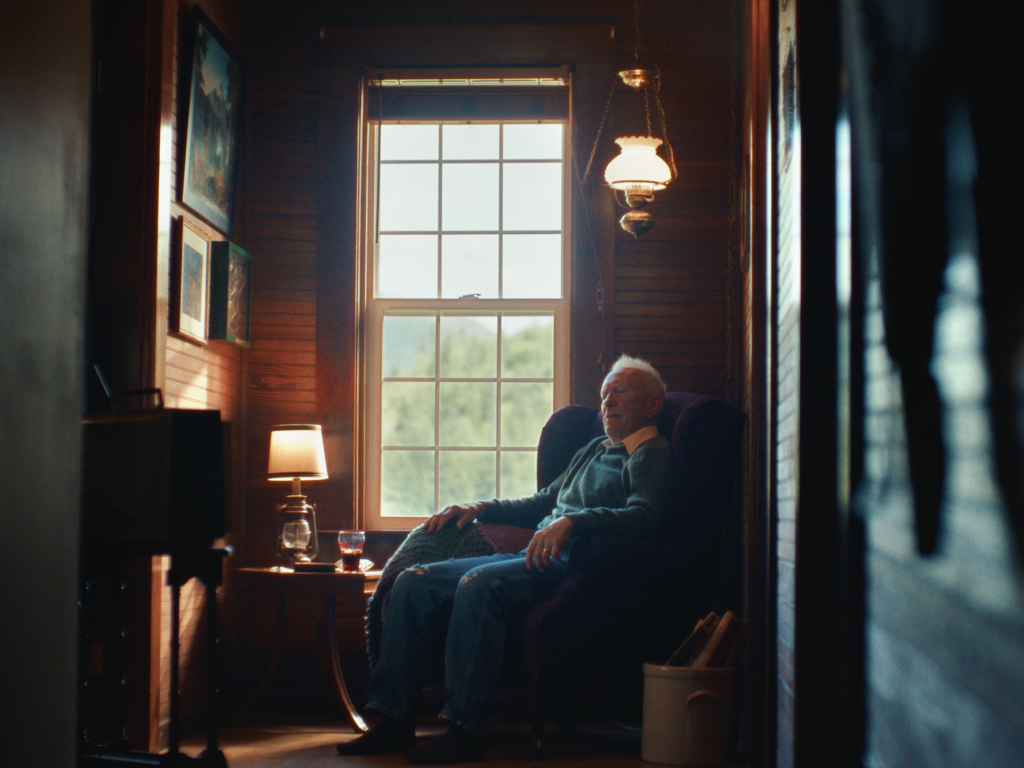
R. Hamilton Wright portrays Harry R. Truman in “Man or Mountain,” premiering this week at the Gig Harbor Film Festival.
Since those cats were hard to wrangle, we do have an appearance from another cat later on in the film, which is hopefully a very pleasant surprise.
GHN: What do you hope audiences take away from the film?
Monda
I think, all in all, what success would look like for me is those that already knew about Harry, to have only ever imagined what it might have looked like, now get to see it right in front of [them] — what it might have been like for someone to stay behind and go through this — [and] to learn a bit more about him beyond headlines.
[Audiences can lean into] more of that gray area where you can decide, “Well, you know, I still don’t really like him, but, like, I can see these other merits to him,” or, “I still think it was destructive that he stayed behind, for the example that it made for others,” or “Even if his situation was different, maybe it was okay, it was his time to go.”
I want people to be chewing on that a little bit. They can decide for themselves whether or not it’s a total tragedy, or if it’s sort of this blaze-of-glory type of thing.
But beyond that, a few other things kind of awakened while making it and while putting it together. One, just a fascination and an interest in what accepting death might look like for someone — what those last moments could really look like, what the psychology is, what phases of your own mood you would go through leading up to the end. There’s an attempt, at least, at running the audience through what that might have felt like, and seeing a hard-shelled man be pushed beyond where he thought he would be pushed, and eventually have to give in to the idea that it’s definitely not going to go the way he was hoping it would go.
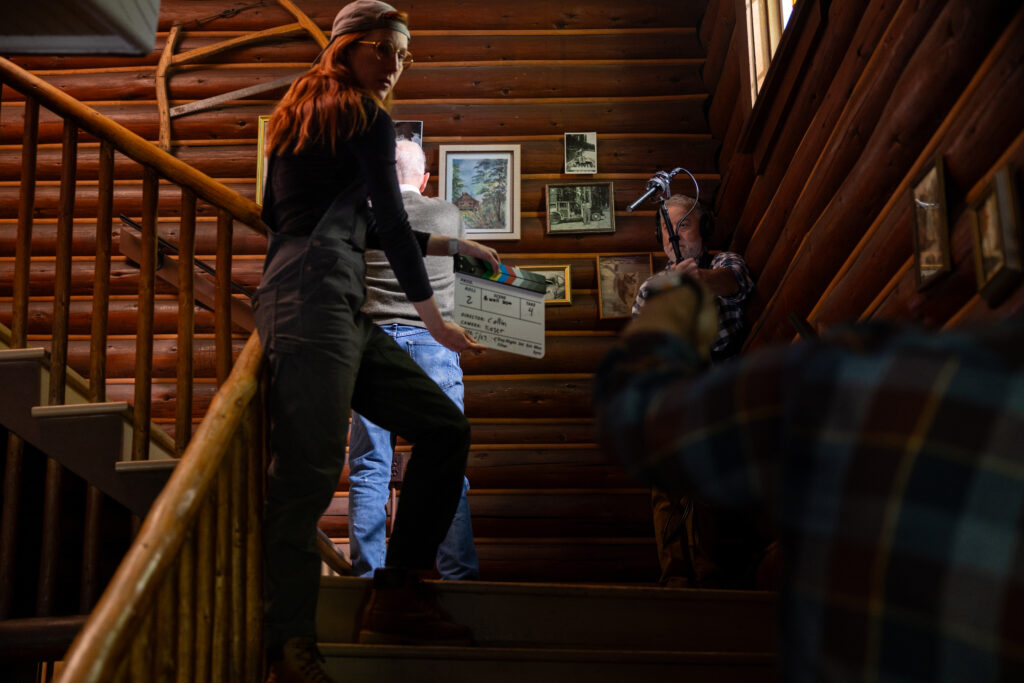
Filming a scene from “Man or Mountain.”
I’ve seen some really wonderful reactions to that piece of it.
And then the other piece that we kind of were thinking along the way, “Why did this [film] shake up now?… Why did this seem to really strike, the way that it did, out of the blue?”
There’s a definite feeling in it that Harry felt like he knew the land better than anybody, that he felt like he knew what the mountain was capable of. Even the scientific predictions, in some ways, were lighter than what actually happened, especially in the direction it blew, which was squarely his direction.
There’s a sense today with so many natural disasters — and they feel like they’re building and getting bigger, and now we’ve just had this Nepal disaster as well — that we really never can fully estimate the power of what nature’s capable of. So this [film] is a good reminder of that kind of awe, that we ought to be a bit humble.
I think there’s so much we haven’t seen that we could see. While this film is not indicative of a warming climate, [the Nepal disaster] does remind us [that] … some aspects of it are related to the warming. We’ve had a disaster that operated in some ways similar to the way this landslide worked for Mount St. Helens.
Man or Mountain will show during the Gig Harbor Film Festival’s Made In Washington block of films, which will run at 12:35 p.m. Thursday and 12:05 p.m. Saturday. The block’s runtime is 84 minutes. The cast, crew and Massy Ferguson will hold a Q&A after both screenings of the film. Tickets to the Gig Harbor Film Festival are available here, and readers can find a full festival program here.