
Community Government Police & Fire
City Council rejected Flock cameras for police, but businesses and neighborhoods still host them
Last year, the city of Gig Harbor received a grant that would have paid for automated license plate reader technology operated by Flock Group, Inc. But after residents expressed concerns over data privacy and security, the city council voted down the proposal.
Just a couple months after that vote, reporting from the independent publication 404 Media revealed the extent to which Flock’s systems — and, therefore, individuals’ data — are vulnerable to outside actors. These reports revealed that federal immigration agents accessed license plate data without warrants and, in some cases, without the permission or knowledge of local jurisdictions or law enforcement.
Additionally, Flock this year weakened data protections in its terms of service. Meanwhile, in a September hearing in the U.S. Senate, Flock acknowledged that users can search its footage using physical features in the high-resolution images that their cameras collect.
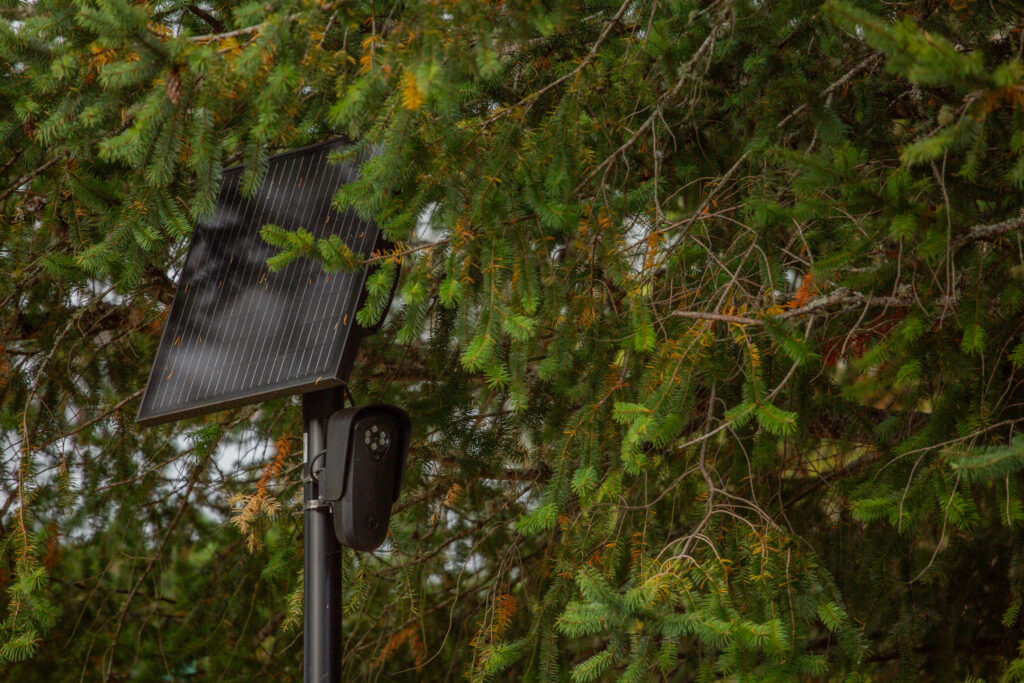
A Flock camera near the Gig Harbor Home Depot on Nov. 5, 2026. Photo by Carolyn Bick
While many private companies and organizations have since terminated their contracts with Flock since 404 Media began reporting on the company, others have not.
Home Depot continues to contract with Flock for security surveillance, and its Gig Harbor location on Borgen Boulevard has four visible Flock cameras. A private homeowners association on Raft Island voted in February to remove its single Flock camera. And several other cameras in residential areas around Gig Harbor appear to belong to homeowners associations.
Data security, privacy concerns
404 Media found that federal agents accessed data from Flock cameras in a variety of ways. In some instances, local law enforcement gave agents access as an informal “favor.” In others, federal agents used digital “backdoors” to get the data, apparently without obtaining explicit permission. Flock’s responses to media requests did not make it clear whether users unknowingly opted into data-sharing.
A University of Washington Center for Human Rights report last October found that immigration agents accessed driver data through at least eight instances of direct, warrantless access and at least 10 instances of backdoor access.
Following the UW’s report, state lawmakers this year passed a bill restricting so-called “backdoor access” to Flock cameras. This includes requiring law enforcement to obtain a court-issued probable cause warrant to access private Flock users’ cameras.
However, the structure of Flock systems still allows outside actors to access data without permission or user knowledge, according to a cybersecurity engineer who testified before a U.S. Senate subcommittee this year.
Furthermore, this year, Flock changed its terms and conditions regarding what it does with the data it collects.
Flock previously stated that it did not sell the data it collects and stores. But in February, the company removed that language from its terms and conditions.
Flock also added a perpetuity clause that allows the company to retain and use user data, even after a user has terminated their contract with Flock.
Home Depot
Four Flock cameras monitor the parking lot of the Home Depot on Borgen Boulevard.
Gig Harbor Now asked Home Depot whether its employees know about the cameras at the store and how it protects its employees’ and customers’ data. Gig Harbor Now also asked why Home Depot continued to contract with Flock, given the privacy concerns; and whether Home Depot would consider warning customers that Flock could collect and distribute their data without permission.
A spokesperson from a communications and marketing strategy group, Ominocom, responded on behalf of Home Depot. She said: “We’ve had parking area security cameras in place at our stores for many years, as many retailers do. These cameras are used to help us prevent and investigate theft, fraud, and organized retail crime and to protect the safety of our customers and associates in our stores. We do not grant access to our license plate readers to federal law enforcement.”
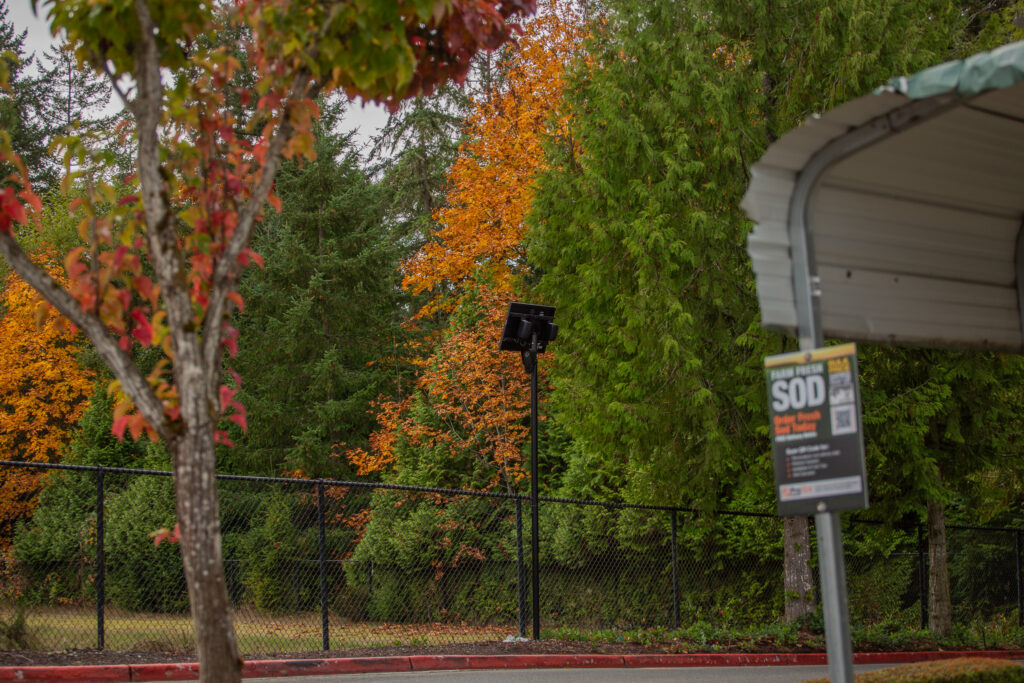
A Home Depot representative said the Flock cameras help “prevent and investigate theft, fraud, and organized retail crime,” including at its Gig Harbor store. Photo by Carolyn Bick
She did not address the issue of agents’ backdoor access to user data or the issue of individuals’ data security.
Raft Island
The Raft Island Homeowners Association voted in February to remove a Flock camera it had installed in 2024.
While terminating the contract and removing the camera, several residents discovered that the Puyallup Police Department had access to the camera.
Flock took more than two weeks to remove its camera after the association terminated its contract. Association members were unsure whether the camera was still operational and collecting data in that time.
Puyallup Police Department Capt. David Beerbower explained that Flock cameras aren’t monitored like a CCTV camera. Law enforcement needs a lawful reason to search the data the cameras collect.
The department previously had access to the cameras and could use them to conduct searches, but that was legal at the time. Before the legislation governing access to private Flock camera data, any Flock user could grant any jurisdiction access to its cameras. The law now states that agencies require a valid, court-issued probable cause warrant to search private Flock camera data.
Puyallup Police Department records show that someone from the association granted the police department access to the cameras upon request in October 2024.
Residents who requested anonymity, citing privacy concerns, told Gig Harbor Now that no one else was aware of this. They only found out after the board moved to terminate the contract with Flock.
Beerbower said that “[o]peration and ownership were solely that of the HOA and had nothing to do with the Puyallup Police Department.”
Slow to disconnect
The records show Puyallup officer Matt Hurley — the Raft Island Homeowners Association president at the time the community contracted with Flock — wrote a March 2024 email from his work account to his personal Hotmail account. In it, he discusses how Flock cameras work and mentions that Raft Island would be the second homeowners association in Gig Harbor to contract with Flock.
Gig Harbor Now reached out to Hurley via his personal and work emails to ask if he had arranged for the Puyallup Police Department to have access to Raft Island’s camera. Hurley did not respond to repeated requests for comment.
An association board member later reported that, in addition to a lengthy removal time, Flock customer service attempted to convince the association to keep its full subscription through August 2026. Flock told the association it would not be eligible for a refund of the unused portion of the subscription.
The board member also added that Flock was unresponsive to subsequent emails and requests for a removal date. The board member said that Flock had been unresponsive and had ignored repeated requests for audit logs in the past.
TransCore, not Flock
A third-party website called Flock Camera Locations shows the locations of different kinds of traffic-related cameras worldwide.
But the site’s name appears to be a little misleading, and its map somewhat confusing, because not all of the cameras on its map are Flock cameras. For instance, the map also reflects the Department of Transportation’s TransCore tolling cameras on the Narrows Bridge — but save for hover-over information, nothing distinguishes them on the digital map from Flock cameras.
“I am not sure why the cameras are being reported as associated with ‘flock,’” the department’s communications director Ryan Overton said in an October email. “The cameras are part of the Tacoma Narrows Bridge tolling system and are not associated with flock in anyway. So someone has reported the WSDOT tolling cameras as “flock” which isn’t the case. I did confirm with our tolling team that the cameras are TransCore, used only for Good to Go! tolling on the Tacoma Narrows Bridge.”
Overton said that the department neither operates Flock cameras nor contracts with the company. Furthermore, he said, “Flock cameras are not permitted within WSDOT right-of-way anywhere in the state.” However, “[w]e have had issues with Flock placing cameras within WSDOT right-of-way in many areas of the state and have worked with them to have them removed.”
‘One-offs’
He explained that in some instances, a local law enforcement agency contracted with Flock and placed cameras in WSDOT-owned right-of-ways. The department does not know about these cameras until someone notices and reports them.
He said that the department does not have a list of locations where this has happened, or how often it has happened.
“These are typically one-offs that occur. We are notified of a Flock camera, our team then notifies Flock and Flock removes the camera,” he said. “Again, this is pretty infrequent around the state and are handled on a case-by-case basis.” He said he came from the eastern region of the state, and could think of perhaps two or three times this had happened in the last three years.
However, he said, he does not know how quickly Flock responds to these removal requests.
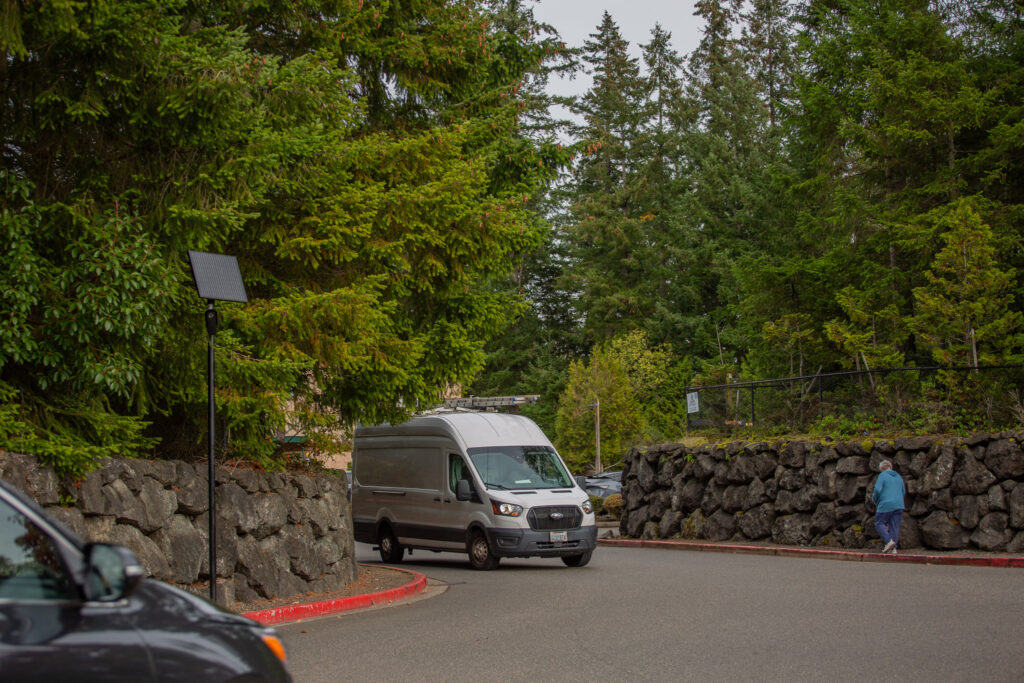
Home Depot uses Flock cameras for security surveillance in the parking lot of its Gig Harbor store. Photo by Carolyn Bick