
Community Education
Critics of proposed $800M bond want school board to scale back the ask
Critics of a proposal to build two new high schools in Peninsula School District last week asked the school board to consider options for trimming an $800 million bond recommended by the Capital Bond Planning Task Force.
Two of the speakers said they participated in the task force.
“My experience on the task force was frustrating,” said Jim Peschek, who suggested the two-new-high-school option was a foregone conclusion. “There was no real options, no real plan. It’s just basically, ask for about a billion dollars and then figure it out.”
School board member David Olson said the task force proposal was “not in stone by any means.” The school board agreed to review the proposal during a study session on Dec. 8.
Olson served on the task force along with two other school board members, Matt Bruhn and Natalie Wimberley
Task force proposal
The task force was open to all community members who wanted to participate, with applications accepted through May 18, according to Chief of Schools Michael Farmer.
The group met six times from May to September, including touring new high schools in Bethel and Central Kitsap School District, before making its recommendation to the board on Oct. 27. TCF Architecture facilitated the workshops, according to Farmer.
Besides replacing both comprehensive high schools, the proposal calls for a new shared district stadium in a “neutral location” to replace Roy Anderson Field on the Peninsula High School campus. Each new high school would have a new pool and performing arts center. The bond would also replace the district’s aging transportation and warehouse facilities.
The proposal calls for a 20-year, $800 million bond. The district in 2019 passed a 20-year, $198.55 million bond to build four new elementary schools and renovate Kopachuck and Key Peninsula middle schools.
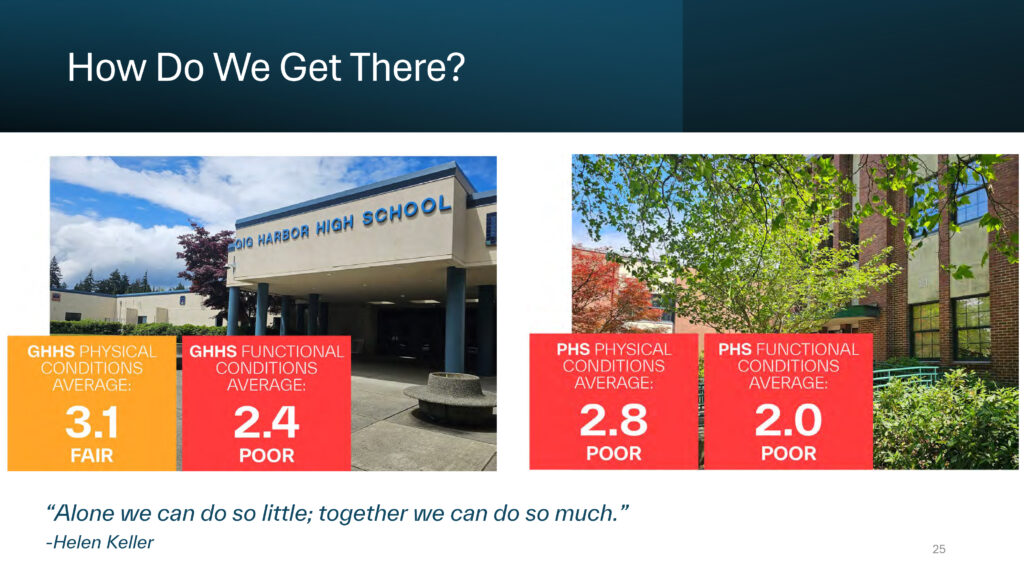
A slide from a presentation about capital facilities needs in the Peninsula School District.
GHHS renovation an option?
Peschek asked why the existing Gig Harbor High School couldn’t be renovated rather than replaced.
“There’s a huge amount of infrastructure that is still extremely good at Gig Harbor High School,” he said at the Nov. 10 board meeting. “The Gig Harbor High School main gymnasium and auxiliary gym are also the best facilities in our area. Why tear them down?”
The main GHHS building, vocational education wing and pool were built in 1978, according to the task force report. A classroom addition and gymnasiums were added in 1991.
Speaker Marty Paul, who also said he participated in the task force, seconded a GHHS renovation. He applauded the district for renovating, not replacing, the two middle schools with the 2019 bond, thereby saving taxpayers millions of dollars.
“The steering committee was never given an option to recondition Gig Harbor High School,” Paul said. “A few of the steering committee were so discouraged by the advisor group’s proposals that we personally met with them to oppose the options. During this meeting, we specifically asked how much it would cost to recondition Gig Harbor High School, and it was estimated $60 to $80 million.”
Location plans questioned
Peschek also questioned why, as he understands, the district would put the new high school on the existing GHHS turf field facility, which he said is a valuable asset.
“And then where would you rebuild (the turf fields)? There is no plan for this,” Peschek said.
The task force’s written report to the board does not specify where a new GHHS would be built.
Peschek and Paul both oppose relocating the transportation and warehouse buildings, as they understand the proposal. They say it would pose an unknown environmental risk.
“They should stay in their current location and do repairs and upgrades,” Peschek said.
Peschek also suggested that the best place to build Gig Harbor High School’s new pool, performing arts center, and Career and Technical Education building is on the current Discovery Elementary parcel, considering Discovery’s relatively low enrollment and potential capacity for its students at nearby Pioneer Elementary.
New PHS but for less
“I agree with building a new Peninsula High School. However, I do think it can be done for a lot less,” Peschek said. “The number that’s being proposed includes moving all sports fields, parking lots, huge swimming pool, huge performing arts center, basically a rebuild of the entire campus.”
Both Peschek and Paul said building a new stadium on the current Roy Anderson Field site at Peninsula High School would save taxpayers millions. Paul estimated the cost to build a new stadium at PHS to be 20 percent less expensive than building in a new location.
Paul also suggested the district could reap savings by partnering with PenMet Parks to build a new community swimming pool on the Gig Harbor High School campus.
The enrollment question
Speaker Randy Boss complained that the task force’s proposal gave him sticker shock.
“I was here two weeks ago specifically to hear about the six-year capital facility plan, and didn’t like what I heard when the committee announced (an) $800 million price tag,” he said.
Boss noted the additional cost in interest on the proposed 20-year bond, which would come on top of the 2019 bond.
“Everyone in this room will be paying for that (2019) bond in their property taxes well into 2040,” he said.
In addition, the district’s enrollment has been trending down since 2019, Boss said. By the time the new high schools are built, the number of students may not warrant the size of the proposed facilities, he says.
Task force participation
Olson said Peschek and Paul participated in the task force in a limited manner.
“Some people only came to one task force meeting, and there were some people there for all of them,” Olson said. “And you know, I think it’s sort of unfortunate that someone that only came to one or two, and then didn’t go through the whole process, and then is all unhappy with what they brought to the board.”
“Marty and Jim joined the task force late in the process. One individual went once, and one went twice,” Farmer said in an email to Gig Harbor Now on Nov. 13. “The task force was open to all community members from May 7 to 18, and we accepted everyone who applied. We also allowed people to join who asked later in the process.”
Farmer said the list of task force members in the presentation included individuals who came to most of the meetings. Peschek and Paul are not on the list.
To learn more about what workshop participants did, see the summaries of Capital Bond Planning Task Force 2026 Meetings on the district’s capital projects page.
Bond proposal in flux
Near the end of Tuesday’s three-hour meeting, Board President Natalie Wimberley suggested the board discuss the bond proposal at a Dec. 8 study session, before its regular meeting.
“I want to thank the task force for presenting (on Oct. 27). I think we saw a lot of good ideas and heard a lot of information,” Wimberley said. “I think it’s an awesome responsibility we have, to decide what to do with it. My recommendation, rather than starting right now, is to hold a study session where we have an opportunity to review. I would like to review all the materials that the task force considered.”
“We are the ones that make the ultimate decision,” Olson said. “Some good ideas were brought up tonight by some of the people that aren’t happy with the task force that I made notes of.”
Olson added that the board has the option to take recommendations “a la carte.”