
Community Government Police & Fire
Gig Harbor sees overall drop in crime rate, driven by drop in property crimes
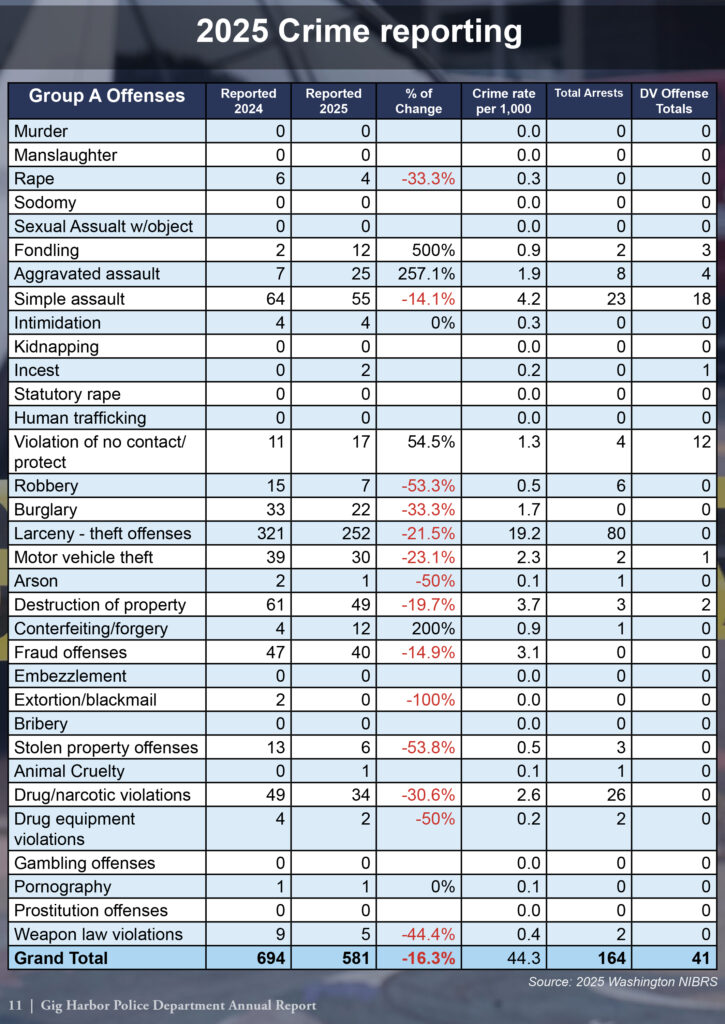
The Gig Harbor Police Department reported that the city crime rate decreased by a little more than 16% in 2025, though calls for service increased from 2024.
The decrease largely reflects a drop in property-related crimes like theft, as well as vandalism and drug offenses. Violent crime rates were mixed, with a sharp increase in fondling and aggravated assault. Violations of no-contact or protection orders also increased. Incidences of rape and simple assault decreased.
The department also conducted more traffic stops, due to its focus on traffic safety.
Mixed crime changes
Police Chief Tray Federici, Lt. Jarab Daniel and Lt. Weston King presented the department’s 2025 annual report during a Nov. 12 study session of the City Council.
A slide from the Gig Harbor Police Department annual report.
In an email to Gig Harbor Now after the meeting, Federici cautioned against drawing conclusions based on the sometimes small sample sizes involved in a small city.
“When we review crime statistics, it’s important to consider that some offense categories involve relatively small numbers of reported incidents. Even a modest increase can result in a significant percentage change,” he said. “While overall reported crime has decreased, individual offense categories can fluctuate from year to year.”
Retail theft
Federici, Daniel and council members honed in on a decrease in retail theft during the meeting.
Daniel said the department works with stores that are “proactive in engaging with us” to combat theft.
“We’ve had very successful retail theft emphases, and we are working with [the stores] continually. And the word is getting out into the community that [we] will take you to jail,” Daniel said. “You will be held accountable for even the smallest theft, and that’s the word we want to get out.”
Federici added that not all stores are interested in prosecuting shoplifters. He said that at times, after his officers arrest a suspect and return stolen merchandise, store managers tell them: “We’re not pursuing this. Thank you for our stuff, but we are not pursuing this.”
Federici said some corporate executives don’t want to risk the liability that may come with accusing someone of a crime. They don’t want to find themselves “on the civil side of the lawsuit. They’d rather write off the item being taken.”
A slide from the Gig Harbor Police Department annual report.
Traffic stops
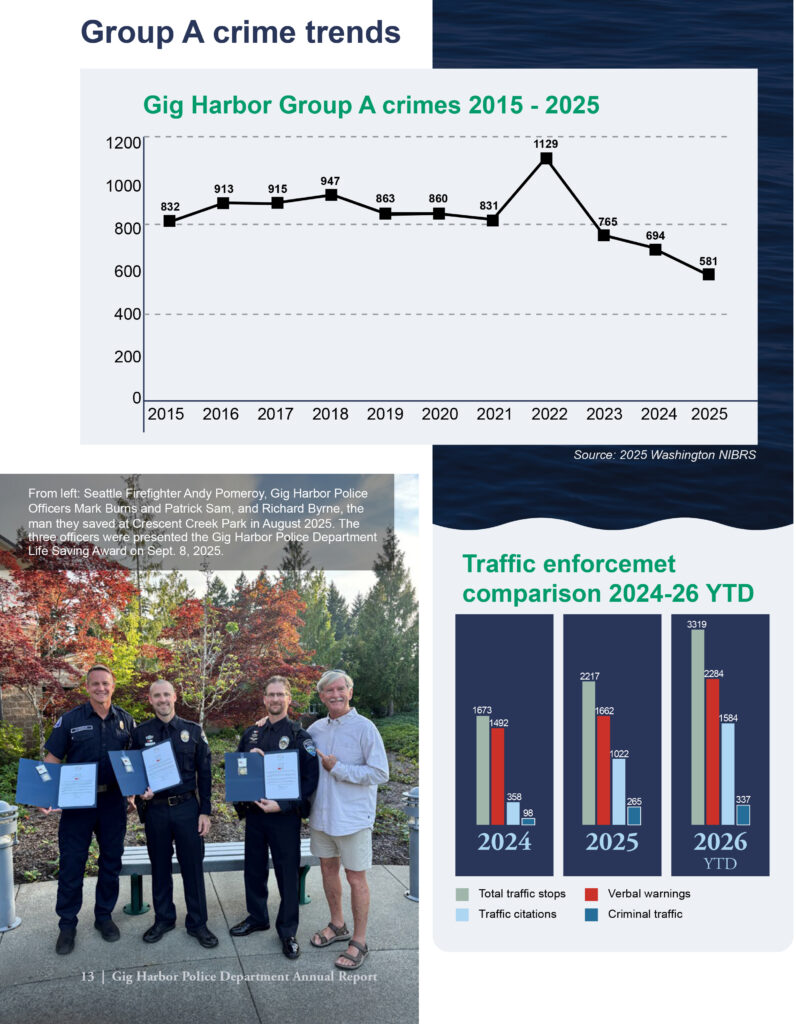
Federici said GHPD officers conducted a little more than 2,200 traffic stops in 2025, an increase of about 33% over 2024. Traffic collisions also slightly increased.
Federici said the department stepped up its focus on traffic safety in both 2025 and this year, when Gig Harbor officers have already conducted more than 3,300 traffic stops.
“We have outpaced 2025 significantly, and the year is not over yet,” he said. “We are taking traffic enforcement very seriously. This increase has been intentional. We’ve placed great emphasis on proactive traffic enforcement throughout the department, and we continue to balance our other public safety responsibilities.”
The department also secured $424,000 in grant money from the Washington State Criminal Justice Training Commission. The funds pay for a traffic officer’s salary and a vehicle.
A portion of the funding also goes toward a co-responder position, a trained mental health professional dispatched alongside emergency personnel like police. Co-responders respond to calls involving things like mental health crises or substance use incidents. The department will ask the city council to formally accept the money.
Federici said community members indicated that traffic enforcement remains “an area of continual concern,” even with the department’s uptick in traffic enforcement.
“We always lean towards education over enforcement,” Federici said. “We haven’t taken away discretion, and when education is appropriate, it’s appropriate. … But we have started leaning towards more of a formal enforcement model because the ultimate goal is to change driving behaviors. And if we start looking on the screen and we see drivers with continual warnings for similar infractions, they’re not getting the message.”