
Arts & Entertainment Community
Day Tripper | A visit to Ballard and Seattle’s mini-Panama Canal
More years ago than I care to remember, I created my first “bucket list.” Near the top was a trip through the Panama Canal (preferably on a luxury cruise ship.) I’ve accomplished many things on that list, and added more, but I’ve been forced to admit that visiting Panama and its canal is most likely not ever going to happen. I’ve come to the conclusion that I’m going to have to learn about canals and locks by visiting its mini-me, Ballard’s Hiram Chittenden Locks.

Arts & Entertainment Sponsor
Arts & Entertainment stories are made possible in part by the Gig Harbor Film Festival, a proud sponsor of Gig Harbor Now.
The Hiram M. Chittenden Locks in Seattle’s Ballard neighborhood.
The Ballard Locks carry more boat traffic — around 45,000 vessels a year — than any other locks in the U.S. Along with the nearby fish ladder and Carl S. English Jr. Botanical Garden, it attract more than one million visitors annually.
The construction of the locks changed the topography of Seattle and the surrounding area. They lowered the water levels of Lake Washington and Lake Union by nearly nine feet, leaving existing piers high and dry, creating miles of new waterfront and reversing the flow of rivers. The locks are on the National Registry of Historic Places and the American Society of Civil Engineers designated them a National Historic Civil Engineering Landmark.
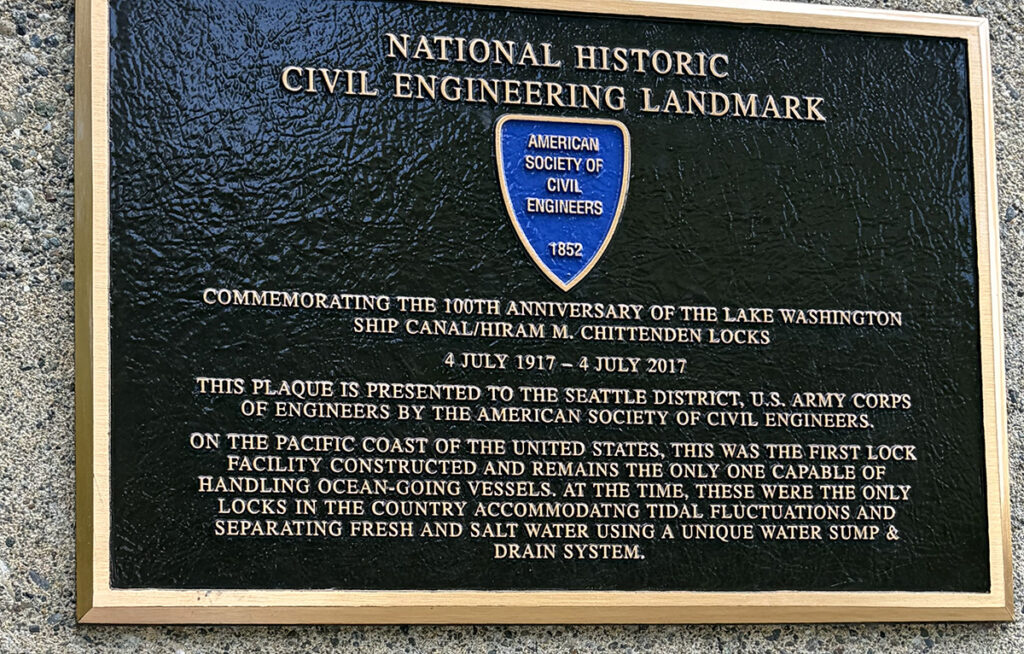
A plaque commemorates the engineering accomplishment of the Ballard Locks. Photo by Mary Williams
Panama-light
The Ballard facility and its big brother in Panama bear a number of similarities. The U.S. Army Corps of Engineers built both. The Panama Canal was completed in 1914, and our locks in 1917. At the time, both were major engineering feats.
The Panama Canal is, of course, much larger: An 8-to-10-hour transit that follows a precise five-step sequence. It connects the Atlantic (actually the Caribbean Sea) and Pacific oceans across the Isthmus of Panama. Panama owns and administers the canal, which is 40 miles long from shoreline to shoreline.
Our locks take only a few minutes to traverse, unless you experience maritime rush-hour traffic. The Ballard locks allow boats to pass between the Puget Sound’s saltwater and the freshwater of Lake Union and Lake Washington, acting as a water elevator.
A four-step process using gravity, valves and sealed concrete chambers raises and lowers boats. Two chambers accommodate different sizes of marine traffic: the 825-foot-long large lock handles large commercial vessels, tugs, and smaller boats when a lot of them are waiting for passage.
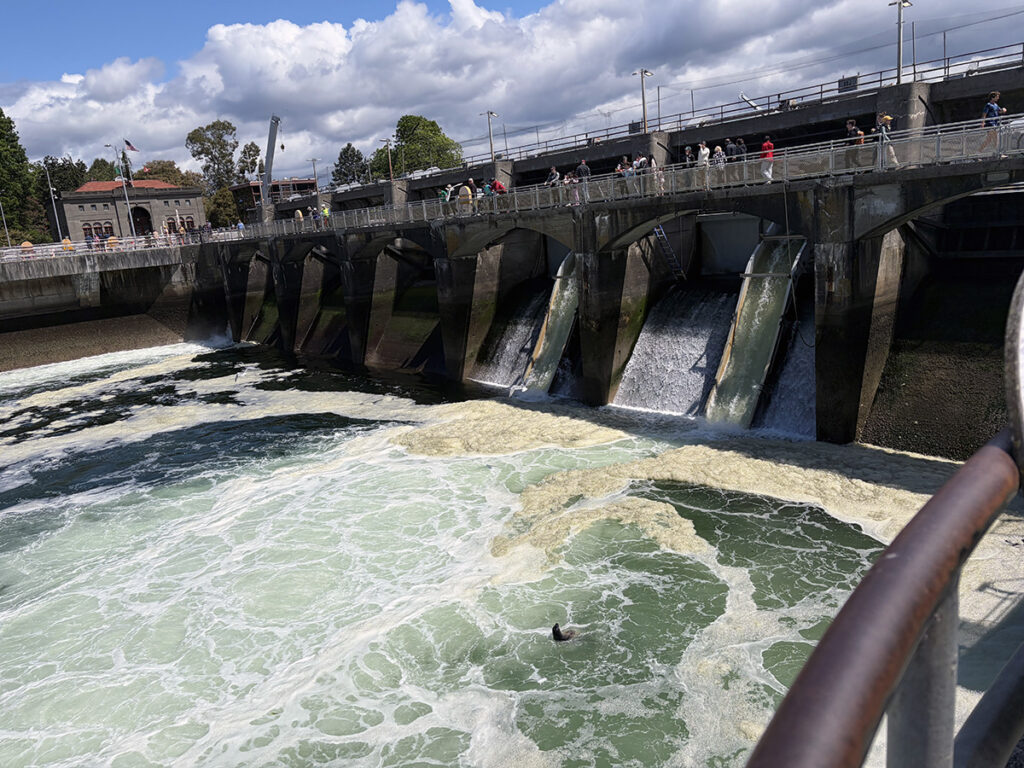
The large locks in Ballard. Photo by Mary Williams
Recreational craft primarily use the 150-foot small lock. The water walls of this chamber gently move up and down with the boats, making it easier for boaters to manage their lines.
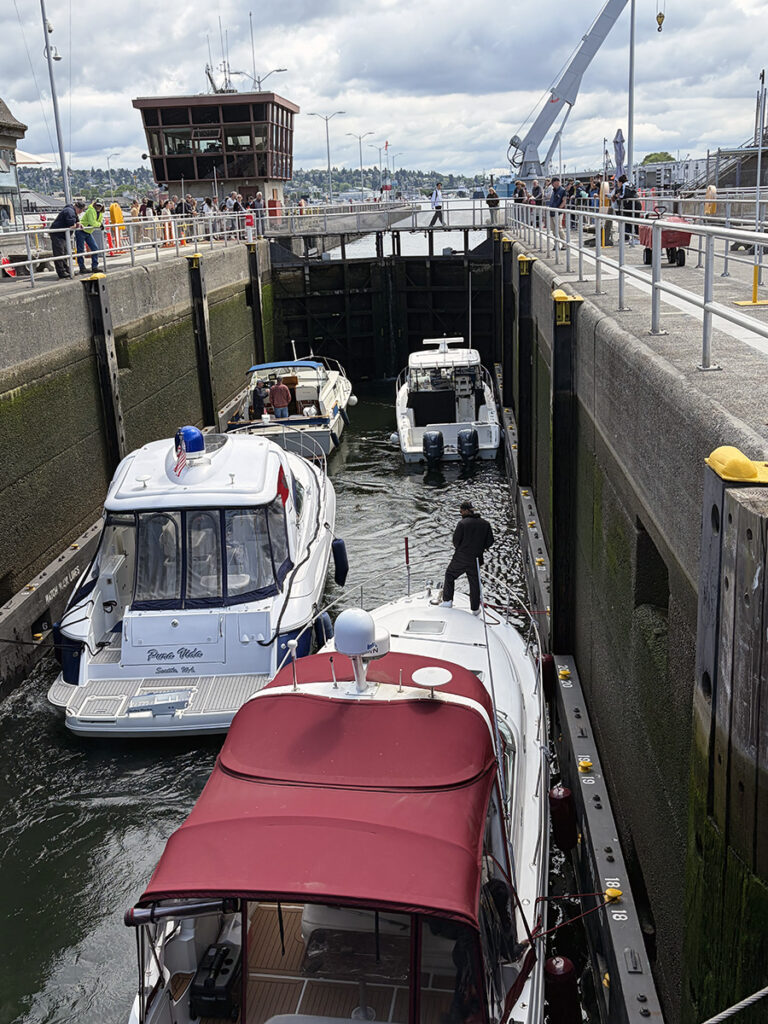
Smaller recreational boats crowd the small locks. Photo by Mary Williams
Fish ladder
Besides serving as an elevator, the locks perform two other important functions. They act as a saltwater barrier, physically preventing the heavier saltwater from mixing with the freshwater lakes, thus protecting the ecosystem. And a specialized 21-step fish ladder is built right into the locks.
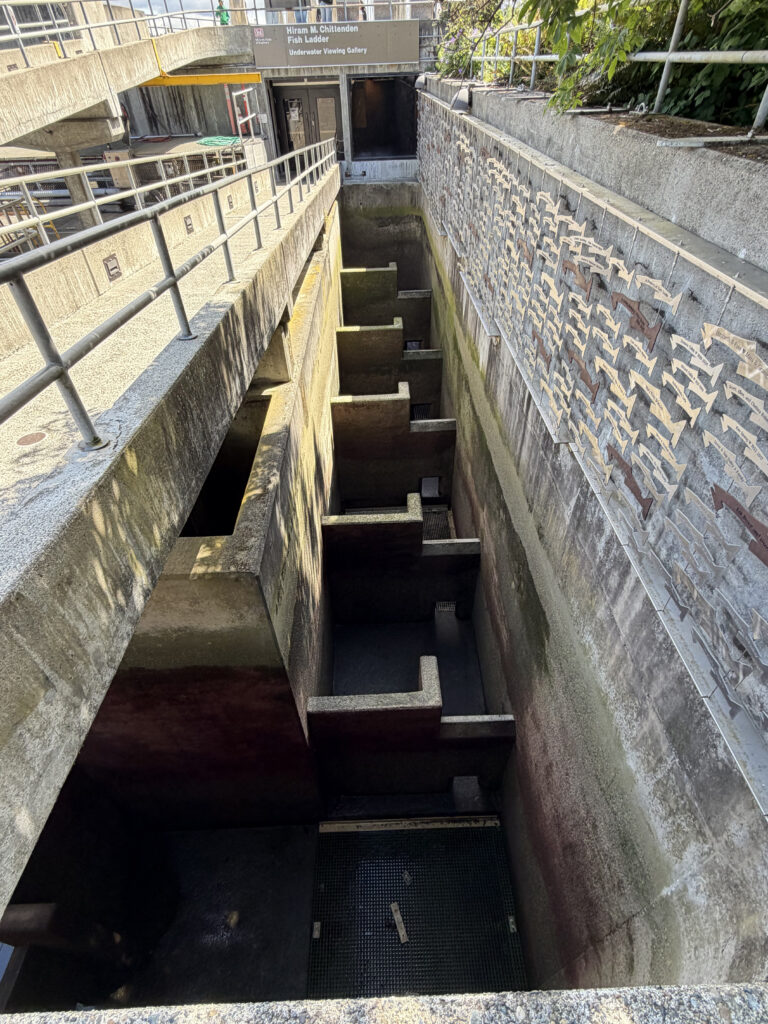
The fish ladder allows salmon to reach their upstream spawning grounds. Photo by Mary Williams
The fish ladder hadn’t been on my radar screen, but since I was there anyway, I decided to visit. It provides safe passage for salmon en route to their spawning grounds upstream.
The next couple of months, from June through September, are the best time to view the salmon swimming upstream, so it would be a great time to plan a day trip of your own.
Touch-screen displays highlight the different salmon species. You’re most apt to spot and identify sockeye salmon in late July and August and chinook and coho salmon in early fall. I guess I’m going to have to take the younger granddaughters and go back. I was disappointed to learn on the day I was there that the fish ladder was closed for cleaning.
Botanical Garden
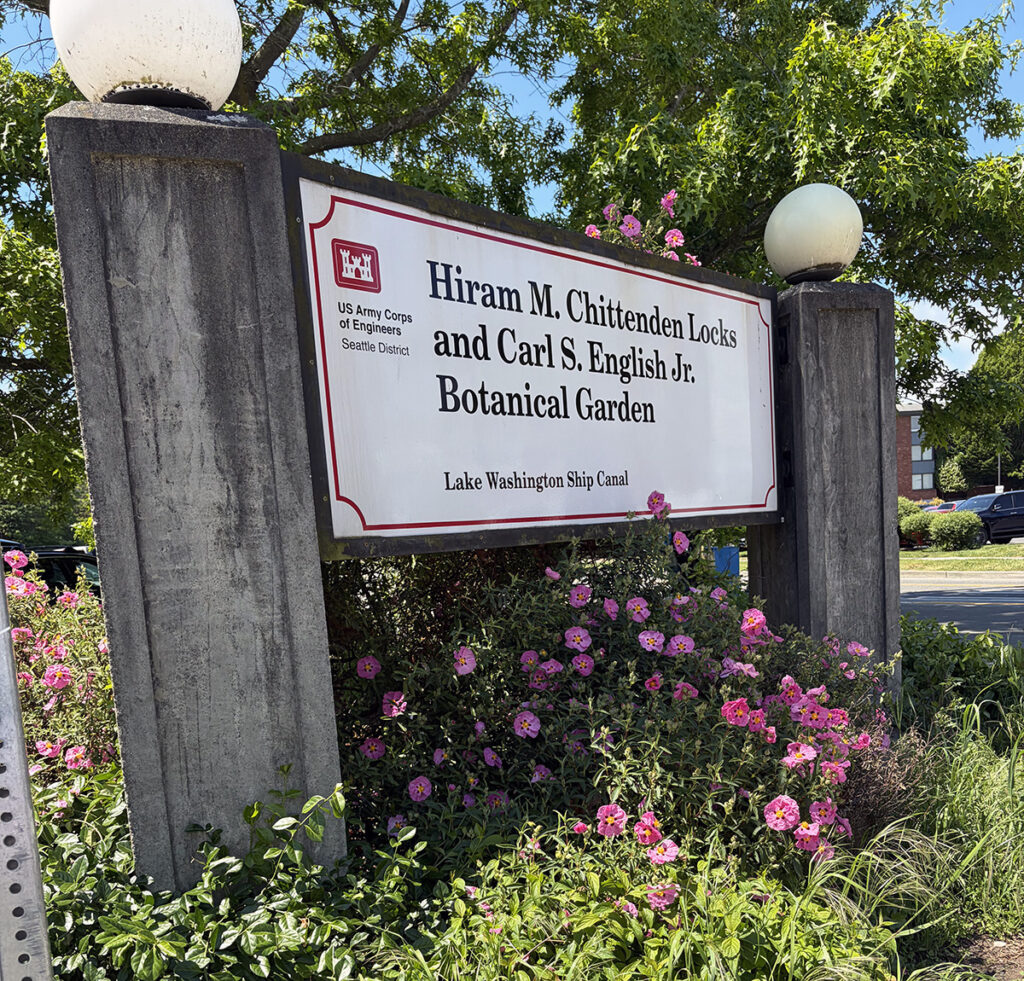
The path from the parking lot to the locks passes through the Carl S. English Jr Botanical Garden. The garden got its start in 1931 when the Corps hired English to tend the grounds, which were little more than an unused construction staging area. His vision and experience as a horticulturist and botanist transformed the garden.
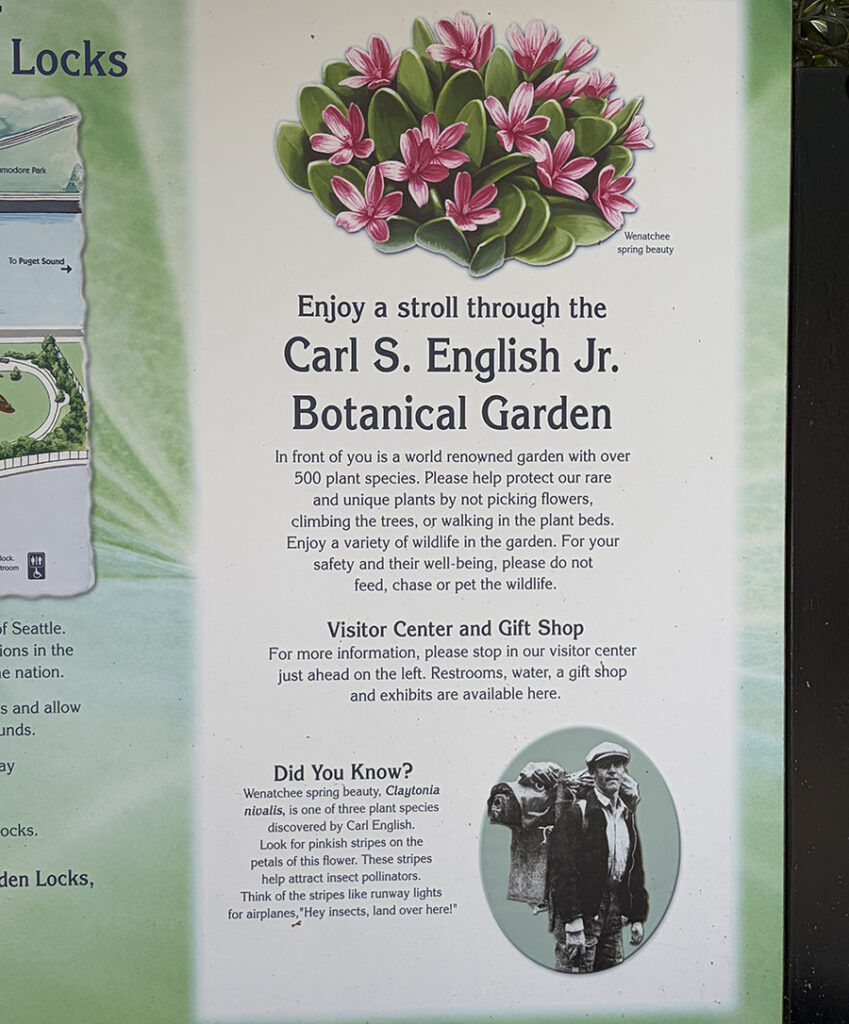
A welcome sign for the Carl S. English Jr. Botanical Garden. Photo by Mary Williams
Working with ships captains and through his own travels, English collected specimens of trees and flowers from around the world. One story found in literature about the gardens explains how he discovered a dawn redwood, previously assumed to be extinct, growing in China. He obtained seeds and propagated them, and eight of the trees now grow in his garden. A tree map provides the locations, names, and a wee bit of information about each of 39 major trees planted throughout the garden.
Today the garden is home to a nursery where new species of plants and trees are propagated.
After English retired, horticulturist Michael E. Fleming took on responsibility for the garden. He managed it from 1974 to 2004, developing and adding many of the beautiful flowers and trees we see today.
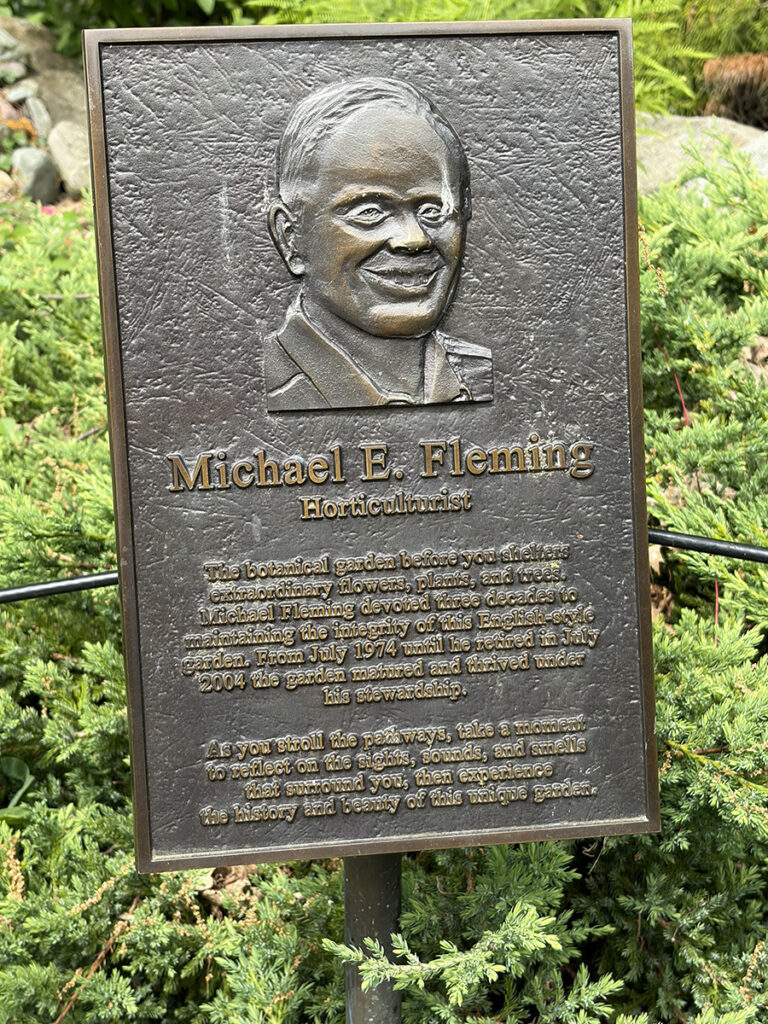
Michael E. Fleming managed the garden for 30 years. Photo by Mary Williams
Tree-lightful
A copy of the tree map is posted in front of the Visitor Center. It is handy if you happen to be there when they are closed. If the center is open, you can pick up a copy you can use while you explore the Botanical Gardens and then take home. A numbered tag identifies each tree on the map.
I love chestnut trees and the map shows that three of them grow in this garden. A scarlet horse chestnut, tree number 39, is directly across the path in front of the Visitor Center.
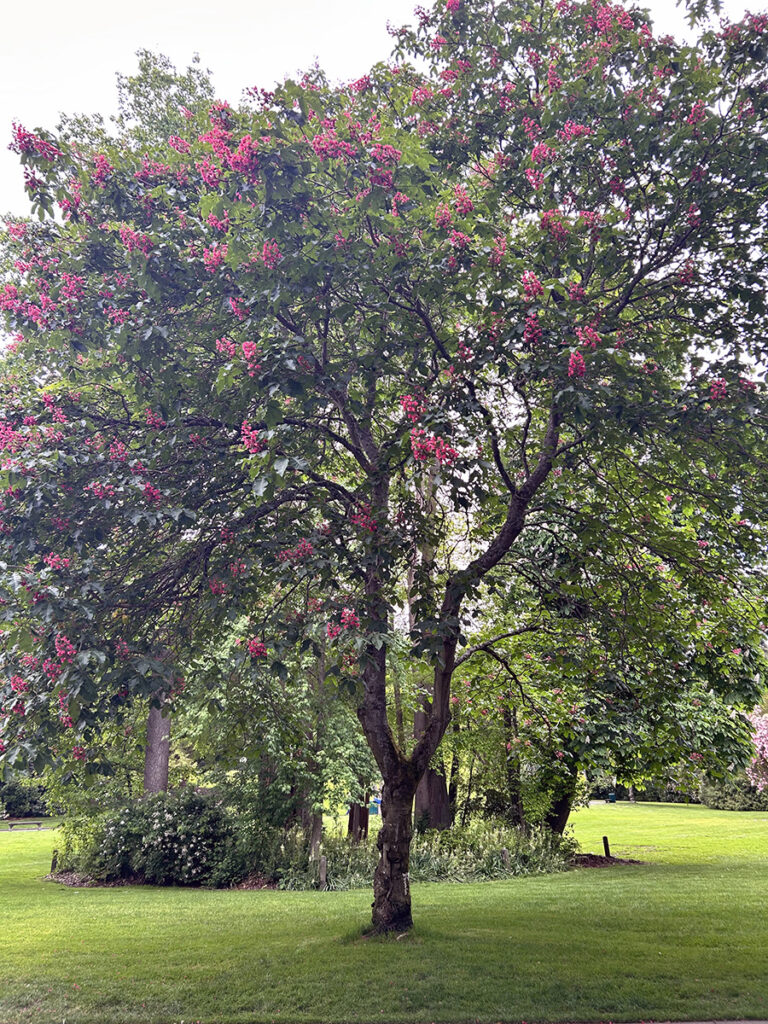
A scarlett horse chestnut tree at the botanical garden. Photo by Mary Williams
I love a good visitors center. While small, the one at the locks provides an interesting mix of historical pictures, reference guides and souvenirs. A variety of books, clothing, toys, and reference materials are also available to buy.
The locks are located in the Ballard neighborhood of Seattle at 3015 NW 54th St. Gates are open from 7 a.m. to 9 p.m. daily. The Visitor Center is open from 10 a.m. to 6 p.m. Wednesday through Sunday. A free walking tour of the grounds and locks leaves at 2 p.m. from the center on days it is open. There is no charge for admission.
If you’d like to learn more about the locks and how they work, there’s a great deal of information on the Army Corps of Engineers’ website.
Hi, Frankie
With the fish ladder closed, I found myself with a little bit of extra time, so I decided to take a walk down Market Street. Since I happened to be day tripping on a Sunday, I decided to check out the renowned Sunday Ballard Farmer’s Market just a few blocks away.
A couple of blocks further down Market is the National Nordic Museum. I would like to investigate it further, but this was not the day. There was a special event going on, and there were a lot of people there, many of them in native dress.
Since I was not appropriately garbed, I stopped to say “Hello” to Frankie Feetsplinter and moved on. We first visited Frankie in autumn 2023, when our six Pacific Northwest trolls were constructed. Originally designed to portray an angry teen, he still doesn’t seem very happy. Perhaps it’s because he’s stuck in something of a concrete jungle while most of his siblings reside on beautiful beaches or in plush green forests.
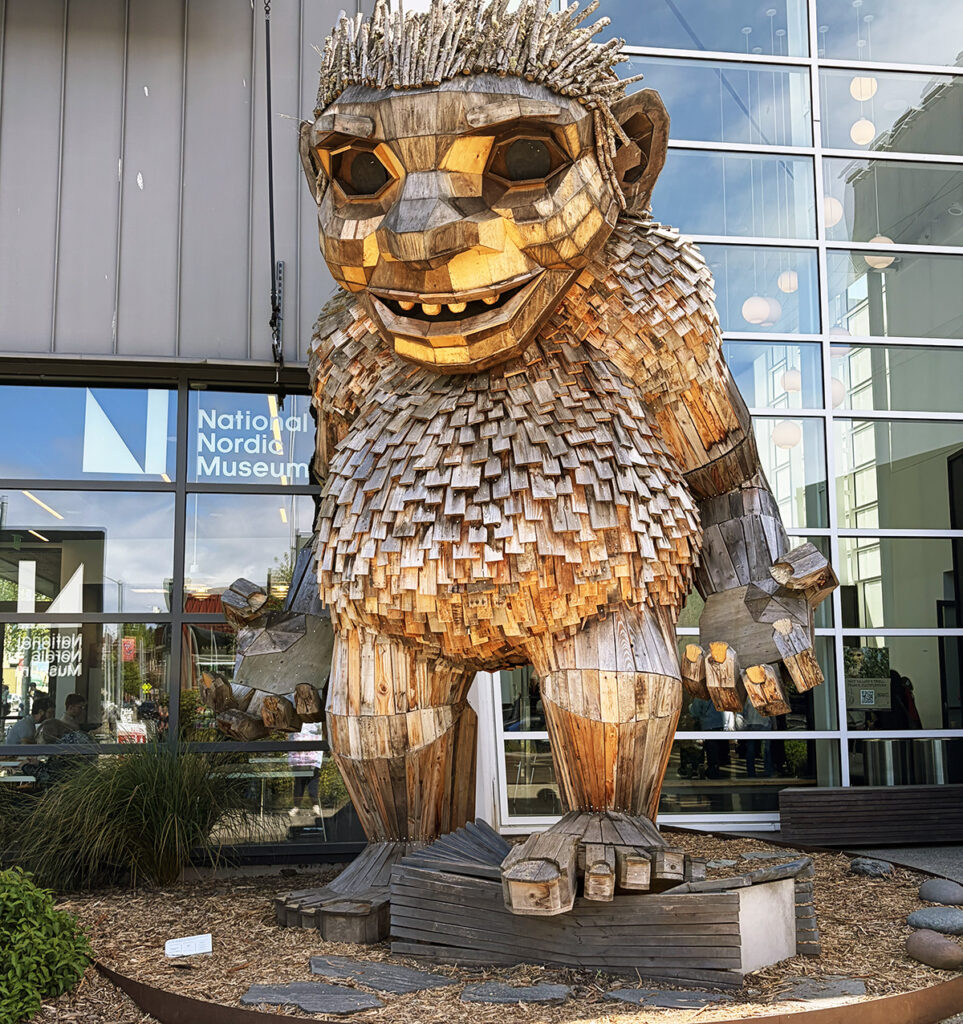
Maybe city life just doesn’t suit Frankie. Photo by Mary Williams
A couple blocks further, at the corner of 22nd Avenue and Market Street, is the entrance to the Ballard Farmers Market. Open since 2000, the Ballard Farmers Market is Seattle’s first year-round neighborhood farmers market. Hours are 9 a.m. to 2 p.m. every Sunday year-round, no matter the weather.
Remarkable market
The great thing about farmers markets is that they are all different based on the local farms, the ethnicity of the foods and restaurants in the community, and the nearby vendors who hope to sell their crafts. I had to remember that I was there to gather information, not more possessions, and forced myself not to linger at the impressive booths and tables. I did purchase a pastry to munch on while I checked out Bergen Square at the intersection of 20th Avenue and Market Street.
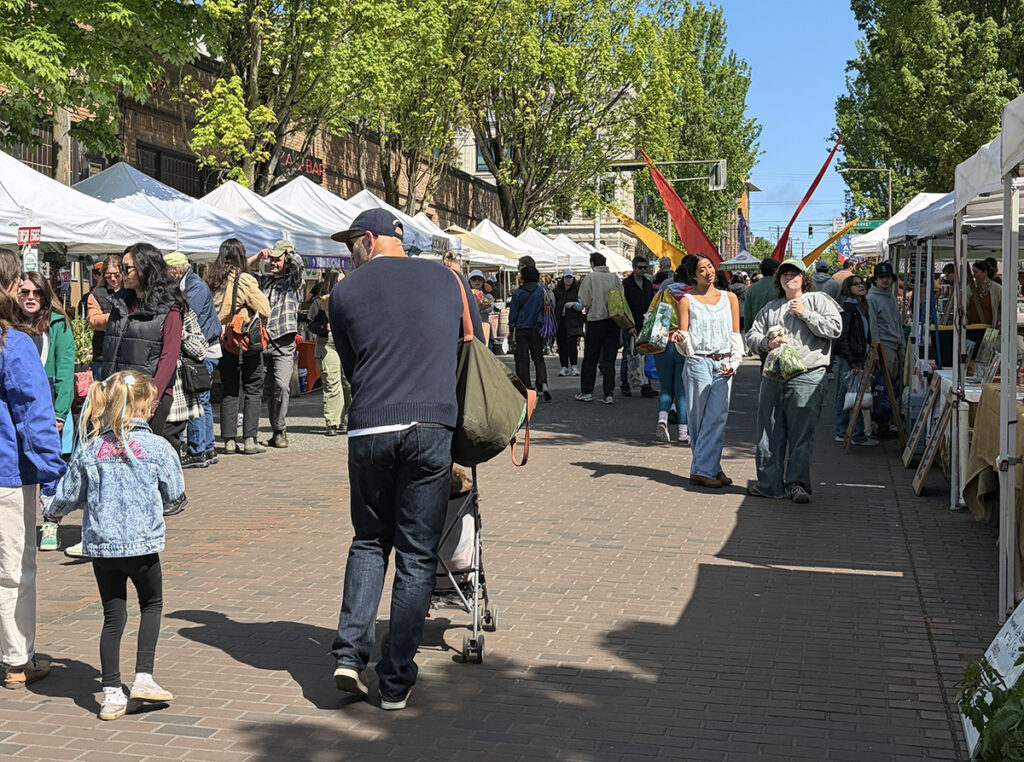
Ballard hosts Seattle’s only year-round farmers market. Photo by Mary Williams
Bergen Square hadn’t even been on my radar screen, but it turned out to be one of the more interesting aspects of my day. Standing at the corner of Market Street, 22nd Avenue and Leary Avenue, I realized I knew very little about this area. With several streets radiating from what appeared to be a central hub, it looked like I was in the heart of the city. At least I had assumed Ballard was a small city. I was wrong.
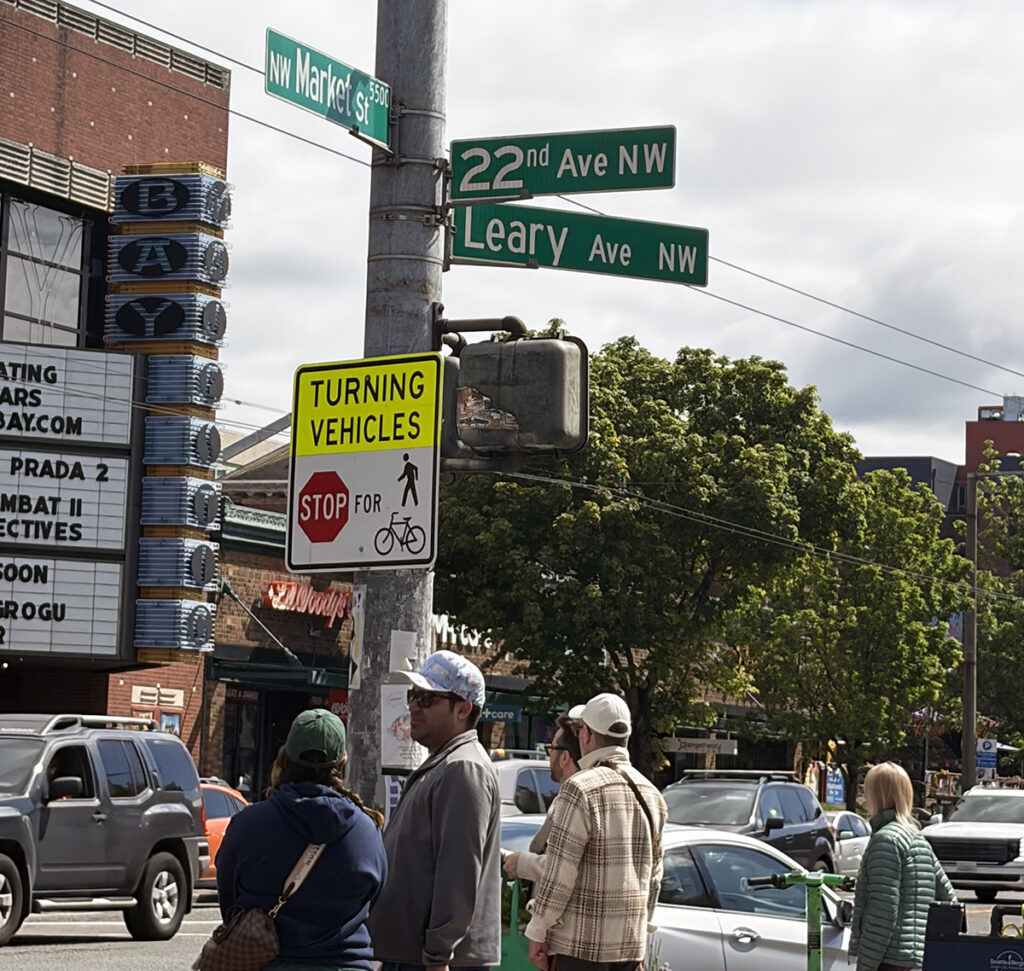
One of Ballard’s busiest intersections. Photo by Mary Williams
Ballard used to be a city, but it isn’t anymore. It’s now a neighborhood of Seattle. As the story goes, Ballard was known as Shingletown in the late 1800s. Scandinavians seeking work flocked to the area to find jobs turning the wood that came into the nearby port into shingles. Ballard incorporated in 1890 and by 1900, it was the seventh-largest city in Washington.
With this growth came increased needs. As demand for fresh water for its residential community expanded, Ballard was forced to annex into the city of Seattle in 1907.
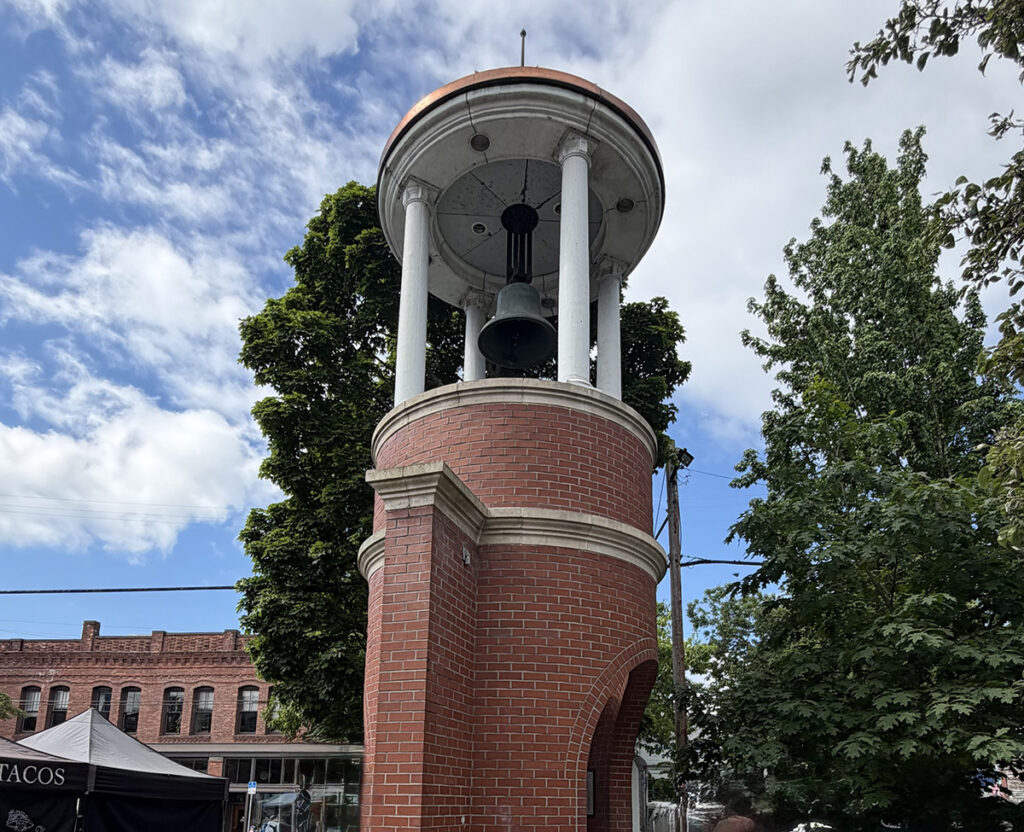
This bell was part of Ballard’s original city hall. Photo by Mary Williams
Royal visits
In 1975, Olaf V, King of Norway, and his wife, Queen Sonja, visited the area and dedicated Bergen Place to commemorate the sister city status of Seattle and Bergen, Norway.
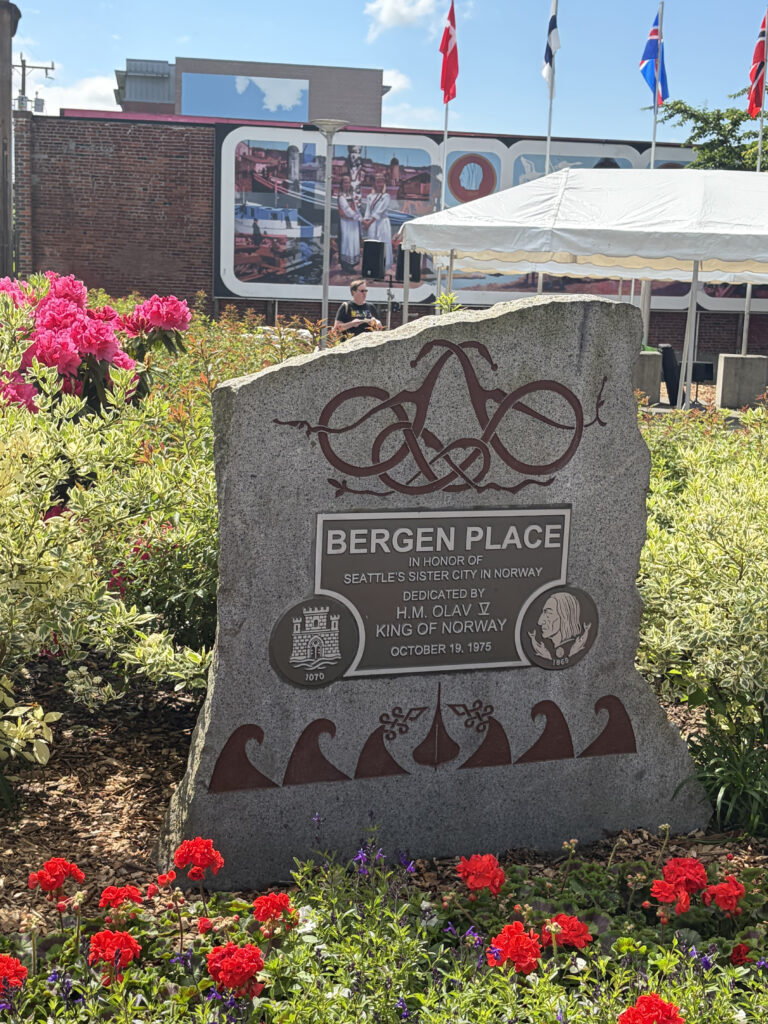
The king of Norway visited Ballard, a neighborhood with deep Scandanavian roots, in 1975. Photo by Mary Williams
A group of artists created the Mural at Bergen Place, which tells the story in drawings of the development of the Nordic influence and the ongoing relationship between the five Scandinavian countries (Norway, Sweden, Denmark, Finland and Iceland) and the greater Seattle area.
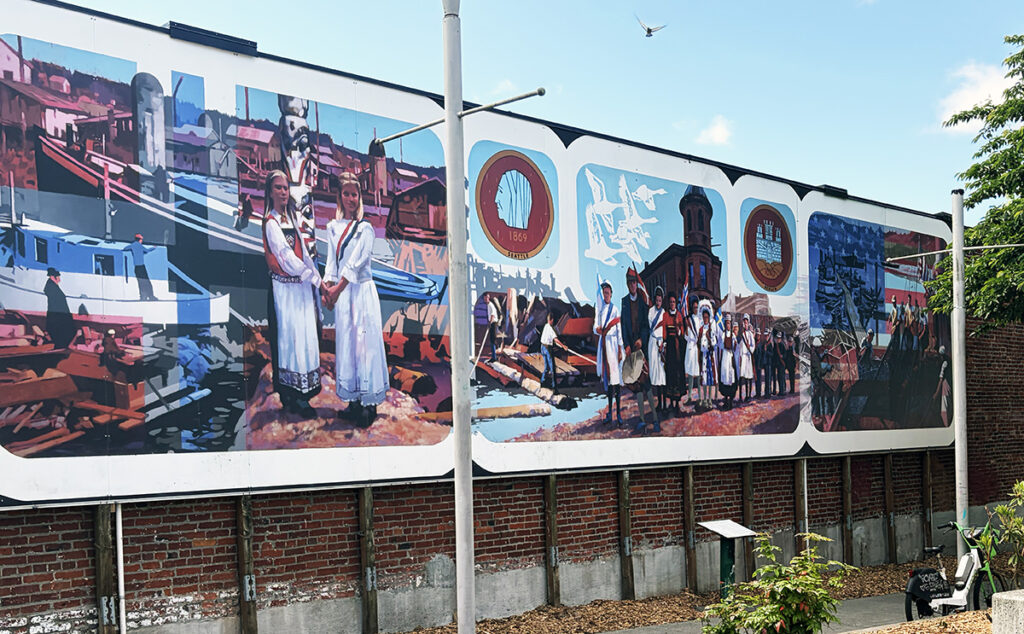
Mural at Bergen Place. Photo by Mary Williams
Signage beneath the mural relates the meaning of each panel in the mural.
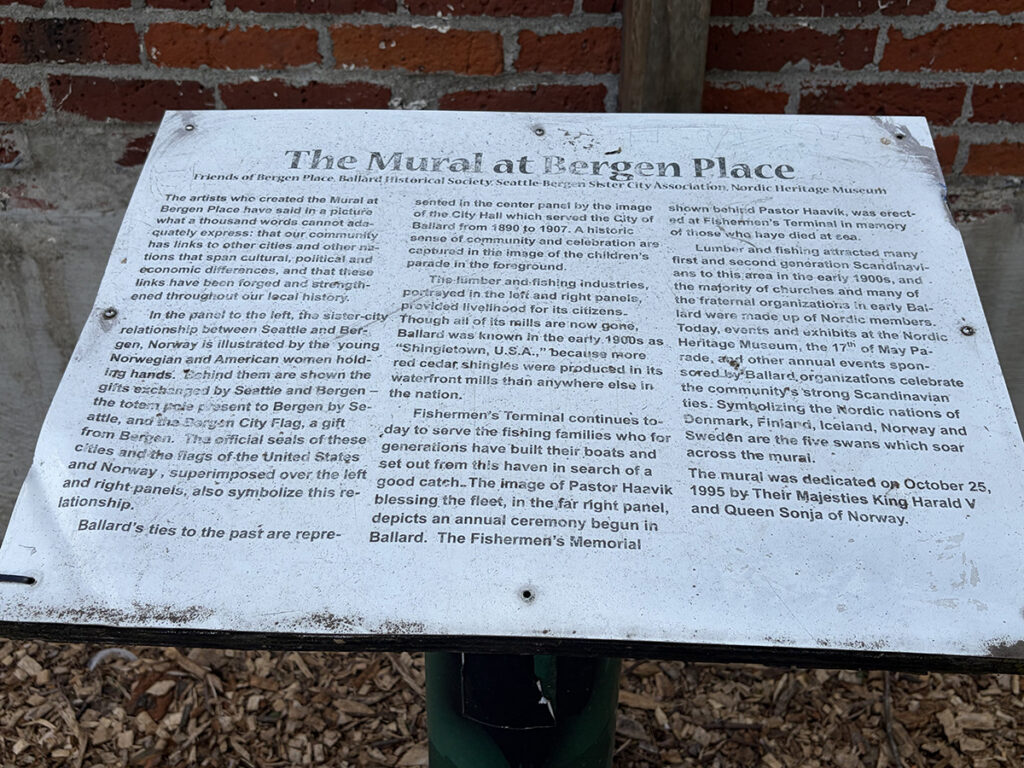
The story of the Mural at Bergen Place. Photo by Mary Williams
A couple of highly recommended parks are only a short drive away. I had been planning to visit both Golden Gardens Park, with its sandy beach and panoramic views of the Olympic Mountains; and Discovery Park, which is home to the West Point Lighthouse and Porcelain Gardens. It didn’t take much brain power to realize that trying to see them in an hour or two would be a disservice to both parks. They deserve a day trip of their own. That will be happening in the not-too-distant future, perhaps when I make a second attempt at visiting the fish ladder.
About the Day Tripper column
Gas prices are sky high, and a night in a hotel is approaching astronomically expensive. So, for the foreseeable future, I imagine many of you are going to find yourselves taking day trips rather than the road trip vacations we’ve grown to love.
This beautiful region in which we live is ripe with opportunities to explore new places, see new things, and learn a little something at the same time. I promise to keep the longest journeys to a one-way distance of under 200 miles. Whether you want to make it an overnight trip, a weekend, or just a very long day trip, we should be able to pull it off.
I hope you’ll grant me the honor of your virtual company as we travel these roads together. Happy trails!