
Arts & Entertainment
Day Tripper | MOHAI hosted historic documents for America’s 250th
I didn’t expect to be back at Seattle’s Museum of History and Industry at the south end of Lake Union quite so soon. We were just there in December. I concluded that story by guaranteeing I’d be back, but I hadn’t expected it to be this summer.

Arts & Entertainment Sponsor
Arts & Entertainment stories are made possible in part by the Gig Harbor Film Festival, a proud sponsor of Gig Harbor Now.
I recently realized that I should have set up a separate e-mail account just for Day Tripper-related correspondence. Nearly every place I go and every website I visit requires that I register in some way that provides them with marketing information. And, based on my inbox, most of them sell it. Rarely does a day go by that there aren’t several e-mails advising me of a destination I’m missing or someplace I absolutely must visit.
One way or another, I ended up on MOHAI’s radar. I’m not sorry. It was in one of their updates that I first learned that the Freedom Plane exhibit was coming to Seattle.
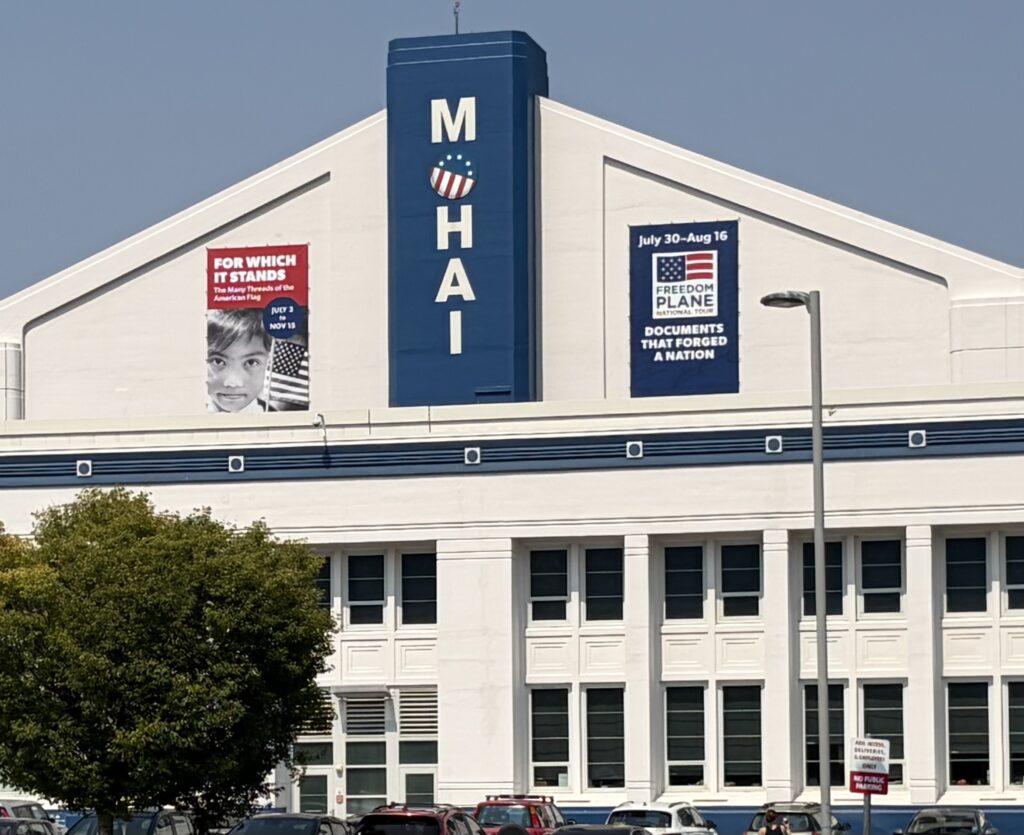
The Museum of History and Industry in Seattle. Photo by Mary Williams
As we discussed in December, MOHAI is a mixed bag of exhibits. A dozen or so are listed as permanent, but there’s a lot more to that story than meets the eye. The museum inventory has over a million cataloged items, with the vast majority in storage or virtual. Just because an exhibit is in the museum right now, doesn’t guarantee it will there next month or a year from now.
At any given time, MOHAI also has a few temporary exhibits that can stay for a few weeks or a couple of months. Many of these are traveling exhibits. That was the case with the Freedom Plane.
Freedom Plane National Tour: Documents That Forged a Nation
I may have mentioned that I suffer from FOMO — the fear of missing out. So when I learned that Seattle was one of only eight cities that would host the Freedom Plane (the others were Kansas City, Atlanta, Los Angeles, Houston, Denver, Miami, and Dearborn), and that the exhibit would only be here for 18 days, I had to get a ticket.
As the final stop on a national tour in honor of the nation’s 250th birthday, MOHAI hosted the Freedom Plane National Tour from July 30 through Aug. 16. Admission to the Freedom Plane exhibit, and the entire museum, was free thanks to a grant from Amazon. I like free!
That gave me an opportunity to check out the other special exhibits on display at the moment and to see what changes have been made to the rotation of permanent exhibits since December without impacting my bank balance.
Ordinarily, I wouldn’t tell you about an attraction that you can’t visit yourself. In this case, I decided to make an exception. In the first place, I consider myself fortunate to have been able to experience something so few could. A great deal of time, work and money went into developing this opportunity in honor of the nation’s 250th anniversary. If you couldn’t see it for yourself, I feel obligated to remind you of everything that went into creating a foundation for this country of ours.
And I want to tell you about the other temporary exhibits that are there now and that you can still visit if you hurry.
Heavy security
The website where I first learned about the Freedom Plane promised that I would get to see an early engraving of the Declaration of Independence (1823), the Secret Printing of the Constitution in Draft Form (1787), the Treaty of Paris, and the Bill of Rights.
The National Archives loaned these documents, central to the founding of the United States, to the Freedom Plane project. It was the first time they had ever traveled together. Because they are so rare, security was very high.
Large glass cases enclosed all of them. That kept them safe but made them hard to see. Leaning against the cases to try to get a better look or even touching one to steady yourself earned you a stern admonishment from a guard.
The museum issued me and other visitors time-specific tickets. But by mid-morning, the line to get into the exhibit was running 20-25 minutes behind.
By the time I got into the actual room with the documents, I was already tired and grumpy, so I wasn’t too happy to find yet another line creeping past glass cases at something just a bit quicker than a lethargic snail’s pace.
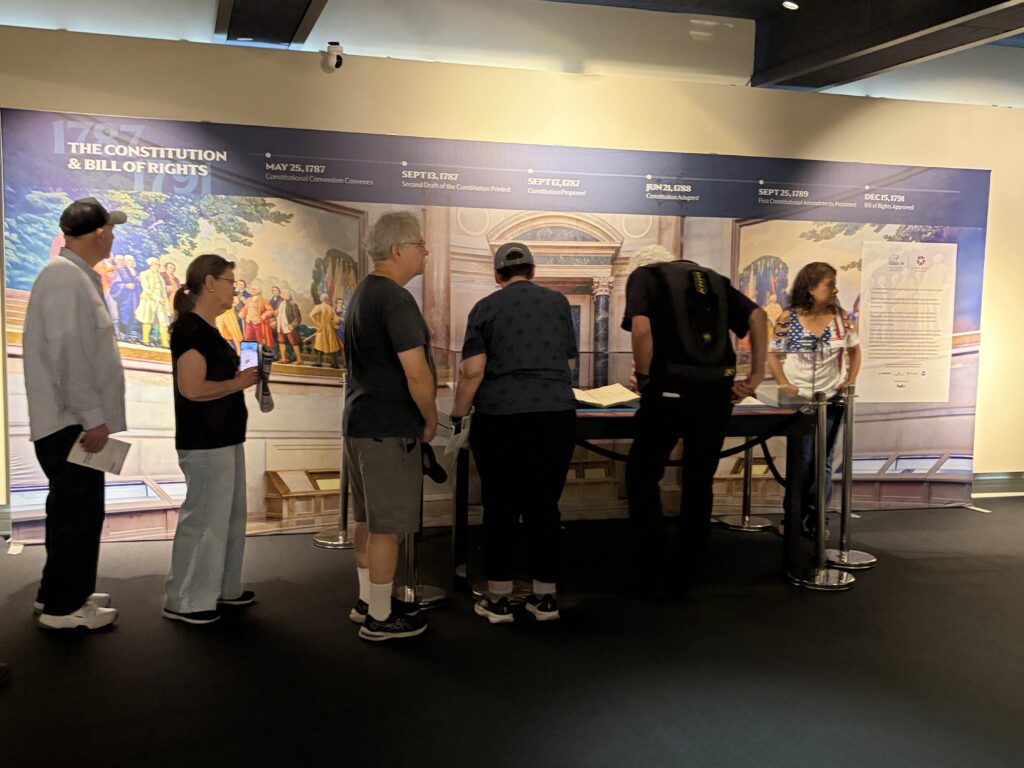
Waiting in line to see the historic documents. Photo by Mary Williams
Walking through history
In addition to discussing the documents, a very brief review of seventh grade American history is probably in order.
The First Continental Congress met to coordinate colonial opposition to British rule in the fall of 1774. The group developed and signed the Articles of Association, which urged colonists to boycott British goods. All 53 delegates signed this first major unified act of resistance.
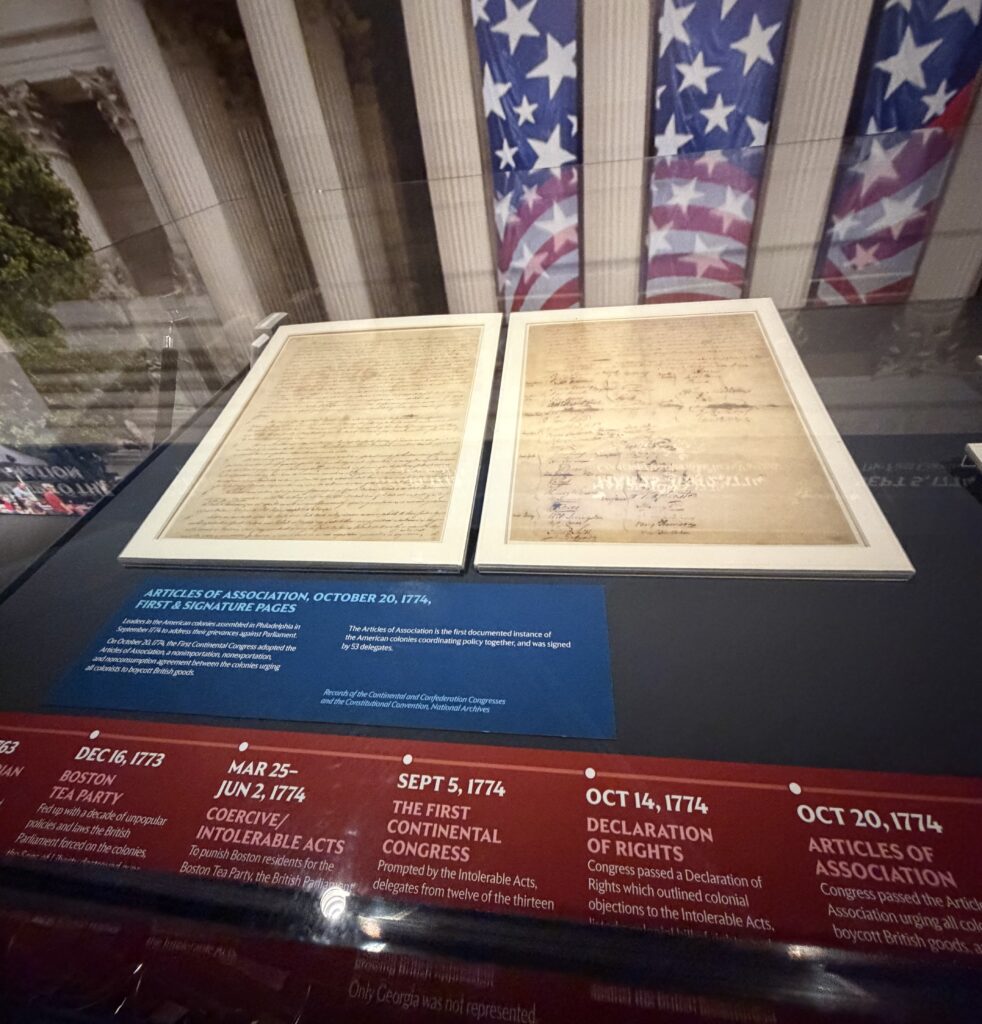
The Articles of Association as approved by the first Continental Congress.
The battles of Lexington and Concord started the armed conflict with the “shot heard ’round the world” in April 1775.
The Second Continental Congress adopted the Declaration of Independence on July 4, 1776. Happy Birthday, USA!
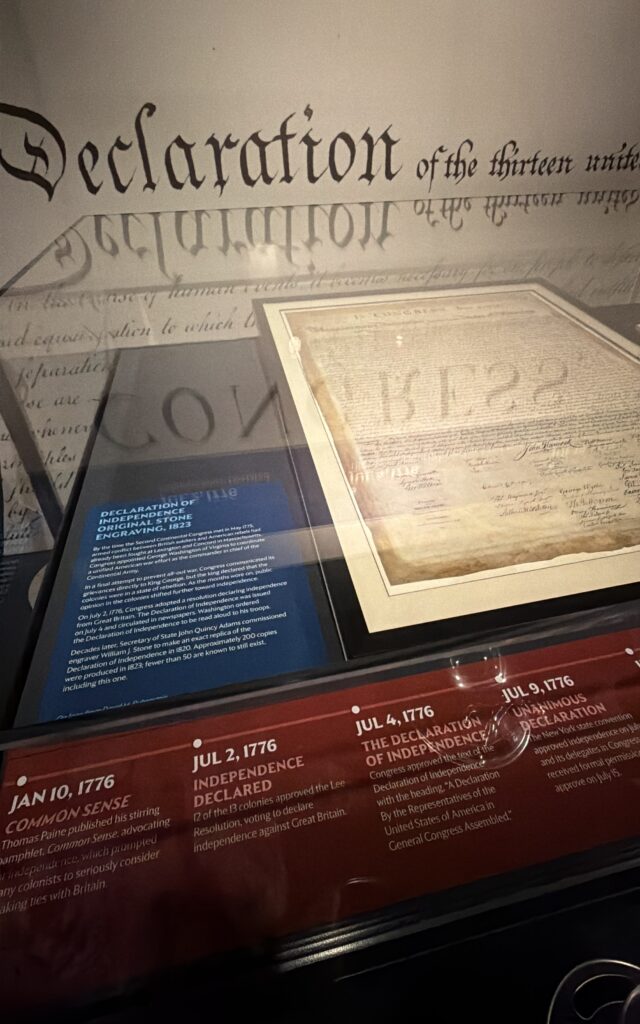
The Declaration of Independence.
The birth of the nation was official, but the work was not done. Diplomacy and the work of the Continental Congress continued.
France signed a treaty of alliance with the United States, turning the conflict into a global war in fall 1777. The treaty formally recognized the United States as an independent nation. Among the representatives who signed it on behalf of the U.S. were John Adams, Ben Franklin and John Jay.
All officers of the Continental Army during the revolutionary war were required to sign an oath of allegiance. The oaths signed by George Washington, Alexander Hamilton and Aaron Burr in 1778 were part of the exhibit.
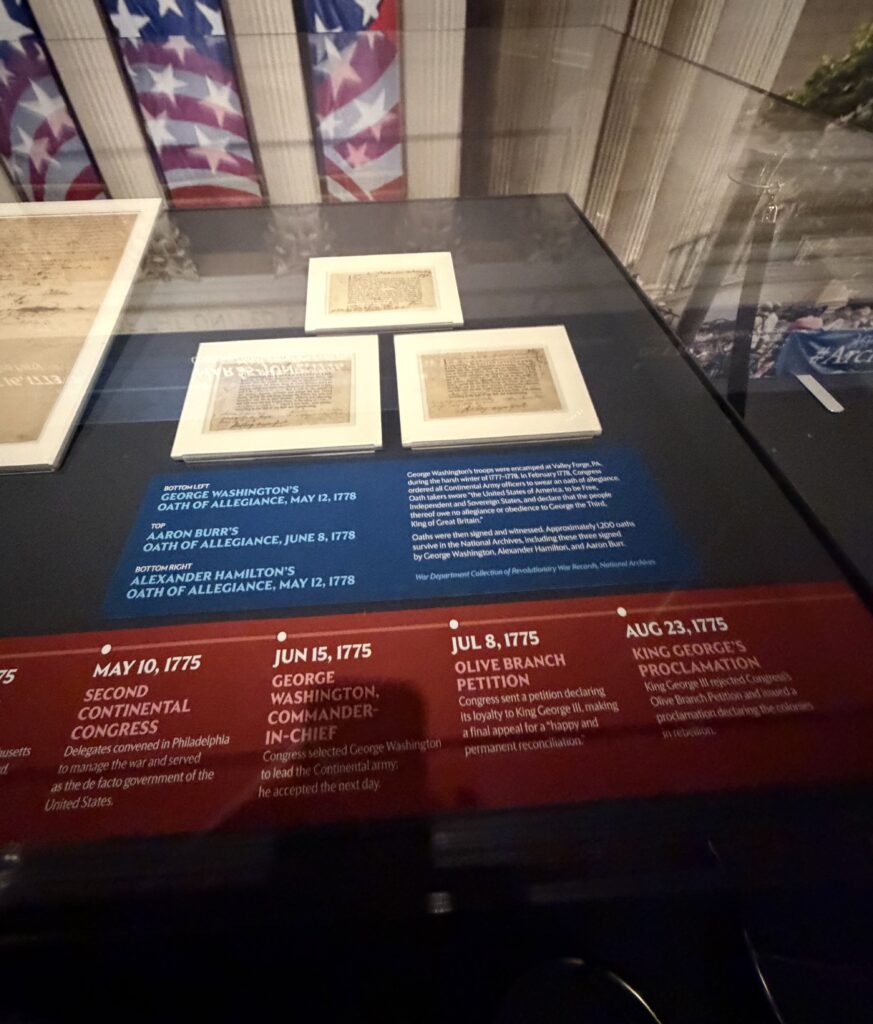
All officers, including George Washington, swore an oath of allegiance.
The war ended with the Treaty of Paris in September 1783.
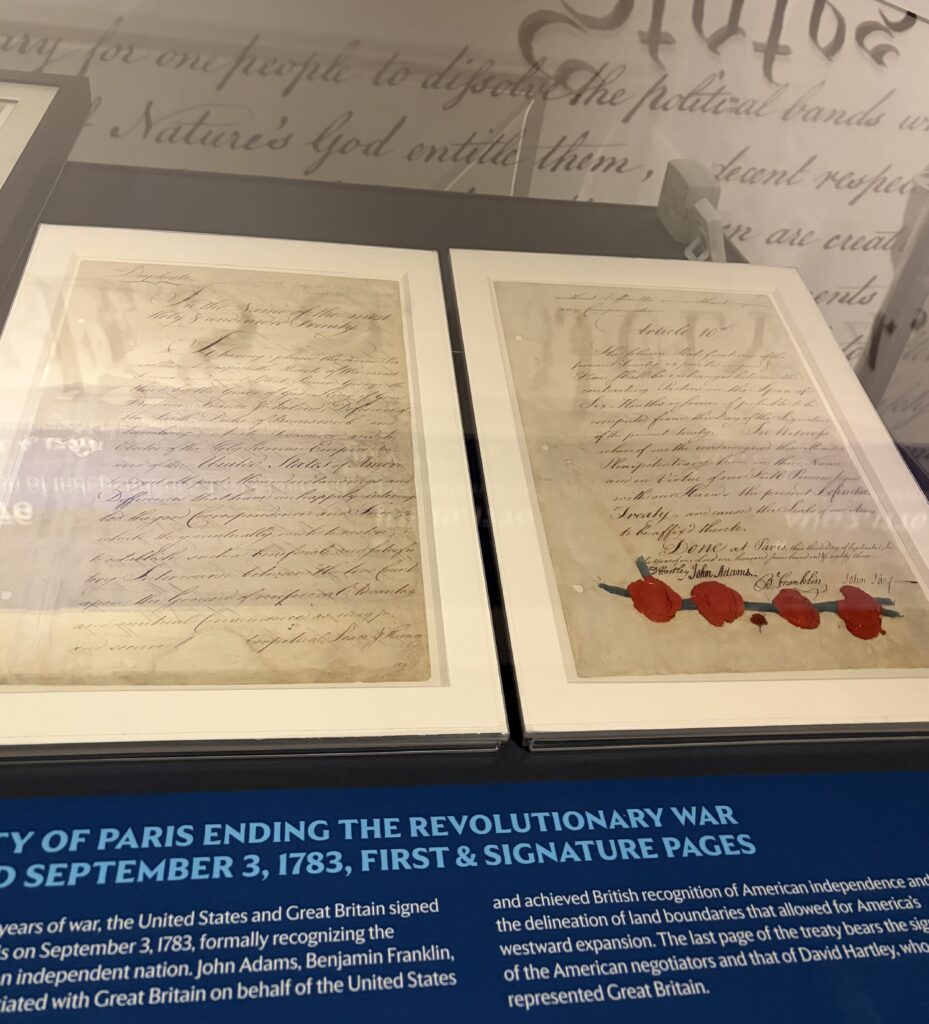
The Treaty of Paris.
Constitution
The Articles of Confederation, ratified in 1781, served as our first constitution. It created a very weak central government that had no taxing authority, no power to regulate trade and no way to enforce its own laws.
With the new government pretty much in crisis, delegates from 12 of the 13 states gathered in Philadelphia in the summer of 1787 to fix the Articles. Instead, they scrapped them entirely and wrote a new Constitution from scratch. It has been amended 27 times since its ratification.
Obviously, a document of such importance required much review and revision before the final document was adopted. A 1787 draft complete with handwritten notes by the delegates was part of the exhibit.
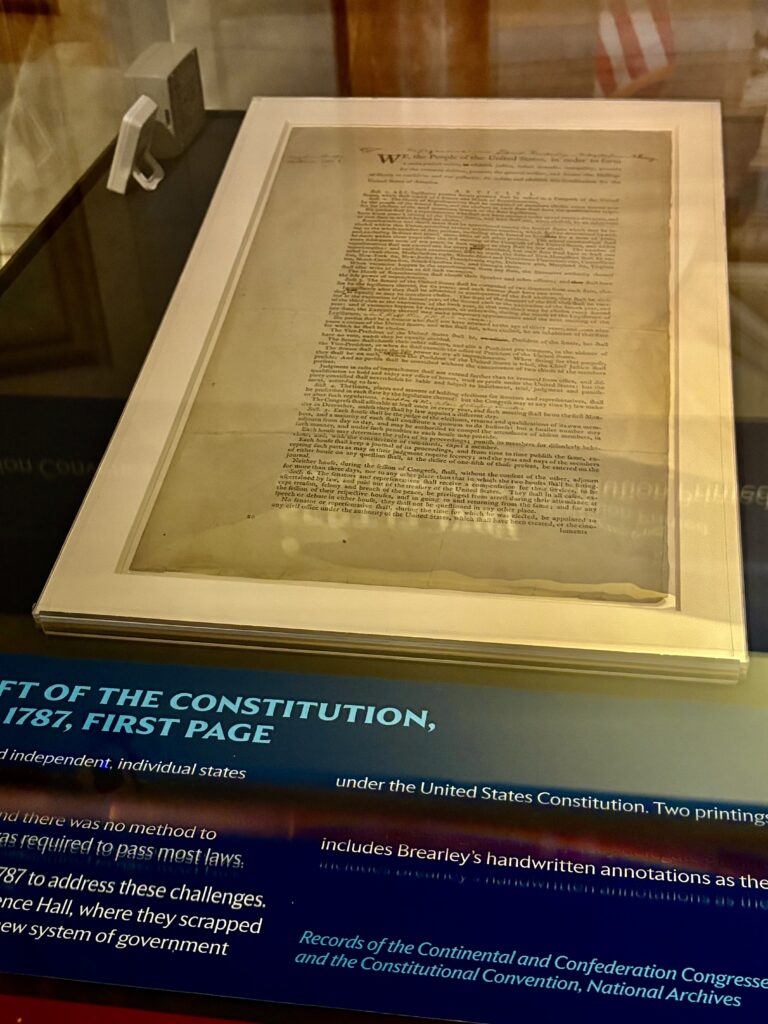
An early draft of the Constitution.
The history of the debates, voting records, resolutions and the vote on the final text of the Constitution were recorded by hand in a large journal.
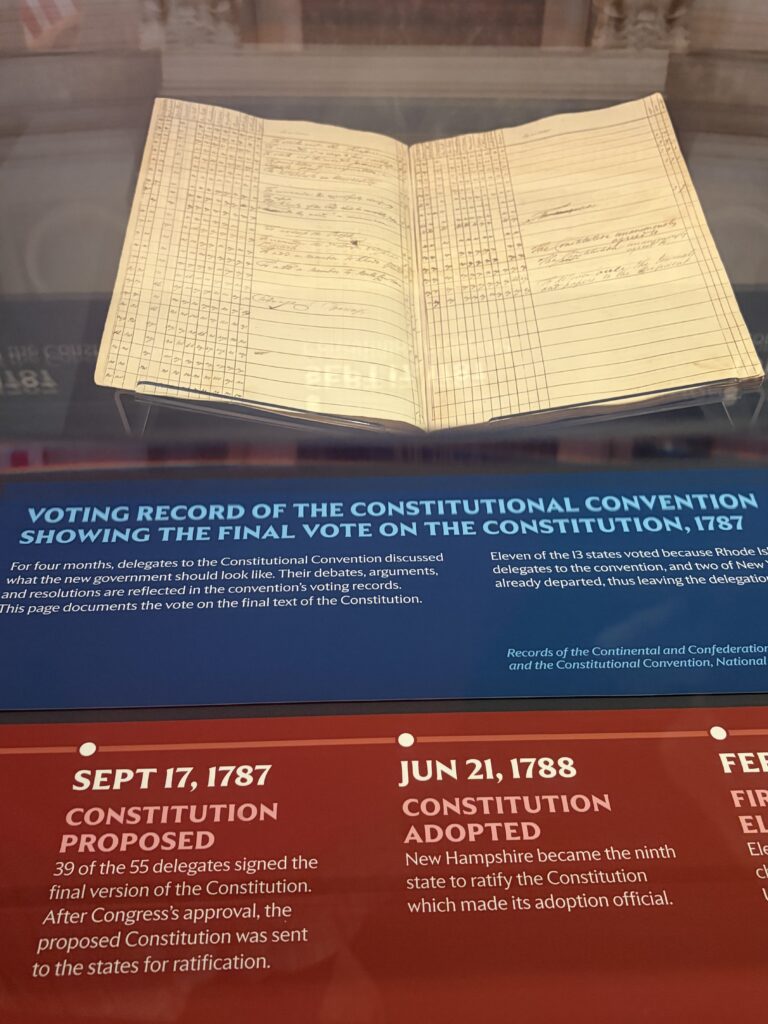
A journal used to track edits to the Constitution.
After the states ratified the Constitution, James Madison proposed a series of amendments based on the concerns of the states. The exhibit was a markup of what eventually became the Bill of Rights.
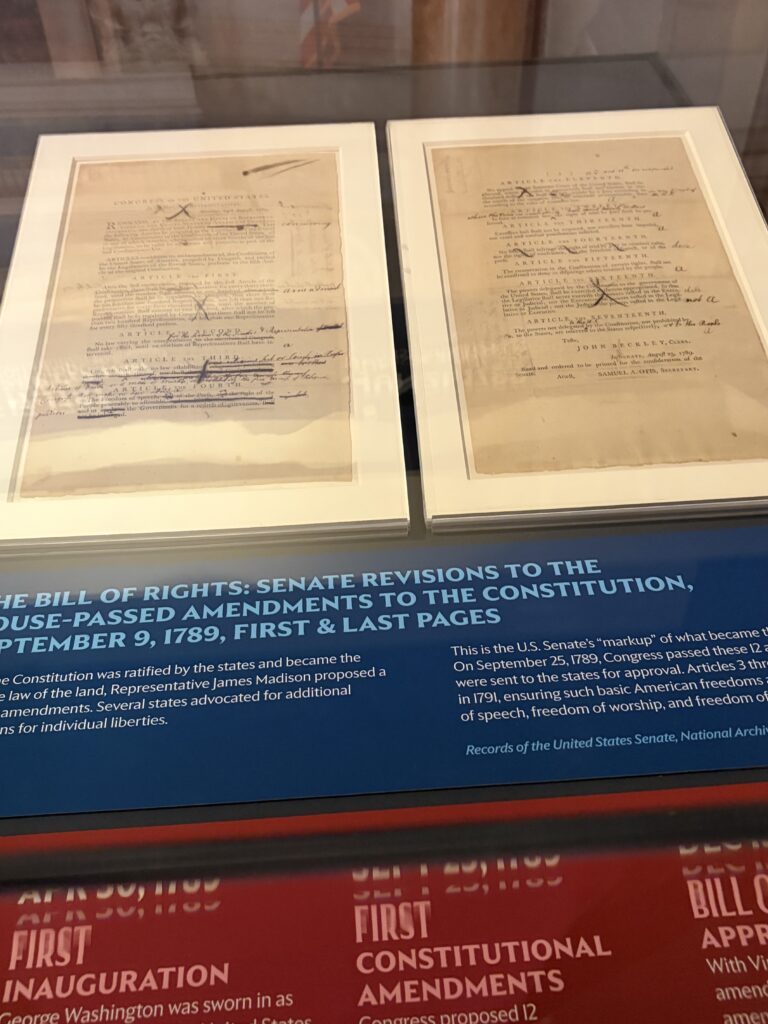
A markup of the Bill of Rights.
Copperplate
Around 1820, officials noted that the original Declaration of Independence was deteriorating rapidly. In 1823, John Quincy Adams commissioned engraver William J. Stone to create a copperplate of the original Declaration. He created reproductions of the size, text, lettering and signatures of the original document.
He completed it in June 1823 and then used it to print 200 official copies on thick parchment. They were distributed to government leaders and surviving signers. Fewer than 50 copies can be accounted for today.
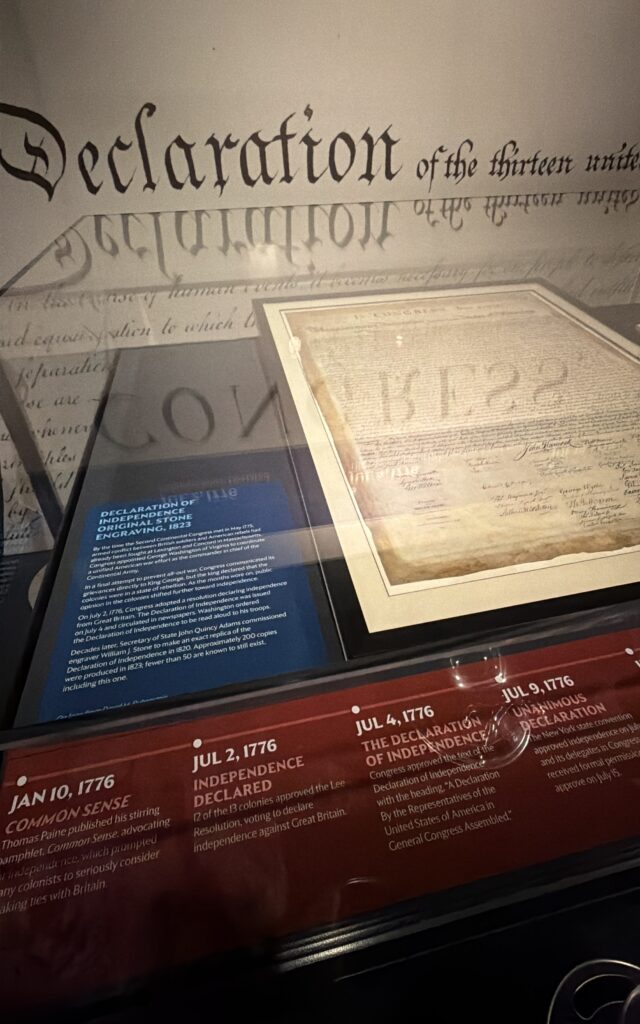
One of 50 surviving copperplate copies of the Declaration.
Three other temporary exhibits are on display right now at MOHAI. One examines various elements of the development of the American flag.
For Which it Stands: The Many Threads of the American Flag
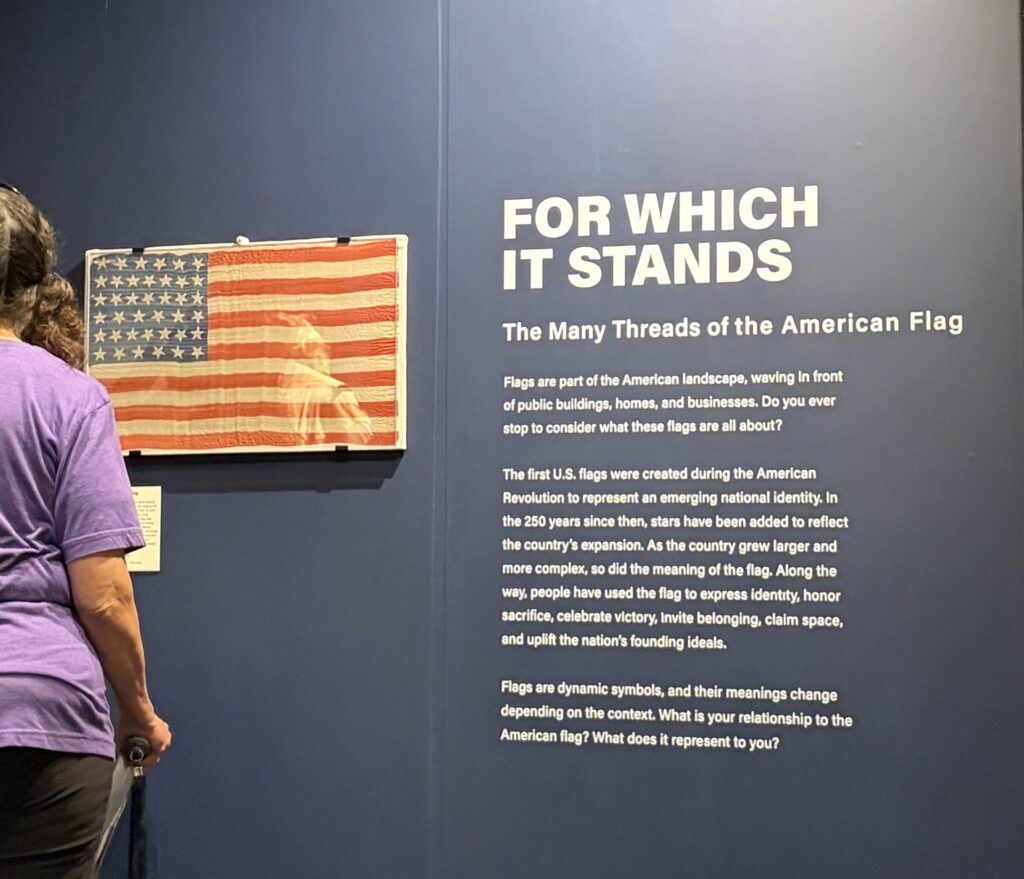
For Which It Stands is not your typical display focusing on Betsy Ross or how the flag was adopted. Rather, it addresses how flags are used in times of unity, protest, conflict and change.
One element of the exhibit was an interactive structure that allowed visitors to weave their own strand into an existing structure.
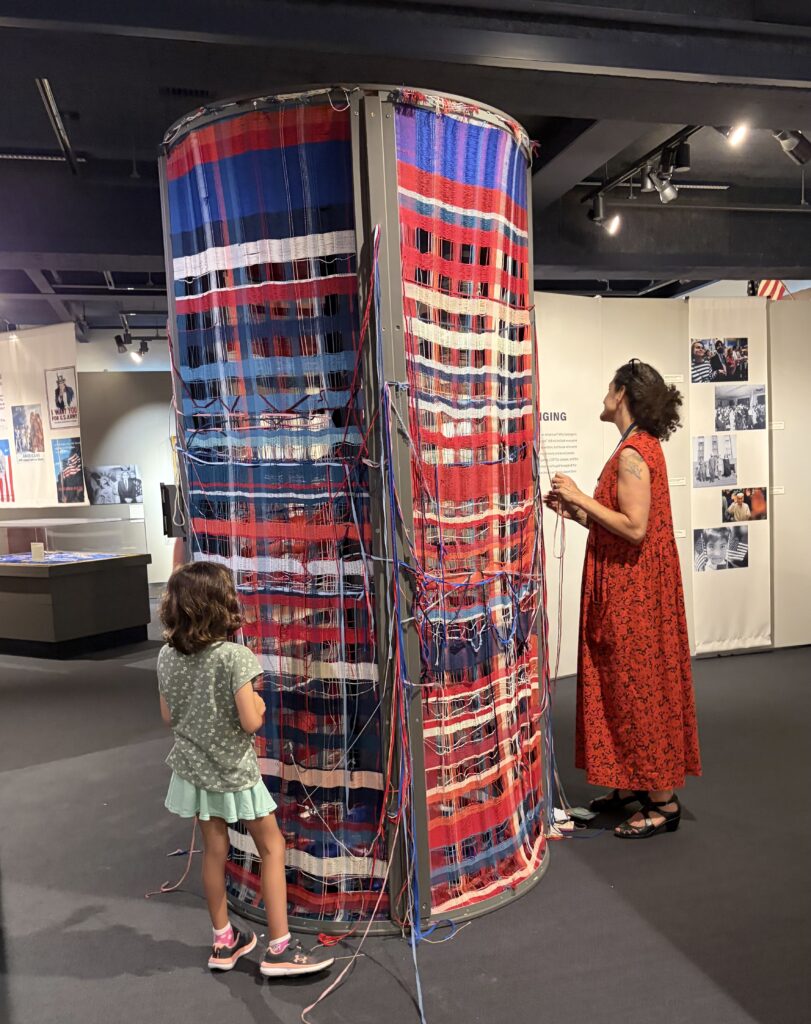
MOHAI visitors weaver their own flag structure.
The exhibit encourages visitors to think about not only how national symbols influence decision making but addresses how flags and banners create a sense of unity.
A grouping of political posters demonstrated how the flag was used to influence legislators or supporters.
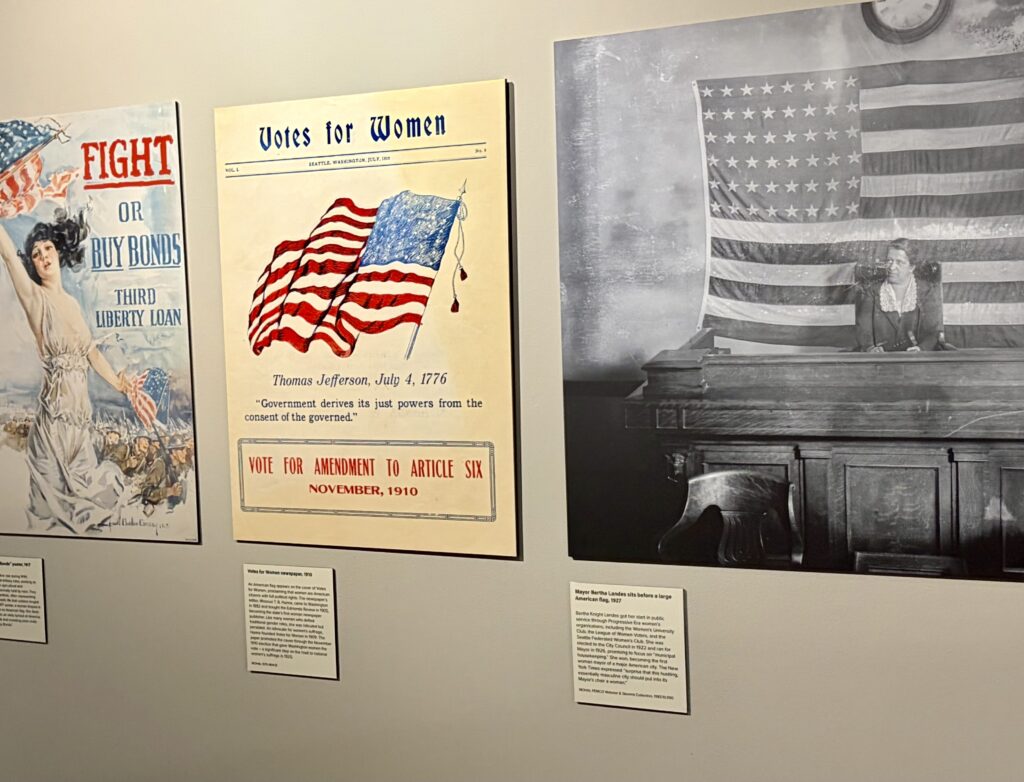
Flags used in political messaging.
One of the most common flags, at least here in Western Washington, emphasized how public enthusiasm and a sense of unity is developed by encouraging the use of a common symbol in the form of a flag.
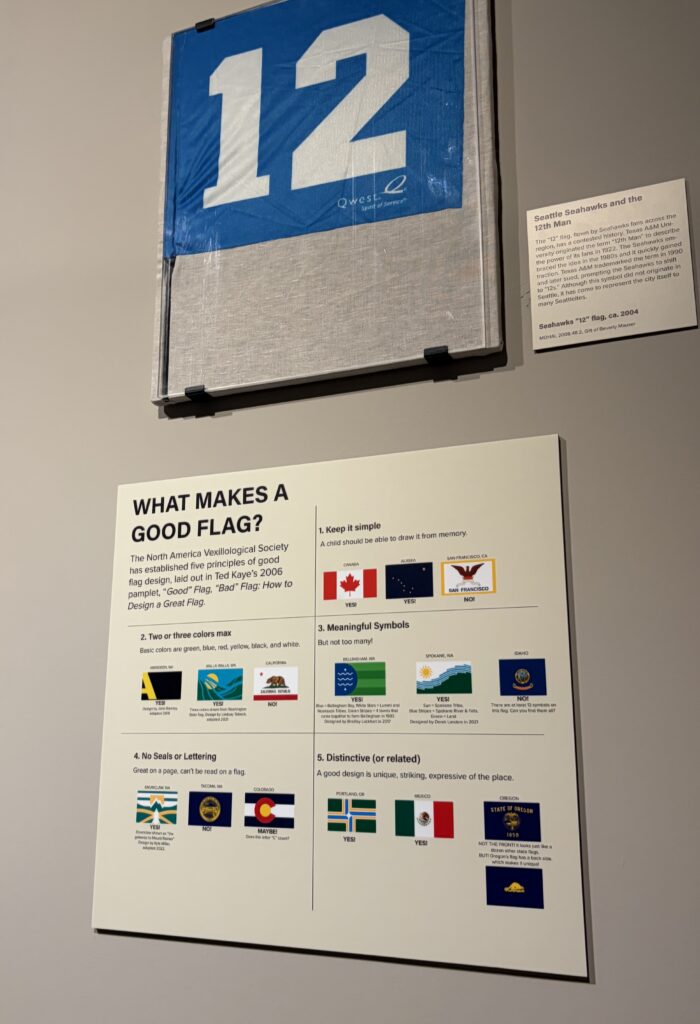
Another flag that displays unity.
This exhibit will be at MOHAI until Nov. 15 and is free with admission to the museum.
Reframing Seattle’s Southeast Asian Histories
An exhibit exploring how Southeast Asian refugees have been represented in the media and in MOHAI collections was developed based on the research of Curator’s Fellow Thanh Tan. The exhibit explores the legacy of the Southeast Asian refugee and immigrant experiences.
This exhibit will be at MOHAI until Sept. 20.
The Beautiful Game: How Soccer Connects Us All
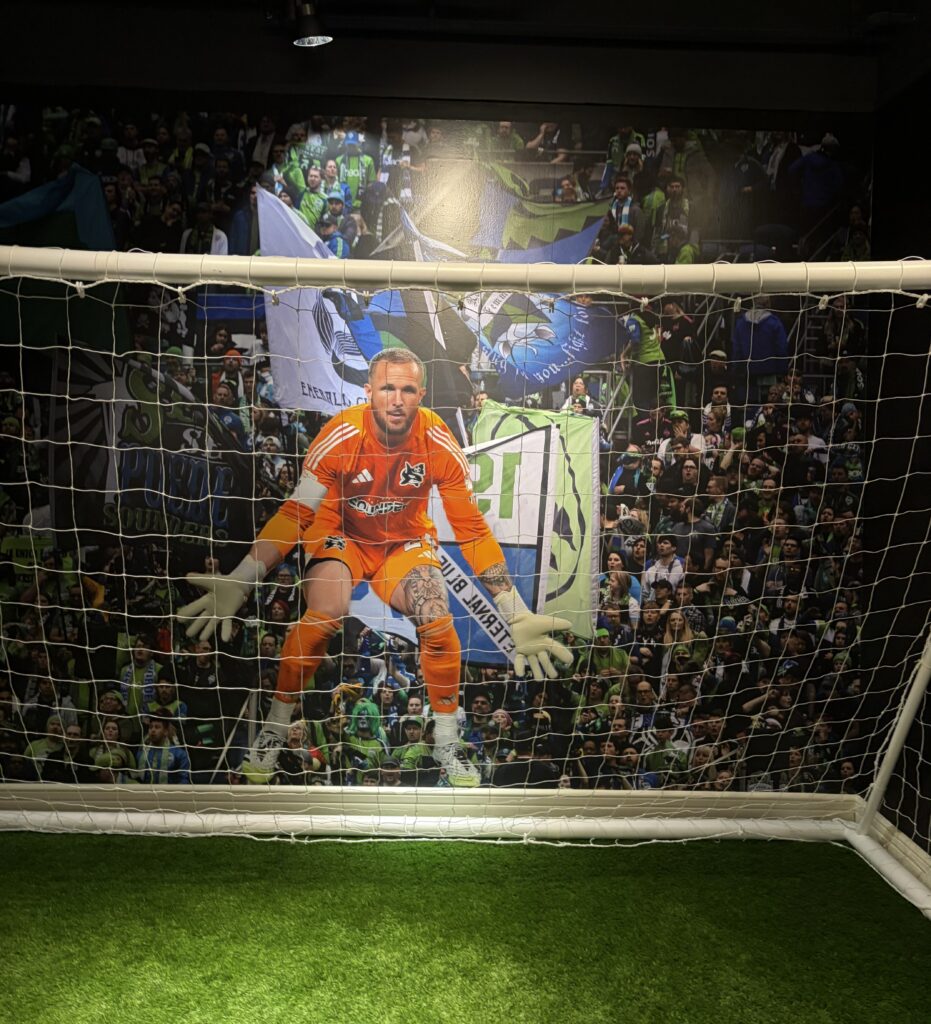
The Beautiful Game was timed to entice visitors to visit MOHAI while in Seattle for the World Cup.
It featured an assembly of photographs from Magnum Photos, acclaimed as the world’s leading international photography agency, and from MOHAI’s collection showcasing local soccer teams. Pictures of the Seattle Sounders were featured throughout. This photo is of goalie Stefan Frei defending the goal during the 2019 MLS Cup.
A wall of soccer balls represented the teams, clubs, and nonprofits supporting soccer in the local regions.
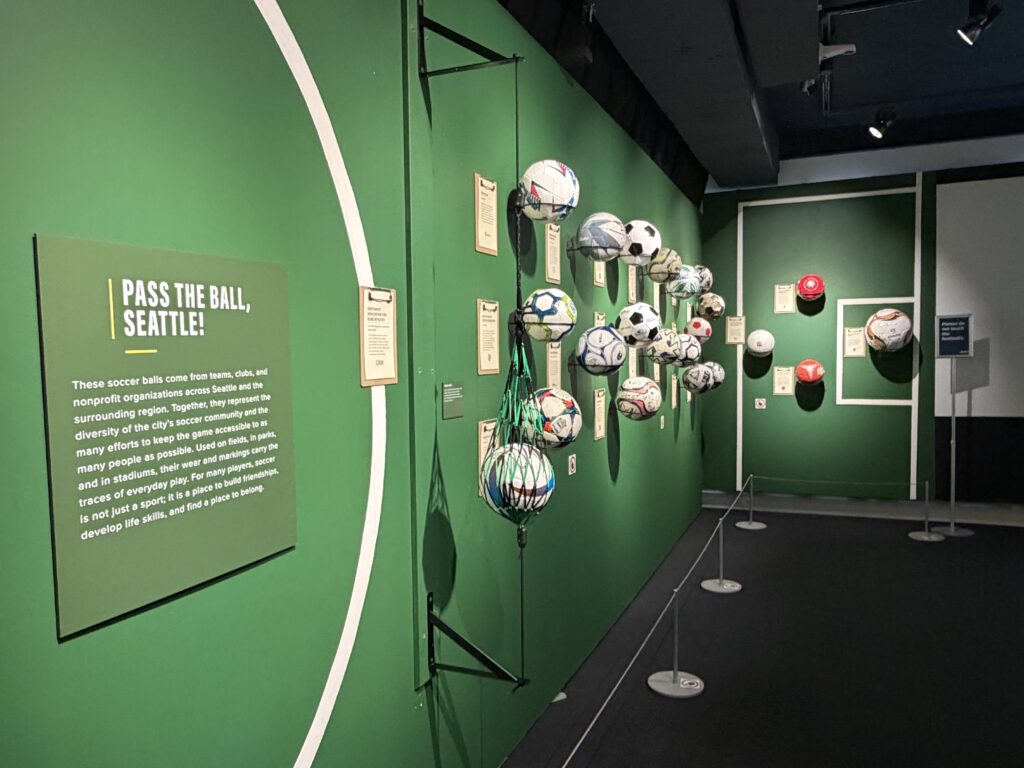
This exhibit will only be on display through Sept. 7, so if you want to see it, you have no time to waste.
Center for Wooden Boats
As I left MOHAI, I decided to visit the Center for Wooden Boats. The Center for Wooden Boats is a museum dedicated to preserving and documenting the maritime history of the Pacific Northwest. It is at 1010 Valley St., just south of MOHAI. As usual, it features a small gift shop with some really cool stuff.
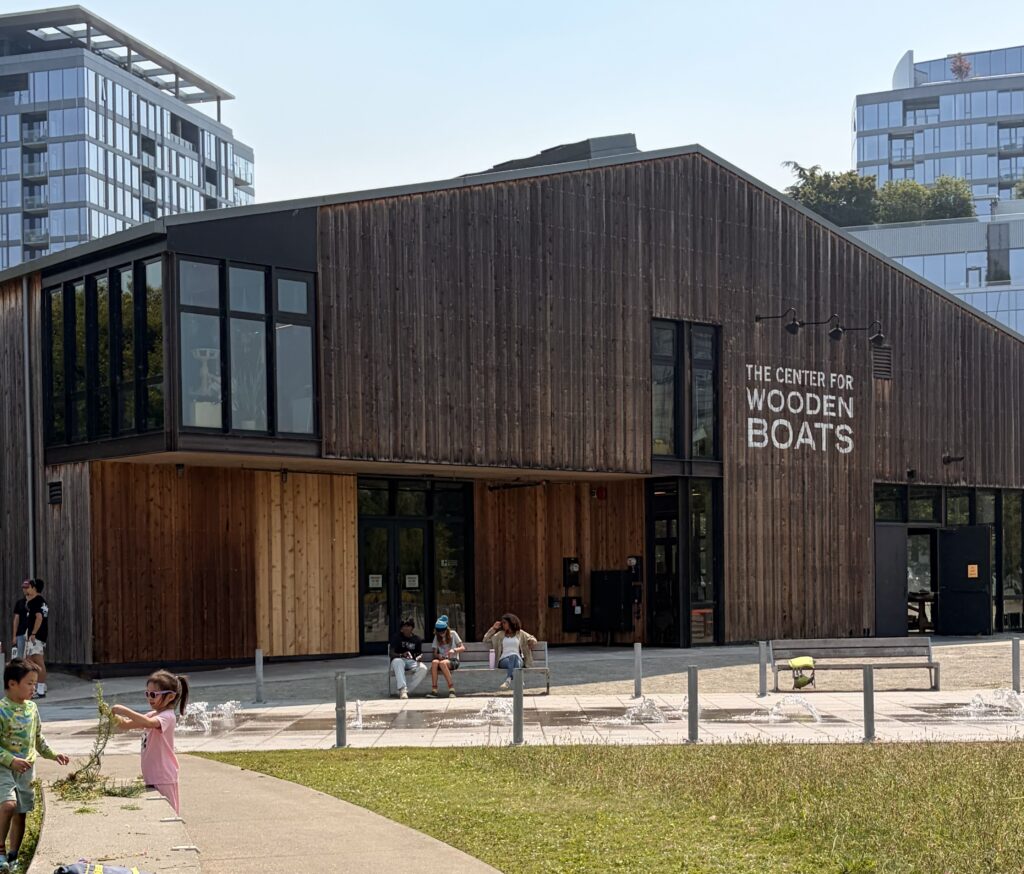
The Center for Wooden Boats.
The original founders of the center, Dick and Colleen Wagner, lived in a houseboat under the Aurora Bridge. With help from friends and supporters, it became a 501(c)3 nonprofit in 1979.
The organization’s original bylaws stated that education was its primary purpose, and the most effective means of education was direct experience. As a hands-on maritime museum, the exhibits were put in the water and the public was encouraged to use them.
Things have changed quite a bit at the center in 50 years. Boat building classes are a primary function now, as is exhibiting vessels that have been central to the development of boating. Other activities at the center include sailing and safety classes, summer camps and boat rentals.
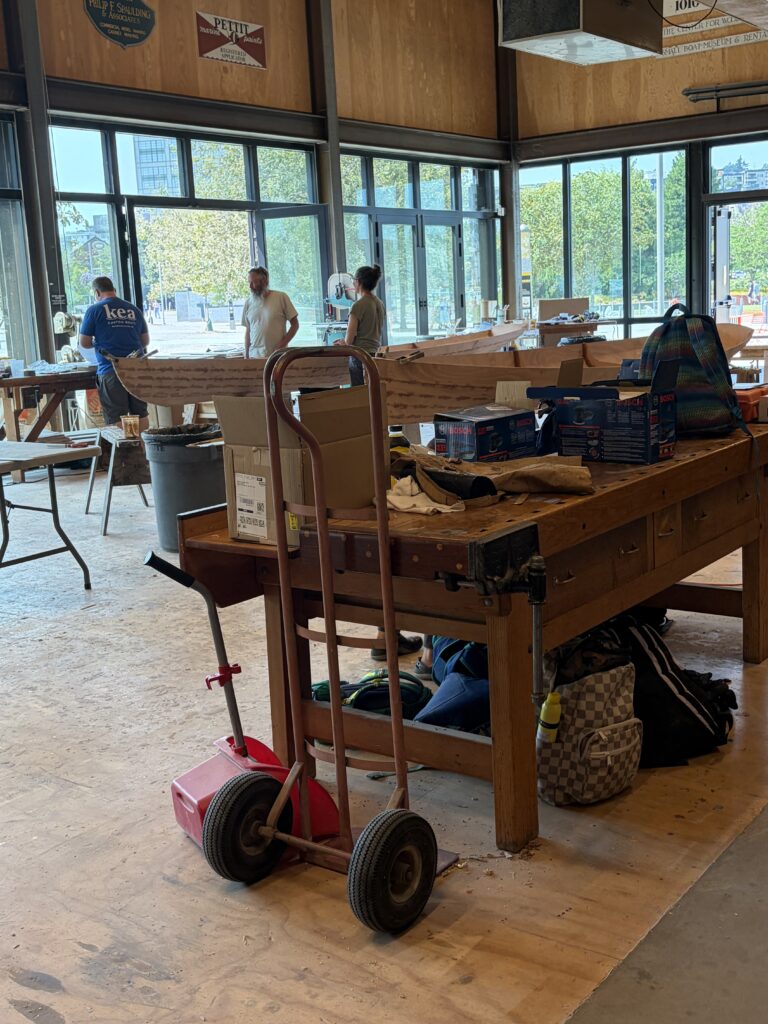
A classroom area at the Center for Wooden Boats.
The museum is hosting a special called “Pacific Rim Institute of Marine Artists Jubilee Art Exhibition: A Nautical Celebration” through Nov. 8. It features 17 artists displaying their marine related Pacific waterways art.
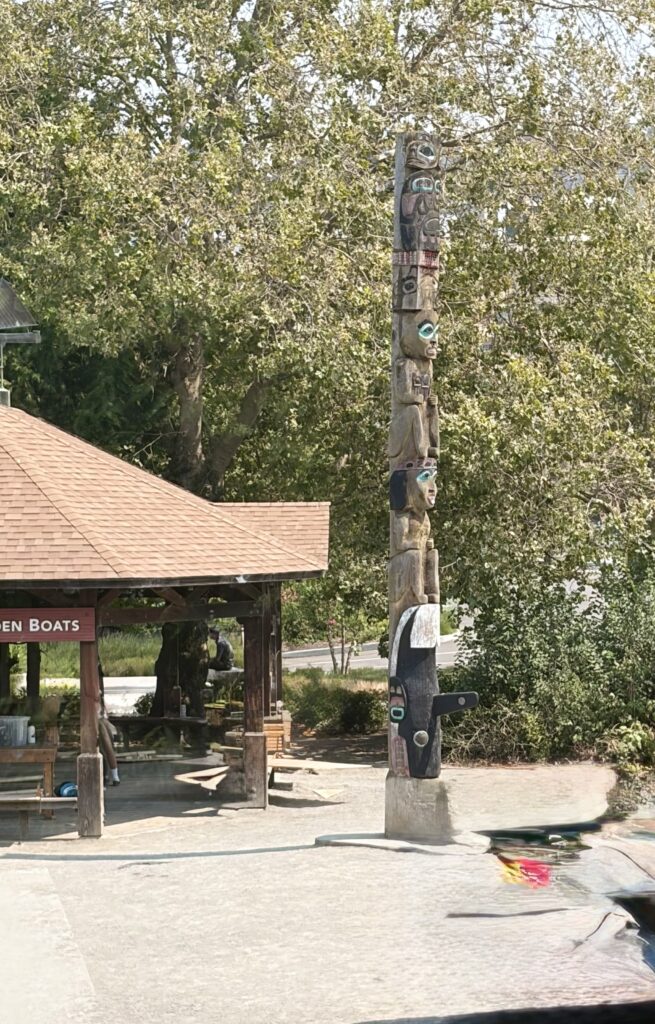
One of my favorite items at the center is the totem pole out in front of the recreation area. The pole was a gift from the Tlingit tribe from Klawock, Alaska.
Five young carvers crafted it under the guidance of master carver Jon Rowan. Dedicated in August 2007, it was a reciprocal gift presented as a cultural exchange in return for a canoe gifted to the tribe by Seattle master carver Saaduuts.
About the Day Tripper column
Gas prices are sky high, and a night in a hotel is approaching astronomically expensive. So, for the foreseeable future, I imagine many of you are going to find yourselves taking day trips rather than the road trip vacations we’ve grown to love.
This beautiful region in which we live is ripe with opportunities to explore new places, see new things, and learn a little something at the same time. I promise to keep the longest journeys to a one-way distance of under 200 miles. Whether you want to make it an overnight trip, a weekend, or just a very long day trip, we should be able to pull it off.
I hope you’ll grant me the honor of your virtual company as we travel these roads together. Happy trails!