Arts & Entertainment Community
The Big Cheese reveals the soft heart, true grit of cheesemongering
Courtney Johnson finds her earliest memory of cheese tucked away in a warm corner of childhood — those little family traditions you don’t at first realize have been passed down through generations of lineage and culture.

Arts & Entertainment Sponsor
Arts & Entertainment stories are made possible in part by the Gig Harbor Film Festival, a proud sponsor of Gig Harbor Now.
“My mother’s from Germany, and we would always eat something called Brötchen [small, malted bread rolls] … and eat them with sliced cheese and meats from the grocery store,” Johnson said. “That’s what you eat for breakfast in Germany. The sliced cheeses and meats had a place in their own special little meal. That’s my earliest cheese memory.”
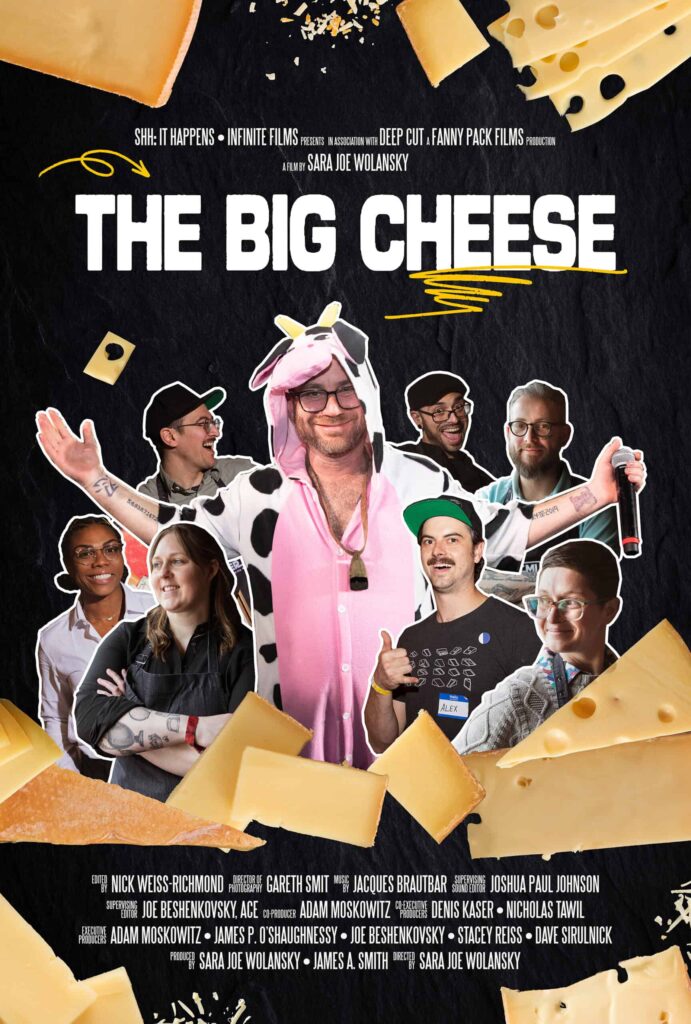
‘The Big Cheese’
Johnson is one of the cheesemongers — specialists who select, procure, store and sell cheese — featured in The Big Cheese, the documentary that will open this year’s Gig Harbor Film Festival, which runs Sept. 24 through 27. Johnson co-founded and co-owns Street Cheese, a Seattle-based cheese shop. Johnson is also the head of the Washington State Cheesemakers Association, a role she has held for a little more than six years.
She wasn’t always in cheese, though. In fact, even though both of Johnson’s parents worked in grocery stores, it wasn’t until the tail end of her schooling to become a German literature professor that she realized the field wasn’t for her. It was only then that she realized she had more interest in food — and cheese specifically — than academia.
Despite an advanced degree in literature, one of the only jobs Johnson could get was in a grocery store. Her future career started clicking into place when she worked behind the cheese counter and met her first mentor, a woman who gave her an informal apprenticeship in cheesemongering.
Several years later, Johnson met Tailor Kowis while the two worked together at PCC Community Markets. Johnson was the store’s cheese specialist, and the two launched Street Cheese as a mobile cheese shop.
Because they decided to launch the business at the beginning of the COVID pandemic, Johnson and Kowis started doing pop-ups mostly at breweries with open-air dining. But their quickly growing business forced them to make a choice: stop or grow.
The pair chose to grow, and opened their first physical store last year. But between winding down the pop-up business and finding and opening a store, Johnson was also filming The Big Cheese.
Something to prove
Johnson initially spoke to director Sara Joe Wolansky in 2022, when Wolansky was looking for a cheese-focused project. Someone had referred her to Johnson, because Johnson was on the American Cheese Society’s certification committee, which oversees the Certified Cheese Professional exam.
Johnson told her that she felt that year’s Cheesemonger Invitational would be Wolansky’s best bet at getting some lively footage. Wolansky had already been in touch with Adam Moskowitz. Moskowitz — a.k.a. “Mr. Moo” — was on a mission to send American cheesemongers to France’s highly competitive Mondial du Fromage the following year, in order to show that American cheesemongering was not “lesser” than French.
Johnson said that “the world views our cheese culture as being Kraft singles and Cheez Whiz, and (has) this assumption that we don’t have any sort of cheese culture of our own. There was this perception that the Americans would be fat and sloppy and not polished and not serious, and that we would just do things for an American palate.”
Johnson won a trip to Vermont by placing second in the invitational that year. She met up with Moskowitz and a previous Mondial winner on that trip. Soon after, everything clicked into place: she won the Cheesemonger Invitational Masters the following year, which also won her a place in Wolansky’s documentary.
Intimate filmmaking
Wolansky has always loved cheese. While her career path took a different turn than Johnson’s, Wolansky remembers frequently visiting Formaggio Kitchen, a specialty cheese store in Cambridge, Massachusetts, near her dorm at Harvard University.
“I used to just buy hunks of cheese and bring them back to my dorm room, and bite into them as if they were a sandwich or something,” Wolansky said. “I’ve always loved cheese, and I wanted to know more about it. Cheese is a topic. It’s not a film in itself. I knew that to tell a compelling story, it was really going to be a story about people in the world of cheese.”
From the outside, cheese might seem like a niche business or topic. But it can actually be a vehicle of acceptance and belonging for people who might otherwise feel outside the margins, said Nick Weiss-Richmond, the documentary’s editor.
“I don’t have a clear explanation for why this is,” he said, “but I think you find a lot of people in the culture bonding and being like, ‘Oh, I finally found my home. I finally found a place where I feel seen, a life that feels meaningful and a community that accepts me.’”
Moskowitz is one of these people. His big personality shines amidst the bright lights and high stakes of the film’s competitive action. But behind all of that is his journey through alcohol addiction and recovery. Cheese and cheesemongering literally saved Moskowitz’s life.
So, while the film can be loud and big and flashy, it isn’t a story about the glitz and glam. It isn’t really even a film about a competition. This is deliberate, Wolansky said.
“I always knew that I wanted this to be an intimate film, even though on its surface, it’s … about cheese — and certainly there’s a ton of cheese puns and things like that,” Wolansky said. “But really, the people in the film all have such incredible stories of the things that they’ve been through, the things that they’re doing. I think the film goes in an unexpected direction insofar as it does have this more intimate side of the story.”
No set ending
No documentary ever starts out fully formed, and The Big Cheese was no exception. In editing the documentary, Weiss-Richmond watched literally hundreds of hours of footage and created a rough cut he and the crew ultimately had to revamp. But he still knew which parts of the film would serve as its core — the parts that would give the audience the same chills he got.
“I had watched this scene with Adam [Moskowitz] where he is talking to the people who are about to compete … [and he says,] ‘For me this is redemption. And so I’m taking this super-serious. So who becomes Team USA tomorrow are the two people I believe can actually win this motherf—er.’” Weiss-Richmond remembered. “I had chills. I was like, ‘This guy is deadly serious.’ There are people in the room who are crying. You could hear a pin drop. … And the camera doesn’t lie. You can tell when people are being phony or when they’re putting it on for … a film crew … and they weren’t at all. … So I was like, ‘Wow. Okay. You got me, movie. I have to see what this is about.’”
Of course, Wolansky could not plan for who was going to win the Mondial. That was going to dictate the direction of the rest of the film. But that was all right.
“The whole fun part of a documentary is when things don’t work out how you thought they were going to, and that that’s where they really come alive,” Wolansky said. “I think a documentary that you know exactly what it’s going to be when you start shooting it and then it ends up being that thing has got to be pretty boring.”
‘An underdog story’
What surprised Johnson the most at the competition wasn’t the the unknown element of its outcome. It was how kind and friendly everyone was, regardless of any assumptions about American cheese culture.
“You don’t really know what to expect the first time you compete in an international competition of this caliber,” she said. “You expect everybody to sort of be a little aloof and standoffish, but everybody just comes together, sort of the way that we do in our own American cheese gatherings where it’s like a big family reunion and everybody’s happy to see each other again.”
She felt that Wolansky and the crew “did a good job of showing how our community is very tight-knit in the cheese world, even if there are little rivalries and things that we deal with at the same time.”
Wolansky sees the film as “an underdog story.”
“It’s about these underdog Americans going to compete against these French cheese elites,” Wolansky said. Typically, she said, in a Hollywood underdog story, the underdogs win — but this is real life, so a feel-good ending isn’t always in the cards. But is it in this film? Wolansky suggests readers who want to know that watch the film.
“That also is part of the fun: seeing what happens,” she said. “And no spoilers, but — wink, wink — I’ve heard that the ending will leave a smile on your face.”
The Big Cheese will open the Gig Harbor Film Festival at 6:30 p.m. at Galaxy Theatres at 4649 Point Fosdick Dr. on Sept. 24 and a second showing at 5:05 p.m. on Friday, Sept. 25. There will be a Q&A with Johnson and Weiss-Richmond after the first showing on Sept. 24, and another with Weiss-Richmond after the showing on Sept. 25. The festival runs from Sept. 24 – Sept. 27. Readers can buy tickets here and find a full program here.