
Business Community Environment
Birches in Gig Harbor Home Depot parking lot turn dead and ghostly, in time for Halloween
Dozens of birch trees in the Gig Harbor Home Depot store’s parking lot are dead or dying. They stand white, bare and brittle just as foliage outside neighboring stores in Gig Harbor North erupts in fall colors.
The die-off is so bad that the city of Gig Harbor granted Home Depot a permit to remove all 42 birches in its parking lot landscaping and replace them with some other kind of tree.
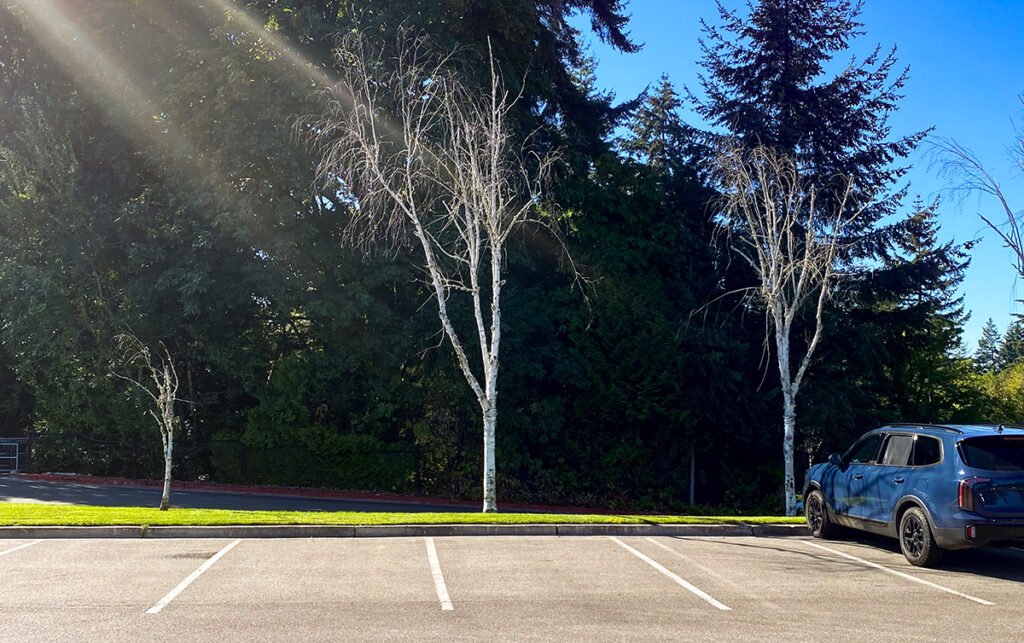
Ghostly birch trees at the Home Depot parking lot. Photo by Ted Kenney
An arborist’s report from the permit filing points to Agrilus anxius, aka the bronze birch borer, as the culprit. Damage from this beetle has “increased exponentially” in Washington state as droughts and hotter summers make birches more susceptible to infestation, according to Washington State University’s Puyallup-based Urban Forest Health Lab.
Experts warn against planting new birch trees here, other than varieties that are resistant to beetle infestation. They also recommend that tree owners provide their favorite birches with some extra love — including plenty of water and possibly an arborist’s care — to prevent the condition.
Three-fourths of birch trees dead
In the Home Depot parking lot, “approximately 75% of the Birch trees are currently dead, and the remaining living trees are showing signs of declining health,” says the report by Gig Harbor Tree Service, the arborists hired to assess the problem.
“The dead trees are rotting and prone to failure, the living trees are heavily declining and are not expected to improve.”
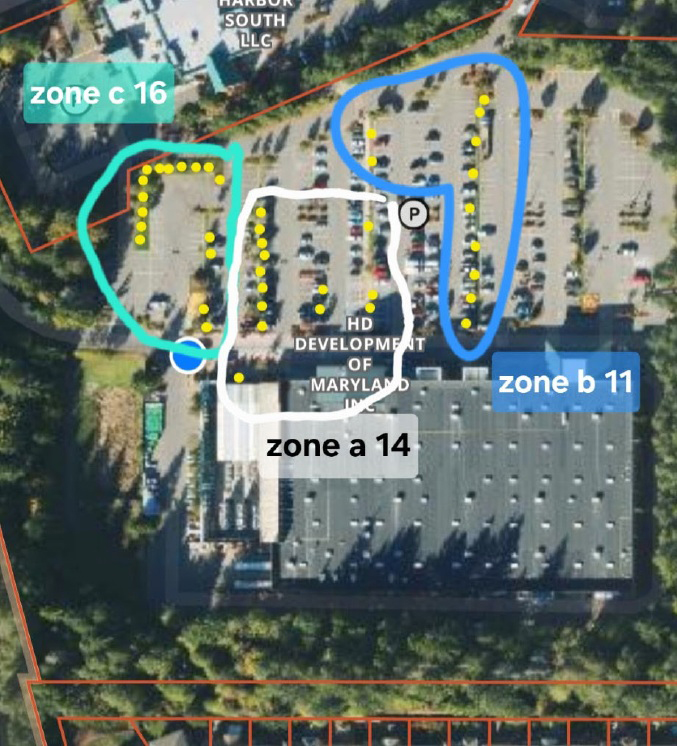
Yellow dots indicate each dead and dying birch tree in the Gig Harbor Home Depot store’s parking lot. This map was submitted to the city in support of a permit application to remove the trees and plant new ones. Source: Gig Harbor public portal
A big box store parking lot turns out to be a poor environment for trees. Limited soil space and heat reflected from pavement combine to cause stress to the trees, the arborist’s report says.
Humans and their big, heavy vehicles sharing the parking lot add to the burden. “These trees are constantly getting hit by cars,” says an email sent by PC Maintenance, Home Depot’s Idaho-based maintenance contractor, to a Gig Harbor planner.
The cumulative stress weakens the trees’ immune systems, allowing the infestation to take hold, said Matthew Jackson, a Gig Harbor Tree Service arborist.
Bug is native to Washington
The bronze birch borer is native to Washington, said Joey Hulbert, Ph.d, a research assistant professor with the Urban Forest Health Lab, which is part of WSU’s Department of Plant Pathology. It is “cousin or sister” to the emerald ash borer, he said, referring to Agrilus planipennis. That exotic pest turned up in Washington for the first time this year and has reportedly wiped out more than 100 million ash trees throughout the country.
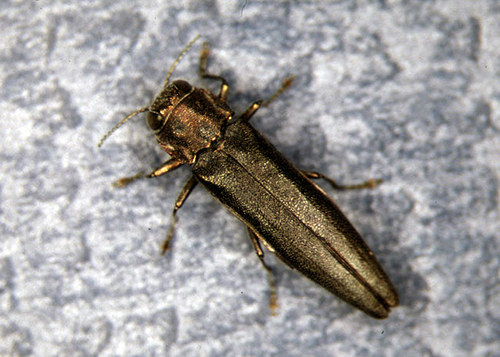
Agrilus Anxius, also known as the bronze birch borer, is a narrow beetle with an iridescent copper-like reflection. It lays eggs in compromised areas of birch tree bark. Photo courtesy University of Utah extension
“Since 2016, we have had longer and hotter droughts” that make birch trees more susceptible to bronze birch borer infestation, Hulbert said. The increased popularity of birches in landscaping also provided a boost, he said.
An infestation starts when females lay eggs on compromised areas of tree bark such as cracks and flaps. “After a few days, the eggs hatch into tiny white larvae that chew into the bark and begin feeding,” the WSU Urban Forest Health Lab website says.
Next, the now-adult beetles bore their way out of the tree, leaving three- to five-millimeter exit holes, often with reddish “bleeding” marking each hole.
Along with telltale holes and bleeding, another infestation symptom is yellow, sparse or stunted foliage that starts in the tree’s upper crown. “Generally, you just see the tree dying from the top down,” Jackson said.
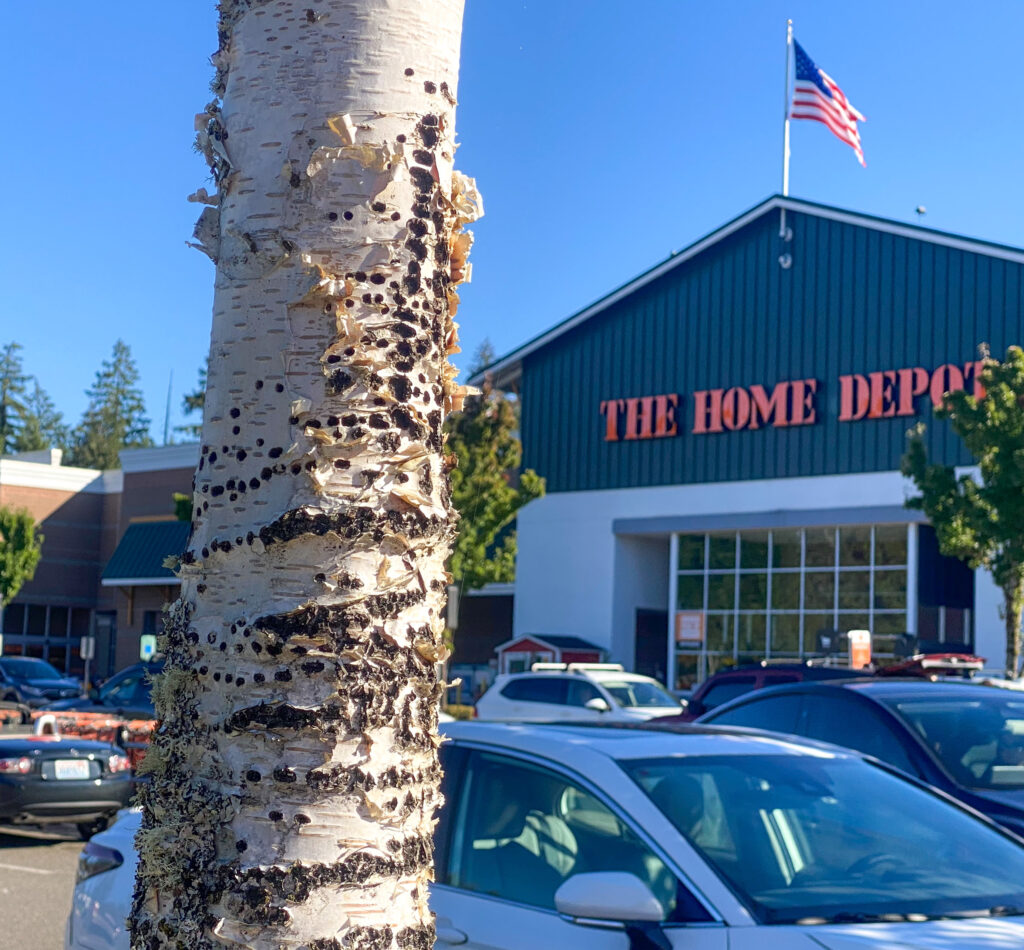
Bronze birch borer larvae hatch in compromised areas of the birch trees’ bark and begin chewing. Adult beetles emerge from the trees, leaving distinctive bore holes. Photo by Ted Kenney
Treatments
There are ways to treat or prevent bronze birch borer infestation. One is a systemic pesticide injection that trees absorb, making them toxic to the insect, experts say. But recovery is unlikely once 30 percent of a tree’s canopy is affected, Jackson said.
A few businesses near Home Depot, including Mattress Firm and Petco, have what appear to be birch trees suffering from Agrilus anxius in their parking lot landscaping. But birches do not appear to be widespread in either the commercial or residential neighborhoods of Gig Harbor North.
That’s a good thing, said Hulbert, the WSU scientist. “Right now, if you see a new development in Puget Sound and they’re planting birches, it’s a poor decision” unless a resistant variety such as river birch is used.
If you plant a susceptible birch, “there’s a good chance it will die before maturity,” he said.
Maples will replace birches
Permit filings show that Gig Harbor Tree Service recommended replacing the non-thriving birches with columnar maples, a tall, narrow tree variety that grows well in tight spaces.
Gig Harbor Tree Service diagnosed the bronze birch borer infestation in Home Depot’s parking lot landscaping and came up with the plan to address it, a tree service representative said. The store’s maintenance contractor is handling the trees’ removal, he said.
Home Depot assistant manager Heather Griffin said she is uncertain when that removal will occur. A representative of PC Maintenance declined to comment.