
Community
Gig Harbor Now and Then | A new location of mystery and how the California Gold Rush drove growth in Gig Harbor
In a double switching of normal order, this week’s column will start out with a question of local history, and that question will feature a current photo of the subject instead of a vintage one.

Community Sponsor
Community stories are made possible in part by Peninsula Light Co, a proud sponsor of Gig Harbor Now.
Here’s the current photo, a fine, summertime picture of Gig Harbor Now and Then Location of Mystery No. 3. It shows a vacated building that has seen better days, with an old junker parked out front:
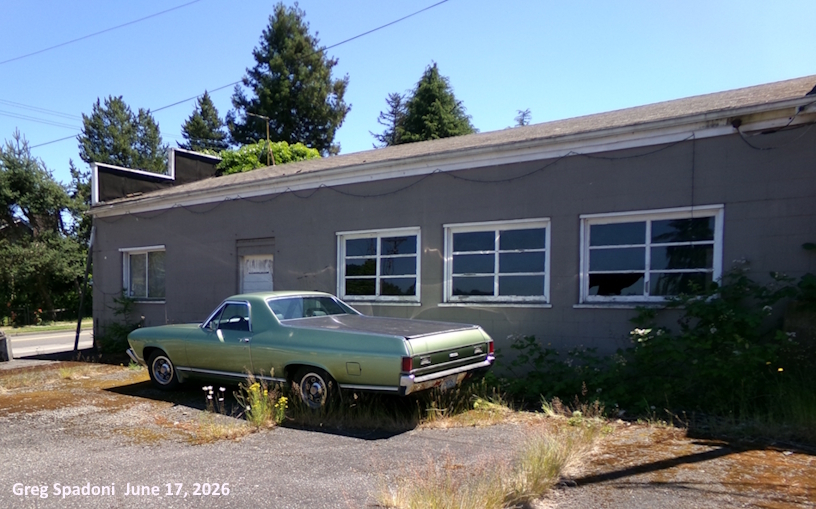
Gig Harbor Now and Then Location of Mystery No. 3. Photo by Greg Spadoni.
Where is Gig Harbor Now and Then Location of Mystery No. 3, and what was the location’s longest use before it was vacated?
The answer will appear in this column on Aug. 10, along with a photo of what it used to look like.
A great many readers already know where it is and what it was used for, but for people who’ve been in this area for less than 20 years, and for anyone who never drives by the place, it will be news to them.
Call of the Timber
The following is an edited excerpt from “The Early Development of Gig Harbor, Washington” by Greg Spadoni, Copyright © 2021.
The impressively tall, impossibly thick coniferous forests of the Pacific Northwest became the driver of settlement in the Puget Sound area just a few short years after the Wilkes Expedition first entered Gig Harbor in 1841.
All else being equal, the migration to the Northwest would’ve happened more gradually, but a now-famous catalyst generated a demand to the movement that could not be ignored: The discovery of gold at Sutter’s Mill in Northern California in 1848. The Gold Rush of 1849 followed, and the explosive growth of the San Francisco Bay area desperately needed building materials, and that meant lumber and piles.
Although the equally impressive timber of what is now the state of Oregon was closer, Puget Sound (a part of Oregon Territory at the time) offered more accommodating inland waters for the merchant sailing ships that would carry the urgently needed wood products to California.
Among the Puget Sound destinations of barques, brigs, schooners, and full-rigged ships was Gig Harbor. They came for the Douglas fir, which covered the hills down to the shore on both sides of the bay and the north end, the only exceptions being the estuaries where the two biggest creeks meet the salt water.
In those earliest days of logging on the Sound, the easiest trees to harvest were taken first. They were the ones within a couple hundred feet of the high tide line. They were felled directly onto the beach or into the water, eliminating the difficult task of yarding the logs across dry land.
Who did the work of cutting trees and peeling the thick bark from spars and piles is a matter of speculation. It wasn’t landowners, since none of the land on the shore of the harbor was owned by private citizens until 1868. It could have been transient loggers, traveling from shore to shore, or it could’ve been each ship’s crew, or a combination of both.
The earliest merchant ships in Gig Harbor
The first ship to load logs in Gig Harbor is not known, although early resident James Wickersham wrote in his Olympic Journal in 1889, “As early as 1850 ship [sic] came into Gig Harbor to load piles for foreign trade.” (The term “foreign trade” does not necessarily exclude California.)
Evidence of such an event in 1850 could not be found during research for this story, but a similar occurrence four years later was discovered. On March 28, 1854, The Daily Alta California, an early San Francisco newspaper, reported that two full-rigged ships, Mason and Leonore (misspelled Leonora), were at Gig Harbor when the fully loaded brig Juno left Puget Sound for California.

What were the two ships in Gig Harbor to load? Piles. According to the Daily Alta California, that, along with lumber, is what Leonore was carrying when it returned to San Francisco on April 22.

The ship Leonore was carrying piles and lumber when it returned to California from Puget Sound. The return trip took only six days.
Piles (straight, defect-free logs used for driving vertically into soft ground to support bridges and docks) and spars (ship masts, yards, and booms) were a frequent cargo for ships loading in Puget Sound, though they also carried whatever other products they could contract for. It was common for ships to haul mixed loads of goods, as Leonore did in the spring of 1854. Because Gig Harbor did not yet have a sawmill, the ship had to have stopped elsewhere to pick up the lumber.
There is some evidence that Mason might not have taken on any cargo in the harbor on that trip. An early written history of Seattle includes an interesting note concerning a lawsuit involving the ship in that year of 1854: “…George W. Lee against John Sword [owner and/or agent of Mason], in which the ship Mason at Gig Harbor was attached and brought to Seattle.”
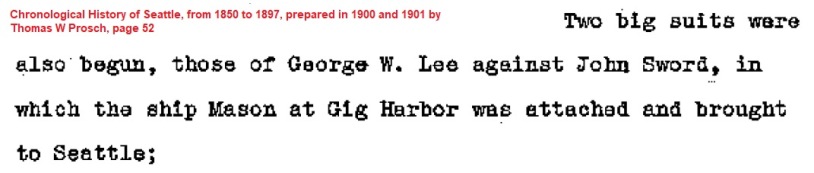
As part of a lawsuit over unpaid bills, the ship Mason was taken to Seattle before it could load piles at Gig Harbor.
Sword, like other San Francisco shippers, often hauled goods to California on speculation that he could sell them in the thriving Bay area. Perhaps he was not as successful as he had expected, leading him to owe George Lee $2,400.69. That trouble, in combination with Leonore reporting upon arrival back in San Francisco in April that when it left Puget Sound Mason was waiting for cargo, suggests it hadn’t loaded anything at Gig Harbor before it was removed to Seattle by Lee’s legal action against Sword.

When Lenore left Puget Sound in April, 1854, Mason (captained by Wilkinson) was still at Seattle waiting on cargo.
As that clip shows, Juno, Mason, and Leonore were not the only merchant sailers visiting Puget Sound in 1854. When the Leonore sailed for California in April, in addition to the Mason, it counted three brigs and one barque remaining at Seattle. There is little doubt that there were more vessels in other ports that Leonore was unaware of.
About Mason and Leonore
Mason and Leonore were frequent visitors to Washington Territory in the 1850s.
Leonore was not a new ship, but was freshly outfitted, as a series of advertisements for its services pointed out in January, 1854. “FOR SALE OR CHARTER—Ship LEONORE, 460 tons register, copper fastened; has new suit sails, new running rigging and full inventory. FOLGER & TUBBS, 49 Pacific Wharf.”

For its part, the owner of Mason described it in an 1853 advertisement as being an “A 1 fast sailing ship.”
Selling the cargo
Upon their return to San Francisco from Puget Sound, sailing ships that had loaded cargo on speculation advertised their goods for sale in newspapers. In 1857, this ad for the cargo of the ship Leonore was placed in The Daily Alta California, on May 5:
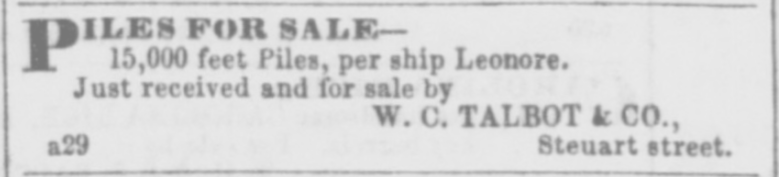
There’s no way to know where Leonore picked up the piles in this ad.
The following year Leonore’s cargo was just a bit more diversified:
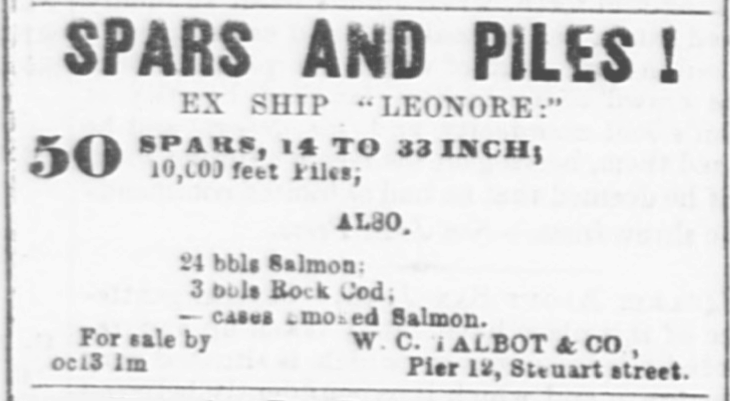
Where Leonore loaded the cargo listed in this advertisement is unknown.
Just the beginning of a major industry
From its modest early beginnings as a source of piles and spars for California and foreign markets, Gig Harbor’s first industry slowly worked its way from the shoreline inland as land was purchased from the federal government, starting in the late 1860s. In the 1870s local logging expanded to include logs for sawmilling into lumber by Puget Sound mills, and by 1887 Gig Harbor’s own sawmill would be under construction. The Harbor’s future, led by the timber industry, was bright as far as anyone could see. As it turned out, no one could see very far.
Next time
Are surprises in history interesting?
I think so.
How about a total surprise for the next installment of this column?
On Aug. 10, Gig Harbor Now and Then will feature an interesting surprise in local history. It’s a very good one. Very positive. A bit mysterious, too, which makes it even more interesting, because mystery tends to lead the imagination to speculate on the missing details.
One of the more intriguing things about the surprise is that it’s been sitting in plain sight longer than anyone alive today can remember — well over 100 years.
On its merits (which are significant), the surprise should result in a certain measure of action by the city of Gig Harbor, in a permanent expression of civic pride and cultural history. In cold reality, it will likely be ignored. That doesn’t make it any less interesting, though.
The Aug. 10 column will also disclose the location of the Gig Harbor Now and Then Location of Mystery No. 3, for all the readers who never drive past it.
— Greg Spadoni, July 27, 2026
Greg Spadoni of Olalla has had more access to local history than most life-long residents. During 25 years in road construction working for the Spadoni Brothers, his first cousins, twice removed, he traveled to every corner of the Gig Harbor and Key Peninsulas, taking note of many abandoned buildings, overgrown farms, and roads that no longer had a destination. Through his current association with the Harbor History Museum in Gig Harbor as the unofficial Chief (and only) Assistant to Linda McCowen, the Museum’s primary photo archive volunteer, he regularly studies the area’s largest collection of visual history. Combined with the print history available at the museum and online, he has uncovered countless stories of long-forgotten local people and events.