
Community
Gig Harbor Now and Then | Location of Mystery No. 4 looks very different today
The Oct. 5 column had a slew of questions in reference to this picture of Gig Harbor Now and Then Location of Mystery No. 4, taken in the late 1940s:

Community Sponsor
Community stories are made possible in part by Peninsula Light Co, a proud sponsor of Gig Harbor Now.
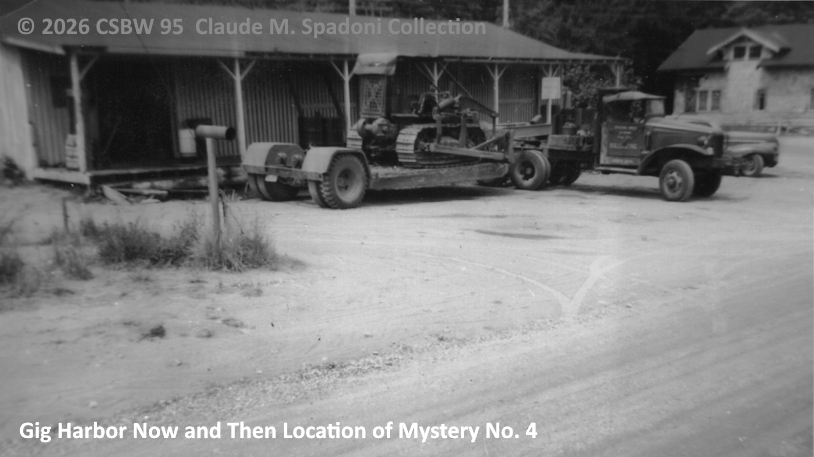
Photo by Claude M. Spadoni.
The first question is, of course:
Where is Gig Harbor Now and Then Location of Mystery No. 4?
Answer: It is the southwest corner of the intersection of Rosedale Street and Stinson Avenue in Gig Harbor. It is where the local road construction company, Spadoni Brothers, was located for many, many years.
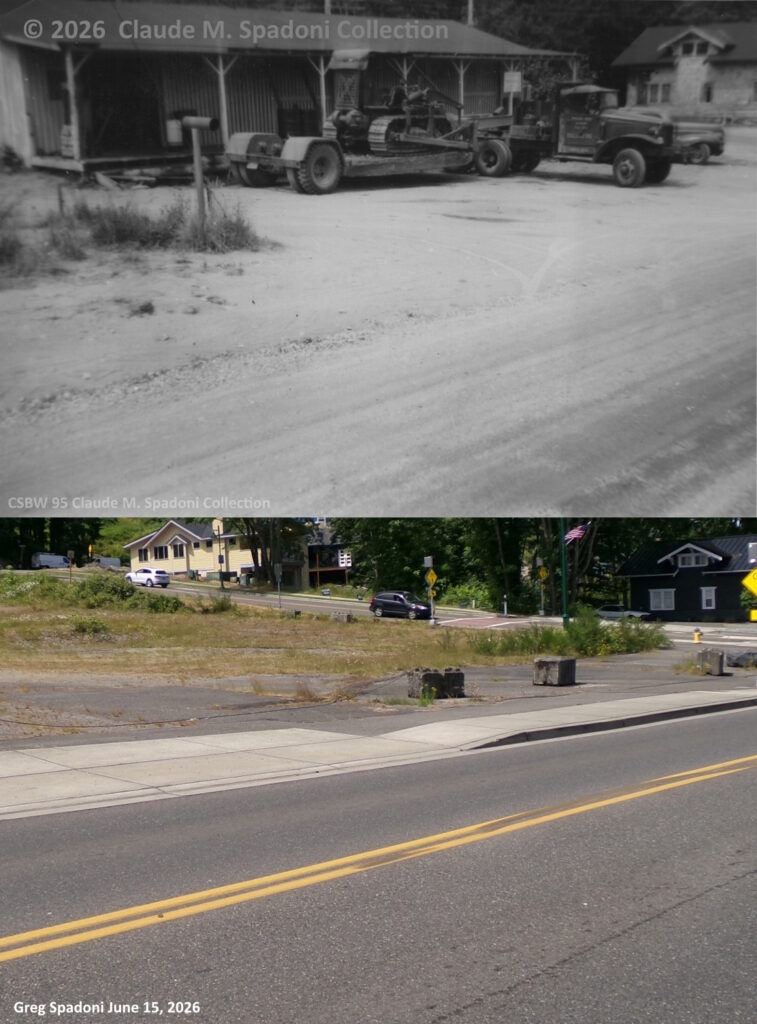
The Spadoni Brothers’ warehouse at 7910 Stinson Ave. is long gone, but the house across Rosedale Street is still there. Upper photo by Claude M. Spadoni, lower photo by Greg Spadoni.
To make it more challenging for those who already knew the answer, I included a short list of more difficult questions. Without needlessly repeating them, here are the answers:
The make of the bulldozer is International Harvester, and the model is TD-9.
The make of the six-wheel-drive truck towing the bulldozer is International Harvester, and the model is M-5H-6.
The first owner of the truck was the United States Marine Corps. Spadoni Brothers bought it brand new in 1946 as World War II surplus.
Before Spadoni Brothers bought the building behind the bulldozer, it was known as the Washington Packers shed. It was a collection point for local fruit farmers.
The building was originally located on the current site of the Gig Harbor Yacht Club, a short distance down the hill on Stinson Avenue. Bert Uddenberg Sr. had allowed the Washington Berry Growers Association to build their warehouse on his property behind his Ford automobile dealership in 1929.
When that cooperative organization merged with the Puyallup & Sumner Fruit Growers Association in 1935, the name changed to Washington Packers, Inc.
I’m not sure when the building was moved up the hill, but it was before 1943. It may have been as early as 1938, when Washington Packers bought the corner lot it’s standing on in the picture.
In 1949, three of the Spadoni brothers, whose construction business had been based beside the building since 1947, bought it from the Kelly-Farquhar Co., which had taken control of Washington Packers in 1948.
About that house in the background
Here’s a question I should’ve included with the others two weeks ago: Who was living in the house on the far right, at 3817 Rosedale St.?
I didn’t know myself until Carl Campen tipped me off, several months ago.
Jeanne Sellers Roby was living in the house when the picture was taken. She and her husband, Harold Roby Sr., bought it in the early 1940s. Mrs. Roby took sole ownership in 1946, after the couple divorced.
Today’s topic: Threats from the Red Menace
“Civil Defense” is an antiquated phrase today, but it was very real and very serious during the Cold War. It was a product of the atomic arms race between the United States and the Soviet Union after World War II. It concerned the survival of the civilian population after a nuclear war.
When the Soviet Union acquired The Bomb (as atomic weapons were sometimes referred to during the Cold War) in 1949, the U.S. lost its position as the sole nuclear power. One of the reactions across the country was to organize communities into civil defense chapters so that local planning for survival of an attack could begin. It wasn’t a new concept, having been done during WW2, just a few years before. But the types of precautionary steps taken were different during the Cold War, due to the unique characteristics of nuclear conflict.
At the beginning of the Cold War, neither side had ballistic missiles, so they could deliver atomic and hydrogen bombs only by airplane. That allowed for the possibility of earlier alert times before an attack, giving the civilian population at least some time to take action to reduce the number of potential casualties. That was the primary purpose of Civil Defense. The secondary purpose was to prepare for surviving the resulting radioactive fallout.
When both the U.S. and the Soviets developed the hydrogen bomb in the early 1950s, tensions were escalated to the degree that thermonuclear war needed to be considered as a real possibility. Civil defense planning needed to include practice.
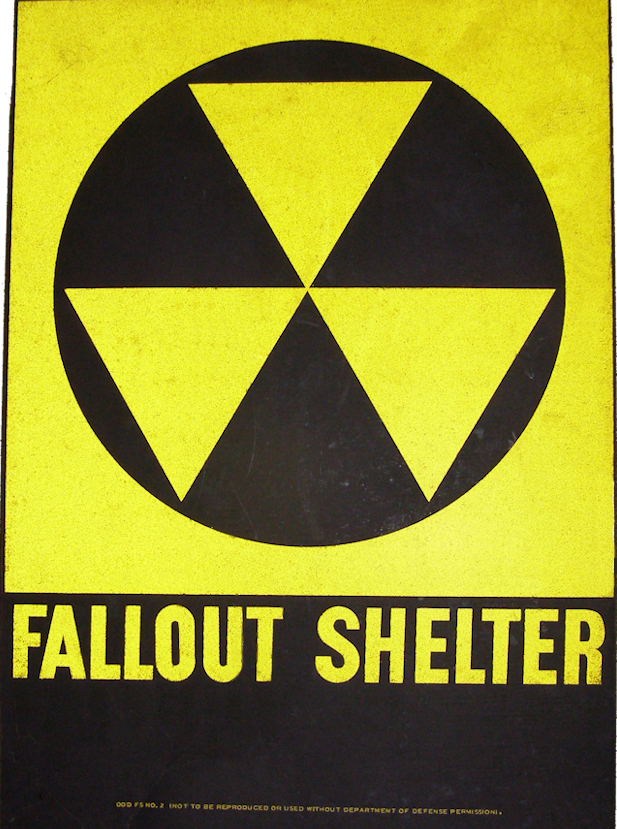
One of the most common symbols of the Civil Defense program was the fallout shelter sign. The ubiquitous signs did not appear until the early 1960s. They were posted on public and private buildings to direct the public to what were considered safe places to shelter during the time that radioactive fallout was a danger. Photo by Greg Spadoni.
Practice drills
By 1953, Civil Defense drills were held sporadically around the country. While cities had the most detailed Civil Defense drills, rural areas, including the Gig Harbor and Key peninsulas, had their roles to play too.
That year, Tacoma was about to have the first Civil Defense drill in the state of Washington. An alert to the upcoming event was published in The Peninsula Gateway on Dec. 4, 1953. The article started off with a real attention-getter:
Gig Harbor and the peninsula area will join with Tacoma in the Civil Defense Drill to Take place on Monday, Dec. 7, when an imaginary atom bomb will explode over So. 38th and K streets in Tacoma.
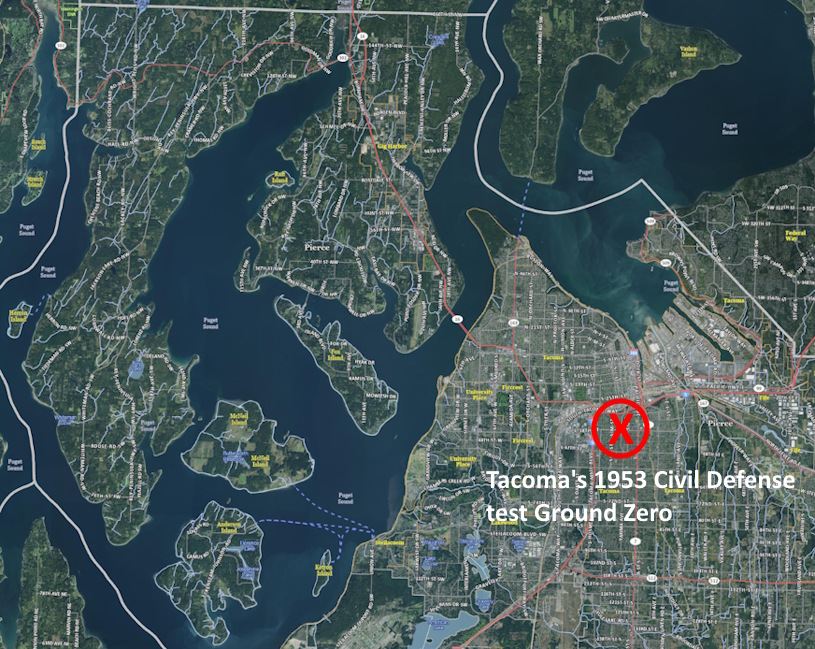
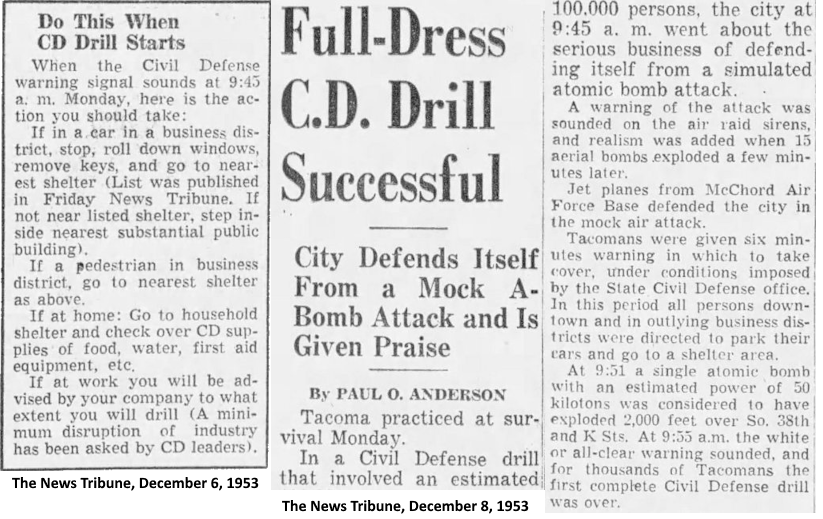
Tacoma’s 1953 Civil Defense drill was structured around an imaginary 50 kiloton atomic bomb, which is extremely small by today’s standards. Ground Zero was 2,000 feet above South 38th and K streets. Pierce County Assessor-Treasurer aerial base map.
Civil Defense drills always started off with air raid sirens, which were tested regularly. So accustomed were people to the familiar, yet ominous, rising and falling whine that the article didn’t need to mention that the warning to be given was the sound of the sirens.
The drill will start with a warning at 9:45 a.m., followed by the imaginary bomb explosion at 9:51. During this period, all persons here on the peninsula are asked to co-operate with local Civil Defense authorities as though the danger were real. It is particularly important that the telephone lines be left free during this period, and unless the need for a call is urgent, do not use the telephones.
The drill was designed to last 10 minutes. That’s not long, but there were to be definite disruptions to life on the peninsulas during that brief period.
Two road blocks will be in operation during the 10-minute period at which time traffic will be halted by civil defense workers. These are to be set up at the west end of the Narrows bridge [the Gig Harbor side] and at the Purdy Junction [the intersection at the east end of the Purdy Bridge] on the Bremerton highway. Cars will be stopped just long enough to explain the purpose of the drill, then allowed to continue on.
Can you imagine that happening today?
Heading the drill in this area are [Gig Harbor] Mayor Harold H. Ryan, Deputy Civil Defense Director, and R. Roy Smith, Civil Defense Director for the Peninsula and Gig Harbor areas. They will be assisted by the district wardens, local law enforcement officers, and several members of the local fire department.
A new danger
Following the primary purpose of bombs in general (the blast), the secondary consequence of an atomic bomb explosion is the nuclear fallout — the radioactive debris thrown into the air. It was always a major consideration during civil defense drills.
Several hypothetical problems have been posed by the “bomb explosion”, Mr. Smith has pointed out. In case of a southwest wind, radio-active dust from the “point of impact” in this drill would sweep across the narrows and be deposited here on the peninsula.
The tertiary consequence is the same as with conventional warfare — refugees.
Another problem would arise in case the Narrows bridge was destroyed. This would call for evacuation of Tacoma residents, by boats, to points here on the peninsula, plus the tremendous task of supplying them with housing facilities and a food supply. Though this may never happen, the fact that it could makes all the more important the need of planning in advance and training a corps of volunteer civil defense workers for such an eventuality.
Speaking of a food supply for nuclear war survivors, on a different page in the same issue of The Peninsula Gateway, there was this friendly public service reminder, from the national office of Civil Defense:

Civil Defense was a very serious business.
As it turned out
The results of the Civil Defense drill were reported in the following week’s Peninsula Gateway. While not a failure, the exercise was not a complete success. But that’s the whole point of drills — to find out what needs improvement.
Last Monday’s Civil Defense drill, held here in conjunction with the large scale drill in Tacoma, was carried off as well as could be expected in an initial effort of this kind, according to R. Roy Smith, Civil Defense director for this area. Particularly praiseworthy, Mr. Smith reported, were the efficiency of the road block crews…
The drill emphasized the fact … that more arrangements will be necessary to make for a full co-operation between C. D. personnel and the fire department, which both are trying to give but find impossible until proposed arrangements are fully developed.
— Greg Spadoni, Oct. 19, 2026
Greg Spadoni of Olalla has had more access to local history than most life-long residents. During 25 years in road construction working for the Spadoni Brothers, his first cousins, twice removed, he traveled to every corner of the Gig Harbor and Key Peninsulas, taking note of many abandoned buildings, overgrown farms, and roads that no longer had a destination. Through his current association with the Harbor History Museum in Gig Harbor as the unofficial Chief (and only) Assistant to Linda McCowen, the Museum’s primary photo archive volunteer, he regularly studies the area’s largest collection of visual history. Combined with the print history available at the museum and online, he has uncovered countless stories of long-forgotten local people and events.