
Community
Gig Harbor Now and Then | Log pirates and brand identification
The Gig Harbor Now and Then questions of local history on June 15 concerned the logging industry. In 1890, a law was passed requiring all logs transported in rafts on the waters of Washington west of the Cascade Mountains to be identified with the owner’s mark. The questions:

Community Sponsor
Community stories are made possible in part by Peninsula Light Co, a proud sponsor of Gig Harbor Now.
What kind of identification was specified?
Answer: A brand, struck into the thick end of the log.
No doubt many readers already knew that, because Gertie Jackson has been advertising it on her whistle-stop reader board for over a month.
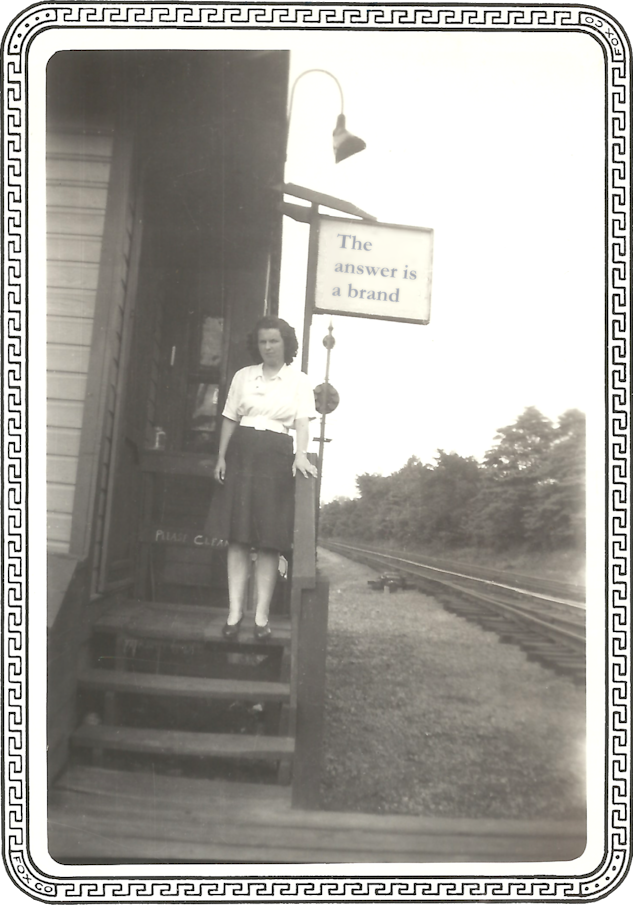
Why was the law enacted?
Answer: While a brand on every log was the only way to identify logs lost from a broken raft, the actual reason for the law was to combat theft.
Log pirates had been a common problem on Puget Sound for many years. Under cover of darkness or the solitude of an isolated cove, log thieves would steal individual logs or sometimes entire rafts.
Even after the practice of branding was adopted, log pilfering was so lucrative that it began to run rampant on Puget Sound. No place on local waters was safe.
Dominic Cavelero, the owner of the Gig Harbor Timber Company, which logged near Gig Harbor by rail from 1909 to 1911, spoke about the problem in a courtroom under questioning by his attorney.
When asked if logs were ever lost out of a boom in general, Cavelero answered in his thick Italian accent (yes, Gig Harbor’s most famous logger was an immigrant from Italy), “I lose lots of logs.”
Asked if logs were ever stolen out of a boom, he said, “A man got to be there all the time to look after them.”
Cavelero went on to say that after having eight sections of a 22-section raft stolen from one of his camps before he started logging in Gig Harbor, he made it a practice to pay watchmen to keep an eye on his dumping grounds.
The maritime log thievery became worse as the years passed, until a group of lumber companies created a state log patrol in the 1920s.
Branding the stock
Log brands look much the same as those on cattle. But instead of being imprinted with a red-hot branding iron, the thick end of each log is struck with a cold brand — either by a heavy hammer that has the identification symbol welded to its face, or with a separate iron struck by a hammer. The resulting indentation identifies the log’s owner.
Branding allows logs scattered from broken rafts to be returned to their rightful owner. It also helps in the return of stolen logs, providing they are recovered before the thief has sawed the branded end off each one.

The Spadoni Brothers’ log brand features the lower half of the S sharing a curve with the upper half of the B. It was designed in 1946 by Margaret Spadoni, the wife of Julius. This imprint was made by their son Roger Spadoni, the current owner of the branding iron, in 2024. Photo by Greg Spadoni.
Log branding is required to this day, though few logs are transported in rafts anymore.
Originally, all log brands were registered with the county in which they were used. They are now registered with the state.
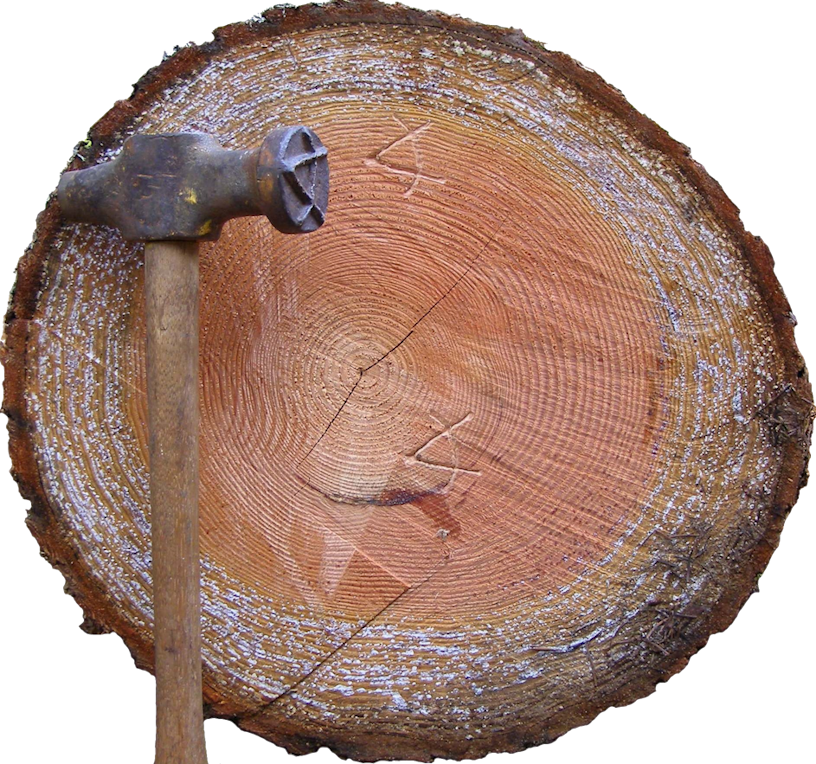
Some log branding irons were welded onto the face of a heavy hammer. This one is from the collection of Steve Spadoni. Photo by Greg Spadoni.
Finding a specific brand
It’s very difficult to find out what log brand was used by which logging camp back in the days when they were registered in counties. Pierce County has a number of them on file, but not in a very organized fashion.
The only local brands I was able to find in the county records are two for the Kangley Timber Company, which logged in South Rosedale in 1911. The following is a transcript of its handwritten registration filed with Pierce County, which includes some old-style spelling and punctuation. The image of the brands should show as actual size on larger screens:
To Whom It May Concern:
T.W. Fairchild, being first duly sworn, on oath deposes and says: that he is manager of the Kangley Timber Company of Tacoma, Pierce County, a corporation organized under the laws of the State of Washington; that Kangley Timber Company has adopted for its mark for marking logs, timbers and lumber two brands, the first being a plain letter “F” of the length of 2½ inches and the width of two inches and a plain box “K” of the length of 2¼ inches and the width of 2¼ inches inclosed in a 3 inch box, and that the following is a true and correct impression of said marks:

That Kangley Timber Company proposes to brand the impress of one of these marks upon the end of logs, timbers, shingles, poles and lumber that may be put into the waters, rivers, lakes, sloughs, and buyous in the State of Washington, as well as the waters of Puget Sound in said state, and this is notice to the public that logs, timbers, lumber, etc., so branded with either of said marks is the property of the said Kangley Timber Company.
T.W. Fairchild
Subscribed and sworn to before me this 22nd day of September, 1911.
F.A. Rice Notary Public in and for the State of Washington, residing at Tacoma. Commission expires Feb. 16, 1914
Filed and recorded at the request of C. Chapman Sep 26, 1911 at 11:30 AM.
W.A. Stewart
County Auditor, Pierce Co. Wash.
By Axel Nelson, Deputy
New business
This time the question of local history is a visual. It’s Gig Harbor Now and Then Location of Mystery No. 2. If you’d like to give it a go, focus your discerning eyeballs on this picture, and see if you can figure out where it was taken. The date range is from early 1968 to April 1969.
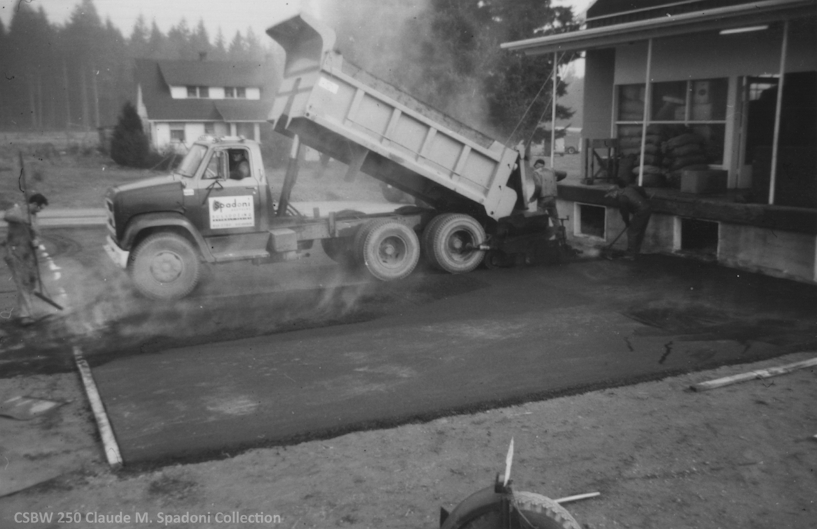
Gig Harbor Now and Then Location of Mystery No. 2 is an easy one for many long-time local residents. Photo by Claude Spadoni.
Clues? You say you want clues? I don’t think this picture needs clues. A lot of readers will know where this is without any clues. It’s obviously a picture of Spadoni Brothers asphalt paving somewhere on the Greater Peninsula (that means both the Gig Harbor and Key peninsulas).
The only person in the picture I can identify is Grant Lytle, driving the truck. It’s Spadoni Brothers’ truck number 12, a 1967 Chevrolet 70 Series tandem-axle, tandem-transmission 10-yard dump (Schetky box), 46,000 lb. GVW, with a Detroit Diesel 6V-53 two-cycle diesel engine, and an inter-axle differential. (Old construction guys like to know those kinds of details.)
It’s one of those 5-speed/4-speed, 20 forward gears, 4 speeds in reverse arrangements I described in Gig Harbor Now and then No. 75. It’s the very truck I learned to drive such transmissions on, a few years after this picture was taken.
Now that I’ve had a minute or two to reconsider, I’ll give a clue. One of the two buildings in the picture still stands today. I’m hoping it’s unnecessary to say the other does not.
The question of the week:
Where is Gig Harbor Now and Then Location of Mystery No. 2?
Next time
In addition to having the answer to today’s question, the July 13 installment of this column will also tell the story of the Bay-Island District. Where it was, when it was, why it was, what happened to it, and the reason it’s hyphenated will all be explained.
The only thing that won’t be explained is why you need to know anything about the Bay-Island District.
That’s because you don’t need to know about it. It’s not important, it’s not information you can use, and there will be no quiz at the end.
It’s just interesting, that’s all. That’s reason enough.
— Greg Spadoni, June 29, 2026
Greg Spadoni of Olalla has had more access to local history than most life-long residents. During 25 years in road construction working for the Spadoni Brothers, his first cousins, twice removed, he traveled to every corner of the Gig Harbor and Key Peninsulas, taking note of many abandoned buildings, overgrown farms, and roads that no longer had a destination. Through his current association with the Harbor History Museum in Gig Harbor as the unofficial Chief (and only) Assistant to Linda McCowen, the Museum’s primary photo archive volunteer, he regularly studies the area’s largest collection of visual history. Combined with the print history available at the museum and online, he has uncovered countless stories of long-forgotten local people and events.