
Community
Gig Harbor Now and Then | The aftermath of the Harbor Inn dump truck crash
In March 1989, a dump truck loaded with logs crashed through the street end of the Harbor Inn Restaurant in Gig Harbor, killing one and injuring three.

Community Sponsor
Community stories are made possible in part by Peninsula Light Co, a proud sponsor of Gig Harbor Now.
Part 1 covered my participation in the cleanup of the mess on the first day, beginning several hours after the accident happened. It included the partial demolition of the building and recovery of the truck.
The conclusion details my participation on the second and third days of the exterior cleanup.
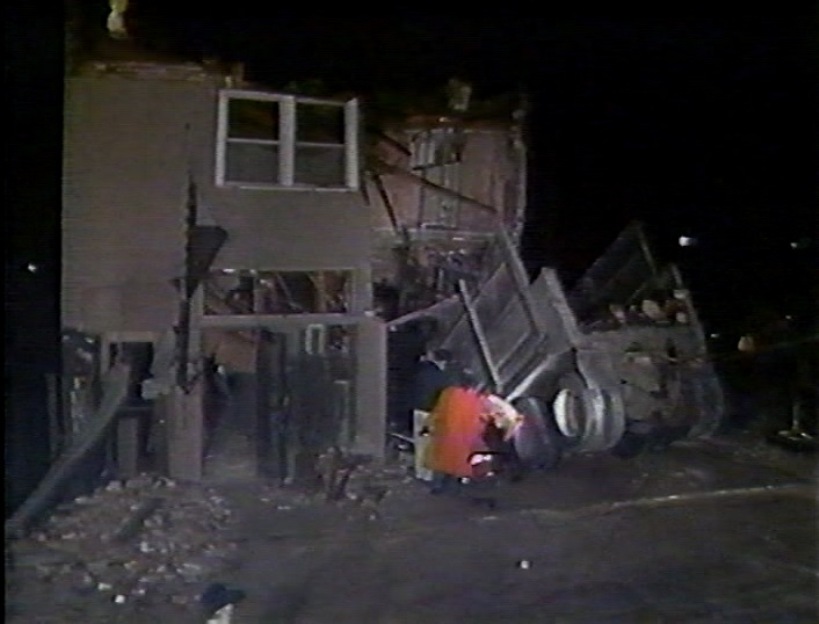
The dump truck was pulled out of the basement of the Harbor Inn after dark. Video screen shot provided by Gary Lodholm.
More waiting
After having been on the job until about midnight on the first day, I was back on the site at eight o’clock the next morning. I spent the entire second day in the loader, mostly waiting to occasionally sweep the debris off the street as the crane continued the partial demolition in preparation for rebuilding.
Unlike the previous day, I didn’t pull the nails from the loader tires after every push of the debris into the big pile. That morning, before I left Spadoni Brothers’ office for the job site, Roy Spadoni told me that as big as some of the nails were, they were not going to fully penetrate the thick, hard-rubber tread and multiple cords of the big tires, so I pulled them out only at the end of the day.
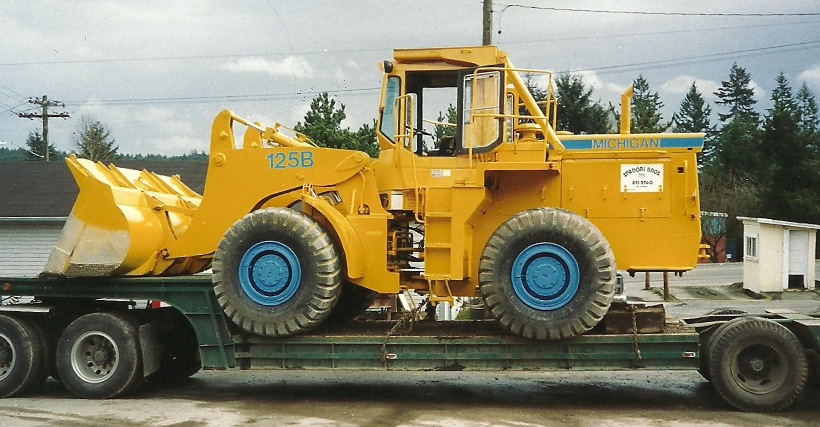
The many nails picked up by the tires of Spadoni Brothers’ loader didn’t cause any problems. Photo by Barry Chunn.
The return of the curious
The crowd of spectators that had dwindled to virtually nothing by the time the truck had been pulled out of the building the previous night reformed in the morning. They were there to watch the continuing demolition. I don’t think it included as many people as the day before.
On that second day, Fire District 5 was on the scene again with both professionals and volunteers. The professional firefighters, with Erik Pearson in charge, were all business. Efficient, and very safety-minded in their work, they helped cut apart the building so that no more than necessary was torn down. Everything went smoothly. The volunteer firefighters, once again having something to do, were very helpful, and did not get in my way.
Personal possessions trashed
The owner of the building, Bob Drohan, showed up at the site the second day. He stood by for a while watching the work, and he looked to me as if he were absolutely stunned by what he was seeing. He’d lost his business, his home, and worst of all, he’d lost an employee. Now he was watching his building (and home) being partially torn down.
The Drohans lived on the second floor and as the clam bucket of the crane took bites out of the second story, sometimes their personal possessions would be swung out over the intersection and dropped in the street. Clothes, furniture, light fixtures, bedding and the like all ended up on the pile of trash.
When the crane grabbed Mr. Drohan’s necktie rack and swung it over the intersection with many colorful ties dangling from the bucket, the crowd cheered. Mr. Drohan finally broke a smile.
I had intended to sweep the pile off the street after that drop by the clam bucket. Instead, I kept my eye on Mr. Drohan. I didn’t know if he wanted to retrieve the ties, but I deliberately gave him the opportunity. A couple of them may have been smunched, but the majority were in perfect shape. He didn’t, and the next bucket of debris dropped on top of the previous one took away the option. I pushed the small pile onto the big pile off to the east side of the building and the ties were never seen again.
More news coverage
KOMO TV 4 in Seattle sent a reporter and cameraman to the site on the second day to take video of the demolition. I saw myself on the evening news that night, operating the loader. After watching the cameraman do multiple setups to take video, I found it interesting to see how it was edited together.
Meals on wheels
Sometime on the second day, a two- or three-person team of Salvation Army volunteers in a small van brought sandwiches and coffee to the site. I kinda scratched my head over that. While I don’t know about the other workers there, I’d brought my lunch that day, just like any other work day. The night before is when we could’ve used some food, being required by the State Patrol to stay on the site almost until midnight, without a bite to eat. Anyway, I took one of their sandwiches during some downtime, just to be nice. Plain baloney on dry white bread. They meant well.
I ate my lunch from home while sitting in the loader, waiting for my turn to do something. I then spent my lunch break sampling a wide variety of flavors in the Ol’ Ice Cream Saloon across the street (unless the name had already changed to A. J. & Charlie).
The partial demolition of the Novak building was completed by the end of the second day.
Recycling on day three
I spent the third day loading the big pile of building debris into trash trailers from the Lige & Wm. Dickson Company in Tacoma. I don’t know where they hauled it to. Somewhere on the other side of the Narrows, I suppose.
There weren’t many spectators on the third day, and most of them didn’t stay very long. All the excitement was over. Among the few who did stay was a small family of junk pickers who arrived in an older, beat-up pickup truck, parked on Harborview Drive in front of what is now the Russell building. They had their eyes on the copper wire, copper pipes, and various pieces of aluminum that were mixed in with the other debris in the pile I was loading out.
Not the shy type, the shorter of the two scruffy men in the group approached me in the loader while I was parked off to the east side of the building, waiting for another truck and trash trailer to arrive. At my motioned invitation, he climbed the steps up to the cab of the loader. He asked me if they could take the recyclable metals out of the pile.
I sympathized with the guy. It was all going to be loaded out and taken to a dump. If he didn’t get any benefit out of selling the metals for recycle, no one would. I wanted to see the scrap salvaged, for it would be a shame for it to go to waste. But I didn’t have the authority to tell him he could take it.
I told him that I was not in charge, so couldn’t give him permission to save the scrap metal. He understood. I then told him that if he could do it without getting in my way, I wouldn’t tell him to leave. He understood that, too. So, he and his partner started in, being very careful not to get in my way. The rest of the family stood well back, near their pickup truck, and watched.
I suspected that anyone working inside the building, or who happened to show up on the site, would simply assume that the pickers were either working with me, or that I had given them permission to salvage the scrap metal, so wouldn’t chase them off. I must have suspected correctly, for nobody else ever approached them. With no one hassling them, and me stirring the pile every time I loaded a truck, uncovering more to salvage, they made a pretty good haul.
I, too, salvaged a piece of the building. Between loading trucks, I took a short 8×8 timber from the pile of debris and set it aside. I used it as an extra vertical support in my basement.
Gross weight
The results of the weighing of the logs on the night of the crash showed that the dump truck was 10,100 pounds over its licensed weight, but that is misleading. It may not have been over its maximum rated gross vehicle weight.
With the purchase of license tabs, the biggest commercial trucks are licensed to carry a certain amount of weight. For a larger fee, they are allowed to carry additional tonnage. Nothing about the truck is any different. The only difference is the amount of money paid to license it.
The April 1, 1989, News Tribune quoted Washington State Patrol Sgt. Bob Lopez as saying the truck was licensed for 40,000 pounds. That was the gross weight before additional tonnage. At least 8,000 pounds additional tonnage could have been purchased for a few hundred dollars more. Depending on the wheelbase of the truck, it may have been possible to license it for even more additional tonnage.
Without knowing if the truck qualified for more than 8,000 pounds additional tonnage, it’s not possible to say if, at a gross weight of 51,000 pounds, it was overloaded according to its rated capacity. The specific wording used in the April 1, 1989 News Tribune, “10,100 pounds over its licensed capacity of 40,000 pounds,” is ambiguous.
Unclaimed cargo
Until the conclusion of legal proceedings against the driver and the owner of the crashed truck, the logs (dumped at Spadoni Brothers’ asphalt plant in Crescent Valley) were still considered to be evidence. Later in the year there was some talk of the owner’s attorney wanting to have them weighed a second time. But because they were green (freshly cut) when the crash happened, by the end of the summer they were considerably lighter in weight, having dried out during the warm weather. To weigh them a second time, that much later, would’ve been pointless. Dry Douglas fir can weigh as much as 20% less than green, and hemlock loses an even larger percentage.
When the logs were no longer needed as evidence, the owner of the crashed truck never showed up to reclaim them. Before they could sit untouched for another year, Kevin Meyer and Leonard Spadoni cut them up for firewood.
Resurrection
The Harbor Inn was rebuilt by Wade Perrow Construction during the rest of 1989. It reopened in early 1990.
A brick planter, shorter than the one there today, was built between the sidewalk and the street to prevent another vehicle from hitting the building. It was proved to be spectacularly ineffective when a Subaru — weighing less than one-twelfth of the dump truck loaded with logs — plowed through it at a high rate of speed in 2008, ending up deep inside the building.
The current, taller brick planter replaced the shorter one. According to the very simple plans sent to me by the city of Gig Harbor at my request — which they claim is everything they have on the structure — it’s just a decorative planter, not any kind of a serious barrier. It would certainly stop a slow-moving vehicle, so does add some protection for pedestrians on the sidewalk.
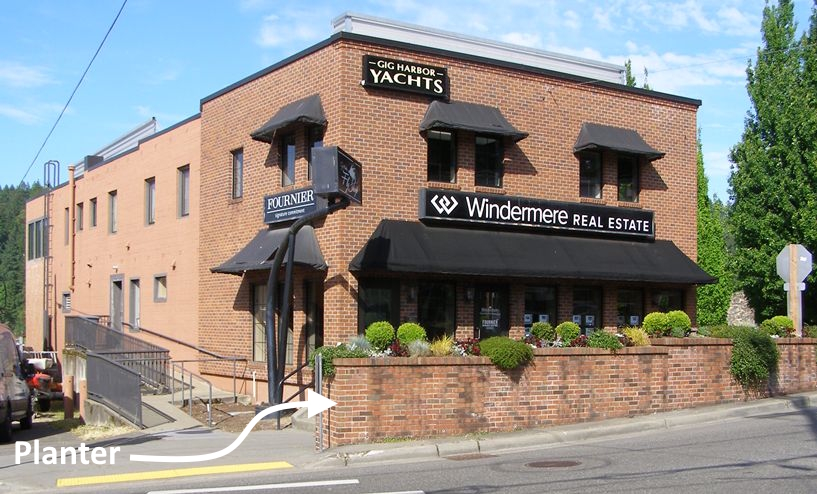
The brick planter in front of the building today is not a serious barrier to out-of-control vehicles, but it looks nice. Photo by Greg Spadoni.
Lawsuits and prosecution
The Drohans later sued the city of Gig Harbor over the accident. That and several related lawsuits were settled out of court in 1992, with the results sealed from the public.
The city posted steep-grade signs at the top of the hill on Pioneer Way and at other hills in town.
The driver of the dump truck was charged with vehicular homicide, and the truck’s owner was charged with aiding and abetting a vehicular homicide. In a jury trial in April 1990, both were acquitted of those charges, but found guilty of the lesser crimes of negligent driving and aiding and abetting negligent driving. They were each fined $250.
Next time
On May 18, the subject of this column will be whales. Local whales, to be specific. Contrary to journalistic habit — because I’m not a journalist — there will be no annoying, cutesy headlines or subheads like, “It’s a whale of a story,” or “They had a whale of a good time.”
There will also not be any contrived elements, such as introducing a fictional monkey and making a bad pun by calling it a lip-smacking story of fish and chimps. Instead, it’s a straightforward, no-nonsense chronicle of local history, to the very end. Almost.
— Greg Spadoni, May 4, 2026
Greg Spadoni of Olalla has had more access to local history than most life-long residents. During 25 years in road construction working for the Spadoni Brothers, his first cousins, twice removed, he traveled to every corner of the Gig Harbor and Key Peninsulas, taking note of many abandoned buildings, overgrown farms, and roads that no longer had a destination. Through his current association with the Harbor History Museum in Gig Harbor as the unofficial Chief (and only) Assistant to Linda McCowen, the Museum’s primary photo archive volunteer, he regularly studies the area’s largest collection of visual history. Combined with the print history available at the museum and online, he has uncovered countless stories of long-forgotten local people and events.