
Community Education
Peninsula School District students help draft proposed AI bill for nation’s K-12 schools
As politicians and AI industry leaders debate the relative promise and perils (some say existential risks) of artificial intelligence, two high school students from Gig Harbor joined peers representing all 50 states to draft proposed legislation on how AI should be deployed in K-12 schools.

Community Sponsor
Community stories are made possible in part by Peninsula Light Co, a proud sponsor of Gig Harbor Now.
Their draft bill, The Students First Act, puts forth guidelines and policy recommendations for students, educators and parents. Students hammered out the nine-page document over two days in July at America’s Youth AI Festival in Boston.
The event was hosted by the nonprofit Day of AI, whose aim is “to equip educators, students and families with the tools to understand, use and shape artificial intelligence responsibly.”
Roadmap for AI in schools
Day of AI sent the Students First document to more than 10,000 public school districts nationwide as recommended policy and to members of Congress as proposed legislation.
“It was pretty amazing to see so many students from across the country so passionate about AI policy in schools,” said Sophia Fenn, a Gig Harbor High School senior who represented Washington state at the festival alongside Kainoa Coit, a Peninsula High senior.
Accompanying the students were principal Bob Marshall and assistant principal Tori Fairweather, both of GHHS.

From left, Gig Harbor High assistant principal Tori Fairweather; GHHS senior Sophia Fenn; Peninsula senior Kainoa Coit; and GHHS principal Bob Marshall at the AI conference.
Reps for Washington state
The School Superintendents Association, one of the festival’s partner organizations, invited PSD Superintendent Krestin Bahr to select two students from her district to represent Washington state during the Day of AI event. She tapped Fenn and Coit.
PSD Chief of Schools Michael Farmer wrote in a news release that the superintendents association selected PSD “because our work with AI is recognized nationally.”
Meet the ‘senators’
Fenn first heard about AI during the pandemic, when learning went online. She leans AI-skeptical but doesn’t fall into the doomsayer camp. She sees the enormous potential of AI, especially in the field of health care, and she firmly believes students need a strong grounding in AI literacy.
“It’s something that can be really useful, but it can also get really dangerous if we just use it to completely take away our idea processing,” she said.
That’s a sentiment many students share, according to a survey she sent to her peers, teachers and community members before the festival. Students are open to using AI but want to express their own intellect and creativity, she found.
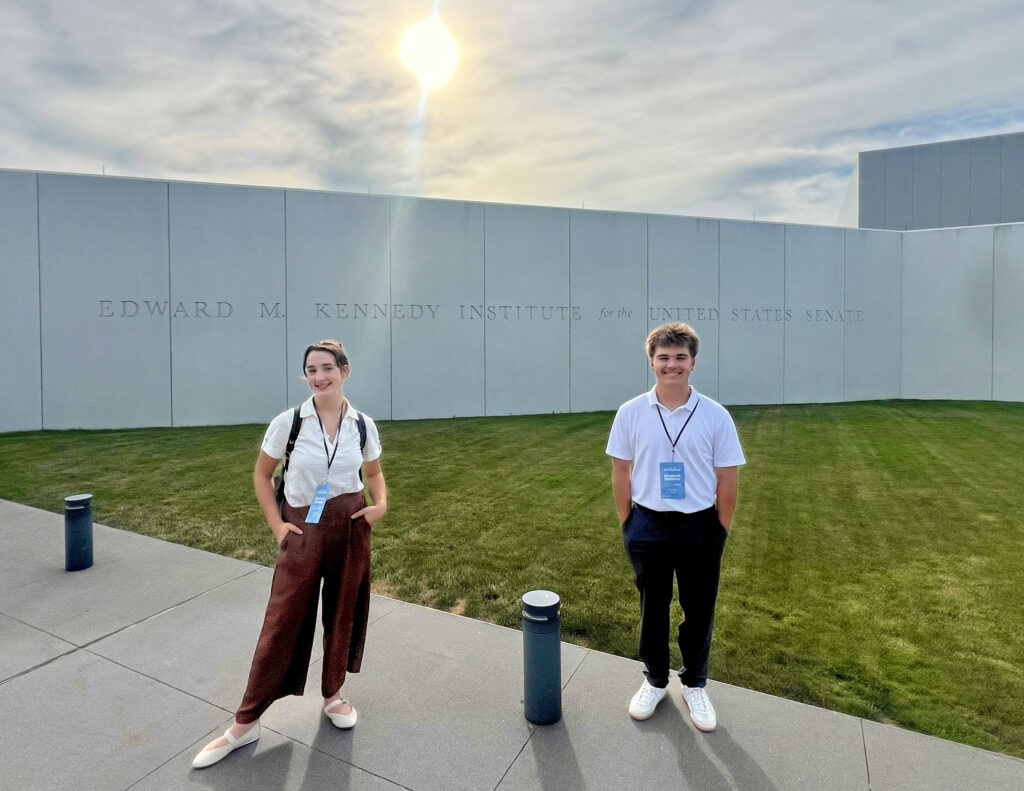
Sophia Fenn of Gig Harbor and Kainoa Coit of Peninsula, both seniors, represented Washington state at the national AI conference.
Coit also reached out to constituents before the event and found students’ experience and views on AI to be a “mixed bag.”
“It was kind of tough because some students use AI a lot, and then some students rarely use it, from my experience,” he said. “So, I wanted to make sure I represented everybody and kind of found the middle ground.”
A student ‘Congress’
The Students First Act aims to provide clarity and consistency in an education landscape where school districts have tackled AI in wildly different ways. Some, like Peninsula School District, have embraced AI as an inevitable and potentially promising technology that will be embedded in all aspects of our lives going forward. Many, however, lack formal policies on AI.
Day of AI asked students to do advance research, including constituent surveys. Fenn and Coit took that on in the latter part of their junior years, amid already busy academic schedules and extracurricular activities. Fenn dances at a local studio. Coit plays for the Peninsula football team.
The Inaugural Student Senate convened on July 18 at the Edward M. Kennedy Institute for the U.S. Senate. In committees, they debated safety, privacy, equity, AI literacy, teacher training and the appropriate role of technology in learning.
What’s in the bill?
The Students First Act includes common-sense provisions on issues like plagiarism and bullying. But it digs deeper. For example, students should be ready to give an oral defense of work produced using AI to demonstrate mastery of the subject. They should have the right to appeal wrongful convictions of AI use. Schools should guarantee that two teachers or administrators, and not an AI checker, will review their work.
Throughout deliberations, the Student Senate focused on fairness, transparency and consequences for misuse, both Fenn and Coit said. Subcommittees drafted provisions for students, teachers, parents and administrators.
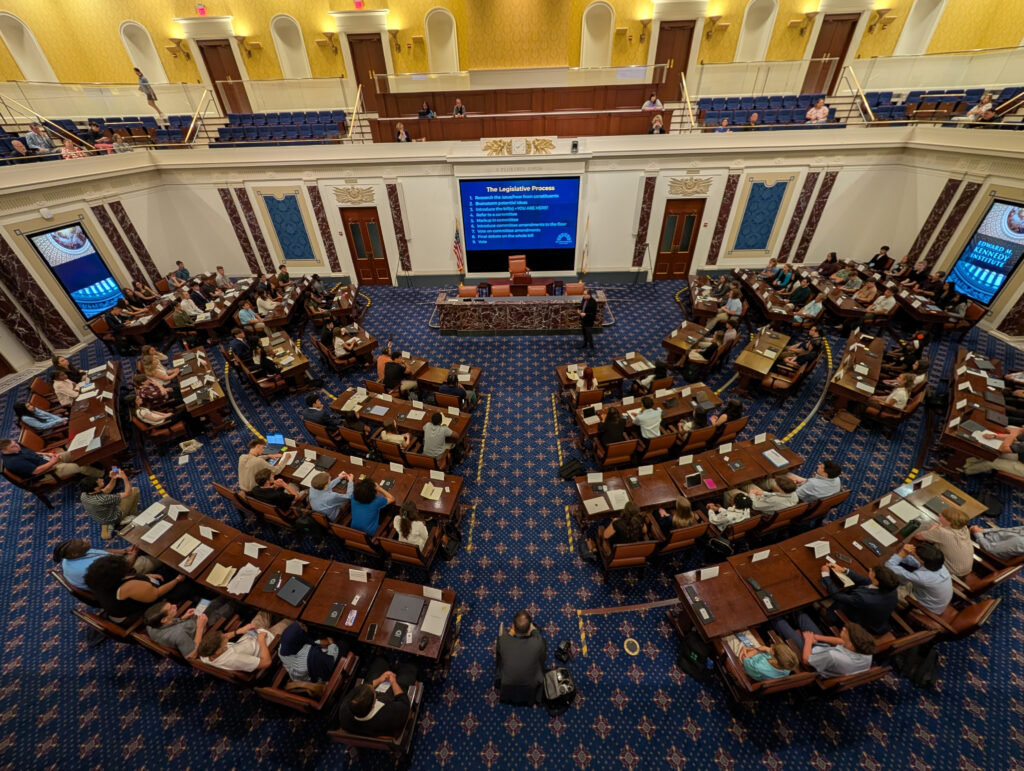
Students deliberated AI policy in a full-sized replica of the U.S. Senate chamber.
“I chose teachers because I thought the teachers have a greater impact of AI usage,” Coit said. “And the things that they can use AI for are super-influential to the students.”
The committee tried to strike a balance between preserving teachers’ autonomy when it comes to using AI and ensuring clarity and consistency for students, Coit said. For example, “Teachers must outline a clear written AI usage policy in their course syllabus at the start of each semester, explicitly stating when AI is permitted, restricted, or banned for specific assignments. The AI rules should be consistent across different classes in the same course or subject, varying by school size.”
How did they vote?
Student senators passed The Students First Act on July 18, 84-14, following a whirlwind of deliberations, amendments and floor speeches arguing for and against the bill.
Both Fenn and Coit initially leaned toward voting “no.” But arguments from their peers, to not let the perfect by the enemy of the good, swayed them. If students had not passed the bill, the conference wouldn’t have forwarded it to Congress. Senate members will continue to refine language in the bill.
“Ultimately, like our leaders reminded us throughout the conference, this draft bill is not expected to be completely perfect,” Fenn said. “We only had two days to work on this, and I can confidently say I feel like this bill will continue to improve and help our students across the country gain a better understanding of AI usage and consequences of overusing it.”
The festival included presentations of AI-enhanced visual and performing arts, and student-developed innovations, such as a low-cost, AI-enabled drone capable of locating natural disaster survivors in real time.
AI, the big picture
Coit said a sense of urgency influenced his ultimate “yes” vote. He says the rapid advancement of AI caught the education system and the country as a whole flat-footed. He predicts proficiency in AI will soon be an expectation regardless of career field. On the other hand, AI unchecked could wreak havoc throughout society, he said. “It needs to be addressed immediately.”
As for doomsday scenarios and international policies, Fenn said, “I think that we need to stop trying to work on being the fastest in productivity but be the smartest in ultimately how we’re going to develop AI. If we want to really be better than China, then I think that we need to be smarter instead of just faster.”
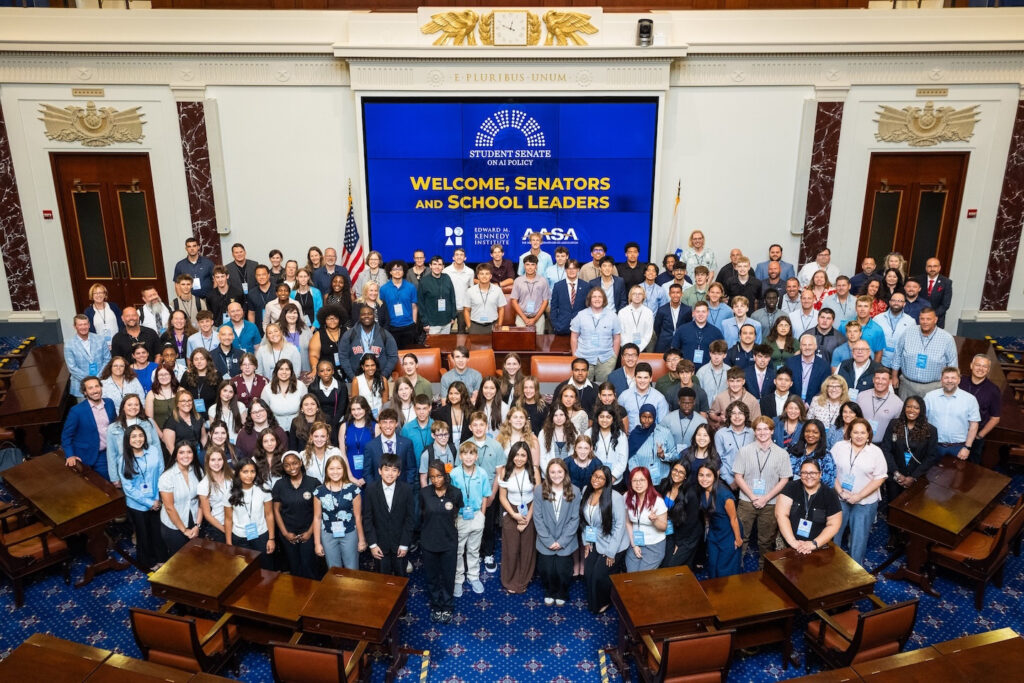
Students representing 50 states gathered at America’s Youth AI Festival in Boston in July to draft proposed legislation and policies governing artificial intelligence.