
Community Education
Peninsula School District taps the brakes on screen time for students
More writing with pencils and paper, more flipping through the pages of a book. Less screen time, less learning via digital apps.
That’s the vision of Peninsula School District for students, especially in the youngest grades, for the upcoming 2026-27 school year.
District leaders, responding to concern from parents over screen time in schools, are tapping the brakes on the use of digital technology in teaching and learning.
“I’ve had more calls this year than I probably ever have in my career with parents that want to talk about, you know, what are students doing on devices?” Kris Hagel, chief information officer, told the school board on March 17.
Hagel and John Yellowlees, chief academic officer, outlined changes coming next year aimed at reducing the amount of time students spend on devices and being more “intentional” about how technology is used in the classroom.
K-4 laptops won’t go home
Yellowlees said the shift toward less screen time has already begun in the primary grades thanks to the district’s new English Language Arts curriculum, which is heavy on “physical materials, storybooks, workbooks, and pencil-and-paper tasks.”
The district found that iPads assigned to kindergarten classes aren’t being used very much, so they’ll be redeployed, most likely at the high school level. Kindergarteners, as a rule, will not have devices.
Students in first through fourth grades will no longer bring their devices home “unless there’s some deliberate instructional need for that to happen,” Yellowlees said. “So, devices can remain at school, be charged at school, be safe at school, and again, we’d recommend those not going back and forth from home as they have done in the past with our current model and our Chromebooks.”
Standardized testing will still take place on digital devices.
Not a babysitter
As part of the districtwide conversation on technology and learning, Yellowlees said, teachers are reflecting on how they use screen time.
“Technology should not be a babysitter or used as a reward,” he said. “Again, it should be for the purpose of learning and instruction. Passive screen consumption should be avoided. We recommend not implementing that as a strategy.”
The district next year will hire a new technology instructional facilitator, an administrative position similar to one eliminated during staffing cuts in 2023. The new hire will support teachers and students in appropriately using technology for teaching and learning, Yellowlees said.
Chromebooks out, MacBooks in
Next year, the district will replace students’ Chromebooks with MacBooks at all grade levels (except kindergarten), Hagel said. Chromebook prices have “skyrocketed.” Meanwhile, Apple’s new MacBook Neo will save the district substantially as it moves through its routine device replacement cycle, he said.
Hagel said the Macs will meet the district’s instructional needs better than Chromebooks, and 95% of teachers are already on Macs.
“So, for them, they’re going to finally have the same platform for themselves as they do for the kids,” Hagel said. That also means teachers can help students with the learning curve as they shift from Chromebooks to Macs.
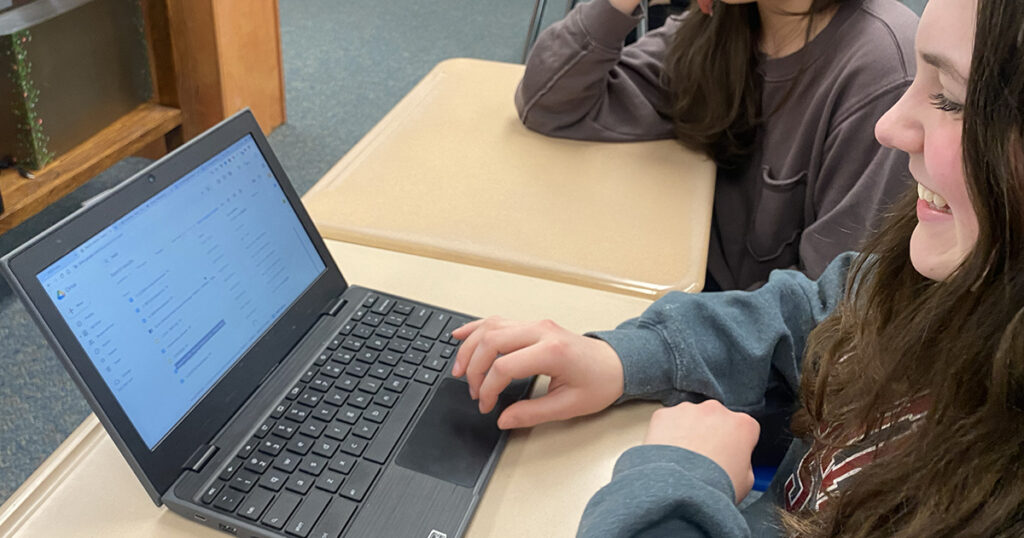
The Peninsula School District will de-emphasize use of screens in some grades next year, and replace its Chromebook laptops with Macs.
MacBook purchase approved
The school board on Tuesday approved a nearly $4.8 million, four-year, lease-to-own contract with Apple to acquire MacBook Neos for all students. Grades 1 through 12 will receive the devices this fall. The board’s resolution shows an estimated cost of just under $4.8 million and authorizes the district to take on non-voted debt up to $4.9 million.
The contract calls for a fixed interest rate of 1.7%. CFO Ashley Murphy said the district is financially better off in a lease agreement rather than purchasing the Macs outright. This way, it can invest the money it would have paid up front and meanwhile earn interest to pay for other district needs.
The district plans to resell its used Chromebooks, which are in high demand.
Personal devices banned
With the switch to MacBooks, the district next year will ban students from bringing their own laptops or other devices from home.
“In some cases, students are bringing devices to school, especially in high school, that were better than what we could offer them,” Hagel said. “And also, we were finding that that was the way that kids were getting around the cell phone ban. … They were bringing their MacBook in, and they leave their phone in their pocket, and then they can still use the messaging app to text all day long on their laptop.”
Hagel said the problem is especially prevalent at Gig Harbor High School, although it sometimes happens at Peninsula High as well. With everyone using the same, school-issued device, the playing field will be level. Teachers will also have more control over what goes on, digitally speaking, in their classroom.
“That has been one of the barriers that I hear from teachers a lot is that they just can’t manage the devices in the classroom,” Hagel said. “They can’t manage the technology if they don’t have control over what the kids are bringing to school.”
Exceptions to the ban will be made for students with disabilities whose individualized education plan calls for a device.
Tracking digital usage
Hagel said the district has been working with the teachers union to plan for upcoming changes. New technology allowing teachers to filter and monitor students’ digital activity is continuously rolled out as upgrades arrive, he said. The district hopes to provide data about digital activity to parents.
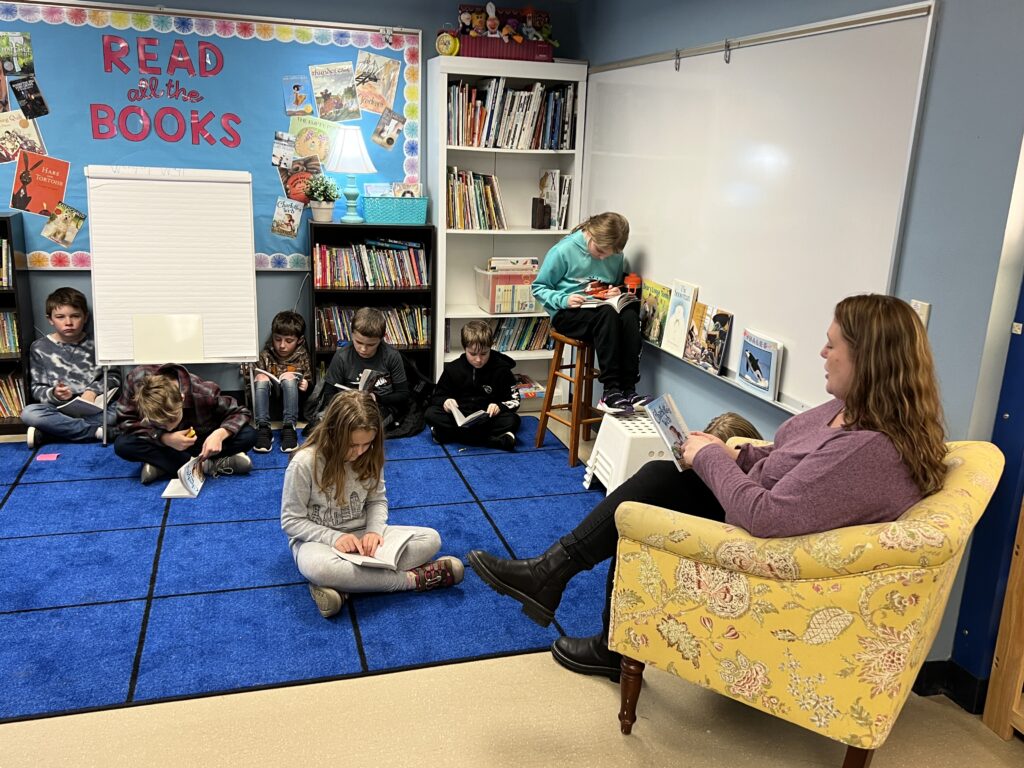
New English curriculum in elementary school is already scaling back use of screens and encouraging reading physical books.
“Some of our technology partners are really kind of digging in to this, because they’re seeing the trends nationally of having these conversations,” Hagel said. “And so, a lot of them are going to be releasing some usage reports and transparency reports that we’re going to be able to publish to parents next school year around what kids are actually doing in the classroom.”
Screen time guidelines
Hagel said the trend away from digital learning is a national conversation that began after the pandemic, with widespread complaints of screen fatigue. The district cites the American Academy of Pediatrics, whose guidelines say it’s not how much time kids are spending online that matters, it’s what they’re doing with that time.
According to the AAP, it’s tempting to set number of screen time minutes or hours per day that is “safe” for children or teens. But there isn’t enough hard evidence showing a benefit from specific screen time limitation guidelines.
Children and adolescents use screen media for a wide range of activities: school, work, connecting with friends and family, entertainment, learning new hobbies and creative expression, the AAP says. The relationship between screen time and negative outcomes in health or wellbeing is complex and depends on many factors. For that reason, “we recommend considering the quality of interactions with digital media and not just the quantity or amount of time.”
The AAP offers a template to create a Family Media Plan with your children that’s in line with your family’s priorities, values and routines.
Contact Hagel at [email protected]. Contact Yellowlees at [email protected].