
Community Environment Government
Council mixed over North Creek culvert replacement project options
To save time and money, the city of Gig Harbor may tackle replacing the North Creek culvert and revamping nearby remote site incubators for salmon eggs as two projects, instead of one.
City staff recommended doing so during a City Council study session meeting on May 14. The recommendation aligns with the Washington Department of Fish & Wildlife’s suggestion for the project.
But not every member of the council is on board. Councilmember Le Rodenberg expressed opposition and suggested scrapping the in-progress project if it didn’t include remote site incubators or a similar replacement. Other council members supported the idea.
History
The city has been in the process of designing a bridge to replace the culvert after WDFW found that it creates a barrier for returning salmon and causes other detrimental knock-on effects.
The city hired planning firm Parametrix to study possible replacements, and ultimately chose a bridge.
Steve Seville, Parametrix’s director of salmon recovery, explained to council members last October that including remote site incubators, or RSIs, would require new permitting and be more expensive. The original project did not call for permitting the RSIs.
The Gig Harbor Commercial Fishermen’s Club installed the incubators in the 1970s and operated them for years, accepting eggs from WDFW. However, the incubators have been idle since the onset of the COVID-19 pandemic. Updated state law requires new permitting to replace the incubators.
Lengthier project timeline, higher costs
Staff estimate that replacing the culvert alone will cost $9 million. Gig Harbor plans to pursue grant funds to cover half that, with the city picking up the rest.
Folding in the RSI replacement would reset the permitting process, delaying the project. It would also cost at least another $1 million to $2 million.
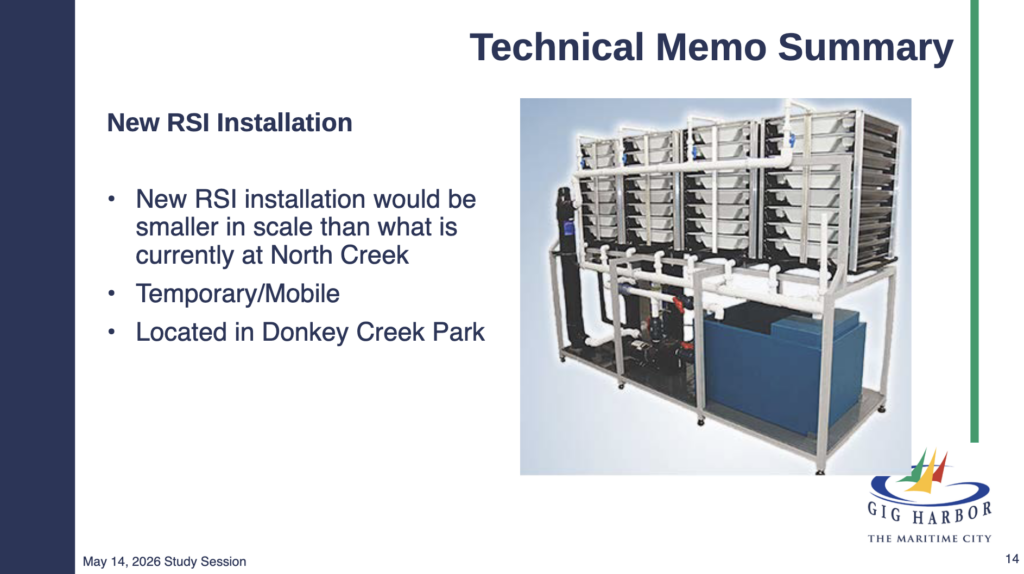
A slide from the city of Gig Harbor’s presentation.
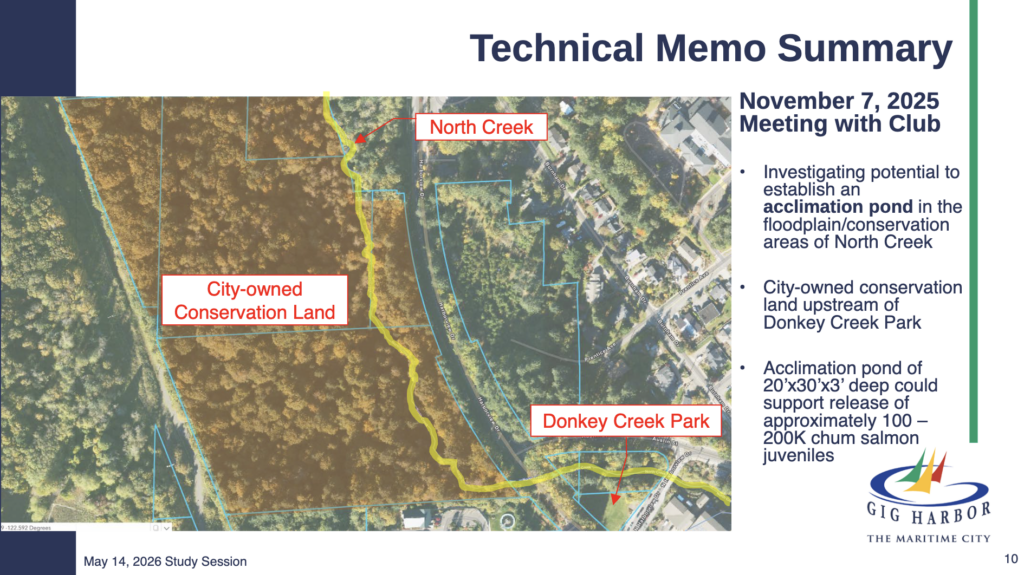
A slide from the city of Gig Harbor’s presentation.
Moreover, as city senior engineer Steven Demmer highlighted, including a new RSI would disqualify Gig Harbor from receiving a $5 million Brian Abbott Fish Barrier Grant. So would including an acclimation pond, which holds juvenile salmon until they are old enough for release into the wild.
The city needs such grants to complete the project.
“A lot of these grant programs are specifically geared towards fish-passage projects. So by introducing the RSI or an acclimation pond, it no longer becomes a fish-passage project,” Demmer explained.
Fish and Wildlife recommendation
Additionally, he said, including an acclimation pond or RSI “would disqualify the project from streamlined permitting for both the state side and the federal side. Inclusion of a pond or an RSI would disqualify the project from construction grant funding. [A] water source, such as a well, would take additional time to design and construct — not impossible, but it would cost additional money.”
The state has placed a moratorium on any new RSIs, he explained, and the likelihood of getting a pond permitted is low. WDFW recommended separating the project into two pieces to save time and money.
“This would allow us to maintain all of that streamlined permitting so we can get the project through permitting, [and it] supports timely project delivery and minimizes risk,” Demmer said. “We’ve spent a lot of time and funds on the design of this project [the culvert replacement] as well, so it would keep that project continued to the end.”
Scrap the project
Not every council member was enthusiastic about the idea.
Rodenberg that he would rather scrap the whole project, culvert replacement and all, if the city couldn’t include RSIs.
“This is not required by law. … I suggest that we don’t do the project at all. You save the $9 million. We don’t use the staff time,” Rodenberg said.
He argued that the culvert doesn’t actually block any fish.
“I’ve seen fish swimming right through that culvert. … They swim in a circle and rest,” Rodenberg said. “So, I think it’s unnecessary. I’d like to see the project stop.”
Rodenberg previously criticized Parametrix for not being a local Gig Harbor firm (it’s a national firm with offices in Washington as well as several other western states). He also suggested Parametrix had “a monetary interest” in suggesting the most expensive options possible.
At the May 14 meeting, he also criticized staff for only meeting once with the Fishermen’s Club in the last eight months.
He also lambasted staff for moving forward with the permitting process for the culvert replacement “without council input.” Demmer explained that staff wanted to ensure the project experienced no permitting pauses, even as the council weighed including RSIs, because the permitting process is so lengthy.
“If we were to pause that, that would have extended the project way, way past anywhere we would want to go,” he said. “And I want to be really clear: this project started without the RSIs. That’s how this project started. That’s how it was designed.”
Other council opinions
Councilmember Julie Martin, who indicated she favors the project, asked how the city could keep working with the Fishermen’s Club on the issue.
“As a community, do we say that Gig Harbor should be continuing to support the commercial fishermen who have done this on a very compassionate and lower-cost basis, say now that the community should be taking over for raising salmon and releasing salmon? Or are we going to look at the commercial fishermen and say, ‘Here’s a price if you want to do an RSI,’ or we do a cost-sharing?” she said. “I’m going to guess they’re probably not going to want to do that with the price of doing this now and getting these contracts.”
Even though the law does not require replacing culverts, that could change in the future, she continued.
“They haven’t confirmed it, the Legislature, that they’re going to require cities to do these replacements or counties to do these replacements,” Martin said. “So we’re trying to get in front of it to be able to get dollars and provide and do the right thing environmentally to open up these passages, which … could potentially give us more fish going into Puget Sound than potentially an RSI.”
Public Works Director Jeff Langhelm confirmed that any fish traversing the creek after the culvert is replaced likely would return to reproduce, whereas RSI salmon would be relocated. He also highlighted that “in other culvert replacement projects that are going on around Puget Sound, they are seeing salmon return.”