Business Community Government
Lodging tax panel hesitates over chamber’s request for lion’s share of available funding
The Gig Harbor Chamber of Commerce has asked the city of Gig Harbor to grant it $520,000 in lodging tax revenue in both 2027 and 2028 to support tourism marketing efforts. But that would leave only about $10,000 for other organizations’ tourism-related work before the city would have to dip into that fund’s reserves.
If the city maintains its current financial grant commitments from that fund, its reserves would be depleted within a couple years.
Lodging tax
The money for that fund and associated grants comes from lodging taxes.
State law allows cities and counties to collect lodging taxes, effectively a sales tax on stays in hotels and motels. Revenue from the so-called hotel/motel tax must be used to promote tourism or support tourism-related facilities.
In Gig Harbor, much of the lodging tax revenue goes to the Chamber of Commerce, which the city designated as its marketing organization for tourism promotion.
That’s a relatively recent designation. A city staff member performed tourism marketing functions before leaving in 2023, at which point a city resolution turned the work over to the chamber.
Committee membership
A nine-person committee called the Lodging Tax Advisory Committee (LTAC) recommends how revenue from that fund is distributed. The committee consists of a city elected official, four representatives from businesses that collect the tax, and four representatives from organizations eligible to receive tax revenue. State law dictates the committee’s membership.
Gig Harbor City Councilmember Ben Coronado chairs the committee.
Representing groups that can receive lodging tax funds are: Miriam Battson, the president and CEO of the Chamber of Commerce; Harbor WildWatch Executive Director Lindsay Stover; Harbor History Museum Executive Director Stephanie Lile, and Clare Dunis, executive director of the Gig Harbor Downtown Waterfront Alliance.
Representing businesses that pay the tax are Best Western Wesley Inn & Suites owner and operator Sue Braaten; Maritime Inn co-owner Jannae Mitton; Wells Fargo manager Kara Sandvik; and Patsy Irwin, manager of the Waterfront Inn.
Facing a potential deficit
City Finance Director Scott Larson told committee members on July 23 that his projections indicate the fund will have just $530,000 to distribute this year. The fund also has $500,000 in reserves.
“There’s also a chance that it comes in higher than expectations, and I think it’s important that the committee understands that as well,” he said. He recommended that the committee operate on the assumption that it has $530,000 to distribute. “If it does come in higher, there’s an opportunity to reallocate some of those extra dollars.”
Larson said the committee typically allocates $700,000 to $800,000 per year, “which is not sustainable. And the fund will be depleted in a couple of years if that’s maintained.”
Lile pointed out that granting the Chamber of Commerce $520,000 each year, when only $530,000 is available, might not be ideal. She also highlighted how much money the chamber received in previous years compared to other organizations, like hers.
In 2025, the city awarded $789,000 in lodging tax grants. The chamber got $500,000 of it.
In 2024, the city distributed $1.3 million in lodging tax grants. Because the city and the chamber shared marketing and tourism work that year, the chamber received $275,650. The city spent $199,400 to co-operate on tourism and marketing activities, for a total of $475,050.
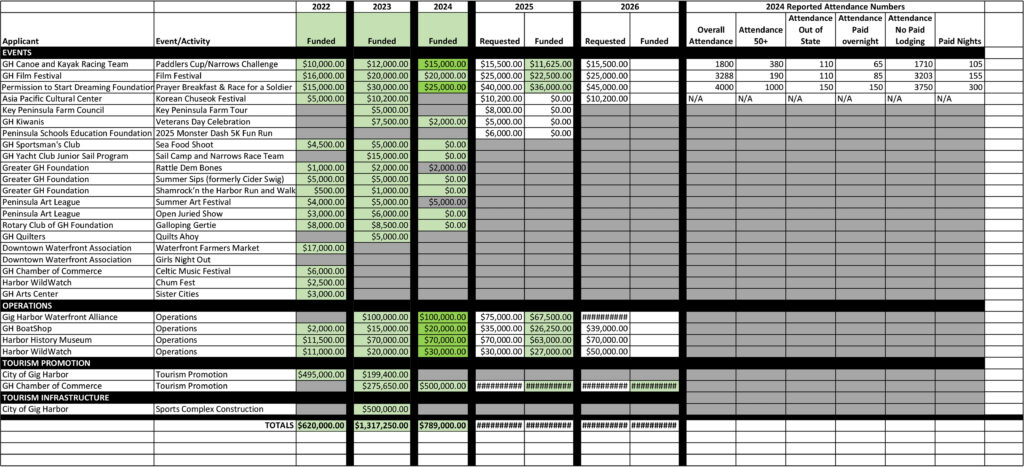
Chart shows past requests and expenditures from the city of Gig Harbor Lodging Tax fund, as well as current requests. Click here to see a PDF of the same chart.
What qualifies as tourism-related?
Stover asked Battson about several items the chamber included in the budget for its funding request. She asked Battson what “Wrap Around Events” were, a line item for which the chamber had requested $48,000, as well as whether the salary of the chamber’s tourism director was included in the funding request.
Battson said that Wrap Around Events include things like walking tours for Harbor WildWatch and the Waterfront Alliance, as well as events with the Gig Harbor Boat Shop and the Harbor History Museum “where people are wanting some extra assistance with some funding.” Funds also went toward a FIFA World Cup watch party this year, and the chamber typically spends about $30,000 on Holidays in the Harbor. Another $30,000 funds Summer Sounds at Skansie concerts.
Battson said funding request includes the tourism director’s salary and that the tourism director also contributed in-kind work.
Battson explained to Gig Harbor Now in a follow-up email that “in-kind work” refers to the tourism director’s efforts to promote other organizations’ events, since the chamber cannot give everyone direct financial assistance.
“This in-kind work allows a cohesive message when tourism then promotes the events on the VisitGigHarbor.com website as well as through community event promotion to help draw visitors from more than 50 miles away,” she said.
“Our contract with the city accounts for all work done on behalf of tourism which does include staffing requirements as a result of the contract,” she continued.
The chamber has asked for $144,000 to cover wages in 2027 and $156,000 to cover wages in 2028.
Local events, or tourism drivers?
Stover questioned whether events like Summer Sounds, Holidays in the Harbor and the World Cup watch party drive tourism.
“Those to me — and correct me if I’m wrong — seem like local events,” rather than tourism-related activities, Stover said. Since those events are not tourism-driving events, she said, Stover wondered whether the city could fund them a different way, such as through its general fund.
“And hoteliers, please, step in and say if you’re getting a lot of heads in beds during those events,” she added.
Battson said that the chamber makes a point of sectioning off an area for out-of-towners during Summer Sounds, so they can track whether the event brings in tourists.
“We’ve really benefited. … We were keeping track of all of the different out-of-towners because while they’re here, they need a good experience,” she said. She also said that the city gets repeat visitors from the event. She gave an anecdote of a couple who drove up from a Southern Oregon beach wedding to see Gig Harbor, because they had heard about the city from someone else. “So the more things like introducing them to Harbor WildWatch, some of the walking tours, all that kind of stuff — it makes a difference.”
She also noted that the city also provides additional resources, such as police and public works staff time, for these events. They are not solely funded through lodging tax revenue.
Heads in beds
But Stover pointed out that this doesn’t necessarily qualify those items as tourism-related, which is why she can’t square funding these events through dollars meant specifically for tourism-related activities.
For instance, she asked, are the hotels full during Holidays in the Harbor?
“Well, no, we’re never full in December, [but] it gives people things to do when they’re here,” Braaten replied. “Do they come to get their picture taken with Santa? No, I don’t think so. But it’s lovely to send them downtown and go, ‘Oh, but this is going on now.’”
Battson also said that tourism is more than just “heads in beds.” She said that it is also an economic driver to get people into shops and stores, which the chamber has focused on through its visitor’s guide.
Creating that visitor’s guide will cost $61,560 per year in 2027 and 2028, according to the line item in the chamber’s budget request.
Dwindling reserves
Sandvik asked Coronado whether the city could subsidize part of the chamber’s request from another source, instead of the full $520,000 coming from lodging tax revenue. Given that the depleting reserves spell “an end point” for funding through the lodging tax, Coronado said, “it’s certainly a valid ask.”
But Battson questioned whether organizations like Harbor WildWatch and the Harbor History Museum should receive funding from lodging tax revenue. She said the city once funded them from its general fund. She asked whether the city should consider doing so again.
Such a switch would take time, other committee members pointed out. Coronado noted that the city is currently engaged in budget conversations. Any requests about switching the funding source would be immediately relevant.
The committee opted to postpone a decision on the chamber request until it receives funding requests from other organizations. Stover suggested that, because the committee has to work within such a limited budget, applicants could focus activities on “shoulder season,” a term referring to the time between peak tourist season and the offseason, when hoteliers struggle.
Reviving a ‘creative district’ idea
The committee decided to open applications for grant funding the week of Aug. 1, and close them the third week in August. The committee will meet again to discuss those applications on Sept. 3.
During a July 27 meeting of the City Council, City Administrator Katrina Knutson announced that “an ad hoc group of local residents, the Peninsula Art League, the Waterfront Alliance, Chamber of Commerce, Visit Gig Harbor, and the city are working together to see if we can put together an application to become a creative district.”
She said that the designation as a creative district could increase tourism, thereby increasing the sales and lodging taxes the city could collect. If successful, this would increase the lodging tax funding pool.
The city had attempted such an endeavor in the past, Knutson said, and had included it in a previous strategic plan. But the last time the city considered it, “none of our local partners were willing to step up and take the work to put together an application for a creative district. However, it appears that that has changed.”