
Community Environment Government
Parks Commission makes recommendations for final txʷaalqəł Conservation Area management plan
The Parks Commission had a few recommendations for the city of Gig Harbor as it drafts a management plan for Phase 3 of the txʷaalqəł Conservation Area. The commission made its recommendations at a Sept. 2 meeting, following a brief presentation from Parks Manager Jennifer Haro.
The conservation area is located along Harborview Drive north of Austin Street. It includes about 2,400 lineal feet of North Creek, also known as Donkey Creek.
Together with Great Peninsula Conservancy, the city purchased land in phases between 2022 and 2024, with the final purchase of Phase 4 bringing the conserved land up to nearly 52 acres. The city has already adopted a management plan for Phases 1, 2, and 4.
Phase 3 is east of Harborview Drive, across from from Phases 1 and 2. The city and former Gig Harbor Land Conservation Fund — which merged with the conservancy in August 2024 — bought the land from the Haub Family for $1 million in September 2022.
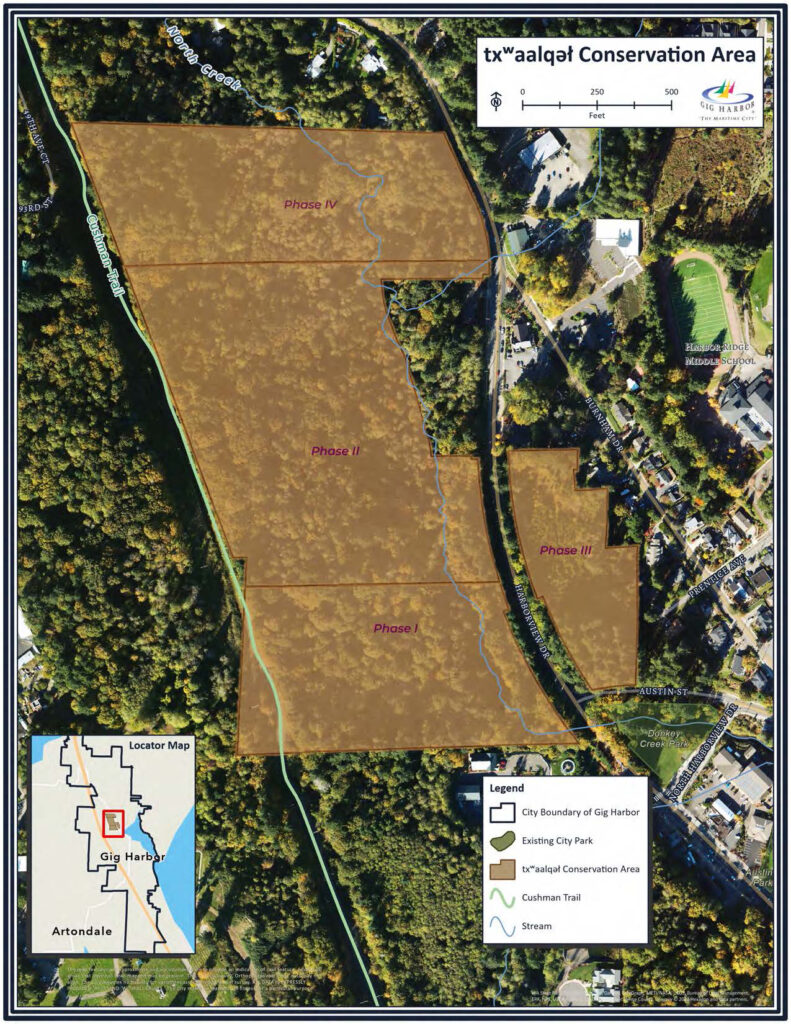
Phase 3 is east of Harborview Drive and north of Austin Street.
Commissioners said the city needs to take traffic in the area into account when planning trails and parking. Commissioner Guy Magnus also suggested the city make a loop trail to have one way in and out, and avoid dead ends.
Commissioners agreed with Gig Harbor city staff and conservancy recommendations regarding removing invasive plants, installing signage, creating accessible trails and connecting the trail to Prentice Street. City and conservancy staff also recommended that the city remove asphalt and consider a potential trail connection to Austin Street.
Rotary proposes memorial tree program
The Rotary Club of Gig Harbor may head up a memorial tree planting project throughout the city of Gig Harbor.
Haro presented the idea to city parks commissioners on Sept. 2. She explained that the club approached the city last year to propose a Living Tree Project, in which Rotarians would plant trees on city land. The program would both help the city meet its tree-cover goals and allow donors to memorialize loved ones with trees planted in their memory.
Click here to buy tickets!
The Rotary Club would purchase trees, train volunteers, coordinate planting and maintain data and records. The club would also provide a yearly report and reimburse the city for unexpected costs, like weekend or evening callouts or sprinkler installation.
Potential to overcommit
Commission Chair Louise Tieman pointed out that different trees might need specific conditions and asked whether the club would be able to plant the trees in the right spots.
She suggested that the city could tell the club how many places it has for a specific kind of tree so that the club only sells that many. This would also help the city know in advance where the first trees would go and would avoid the problem of the club not being able to follow through on specific trees for specific people.
“Better to under-commit and over-deliver than buy first. … They don’t want to sell trees that can’t be planted,” Tieman said. “That’s awkward for everybody.”
Commissioner Kim Anderson worried that the program might create “a perception that we’re not charging enough or we’re charging too little or that we’re consistently charging,” if people receive different price points.
“I would want to ensure that if somebody is buying a memorial tree, that they’re paying the same rate as the next guy that comes along, that there’s some consistency there,” Anderson said.
Haro clarified that, to her understanding, the club would offer tiers to avoid that kind of confusion.
Commissioners also wondered what might happen when a tree dies prematurely. Would responsibility fall on the Rotary or on the city? Any number of things could happen to the trees, they said, including vandals going after them or a drunk driver hitting them.
Commissioners suggested that the city specifically spell out in any contract who is responsible for a tree’s health after it is planted.
Haro will take the commission’s recommendations and thoughts to the city council, which will discuss the Living Tree program idea at a study session later this month.