
Community Government Police & Fire
Pierce County Council approves public safety sales tax after hours of discussion
Following several hours of public comment and council member commentary, the Pierce County Council approved a contentious public safety levy in a 5-2 vote on Tuesday, March 3.
The ordinance creates a 0.1% sales tax that funds public safety initiatives. Proceeds can go to the sheriff’s office, the prosecutor’s office, the court system and the Pierce County jail.
Pierce County plans to use about 80% of the revenue to support existing programs, filling a gap in revenue the county expects in future years. The tax will go into effect on July 1.
Background on the tax
Last year, the state authorized local governments to enact the sales tax and to apply for grants from a $100 million public safety fund. The Washington State Criminal Justice Training Commission administers the grant program.
A committee composed of public safety representatives presented the levy proposal to the council in January. The committee included Pierce County Sheriff Keith Swank and Prosecutor Mary Robnett, who both repeated at the March 3 meeting that they did not like taxes. Swank specifically said he is “anti-tax.”
The council vote was mainly split down party lines, though Republican Councilmember Dave Morell of South Hill sided with his Democratic colleagues in voting for the ordinance. Morell voted against moving the ordinance to full council during a previous committee meeting.
Referendum ahead?
In casting his vote for the ordinance, Morell noted that it was his last term in office.
The council introduced the proposal in two February meetings that together ran about five hours, with a majority of that time devoted to public comment. Most of the live public comment on Tuesday opposed the levy, with many citing already tight household budgets. Written comments against the ordinance number in the hundreds.
Julie Murray, county counsel to Executive Ryan Mello, briefly explained that voters could still strike the ordinance down via referendum.
At the end of the meeting, an unidentified public commenter promised to file a referendum to repeal the ordinance.
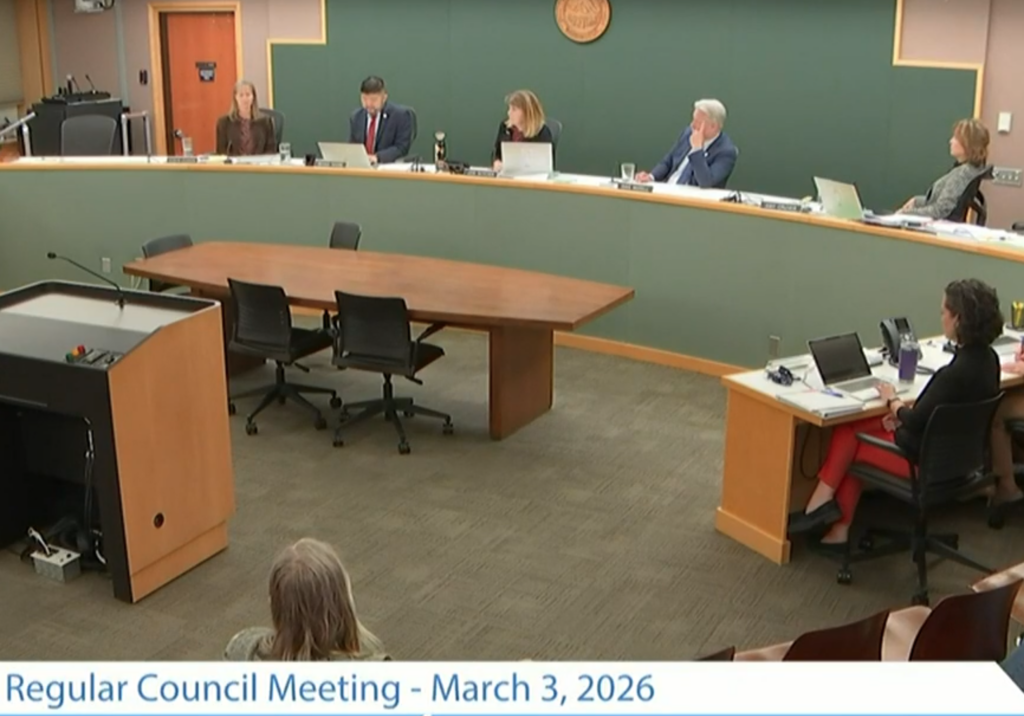
Members of the Pierce County Council vote on a public safety sales tax proposal on Tuesday, March 3, 2026.
Council support
Councilmember Robyn Denson, who represents the Gig Harbor and Key Peninsula area, acknowledged that “no one wants more taxes.”
But, she said, she has also “heard since my time here on council that we have a structural budget deficit and this is not new.” The problem, she said, is the general fund, which the county uses to pay for its public safety programs. Public safety consumes a little over three-quarters of the general fund budget, “which is the money that we can control because the rest is restricted for specific purposes.”
It’s still not enough, Denson said.
“We’ve had lots of instances here recently that show that we need to do better,” she said. “I hear that from my residents. I hear that from our law enforcement officers. We all live in the communities. So we experience it ourselves. And we know this to be true.”
Key Peninsula tragedy
Denson touched on the mass stabbing in late February in which four people, including two Gig Harbor arts commissioners and a volunteer with Visit Gig Harbor, died. A sheriff’s deputy killed the assailant, bringing the total dead to five.
She said Peninsula residents have for years expressed concern over the lack of sheriff’s deputies in rural areas. The community has grown rapidly, she said, but staffing on the Peninsula has not, due to lack of funds. She also noted that other rural communities in Pierce County are facing the same plight.
“We’ve had several very high profile events on the Key Peninsula … just within the last few months, including one that just happened last week. … A lot of the events that tend to be trending right now for us, are mental health and domestic related. And in those instances, we really need deputies to be responding not only faster, but responding together,” Denson said. “These domestic calls are highly emotional, highly volatile, highly dangerous. And for the safety of our deputies, as well as protecting our communities, we need more deputies to respond together and faster to protect our communities.”
She emphasized that the levy not only funds existing positions, but allows the sheriff’s office to start filling vacant positions. She expects the tax to reveal “the light at the end of the staffing tunnel that we have right now to add additional deputies.”
‘Protect the fund’
In expressing his support for the levy, Morell also mentioned the “horrific crime we witnessed in the Key Peninsula last week.” He said that though he is opposed to tax increases, “I must be honest about the realities that we face.”
“Our sheriff deputies and correction officers are overworked, underpaid, and understaffed. In the aftermath of these recent tragedies, we must ask ourselves, what if we were fully staffed?” Morell said. “What if our deputies didn’t have to wait for backup? What if the court order were delivered in a timely manner? Could we have prevented further harm? Could we have responded faster and saved lives? These are not hypothetical questions. They are the urgent truth of our situation.”
Morell said he would propose a resolution to create a master plan for how the county can use the money the public safety tax creates.
He called on his colleagues to “protect the fund. You are the front line for protecting these dollars. I’m gone in 10 months. I’ve been through four or five budget cycles now. And this last one was my last budget cycle. But it’s gonna be up to each and every one of you to protect these dollars and make sure they go to public safety.”
Council opposition
Republican councilmembers Amy Cruver of Eatonville and Paul Herrera of Puyallup voted against the measure.
Herrera, calling in to the meeting from Washington, D.C., said he received “hundreds” of emails from residents opposed to the measure.
“What I hear is that the hardworking Pierce County families simply cannot afford another tax,” he said. “They’re not very happy (with) the process of this being imposed on them without their voice voting for it or not.”
He said the committee that proposed the tax acknowledged that it never considered any other possible solutions.
As a former police officer, Herrera concluded, “I can tell you that taking money without permission, it’s a crime. … And here we are proposing that we reach into Pierce County citizens’ pockets without permission, and the vote of the people.”
Suspicion about motives
Cruver spoke for nearly 30 minutes, running through several loosely related revenue tangents before council Chair Jani Hitchen reminded Cruver of the time and asked her to stay on-topic.
Cruver expressed suspicion about the tax, the state’s motives in introducing it, and the county’s motives in proposing it. Her thoughts echoed those of several public commenters.
“It’s really not about the tax,” Cruver said. “It’s about advancing control over you and me.”
She said that the state “kicks the can and the burdens down to the county, because they’ll just give the county authority to raise more taxes and create all this fear.” She also said that she doesn’t believe the tax addresses public safety, because it funds things other than more police and policing equipment.
Cruver said that when she thinks of public safety, she thinks of “police out getting the bad guys. I see the police going down the street and arresting molesters, thieves.”
State law strictly governs the use of proceeds from the public safety levy, but Cruver said she expects elected officials will find ways to divert the revenue to non-public safety purposes.
“This tax tonight, it’s a catch-all for backfilling years of prolific government spending more than what taxpayers earn,” Cruver said. “Finding more services beyond that which are necessary for community purposes, transferring wealth from individuals to groups and growing government programs and thereby for squeezing out the middle class.”