
Community
Two in Tow & On the Go | Nature and industry at Chambers Creek Regional Park
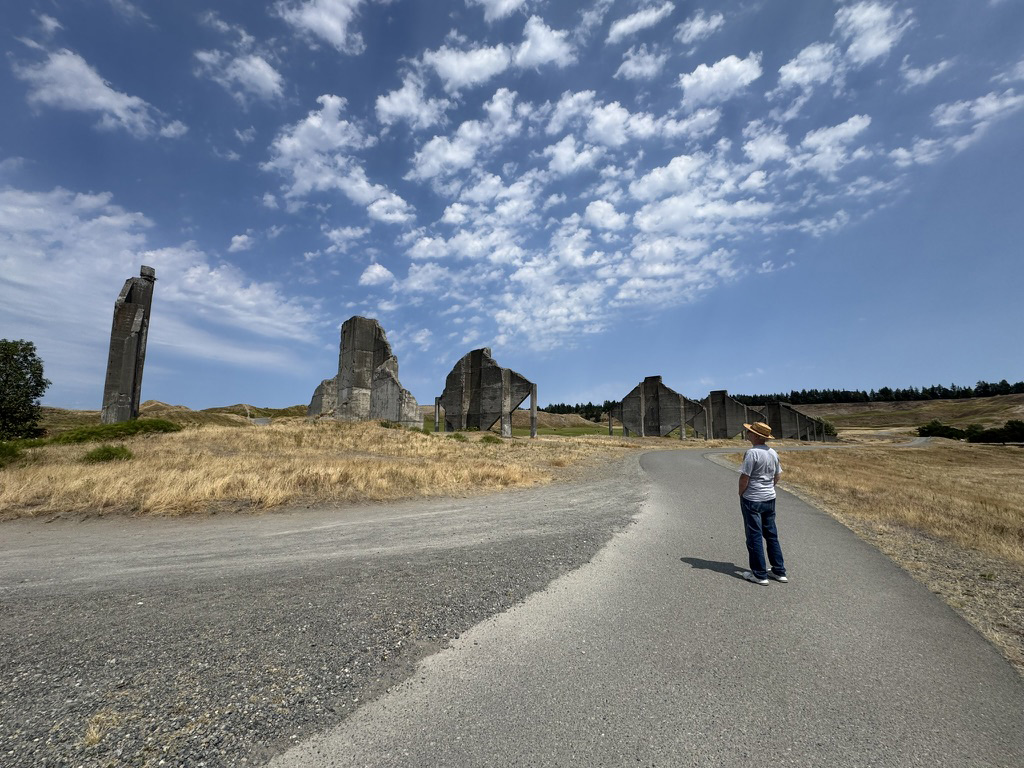
Greg Spadoni remembers former gravel pit work. Photo by Tonya Strickland, July 2026.
UPDATE: John Ladenburg Sr., a key figure in the park’s original development, contacted me after this story ran to clarify that park planning, not construction, began in the 1990s. Ladenburg served two terms as Pierce County executive from 2001 through 2008, following 14 years as county prosecuting attorney.

Community Sponsor
Community stories are made possible in part by Peninsula Light Co, a proud sponsor of Gig Harbor Now.
– Tonya Strickland
Chambers Creek Regional Park is a ginormous 930 acres run by Pierce County, mostly located in the city of University Place. The park has open space galore with meadows, public beach access, a playground and the 18-hole Chambers Bay Golf Course, home to the U.S. Open Championship in 2015.
The park is so big that today’s column features only half the things we saw during our visit in July. I’ll write about the other half in my next column.
It’s surprising how many cool amenities this park packs into a landscape that spent much of the 20th century as a sand and gravel pit. Its products shaped local roads and other infrastructure in the region. But the site’s industrial history stretches back even further. According to Pierce County, settlers began developing the property for industrial uses in the 1890s, including a paper mill.
Today, the shape of the land is quite interesting. Grassy uplands dip and roll and flatten out. Paved trails meander atop the bluffs overlooking almost two miles of Puget Sound shoreline.
If you go
Chambers Creek Regional Park
Main Entrance: 6320 Grandview Dr. W., University Place.
Directions: Enter through the golf course parking lot at this address and drive down the steep hill toward Puget Sound to another parking lot called Central Meadows. That parking area has its own restroom and is closest to the walking paths that lead through the old quarry structures and the bridge to the beach.
Website: https://www.piercecountywa.gov/1317/Chambers-Creek-Regional-Park
The county bought the land in segments over the years, with plans for its transformation taking shape in the late 1990s. But, to be extra cool, planners intentionally left pieces of the site’s past. Some very, very large pieces. Several strikingly tall quarry structures still exist there in various forms of what they once were. And the kids loved seeing them!
A lot of people do. The park is popular with visitors, including the photography crowd. Many travel sites say the dark concrete silhouettes of quarry work make the area look intriguingly “post-apocalyptic.” Can’t say I disagree. Here’s a look:
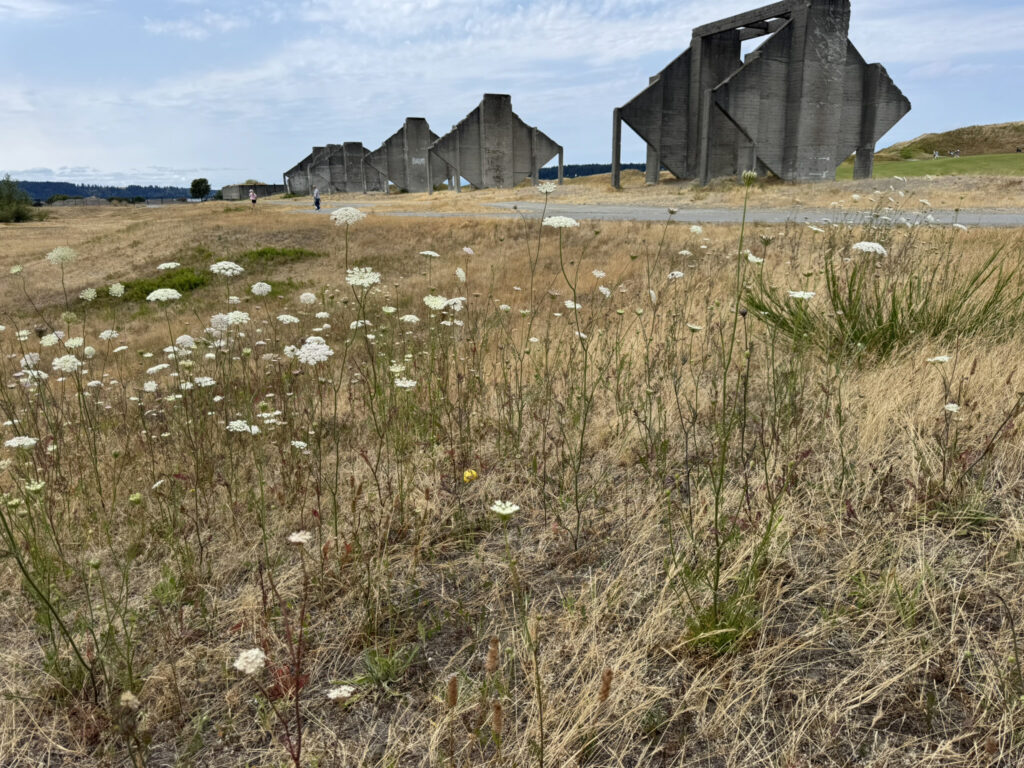
The industrial remnants along the north side of the park’s Central Meadow were once sorting bins for the different types of rock and sand sold on site, and a conveyor tunnel from its gravel-mining days. Photo by Tonya Strickland
Per usual, Greg Spadoni came with us on this Three in Tow (alternate name: Two in Tow & Now & Then) summer adventure. And what a plot twist it was. As it turns out, he’d been there before! But, it had been awhile.
In his road construction days, as Greg told me via text message later, he frequented the site when it was “two separate sand and gravel pits that I used to haul out of when I drove dump truck* for Spadoni Bros. It’s where we got drain rock, crushed rock, pea gravel, and sometimes hot mix asphalt.”
Well, that might just be the most exciting quote I’ve ever put in a story! (I kid). Jokes aside, it was good information, and also pretty fun watching Greg piece together, in real time, memories of the old gravel pit landscape with the park stuff we see today.
He walked the paths and pointed here and there and darted all around in classic big-kid style before breaking into a full sprint to race Clara and Wyatt up a hill (Clara won). Not long after, Greg had pretty much figured out what stood where and showed us what he remembered.
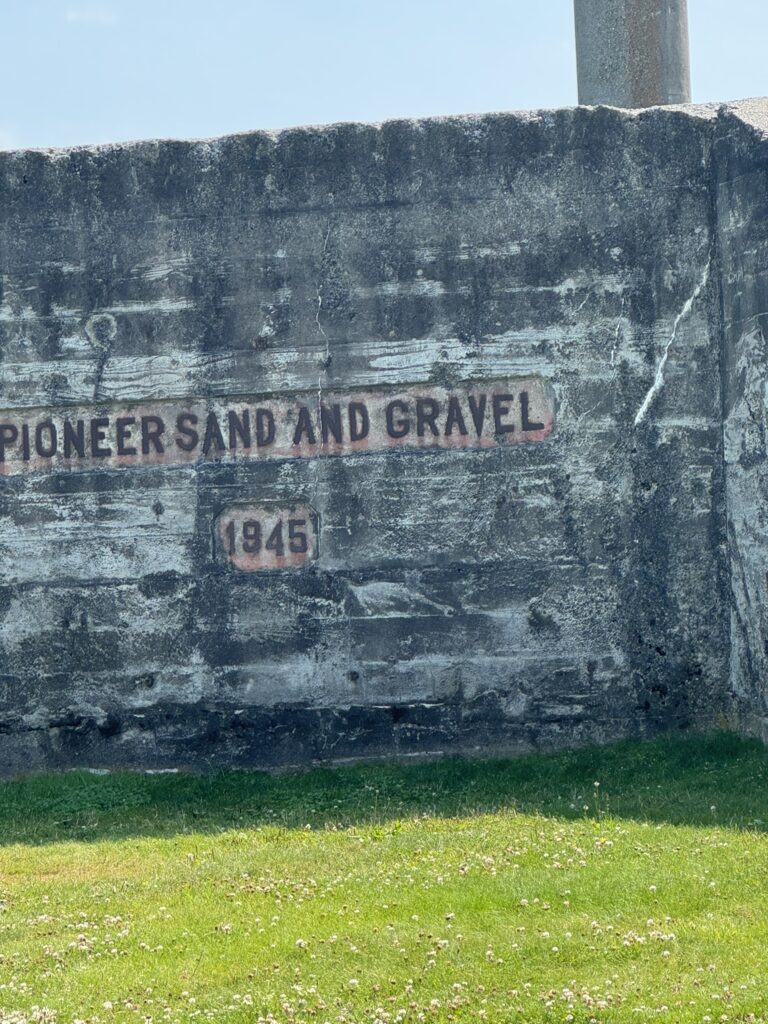
Remnants of its industrial past dot Chambers Creek Regional Park. Photo by Tonya Strickland
The county’s master plan for the park identifies the structures along the north side of Central Meadow as old “sorting bins” used as dividers to separate the giant piles of rock and sand materials. Next to the bins is something the county describes as a former conveyor tunnel. The county deliberately saved those structures during redevelopment to provide a physical connection to the site’s industrial history to expand upon the experience for visitors. Neat, huh?
Here’s a look at the site in 1963 via an aerial image courtesy of the Northwest Room at Tacoma Public Library. The picture shows two large gravel pits separated by acres of trees and a road, according to the library file.
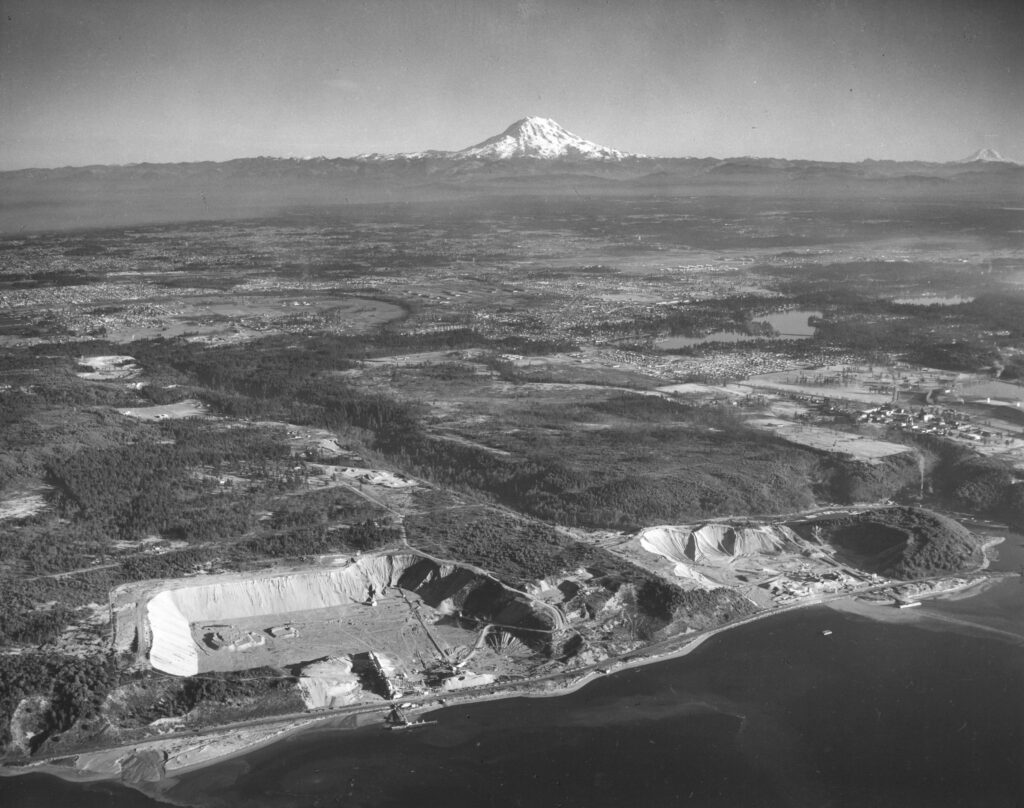
Photo Item D137615-3, Richards Photography Studio, 1963. Courtesy of the Northwest Room at Tacoma Public Library. “This aerial photograph from February 1963 shows the Pioneer Sand and Gravel Company operation just northwest of Chambers Creek with Mt. Rainier looming in the background …”
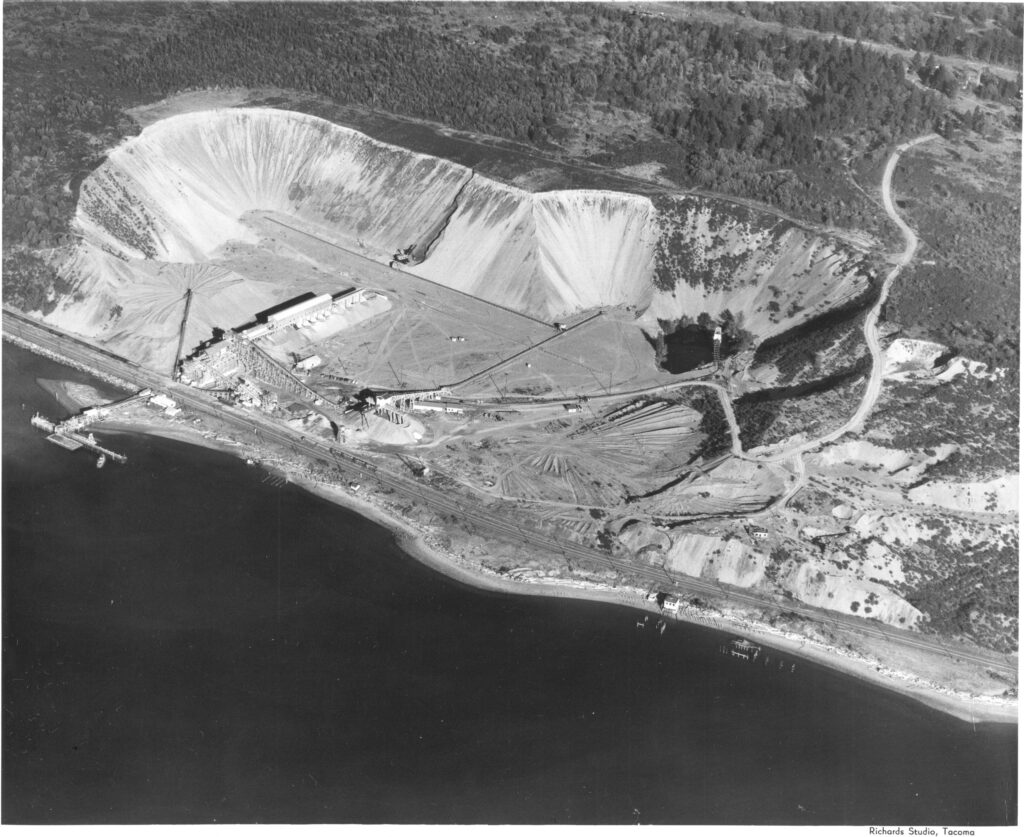
Fourteen years earlier, the caption for this 1949 aerial shot, also from the Tacoma Public Library’s Northwest Room, said Pioneer Sand and Gravel Co. “specialized in sand, gravel, building materials and ‘Tru-Mix’ concrete.”
Central Meadow
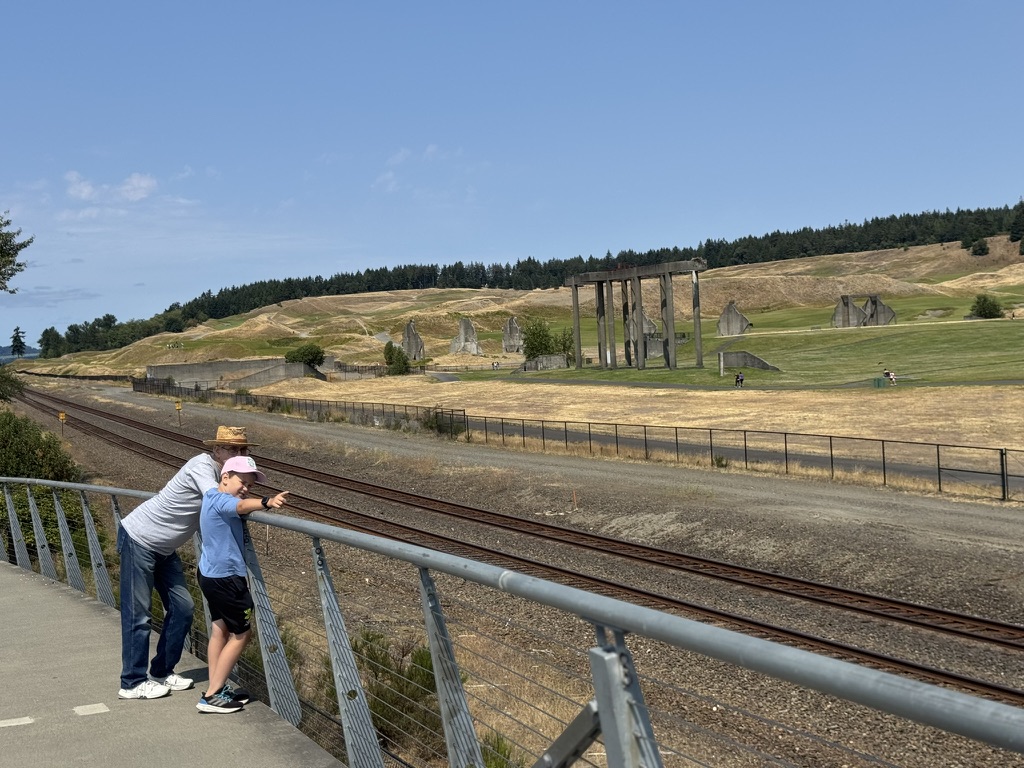
We entered the park at the Central Meadow parking lot, which Google Maps calls the “Chambers Bay Loop Trail Head” at 6320 Grandview Drive West, University Place. In my expert adventure-mom opinion, it’s a little hard to find if you’ve never been to the park before. One reason is because 6320 Grandview Drive is the same address for the Chambers Bay Golf Course, and the Central Meadow entrance and parking lot is located down a very long hill from the golf clubhouse. I wouldn’t recommend trying to walk the road with kids — or at all. It’s pretty far.
Note: the playground at Chambers Creek Regional Park, titled “Playground by the Sound,” is next to the park’s “other meadow,” North Meadow, located on the north side of the golf course.
My kids sure love playgrounds, but we specifically set out for Central Meadow that day because we were looking for open space to fly a kite.
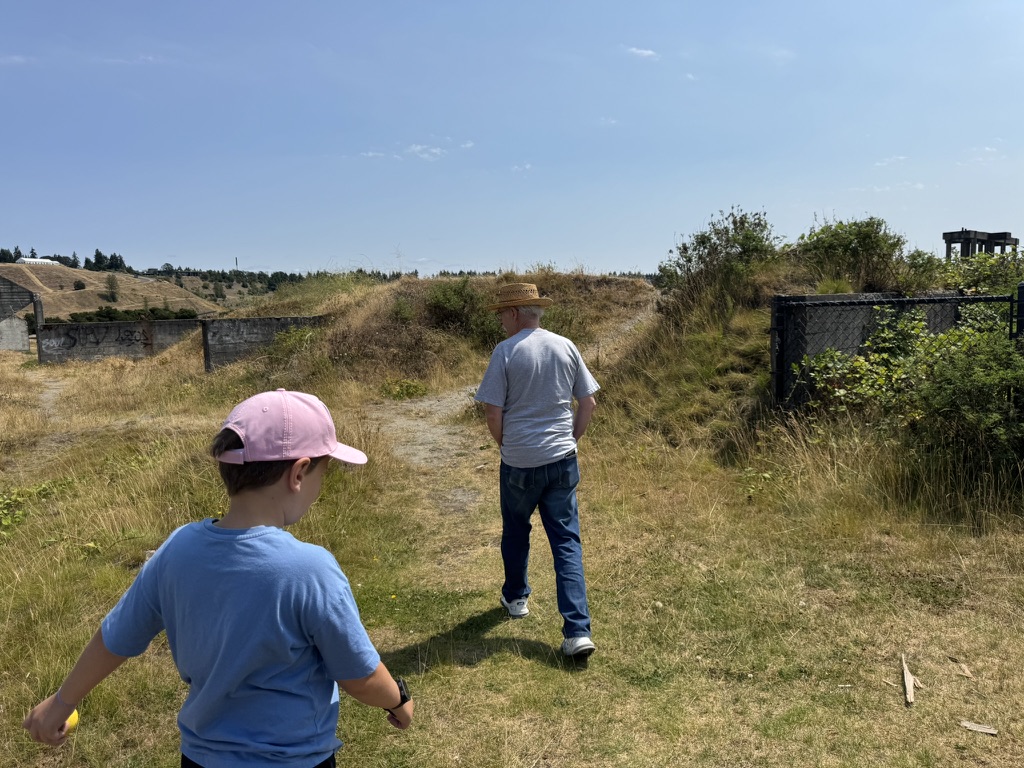
Wyatt and Greg at Chambers Creek Regional Park. Photo by Tonya Strickland
Buzz buzz
But when we went in mid-July, the field at Central Meadow was apparently home to one heck of a summer bee bonanza. No, that’s not the name of some new community event. Not for humans, anyway.
It’s quite literally a feeding haven for so many bees. Hundreds, if not thousands of them. After spotting one bee on a wildflower and taking a closer look, I sized up the situation and realized they were everywhere. I quickly decided that bees + little kiddo feet was just not going to work for us that day.
Apparently, the long, warm-weather days of summer in western Washington make for a prime pollinator season for foraging honeybees collecting pollen and nectar. Chambers Creek Regional Park has extensive areas of restored native vegetation, making it the perfect gathering grounds. At Central Meadow, worker bees come from all over to find the little white flowers carpeting the field — white clover. According to the Puget Sound Beekeepers Association, clover is a solid summer food source for bees after they’ve finished off the dandelions in the spring.
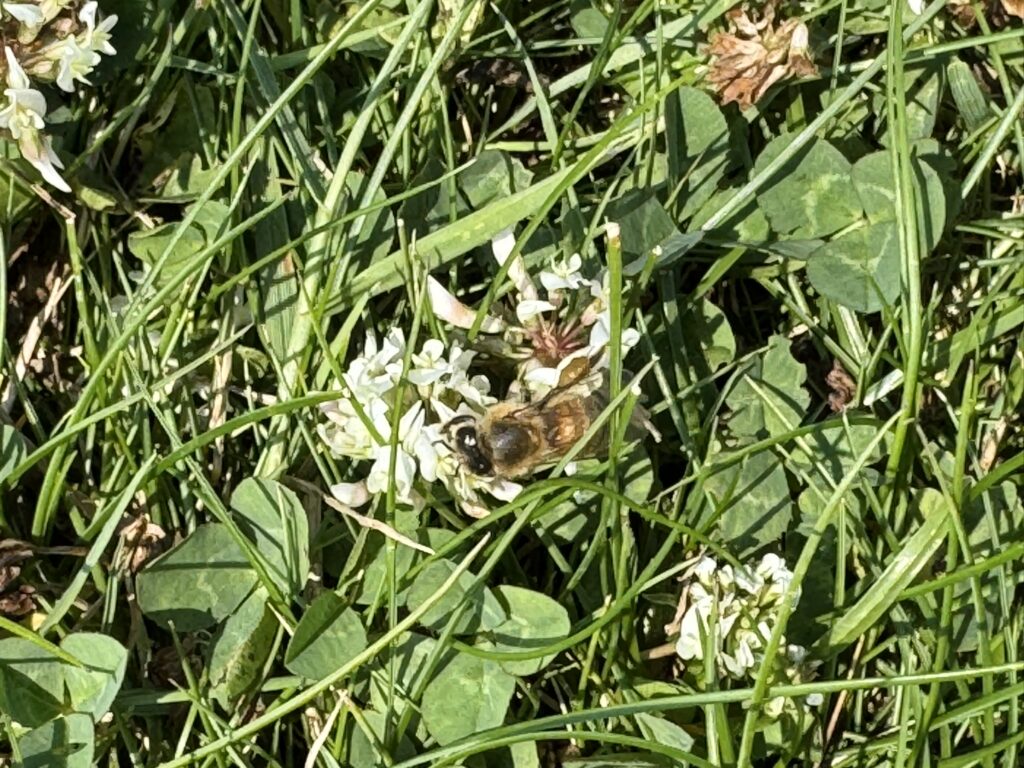
Low-growing clover spreads through lawns and large grassy areas, the association goes on to say, making it attractive for bees that prefer “clusters of the same type of flowers instead of a wide variety of flowers spread all over.”
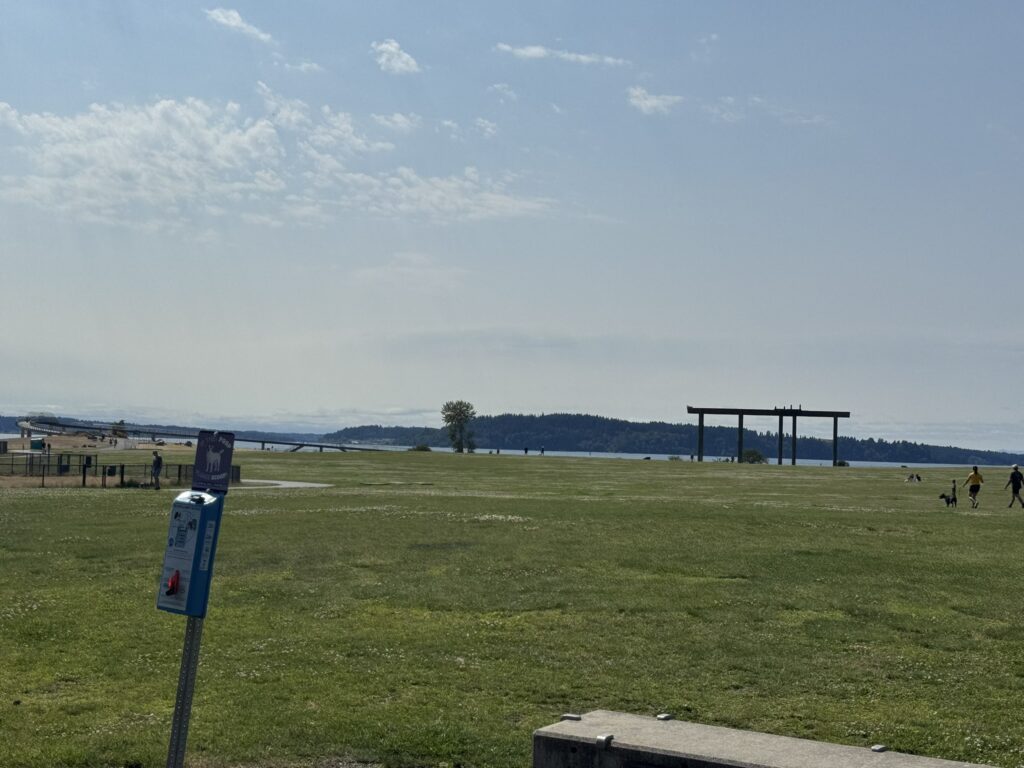
So bee aware, you guys. (Hahaha. #sorrynotsorry, I clearly had no choice). OK, but seriously, here’s a wide shot of Central Meadow to show I’m not talkin’ about just a few clover blossoms dotting a few areas. The field is absolutely peppered with it.
The bridge
Beach access is available through the “Bridge to the Beach” pedestrian overpass just west of Central Meadow. It spans over the railroad tracks, leading to two public beach access points. There’s also a warning to stay off the railroad tracks there because it’s an active train route .
It’s hard to pick a favorite feature, but I think the Three in Tow would all agree that the highlight of the visit was watching — and feeling! And hearing! — a freight train rumble directly beneath our feet from the foot bridge.
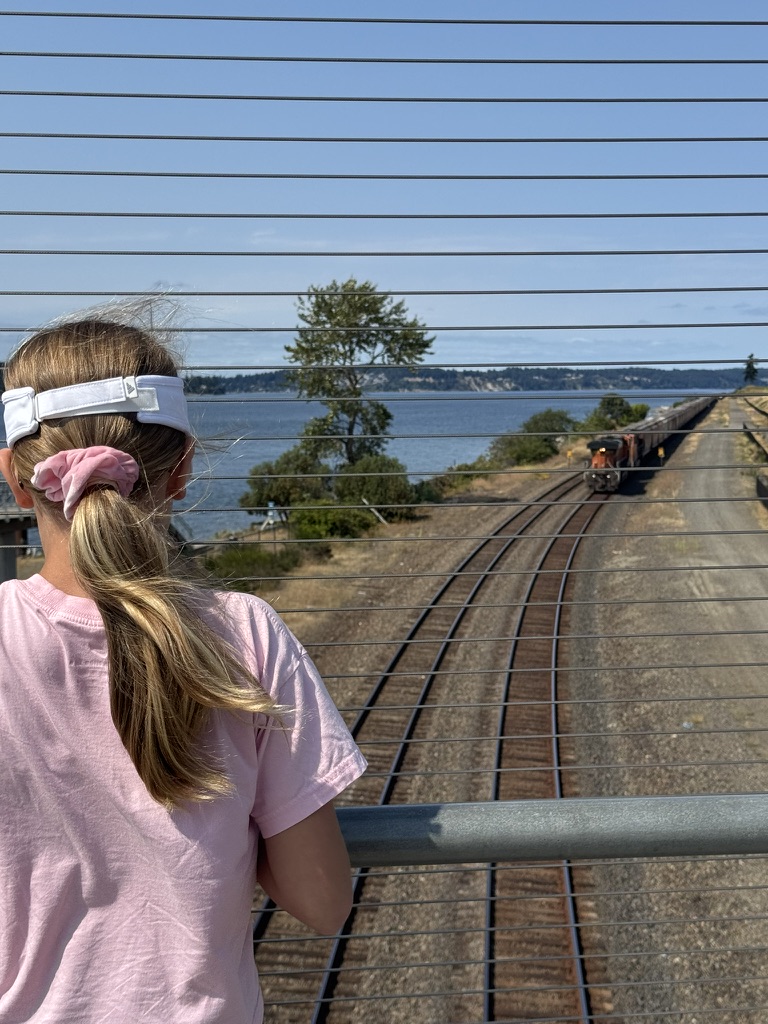
The bridge opened in 2010 and is 900 feet long and 26 feet high. Its length helps keep the approach gradual enough to meet ADA accessibility requirements.
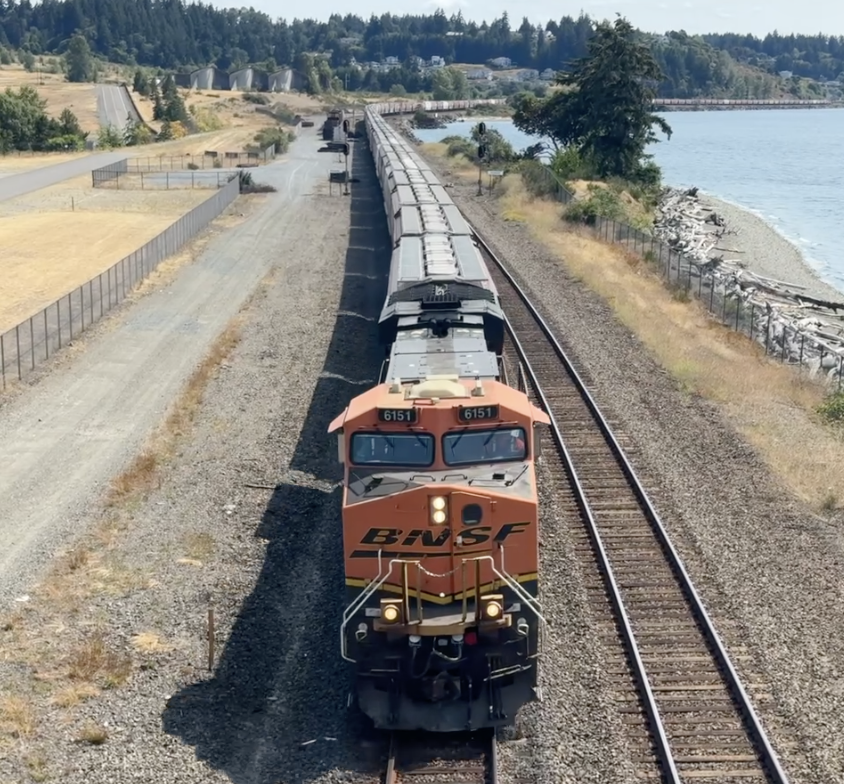
The tracks are operated by BNSF Railway Co., a freight company headquartered in Fort Worth, Texas. Amtrak passenger trains and maybe others also use the tracks. I’m pretty sure we saw two BNSF engines that day, each with a long, winding trail of railcars snaking behind them.
The railroad along the beach there is more than a century old. It started as a shoreline route built by Northern Pacific Railway from 1912 to 1914 from Steilacoom to Point Defiance. Today, the northbound trains, like the two we saw, continue toward Tacoma and eventually disappear into the nearly mile-long Nelson Bennett Tunnel just south of Point Defiance Park near Salmon Beach. The tunnel lets out in Ruston below the Winnifred Street Bridge.
The rumble
And now to describe the ridiculously long freight train that rumbled toward us and how cool it was. First, the experience started well before the train reached us. We were able to stand and wait for it to roll up, so there was a fun bit of anticipation involved.
In the distance, we saw the engine pulling what looked like an endless chain of freight cars — the cars sporting a rust-orange hue were the most prominent in our line of sight. As the train got closer, its rumble got louder and louder until suddenly the sound (and the train) were barreling straight toward us. Luckily, we were more than protected by a tall barrier along the pedestrian bridge.
On the train’s final approach, we stood directly over the tracks and watched it disappear beneath our feet and come out the other side followed by railcar after railcar. Around the same time, we all began to wonder aloud: Just how many of these things can possibly be attached to one train?! Fun fact: The BNSF website says some of its trains are 115 to 150 cars long!
They hear that train a-comin’, it’s rollin’ round the bend.
If you or the kiddos want to brush up on your train-car terminology before or after your visit, BNSF Railway has a pretty cool Virtual Train Tour on its website. It shows icons and pictures of its many different types of railcars one might see. Learn how to tell a hopper from a gondola and find out what each shape is designed to carry. Some examples among the lineup:
- Boxcars haul industrial or consumer goods (or four fictional orphaned children who make for one heck of cute story series)
- Gondolas carry coal, aggregates, ores or scrap metal;
- The extra-long centerbeam flatcars are used for lumber or steel.
- Other types carry liquids, gasses, machinery, piping and, according to the freight company, sometimes even those giant wind-turbine blades.
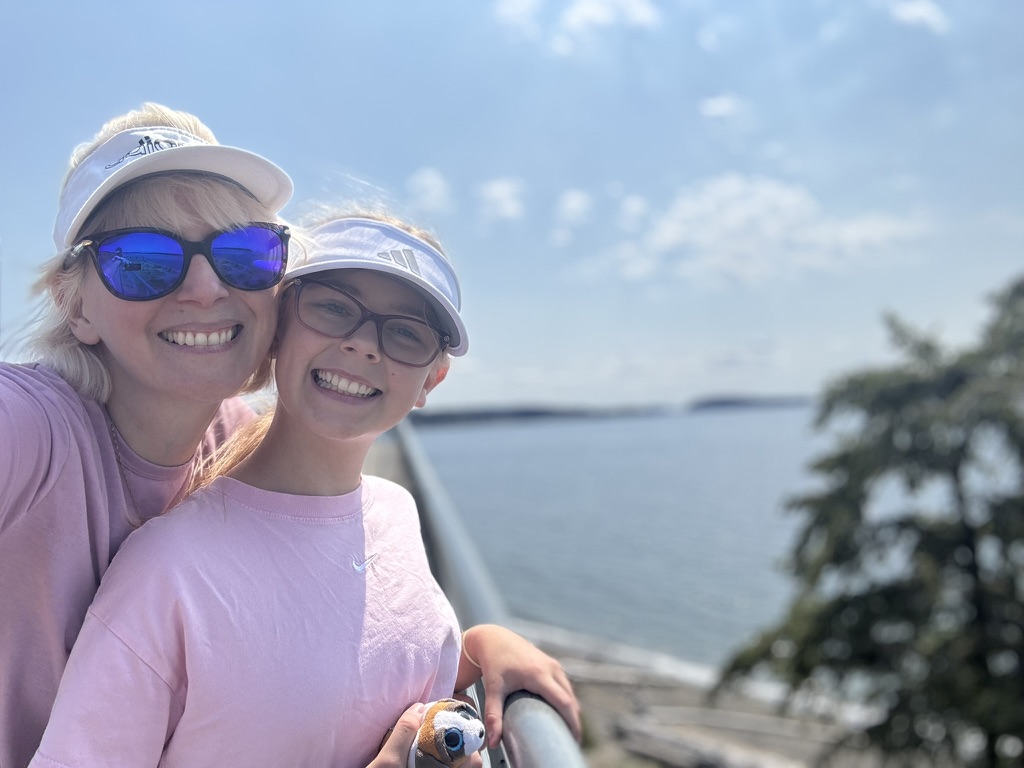
Next time I’ll talk about this park’s beach scene, nesting wildlife and what I’m pretty sure was an epic geocache spot!
See ya out there!
Asterix note from Greg’s quote:
*Just to point it out for my own journo-sanity, there’s no missing “a” in what he just said. It sure looks like it, though. Alas, as I’ve come to discover, dropping the use of indefinite articles like “a,” and “an” before a verb is a type of occupational shorthand for certain lines of work. Other examples I’ve seen online are phrases such as “I worked concrete” or “I ran freight.” Grammatically, these are all examples of article omission. More importantly, it’s how Greg said it. And not by mistake. So I gotta keep it.
Excuse me while I go “write article” now. 🙂

Tonya Strickland is a Gig Harbor mom-of-two and longtime journalist. Now in the travel and family niche, her blog, Two in Tow & On the Go, was named among the 10 Seattle-Area Instagram Accounts to Follow by ParentMap magazine. Tonya and her husband Bowen moved to Gig Harbor from California with their two kids, Clara (12) and Wyatt (10) in 2021. Find them on Facebook for all the kid-friendly places in and around town.