Community Government
A barn and a boat top city’s 2027 legislative priority list
Due to the challenging state budget situation, the city of Gig Harbor may this year seek funding from the Legislature to restore the Wilkinson Farm Park barn instead of asking for money to complete the North Creek culvert replacement.
During a Sept. 17 study session of the City Council, city lobbyist Briahna Murray provided a rundown of possible legislative priorities for the 2027 session. The priorities included funding requests for city projects; the city’s possible future water shortage; and Tacoma Narrows Bridge toll affordability.
Wilkinson Farm barn
Murray said the city applied for a state historic barn grant to rehab the barn and to the Brian Abbott Fish Barrier Removal Board to help complete the culvert replacement. The city received neither grant.
The city applied to the state’s Department of Archaeology and Historic Preservation for the full $400,000 to stabilize the barn. It would need to apply to the Legislature for the same amount.
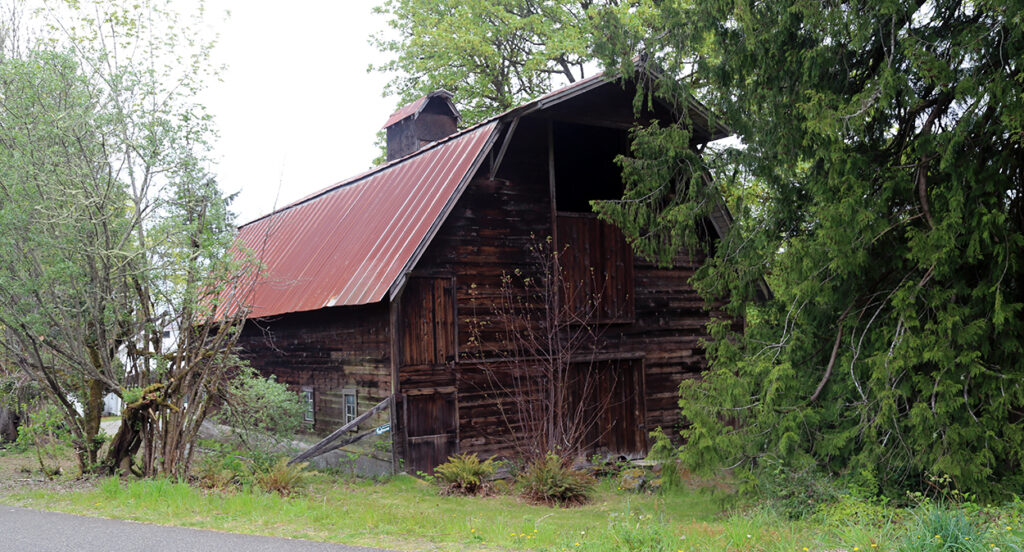
The barn at Wilkinson Farm Park, as seen from Cushman Trail. Photo by Vince Dice
Earlier this year, Murray told the council that it’s usually best for local jurisdictions to ask the Legislature for money after they have exhausted all other avenues for project funding. She also said “the Legislature likes to be the last dollar in on a project, not the first dollar in,” and that lawmakers like to see demonstrated community support.
Fortunately, she told the council on Sept. 17, “barns, for whatever reason, have been compelling to the Legislature and there’s a fairly active … Heritage Caucus, a group of legislators who are pretty committed to historical investments.”
Culvert project
Obtaining funding for the North Creek culvert removal project is a little trickier. The city needs to replace the culvert at North Creek — also known as Donkey Creek — after the state found that it inhibits salmon return and creates other detrimental knock-on effects.
Replacing the culvert will cost an estimated $10 million in total. Even if the city got $5 million from the state, it would still need to obtain as much from elsewhere to start work on the project.

This box culvert is at the northwest corner of Donkey Creek Park. Photo by Vince Dice
“The biggest challenge on this one is that it’s unlikely that the city would get $5 million, and without knowing where the remaining funding is going to come from, it’s challenging to commit to a construction schedule timeline,” Murray explained. “So both the state dollars not being the last dollar in and the timeline [are] the challenging components of that request.”
Police boat
The city will also seek to replace its aging police boat. City Administrator Katrina Knutson told the council in June that the boat is on its last legs and doesn’t have enough room for the tasks it’s increasingly being used for. This includes retrieving human remains from beneath the Tacoma Narrows Bridge.
Murray told council members last month that the city may find it difficult to fund a new police boat. It would require funding from the state’s transportation or operating budgets, both of which are more than tapped-out.
However, “because the police boat is really providing an asset to the state and the region, it seemed particularly compelling and worthy of consideration for inclusion on the legislative agenda.”
She also noted that the city has already committed some funding toward a new boat and has applied for a grant through the state’s Public Safety Funding Program.
At the Sept. 28 meeting, finance director Scott Larson said the city’s draft budget includes a “placeholder” for grant funding for both the culvert and the police boat. The draft budget also shows that the city is considering using $150,000 in short-term sales tax to partially pay for the boat. In the meantime, the city will need to put money toward new engines for the existing boat. The draft budget sets aside $30,000 to replace the engines.
Bridge tolls
The city will have to address a water shortage expected in the next 10 years. It is in the midst of working out how to do that affordably. It may also need to upgrade its wastewater treatment facility, which could create further financial headaches for both the city and Gig Harbor residents. The city is still working out how to address these issues.
The city also supports a state measure to keep tolls on the Tacoma Narrows Bridge affordable through 2032, when they are slated to end (though a 2024 report said that the tolls might continue into 2033, due to an estimated additional $14 million it will cost to operate the bridge between 2023 and 2030).
Tolls help the state pay off bonds it issued beginning in 2002 to pay for the eastbound span of the Narrows Bridge. The bridge cost $717.3 million to construct. Tolling was supposed to end after the state finished paying off $681 million in bond principal, for a total of $1.48 billion with interest.
Murray said annual installments of $13 million to the Tacoma Narrows Bridge account should keep toll rates at current levels, and that the city already supports preservation work on the bridge’s westbound side. The toll for a two-axle vehicle is $4.50 with a Good To Go! transponder, $5.50 at the toll both, and $6.50 through pay-by-mail.
“We’d be monitoring and making sure that those annual installments are included in budgets. Given the constraint funding and the transportation budget, it seems prudent to be keeping a close eye on that,” Murray said. She also said that House Transportation chairman Rep. Jake Fey, D-Tacoma, said the state would not increase tolls to address preservation needs, “because it would create significant equity issues for Gig Harbor and Tacoma communities.”
“Even with that public assurance, my recommendation is that you include this language on your legislative agenda so we can be very diligent in responding to any suggestions or proposals that may come up,” Murray said.