
Arts & Entertainment Community
Day Tripper | Back in Ballard
Last month, I left Ballard wanting more and knowing full well there was still a lot left to see. I wasn’t able to explore the Fish Ladder at the Hiram Chittenden Locks, nor did I make it to either Golden Gardens or Discovery Park.

Arts & Entertainment Sponsor
Arts & Entertainment stories are made possible in part by the Gig Harbor Film Festival, a proud sponsor of Gig Harbor Now.
A friend asked if I’d found the hidden house in the Botanical Gardens. I had not (I still haven’t, since I couldn’t find it). I was also still hoping to spend more time at the National Nordic Museum, so I decided there was no time like the present to make a return trip.
Murals (here we go again)
One thing I noticed during May’s trip to Ballard is that for a small area, the community is home to a lot of cool murals. Lately, we seem to be a wee bit obsessed with murals here at Gig Harbor Now, so I thought perhaps it was just my imagination.
I learned that there is not an official count of the murals in Ballard, but new pieces continue to emerge on a regular basis. According to Google, between 200 and 500 murals are scattered across the 4-square-mile community that is home to approximately 50,000 people. The majority of these were painted by local artist Ryan Henry Ward, Seattle’s most prolific muralist and a Ballard resident. By comparison, Tacoma’s 62 square miles only claims approximately 100 murals.
In May, we checked out the mural presented to the community in 1975 by King Olav V from Seattle’s sister city of Bergen, Norway. Originally painted by Canadians Alan Wylie and Charles Svob, the 52-foot mural was transferred to graffiti-resistant panels and rededicated in 2015. It is located at the intersection of NW Market Street, 22nd Avenue NW and Ballard Avenue NW.
The whole community has been bitten by the mural bug. A project coordinated by Urban ArtWorks and the Crown Hill Village Association transformed both sides of the Crown Hill underpass over the past couple years.
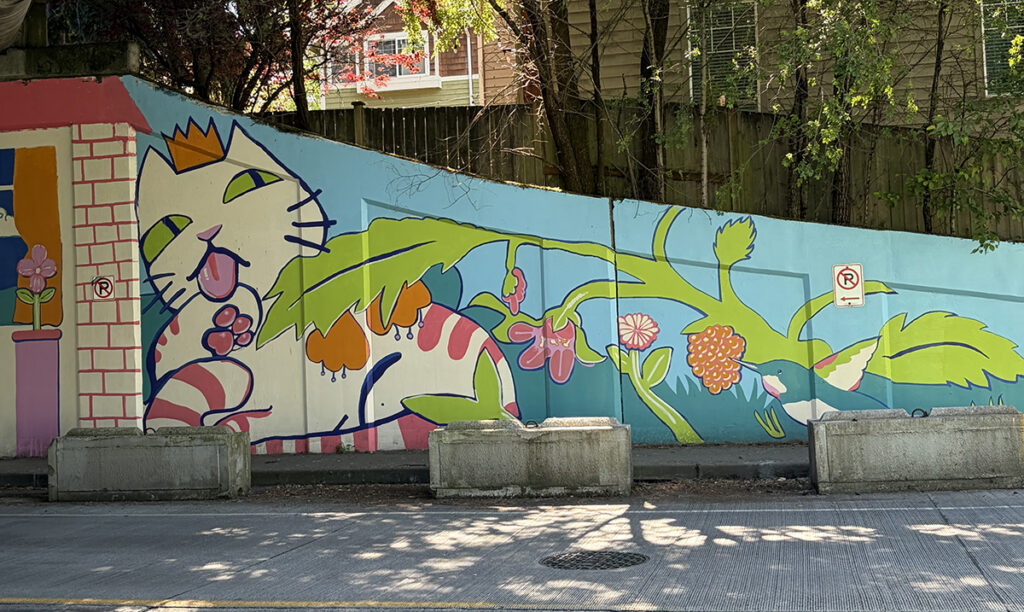
A colorful mural in Crown Hill, a neighborhood near Ballard. Photo by Mary Williams
Completing the mural required community outreach, design sessions and public paint days. Urban ArtWorks says hundreds of community members participated in the community paint days, working alongside young artists.
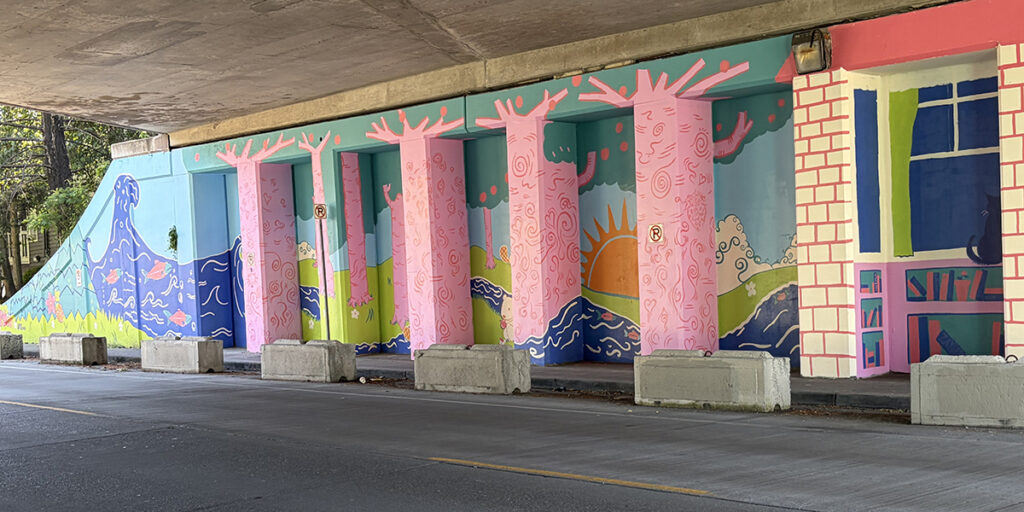
A mural brightens an underpass in Crown Hill. Photo by Mary Williams
Golden Gardens and Discovery parks
I decided to visit the parks next before it got too hot and the crowds became overwhelming. Signs directed me to Golden Gardens.
Golden Gardens includes wetlands, beaches and hiking trails. It’s also a great place for the family with picnic and playground areas, a large expanse of sandy beach, beach volleyball courts, and a spectacular view of the water and mountains.
At least one website pointed out that the park is neither golden, nor includes gardens. It may have been named after the developer’s daughter, who was also named Golden. Many suspect it was a marketing strategy, one that clearly worked.
Discovery Park, on the other hand, is a 534-acre expanse of forests, beaches, and bluffs in the Magnolia neighborhood.
The park clearly focuses on environmental education and enjoyment, with a focus on protecting the wildlife and their habitats. The city’s largest public park contains 11.81 miles of walking trails and is maintained as an urban wilderness. Most of the paths seem to meander through heavily wooded areas and up and down hills.
If you like to hike, this is the place for you. Discovery Park Loop Trail runs 2.8 miles, connecting to other trails. Be really careful as you drive around the park, because hikers are apt to pop out of the woods and treat the busy road as if it were a just another trail.
Fort Lawton
There’s more to see here than just nature. The park is built on the historic grounds of Fort Lawton, which the Department of Defense declared surplus. Most of the Fort Lawton Historic District falls within the park, though the military retained an enclave within the district.
During World War II, at least 20,000 troops at a time were stationed at Fort Lawton. More than 1 million troops passed through before and after the war. It was the second-largest port of embarkation for U.S. forces and important to the Pacific Theater.
The post was also a POW camp, with more than 1,000 Germans imprisoned there. While many buildings have been torn down, some structures remain, easily identified by their military style and buttercup paint.
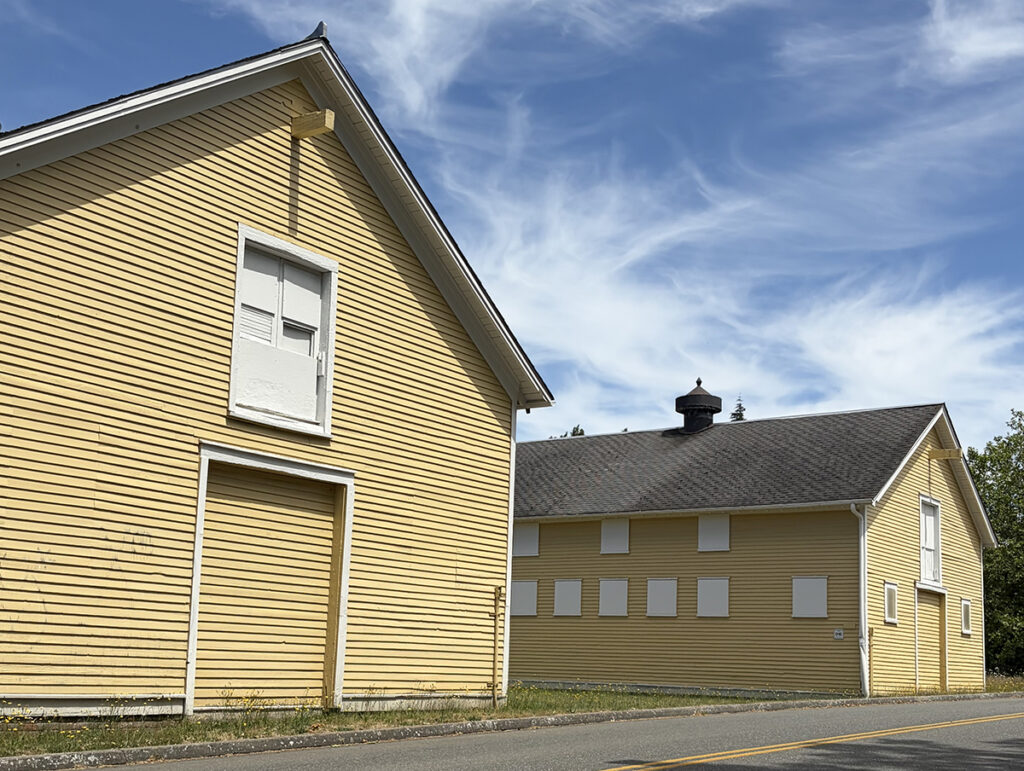
Military buildings at Discovery Park, the former Fort Lawton. Photo by Mary Williams
Just off the road to the Environmental Learning Center, a small military cemetery is the final resting place for approximately 1,000 veterans or civilian military employees and family members. Two prisoners of war who died in custody are also buried here. The first internments were just after the civil war.

The military cemetery at Discovery Park in Seattle’s Ballard neighborhood. Photo by Mary Williams
Daybreak Star Indian Cultural Center
The park also houses the Daybreak Star Indian Cultural Center, a native American cultural hub. The center was developed around 1970.
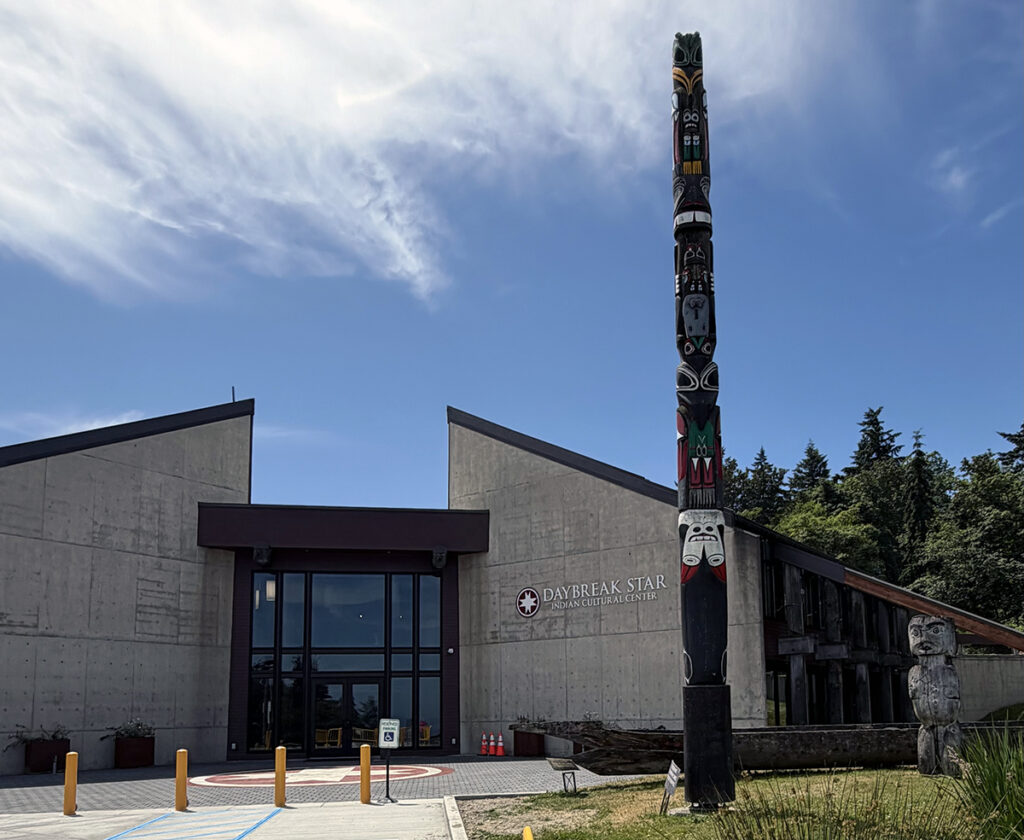
The Daybreak Star Indian Cultural Center at Discovery Park. Photo by Mary Williams
The building incorporates elements of traditional Northwest native architecture. Arai Jackson Architects and Planners designed the building, completed in 1977.
The building functions as a conference center, is a location for pow wows, and houses a Head Start school and an art gallery. The center’s permanent art collection includes a variety of large artworks by and about Native Americans.
Two of them are Blue Jay, a 30-foot wide, 12-foot-high sculpture by Lawney Reyes that hung at the Bank of California building in downtown Seattle for more than 30 years. When the bank merged with Union Bank in 1996, it donated the work to the Daybreak Star Center. A major oil painting by Guy Anderson also was part of the donation.
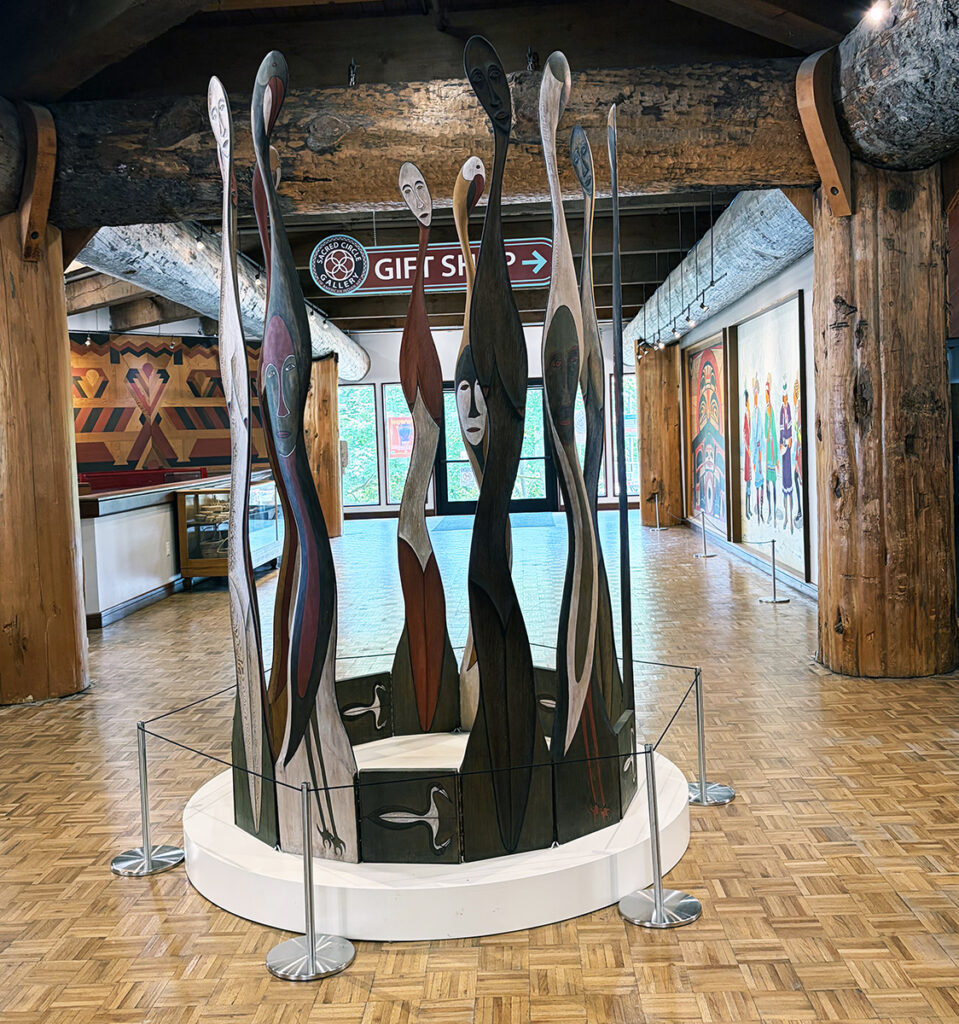
Native art inside the Daybreak Star Indian Cultural Center. Photo by Mary Williams
West Point Lighthouse
Discovery Park is also home to West Point Lighthouse, located on the westernmost point of both Seattle and the park. It remains an active aid to navigation and is similar in design to the Point No Point Lighthouse in Hansville, Kitsap County.
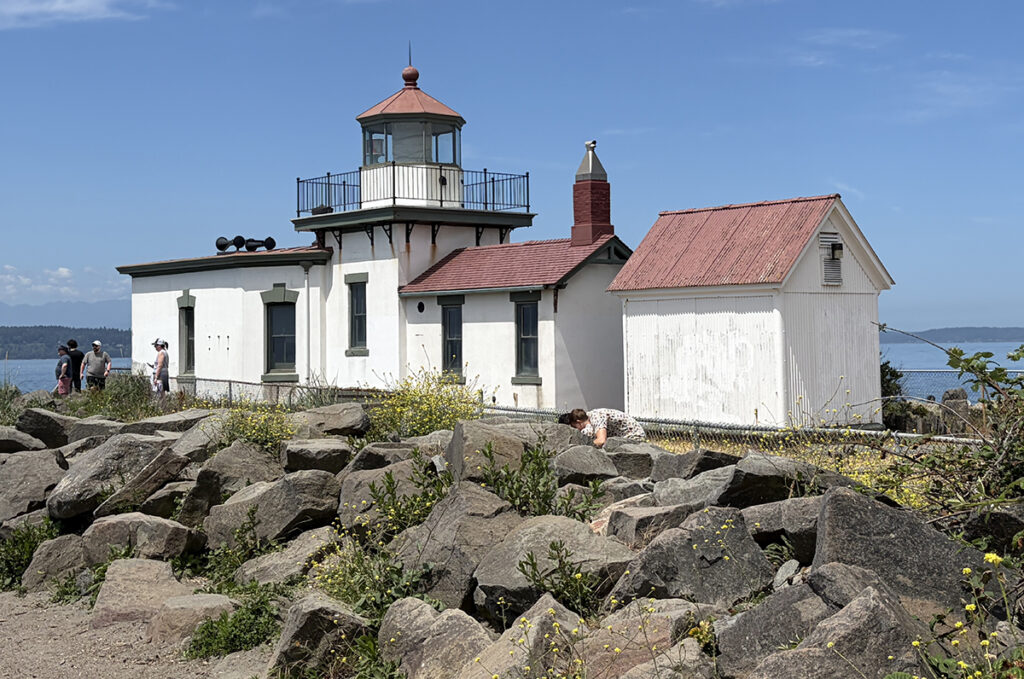
The West Point Lighthouse in Ballard’s Discovery Park. Photo by Mary Williams
One of the 18 active lighthouses in Washington State, West Point Lighthouse was established in 1881 and can be viewed from the South Beach Trail in the park. Over the course of my explorations, I’ve seen a handful of the area’s lighthouses. West Point is one of the smallest and most basic.
The 23-foot-high lighthouse began operation on Nov. 15, 1881. It was the first manned light station on Puget Sound and cost $25,000. Ironically, in 1985, it was the last station to become automated.
A kerosene lamp provided illumination for its first 44 years, until it connected to Seattle’s electricity grid in 1926. The city obtained the property in October 2004 under the National Historic Lighthouse Preservation Act of 2000. It was added to the National Register of Historic Places in 1977.
Two boarded-up buildings, which once housed the keeper and assistant keeper, are adjacent to the lighthouse.
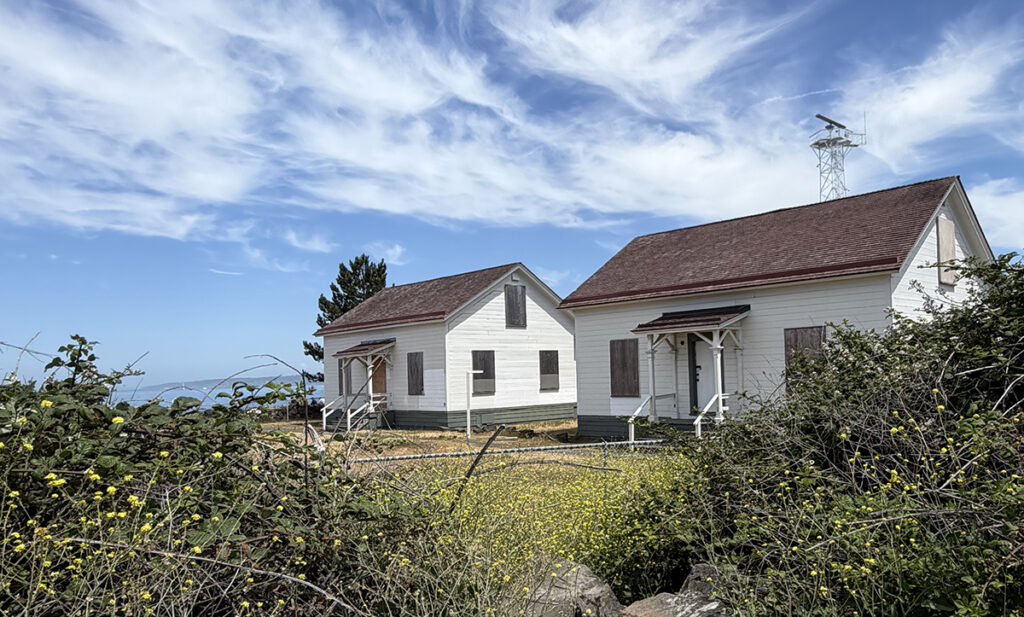
These small buildings housed the lighthouse’s keepers. Photo by Mary Williams
You can reach the shoreline by road or trail, although the hike back up from the beach is pretty strenuous. Driving and parking at the beach usually requires a free permit from the Environmental Learning Center in the east parking lot. But a broken pipe and flood last year destroyed the bottom level of the center, causing it to be closed until sometime in 2027. Access to the lower parking area is, therefore, currently available only to those with a state-issued disabled parking permit.
The south beach is on the windward side of the peninsula. Elliott Bay and the north beach are on the leeward side and has views of Shilshole Bay.
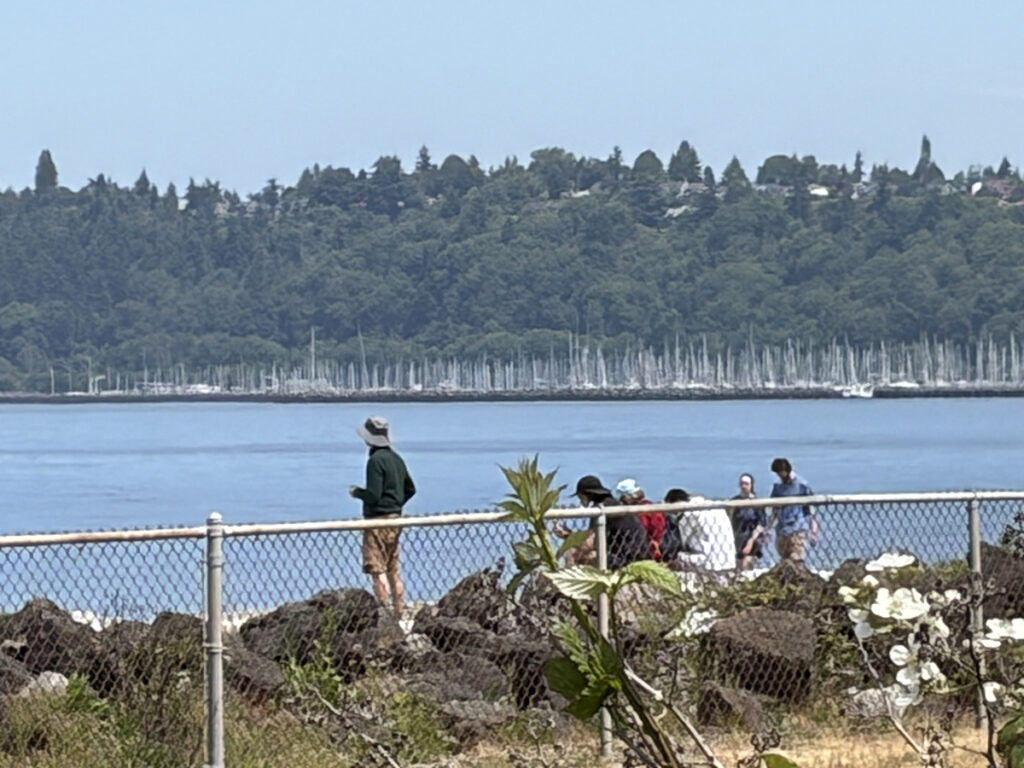
Shillshole Bay as seen from Discovery Park. Photo by Mary Williams
Fish ladder
I could have easily spent the day lollygagging around in one park or the other, but I still wanted to see several other things. My next stop was back at the locks and the Carl S. English Botanical Gardens. I was determined to check out the fish ladder.
When Major Hiram Chittenden engineered and designed the locks, he recognized the importance of protecting salmon and planned to build a fish ladder. Built in 1917, the ladder was renovated and improved in 1976. Today’s ladder has 21 steps, which allow fish to swim upstream on a gradual incline.
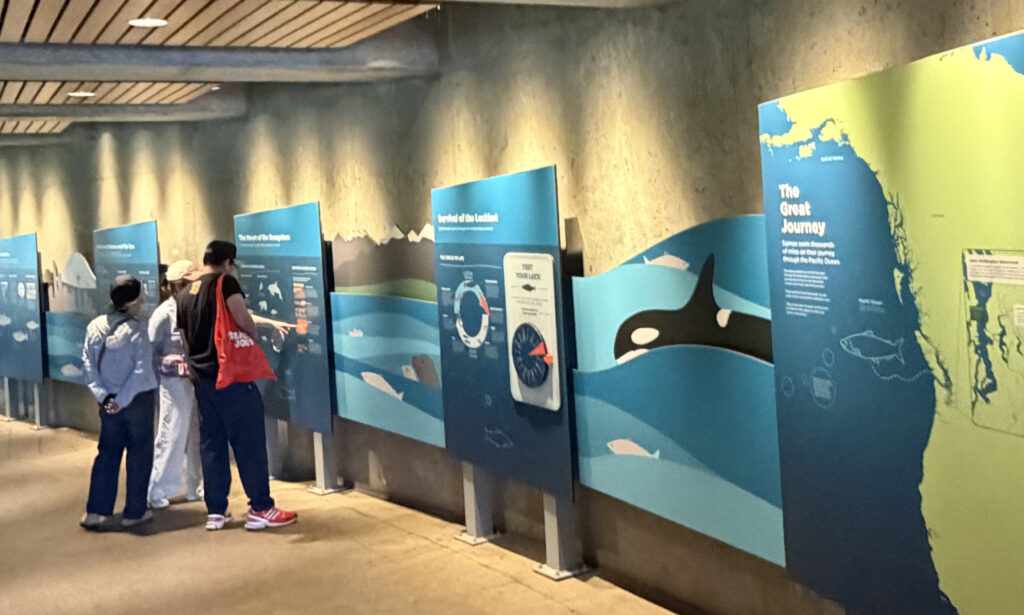
Signs explain the fish ladder at the Hiram Chittenden Locks in Ballard. Photo by Mary Williams
Salmon and steelhead hatch and partially grow up in rivers and streams. After journeying to the sea and spending most of their adult lives there, surviving salmon journey back to spawn in the streams where they hatched years before. Fewer than one egg in 1,000 survive to spawn as an adult.
Interesting interactive exhibits help both kids and adults understand the precarious nature of a salmon’s life and why they need protection.
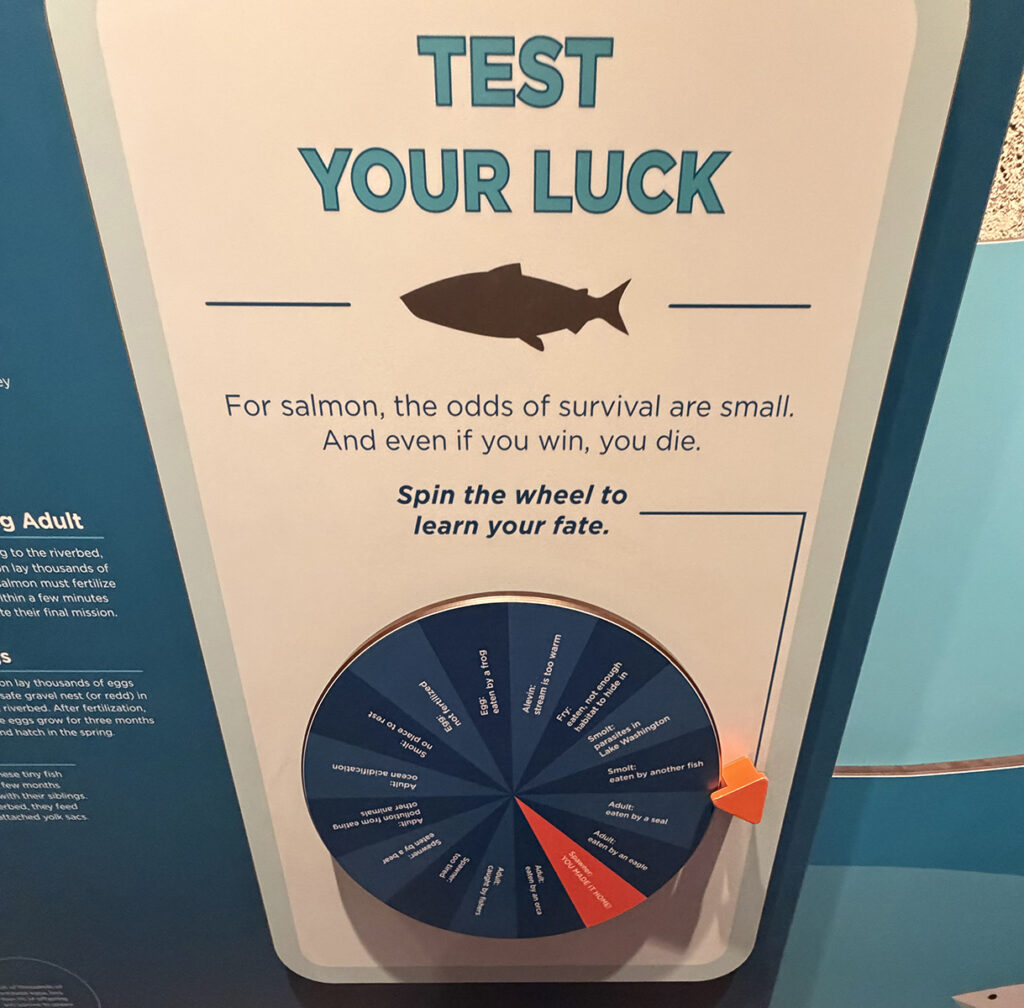
The odds are against salmon surviving to reproduce. Photo by Mary Williams
Windows allow visitors to watch the salmon traverse the locks. While I was there, one small salmon tried to make its way upstream under the fascinated gaze of a small boy.
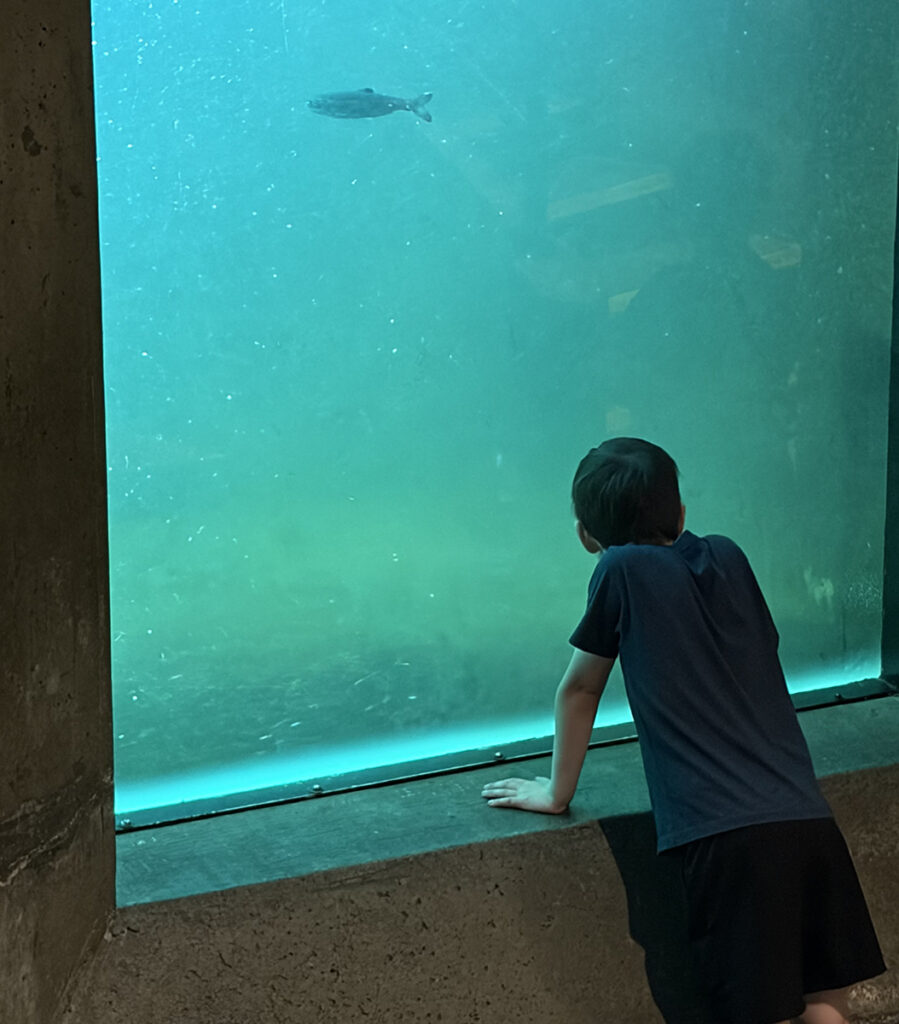
A visitor to the Ballard Locks watches a salmon attempt the fish ladder. Photo by Mary Williams
The best times for viewing salmon migrating upstream in the ladder are:
- Chinook, or king salmon: July through November (best viewing last two weeks of August)
- Coho, or silver salmon: August through November (best viewing last two weeks of September)
- Sockeye, or red salmon: June through October (best viewing July)
National Nordic Museum
I’ve stopped by the National Nordic Museum several times, but only to visit one of our Dambo trolls, Frankie Feetsplinter. I’ve admired the modern exterior and taken a quick look at the Freya Café and gift shop near the entrance on the lower level. But I’ve never taken the time, or paid the admission fee ($20 adult; $16 senior), to actually look around. I vowed that this trip would be different.
Founded in 1979, the National Nordic Museum is the only institution of its size and scale in the United States. It presents the history and culture of the entire Nordic region: Denmark, Finland, Iceland, Norway and Sweden; the regions of the Faroe Islands; Greenland; Åland, an autonomous region of Finland; and the cultural region of Sápmi, which spreads across parts of Norway, Sweden, Finland and Russia. The museum also celebrates the legacy of Nordic immigrants to the United States.
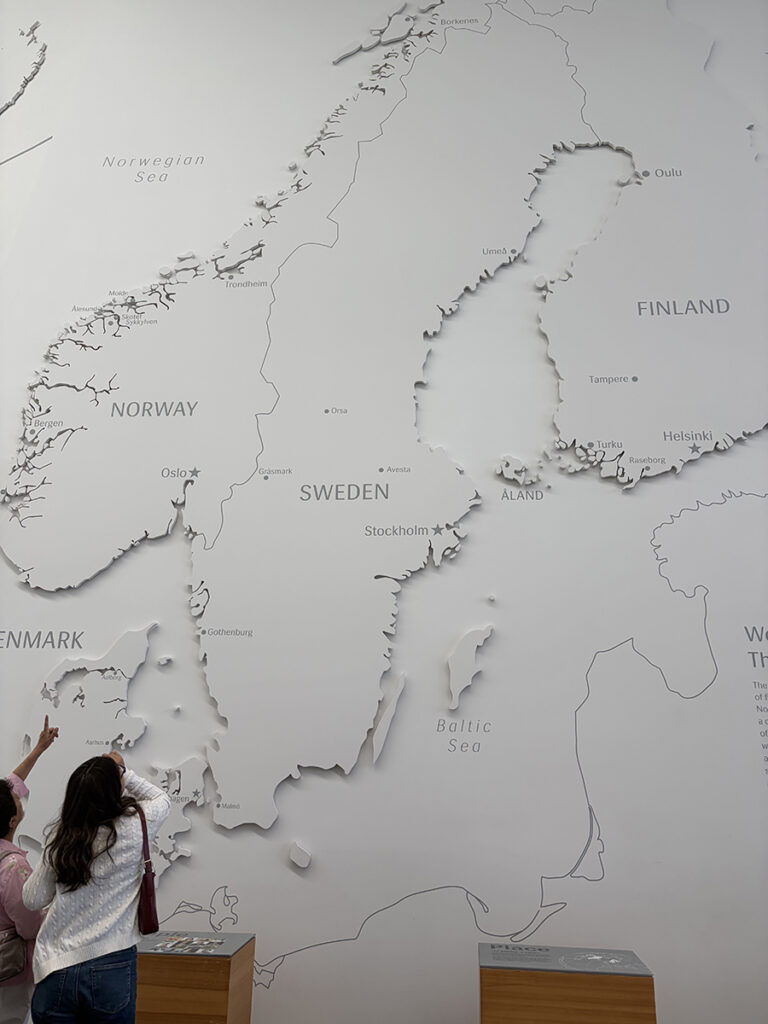
A map at the National Nordic Museum. Photo by Mary Williams
The museum opened in 1980 in leased space in the historic Webster School in Ballard. It began raising funds in 2003 to build a permanent home and eventually opened a nearly 58,000-square-foot facility in 2018. The opening celebration included remarks by the president of Iceland and the crown princess of Denmark.
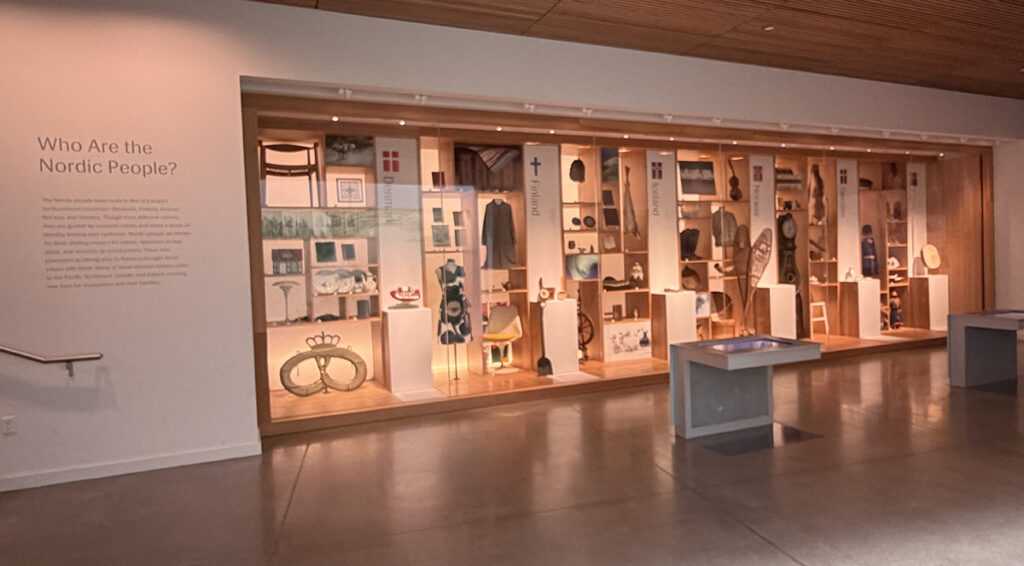
The National Nordic Museum in Ballard. Photo by Mary Williams
The building houses a variety of collections, including rare objects such as the studio of Swedish-American weaver and loom inventor Margaret Olofsson Bergman. The corporate archives of the pioneering Norwegian-American Ibsen Ski Company are at the museum, as are nearly 1,000 drawings by Danish-American artist Dines Carlsen. While many of the objects have Pacific Northwest origins, the collections also feature items that have connections to the American Midwest, East Coast, and Canada.
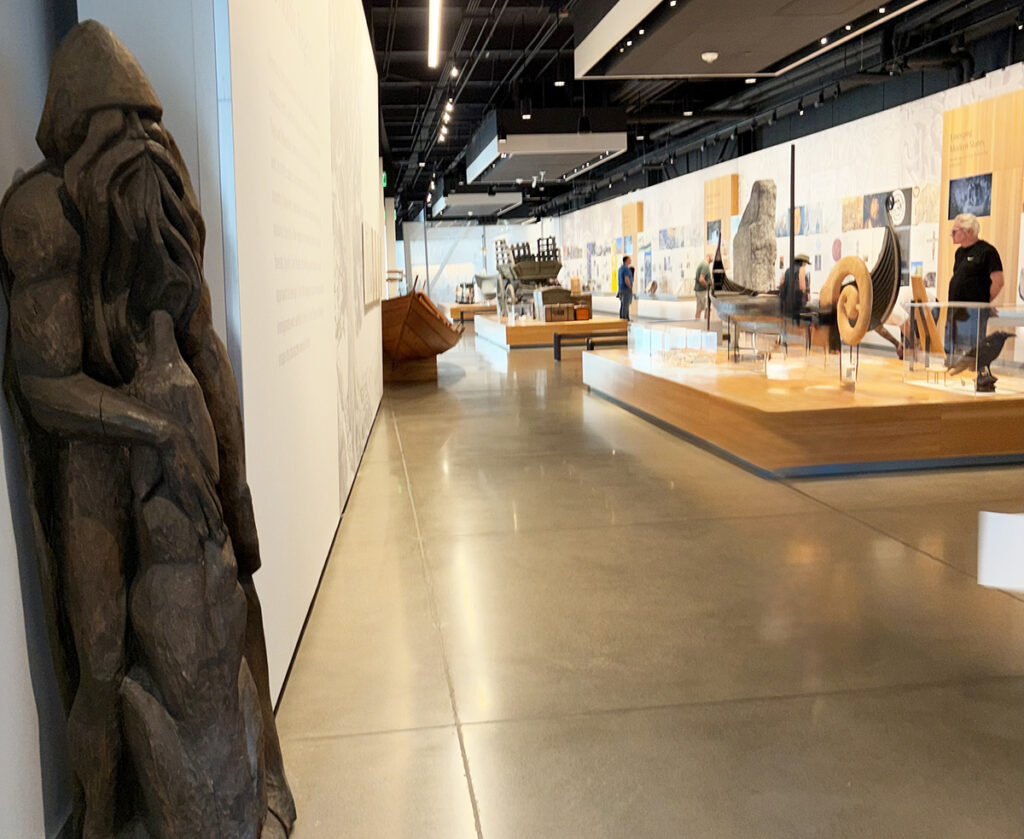
Objects at the National Nordic Museum in Ballard. Photo by Mary Williams
Art and history
As a pan-Nordic institution, the museum collects fine and decorative art, design, photographs, manuscripts and publications, and archival materials. Some standout artifacts include a late 19th-century Greenlandic Inuit qajaq (it’s from this vessel that we get the word “kayak”) and celebrated Norwegian explorer Roald Amundsen’s snowshoes. Although it may not be the most important, my favorite was a traditional Norwegian Dala horse.
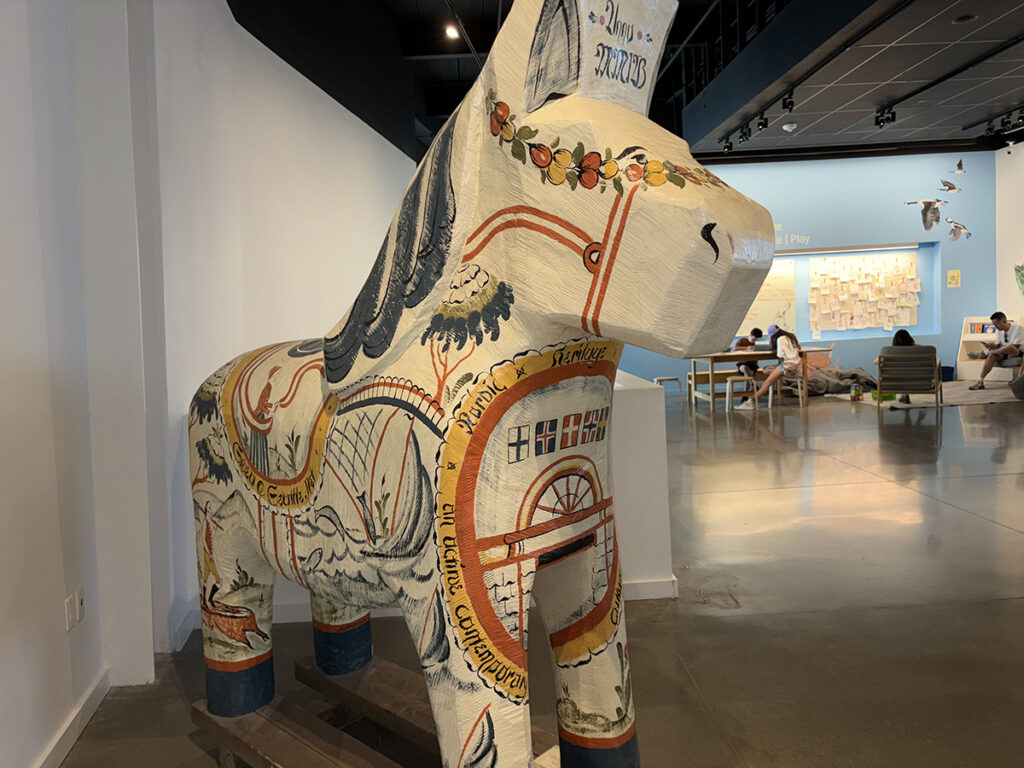
A traditional Norwegian Dala horse. Photo by Mary Williams
The collection includes nearly 1,000 digitized oral history interviews that share the experiences of Nordic and Nordic American peoples, as well as audio and video recordings, instruments, and texts that document Nordic folk and traditional music and dance. The museum also has a significant collection of books and publications devoted to Nordic history, culture, and art. A quiet room is available for research and study.
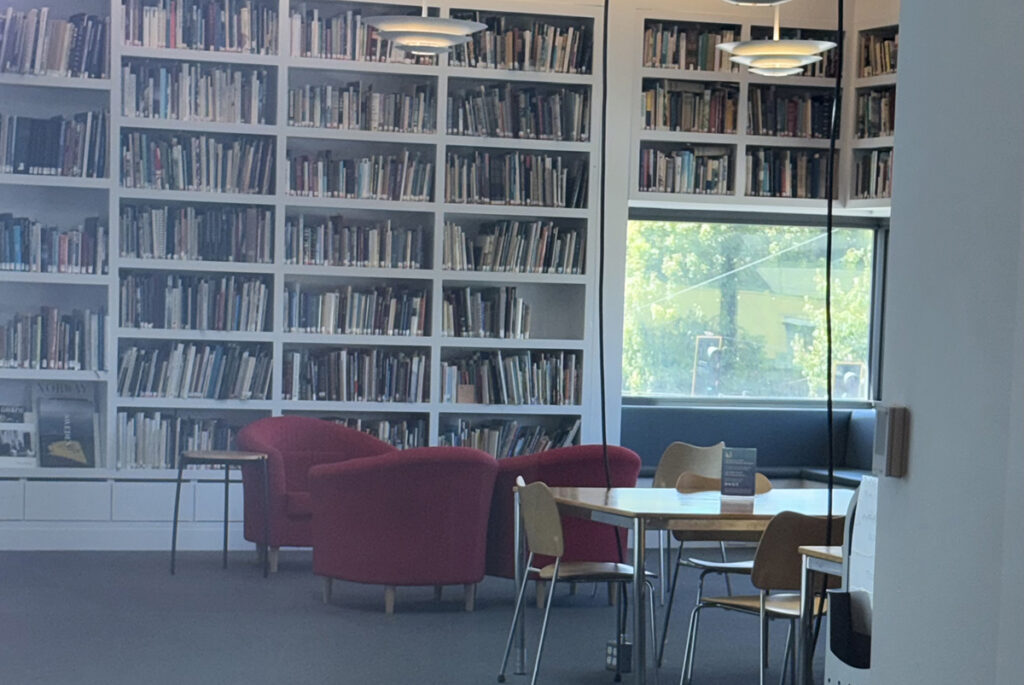
Some light reading is available at the National Nordic Museum’s library. Photo by Mary Williams
The museum also features short-term exhibits, including currently the story of the Moomins and the Sea. Moomins are characters devised by Finnish author Tove Jansson and featured in children’s books and comics.
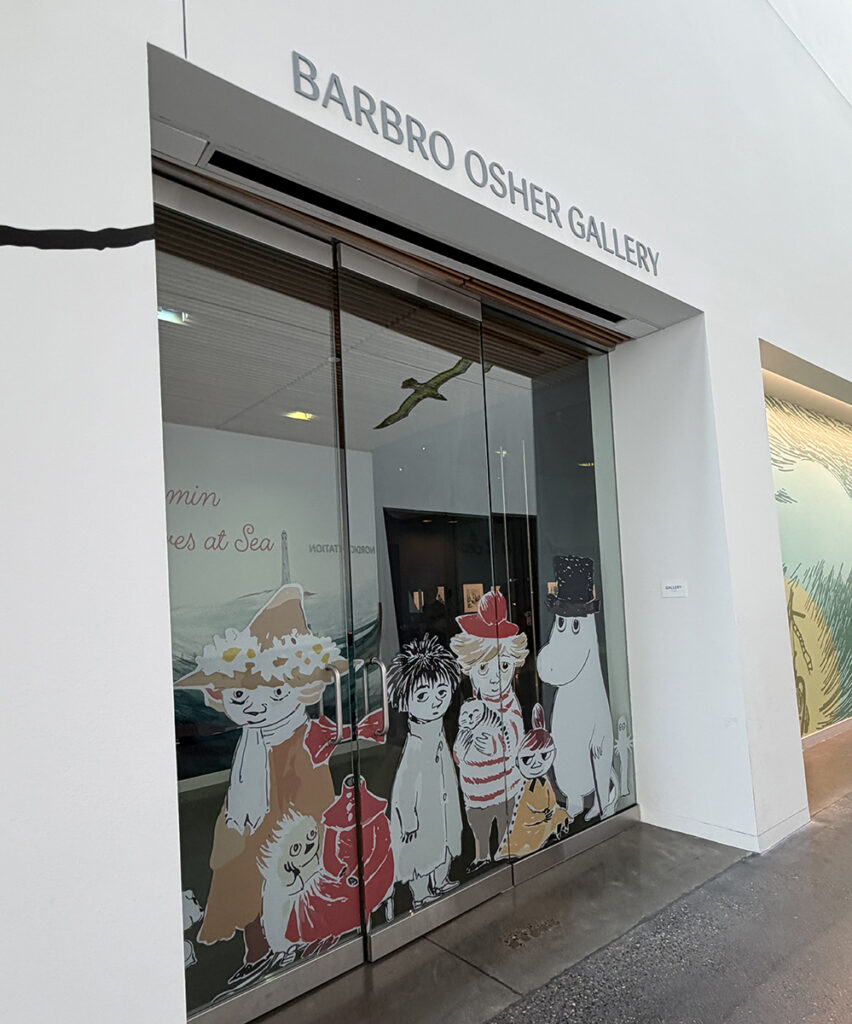
These are Moomins. Photo by Mary Williams
The Moomins exhibits are at the Museum now through Sept. 6.
The 51st state?
In addition to the maps, several areas of the museum focus on the geography of the region. Many of the exhibits stress the unity of the countries and territories that make up the region and speak to their solidarity.
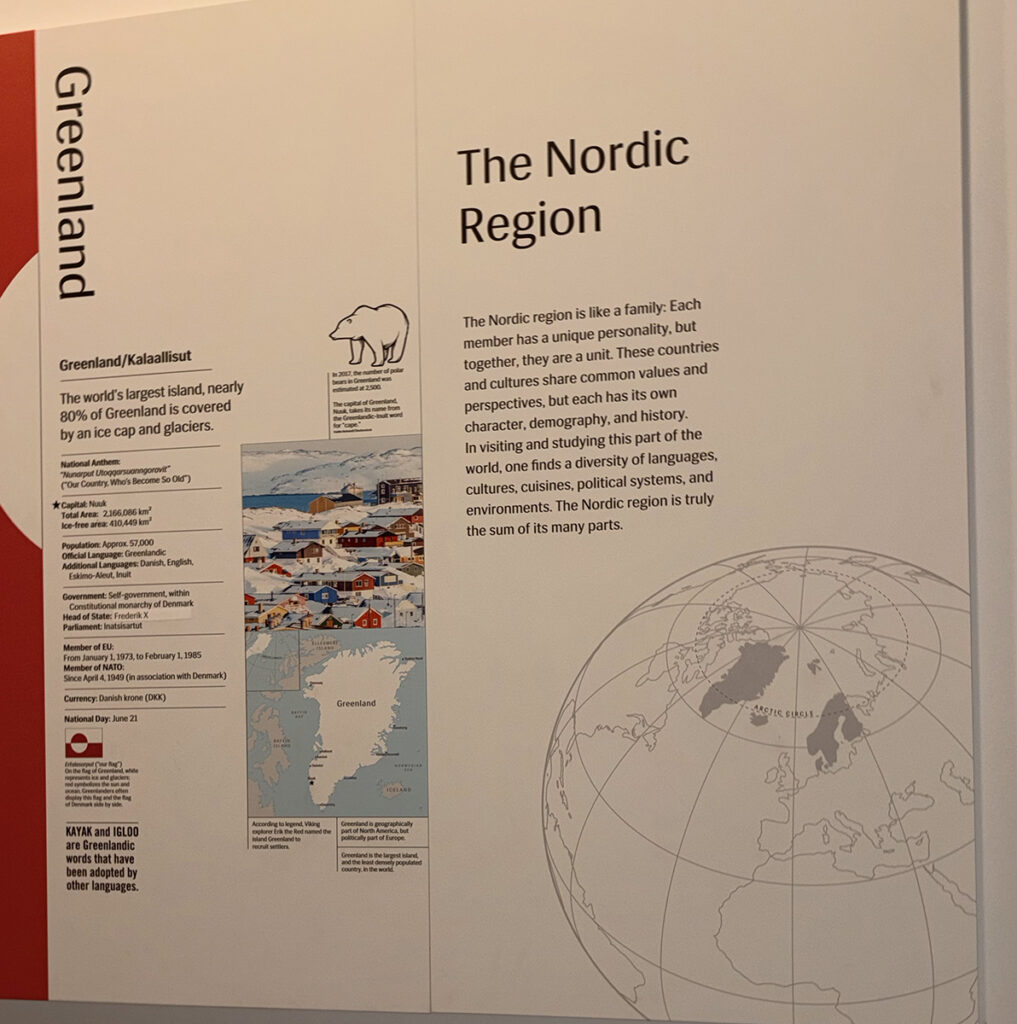
Maps delve in to the geography and people of the Nordic nations. Photo by Mary Williams
Having read several statements hanging throughout the exhibits, its hard for me to believe that the Nordic region would ever go along with Greenland becoming our 51st state.
When I visit places like Ballard, Discovery Park, or Golden Gardens for the first time, I don’t ordinarily go for the recreational effect. I’m there to learn a bit of history and decide whether I want to go back, either by myself or with the grands. I also want to figure out whether these are places I want to recommend.
I also don’t want to pretend I’ve seen every aspect of a location. My goal is to be a scout, hunting down (almost) local places that I think might be a lot of fun.
I think the most important thing I’ve learned over the past three years is that we’re surrounded by places I didn’t know I wanted to go, and so many things I didn’t know I wanted to do, but have loved once I got there. I hope you’ll give some of them a chance so you can experience that, too.
About the Day Tripper column
Gas prices are sky high, and a night in a hotel is approaching astronomically expensive. So, for the foreseeable future, I imagine many of you are going to find yourselves taking day trips rather than the road trip vacations we’ve grown to love.
This beautiful region in which we live is ripe with opportunities to explore new places, see new things, and learn a little something at the same time. I promise to keep the longest journeys to a one-way distance of under 200 miles. Whether you want to make it an overnight trip, a weekend, or just a very long day trip, we should be able to pull it off.
I hope you’ll grant me the honor of your virtual company as we travel these roads together. Happy trails!