Business Community Government
Committee finds compromise on lodging tax recommendation
The city of Gig Harbor’s Lodging Tax Advisory Committee (LTAC) voted at its Sept. 3 meeting to give several of the eight organizations seeking funding for 2027 about two-thirds of what they received this year. However, some organizations received substantially more and some received substantially less.
Committee members also discussed seeking outside funding, either from the city council or another source. The committee voted to recommend the city allocate $379,400 to the Gig Harbor Chamber of Commerce, the largest funding award.
The committee recommends how to spend revenue from taxes on hotels and motels in the city. Revenue goes to organizations that promote tourism and draw visitors from 50 or more miles away. The fund maintains a reserve, but it is dwindling.
By law, the committee is made up of representatives from businesses that pay the tax and organizations that benefit from it. Its membership includes leaders from the Chamber of Commerce, Harbor WildWatch, the Harbor History Museum, and the Gig Harbor Downtown Waterfront Alliance.
In July, city Finance Director Scott Larson told the committee it would have $530,000 to award before dipping into a $500,000 reserve fund. The Chamber of Commerce, which contracts with the city to handle tourism and marketing, asked for $520,000 in 2027 and 2028, which would eat up most of the funding. The committee voted to hold off on granting those funds.
The city and a coalition of local organizations are considering whether to found a creative district, which could boost the lodging tax pool. But even if that effort goes forward, the solution is likely months or years away.
Focus on tourism
State law requires local governments to use lodging tax revenues to promote and drive tourism.
Chamber of Commerce President and CEO Miriam Battson said the committee needs to “keep a focus” on that.
Battson questioned whether some organizations applying for lodging tax revenue meet that purpose. The kinds of events and organizations that bring tourists to town are not always the same as those that provide attractions while they are in the city, she said.
“They’re very important, because without those things to see and do when here, it makes for a very boring visit,” she said. “I just don’t know if lodging tax is the right venue for which to fund it.”
Harbor History Museum Executive Director Stephanie Lile said she felt differently. She said each applicant promotes tourism in ways that the Chamber of Commerce, as a destination marketing organization, does not. These individual organizations bring “people to this location to spend money, stay overnight — do a lot of things.”
She also said it is easier to ask the city council for destination marketing funding than to ask for unique organizational funding.
“I just approach it in a little bit different way, because I think it’s very hard for the council to, say, get an individual request from all these different organizations to say, ‘Support us, support us!’ And then you’re pitting us against each other,” Lile said.
Two-thirds compromise
Organizations receiving lodging tax funds are the Gig Harbor Boatshop, the Gig Harbor Canoe and Kayak Racing Team, Harbor WildWatch, Harbor History Museum, Gig Harbor Downtown Waterfront Alliance, Permission To Start Dreaming Foundation, Gig Harbor Film Festival, and the Chamber of Commerce.
Lile calculated that the committee could keep the budget relatively on track by awarding each organization 66% of its 2026 total.
Lile’s proposal also required trimming the chamber’s request beyond giving the chamber 66% of what it was awarded last year.
The chamber asked for $78,000 for the Summer Sounds at Skansie concert series and associated events. Committee members nixed that.
Harbor WildWatch Executive Director Lindsay Stover said cutting Summer Sounds funding protects the chamber’s direct marketing work.
“It wouldn’t take any marketing and advertising away,” Stover said. “It would just take events away that are … experiences for people that are already here, not necessarily drawing people here. … The (associated) events are things like the walking tours. They’re things like the [Harbor History Museum’s] Round Rock competition. … We have to cut somewhere.”
Lile said that the chamber does “a fantastic job” of putting together Summer Sounds, “but to me, that’s a parks program. That should not come out of your budget for LTAC.”
The committee also approved giving the chamber $62,600 from the lodging tax reserve fund, bringing the organization’s total to more than 66% of what it received last year.
Future lodging tax projections
Coronado noted that the committee may have to cap funding at $530,000 for the foreseeable future, which may not leave much room to grow destination marketing services.
“What does that look like in five or 10 years when the ask is [$550,000 from the chamber], and we don’t have that money at that point?” he said.
Battson said that she worries about this, too.
“The other component to it is there’s also sales tax that we now have to pay on certain things that we didn’t have to pay for [before],” she added. “And so there’s a number of additional expenses that we’re looking at that we have to include, and [expenses are] going to do nothing but go up and up. So, I’m with you on this. I’m concerned about, you know, where is, where are we at?”
The committee unanimously voted to recommend the city fund several applicants at 66% of what they received this year, but not all of them.
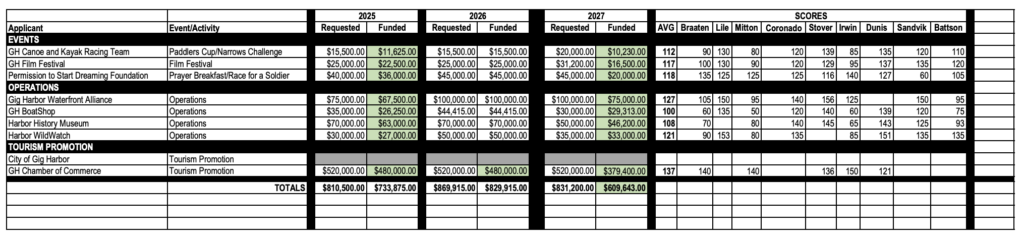
A table shows previous lodging tax allocations and LTAC committee members’ scores for each application.
The committee recommended the chamber receive $379,400, about 79% of what it received last year. Some of that money comes from the lodging tax fund’s reserves. The chamber may also seek some amount of additional funding from the city to help reach that amount, but Battson did not specify how much.
BoatShop, Alliance, PTSD
The committee also opted to recommend funding the Gig Harbor BoatShop at nearly exactly the level it requested for 2027. The organization requested $30,000 and the committee recommended the city award it $29,313.
Committee members acknowledged that the Waterfront Alliance’s funding level printed on the table they used in the meeting was incorrect, and that the alliance actually received $100,000 in 2026, not $75,000.
The committee voted to award the alliance $75,000 in 2027, instead of $66,000.
In addition to reducing the Permission To Start Dreaming Foundation’s funding to 66% of what it received last year, the committee also voted to take an additional $9,700 from the foundation’s funding recommendation. This brought the total funding allocation for the foundation to $20,000. If the committee had recommended the city fund the foundation at 66% of what it received last year, that number would stand at $29,700.
Gig Harbor Waterfront Alliance Executive Director Clare Dunis said that she had a hard time discerning between the foundation’s request for operational expenses versus events.
Both Lile and other committee members said that they had before the meeting chosen to recommend the foundation receive $20,000, because they were not sure the request fit the LTAC criteria.