
Community
Gig Harbor Now and Then | Our not-so-mysterious Location of Mystery and the origins of Bay-Island
The June 29 Gig Harbor Now and Then column introduced a photograph of Location of Mystery No. 2, which, for your convenience, is reposted below:

Community Sponsor
Community stories are made possible in part by Peninsula Light Co, a proud sponsor of Gig Harbor Now.
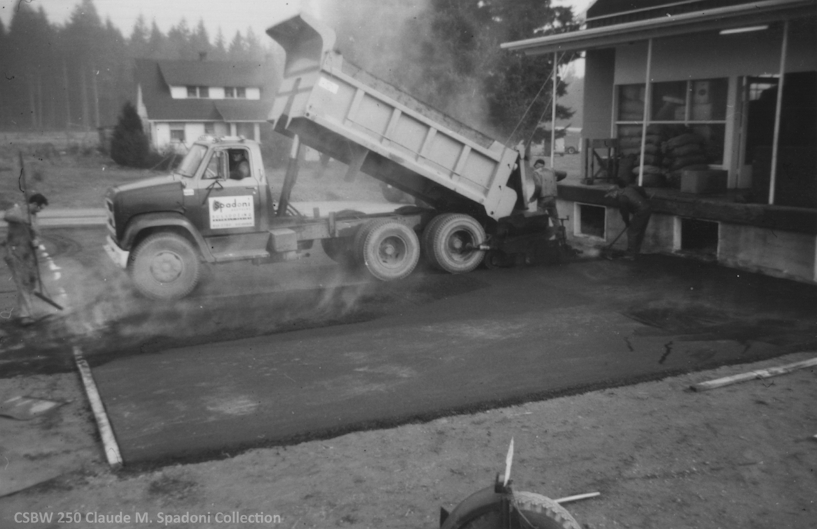
Spadoni Brothers asphalt paving was the reason the Location of Mystery No. 2 photograph was taken. Photo by Claude Spadoni.
The clues given were that the date range is from early 1968 to April 1969, the location is somewhere on the Greater Peninsula and that one of the two buildings is still standing. The question is:
Where is Gig Harbor Now and Then Location of Mystery No. 2?
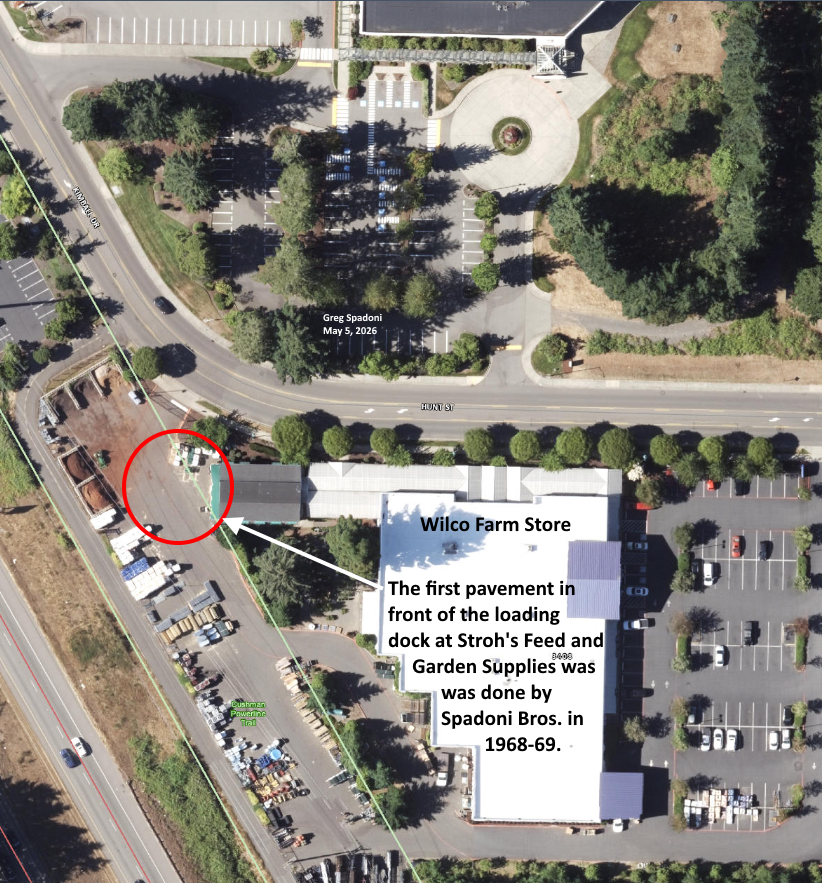
Answer: The loading dock of Stroh’s Feed and Garden Supplies, which is now the westernmost part of Wilco Farm Store, 3408 Hunt St. in Gig Harbor.
The pavement there today is not the same asphalt that Spadoni Brothers laid down over 50 years ago.
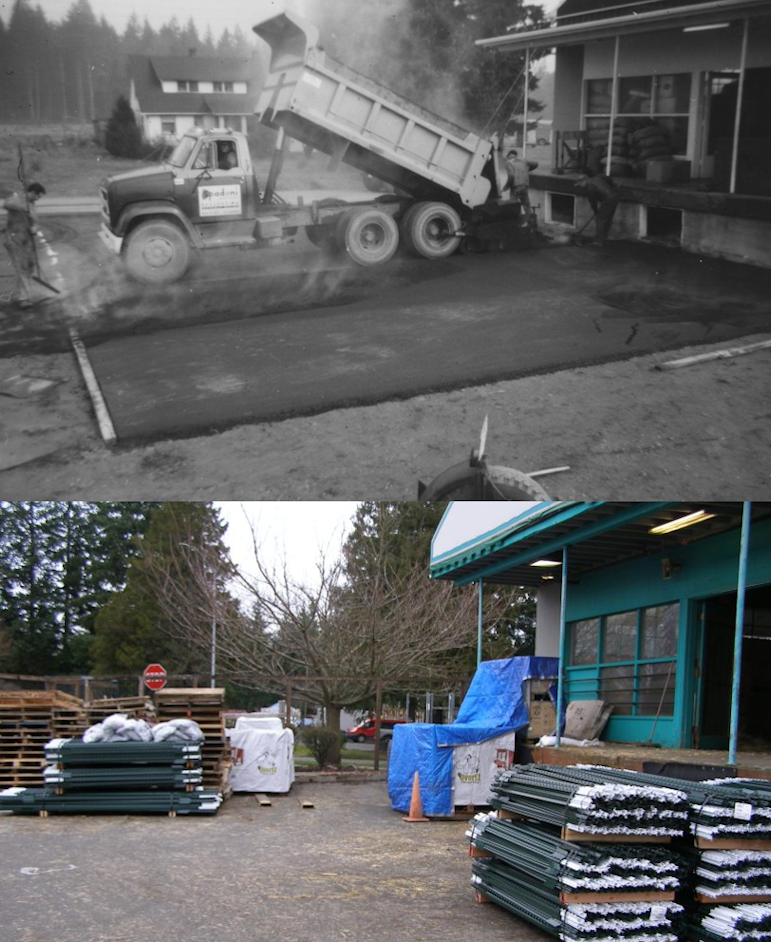
The house across Hunt Street is the building that’s no longer standing. It was built in 1914 by Civil War veteran Thad Waters from lumber milled out of logs supplied by local logger Frank Kimball.
Stroh’s building was originally further west. In the 1960s, when Highway 16 was expanded to four lanes from two, the state took the chunk of Stroh property the building was sitting on and built the northbound lanes across it. Rather than tear it down, Fred and Dorothy Stroh moved it back from the highway to where it is now.
Pictures within pictures
This is something you don’t see every day. It’s a picture of me taking a picture of the subject of a picture that includes the picture of the subject that I’m taking. Or, as I named the photo file, Picture of a Picture and a Picture Being Taken.
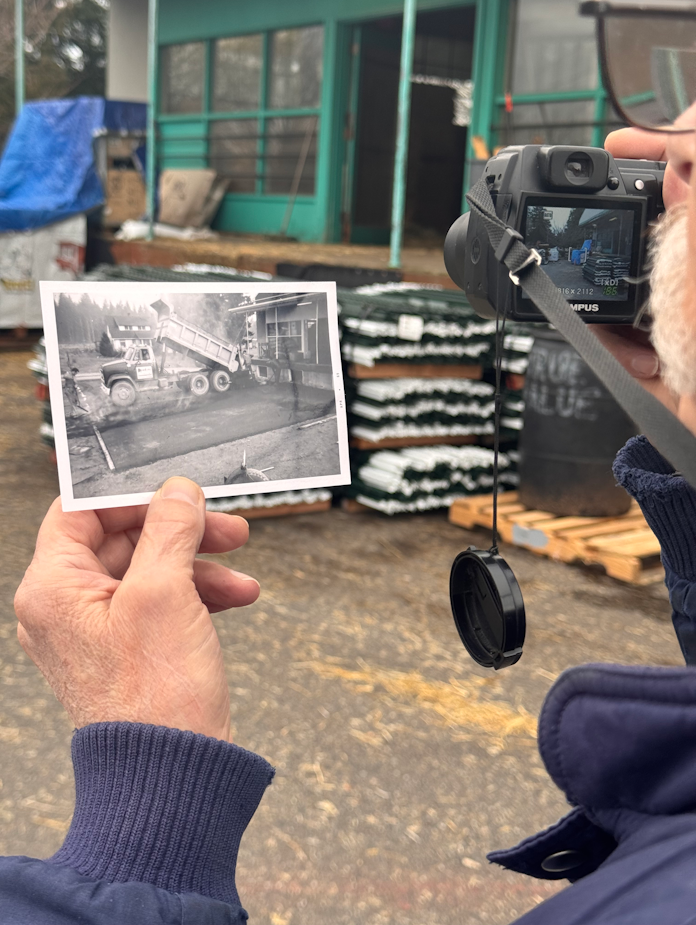
This picture of a picture and a picture being taken was taken by Gig Harbor Now columnist Tonya Strickland.
New business: The Bay-Island district
Any dive into Gig Harbor Peninsula history that includes the first couple decades of the 20th century will bring you face-to-face with many mentions of Bay-Island. It shows up in several forms, the most common being the Bay-Island district, the Bay-Island Producers’ Union, the steamer Bay Island, and the Bay-Island News.
There being no Bay Island in South Puget Sound, the name is a head-scratcher today. Fortunately for those of us who want to know more about such things, William Lotz of Warren explained the origin of the name in a letter to the editor of the Bay-Island News, the weekly newspaper in Gig Harbor and Key Peninsula from 1917 to 1923. The newspaper ran the letter in its Oct. 14, 1921, issue.
“As to the origin of the name, it dates back to a not very ancient period,” Lotz wrote. “In February, 1904, a mass meeting of the stockholders and patrons of the Hales Pass and Fox Island Fruit Growers’ Association met at Peoples Hall on Hales Pass, when it was decided to enlarge its territory and change its name—in fact to reorganize the association. A committee on by-laws and constitution and a new name was appointed. The writer, as president of the association, acted as chairman of the committee. When the committee reported its draft of the constitution and by-laws, it also recommended as a name for the organization ‘The Bay-Island Producers Union,’ explaining the fact that the proposed territory to be included (being all that part of Pierce county lying west of the Narrows) every settler lived either on or close to a bay or on an island and the Bays and Islands would be the most euphoneous [sic] and appropriate name, and to shorten it the ‘Bay-Island’ was substituted. The report of the committee was unanimously adopted.”
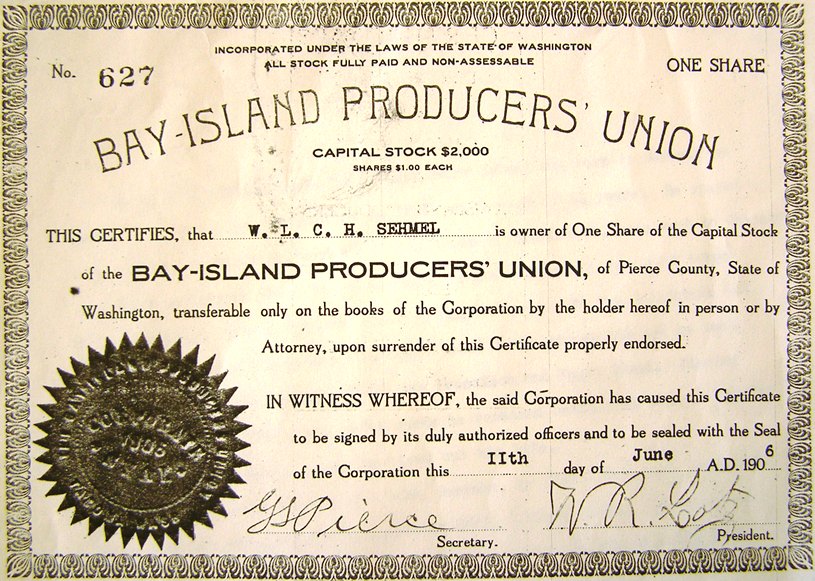
This photocopy of W. L. C. H. Sehmel’s Bay-Island Producers’ Union stock certificate was found in the files of the Harbor History Museum.
As to the proper spelling of Bay-Island, Lotz added, “In conclusion I would say that the name is often erroneously used as two words instead of a compound or hyphenated word, thus causing strangers to sometimes ask the question, ‘Where is this Bay Island?’ presuming it to be an island, as ‘Day Island,’ ‘Fox Island,’ etc. When the name is properly spelled they would know better. It would be pleasing if the Tacoma papers would pay a little more heed to the above, and spell it right.”
Although Lotz defined the Bay-Island district as “all that part of Pierce county lying west of the Narrows,” according to a map published in the Bay-Island News multiple times, it extended a bit further north and west. It also included Olalla and Burley, both in Kitsap County, and Victor, Allyn, Detroit, and Harstine Island in Mason County.
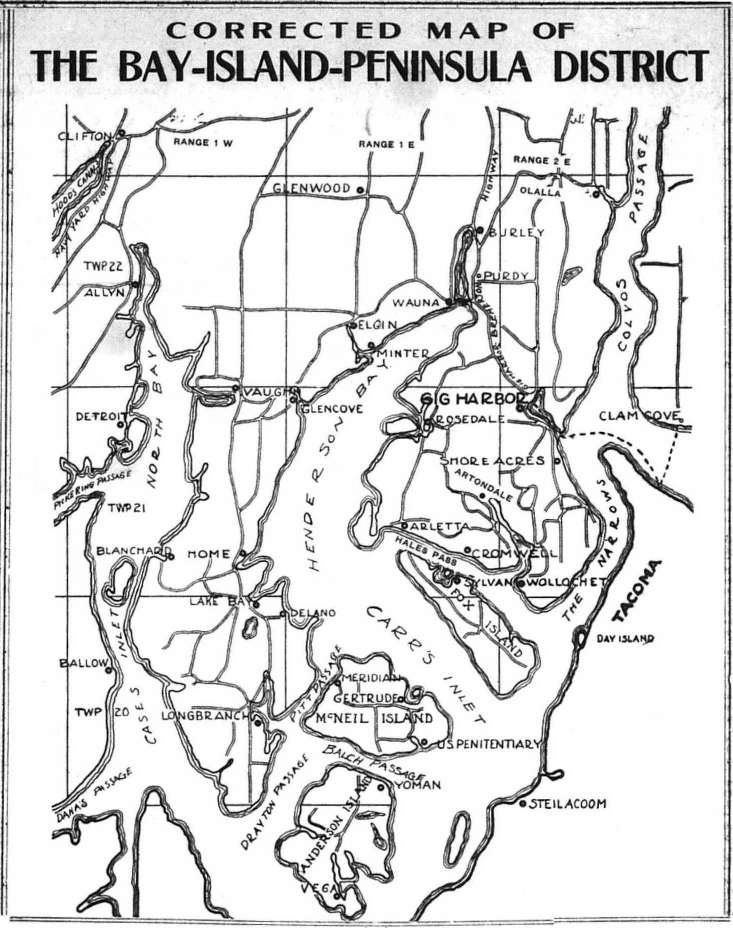
The previous map incorrectly indicated the geographic ranges as 1 East, 2 East, and 3 East. This corrected map, published in the Bay-Island News on Jan. 13, 1922, properly names them as 1 West, 1 East and 2 East.
A common cooperative fate
The Bay-Island Producers’ Union was a successful operation at first. In his own letter to the Bay-Island News, on December 20, 1917, former member Clarence Ludden of Arletta explained how it collapsed after a few short years:
When I came into the [Bay-Island] country seven years ago the Bay-Island Producers’ Union was doing a good business with over nine hundred members. That year we shipped out forty [railroad] carloads of strawberries, but the members could not stand organized cooperation. They began shipping their best products to commission men and their poor stuff to the B.-I. P. U. and of course business began to fall off, and finally failed, leaving six men to pay a $2,000 bank note which had been carried along for three years. Not one of the nine hundred members offered to pay a cent. That was organization without cooperation.
Ludden made his comments to the newspaper shortly before the Bay-Island farmers made one more attempt at cooperation.
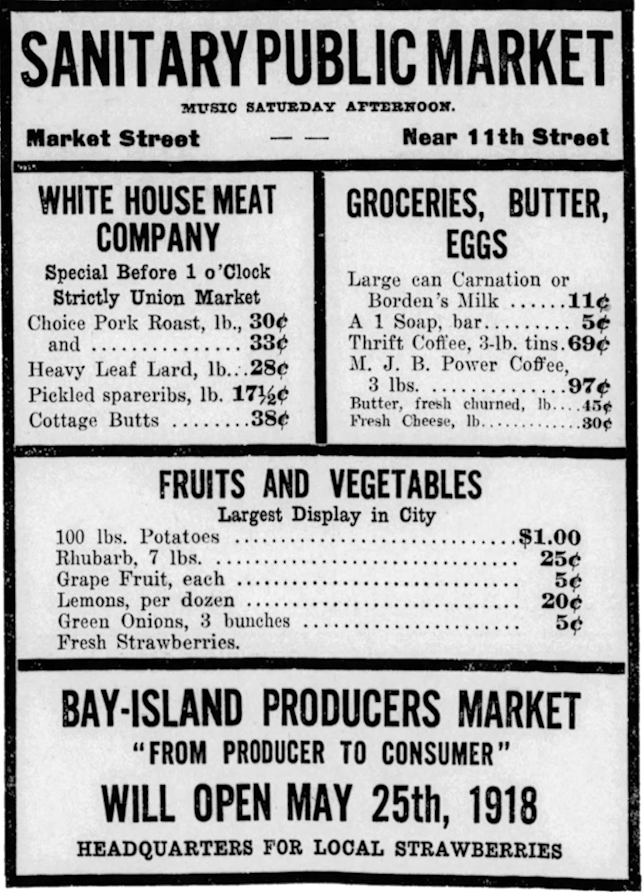
The Bay-Island Producers’ Union Market was one of several vendors in Tacoma’s Sanitary Public Market at 1106-12 on Market Street. From the News Tribune, May 17, 1918.
Managed by Otto Jahn, whose name is now attached to two county roads on the Gig Harbor Peninsula (Otto Jahn Road and Jahn Avenue), the Bay-Island Producers’ Union Market opened in Tacoma in 1918. Its purpose was to eliminate the middle man between Bay-Island farmers and consumers. Its life was short. It was taken over by the Sound Co-operative Produce Union in 1919, less than a full year after it opened.
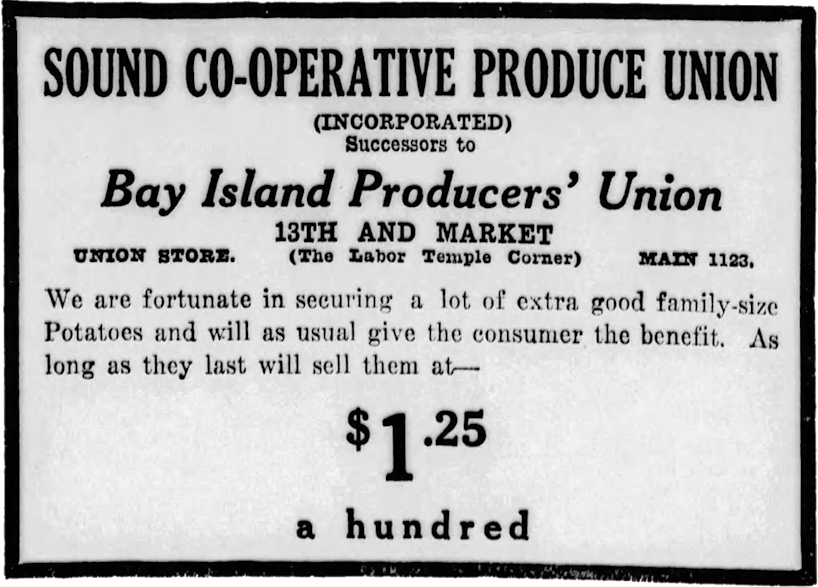
The Bay-Island Producers’ Union Market was taken over by the Sound Co-operative Produce Union in 1919 and moved to 13th & Market Streets in Tacoma. From the News Tribune, April 18, 1919.
Fade to black
With the end of the Bay-Island Producers’ Union and its public market, the name for that region of Puget sound began to fade. The Bay-Island News was sold in 1923, and the new owner promptly change the newspaper’s name to The Peninsula Gateway.


The steamer Bay Island (I don’t know if its name was hyphenated) was sold and moved north before it sank during a storm near Mukilteo in 1928, leaving nothing much to remind people of the Bay-Island district.
While the physical area remains, the name does not. Or at least not for now, anyway. Perhaps the current Pierce County secessionists will consider “Bay-Island County” for the name of their new government. But maybe that’s not such a good idea, considering the name’s legacy of inglorious endings.
Next time
Another mysterious photo will be featured on July 27. It will be the Gig Harbor Now and Then Location of Mystery Number 3.
Actually, it’s not really much of a mystery. The location is right beside a very busy public road, and the photo is from just last month. But for newer residents of the area, the mystery will be what the place used to be, so it does come with at least a measure of the unknown for some readers.
Note to baby boomers
How does it make you feel to know that Ringo Starr turned 86 last week?
— Greg Spadoni, July 13, 2026
Greg Spadoni of Olalla has had more access to local history than most life-long residents. During 25 years in road construction working for the Spadoni Brothers, his first cousins, twice removed, he traveled to every corner of the Gig Harbor and Key Peninsulas, taking note of many abandoned buildings, overgrown farms, and roads that no longer had a destination. Through his current association with the Harbor History Museum in Gig Harbor as the unofficial Chief (and only) Assistant to Linda McCowen, the Museum’s primary photo archive volunteer, he regularly studies the area’s largest collection of visual history. Combined with the print history available at the museum and online, he has uncovered countless stories of long-forgotten local people and events.