
Community
Gig Harbor Now and Then | One man’s ambitious plan for the town of Artena
Last time, on July 27, I said today’s column would have an interesting surprise in local history, and that it would be “a very good one. Very positive.” That’s exactly what it is. It’s a surprise that’s been hiding in plain sight for 136 years.

Community Sponsor
Community stories are made possible in part by Peninsula Light Co, a proud sponsor of Gig Harbor Now.
But first is the answer to the double question of July 27, which won’t be a surprise to many people:
Where is Gig Harbor Now and Then Location of Mystery No. 3, and what was the location used for before it was vacated?
It was in reference to this photo, taken in June:
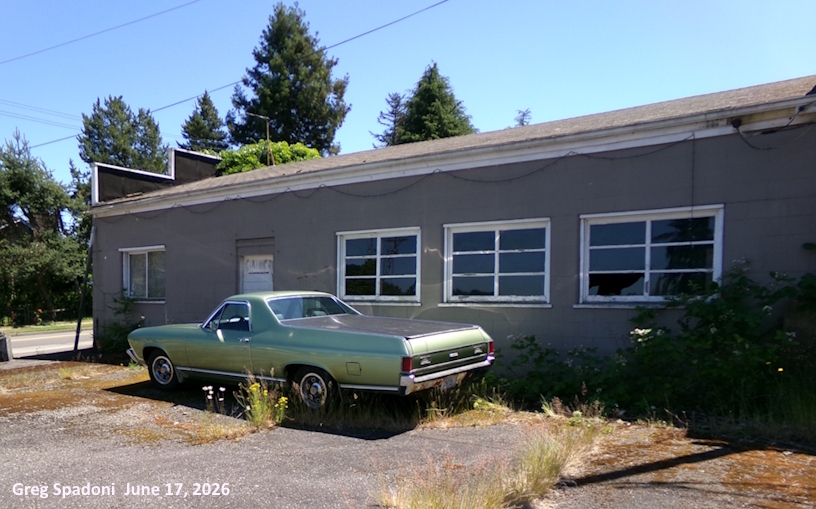
This deteriorating building and junk car are at Gig Harbor Now and Then Location of Mystery Number 3. Well, the car’s not there anymore. It was there only for the photoshoot on June 17. Photo by Greg Spadoni.
Answer: The location is 7910 Stinson Ave. in Gig Harbor, at the southwest corner of the intersection of Stinson Avenue and Rosedale Street. It’s the former office, maintenance shop and equipment yard of Spadoni Brothers, a road construction company that operated for 59 years, all but one of them at this location. This is what it looked like in 2004:
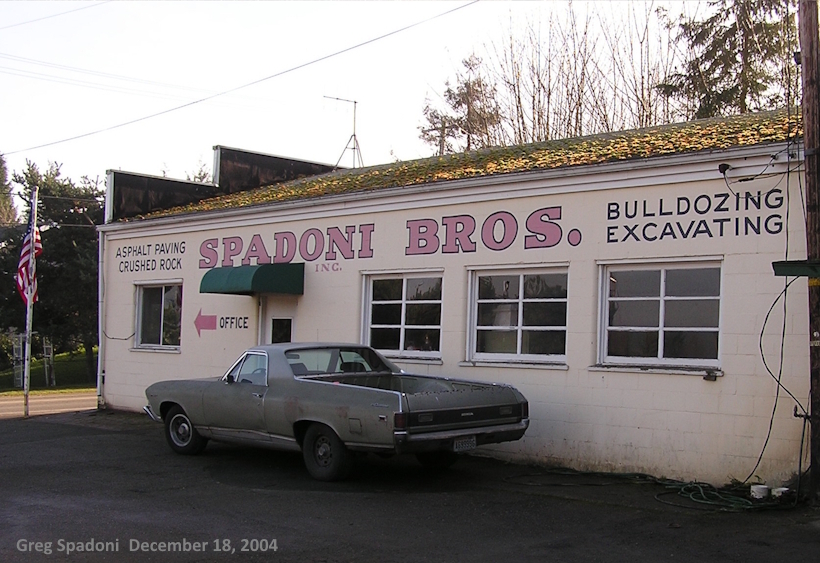
The same old junker was in front of the building 22 years ago, in the exact same spot. During all that time, instead of getting even junkier, it somehow got a lot shinier. Photo by Greg Spadoni.
The building was briefly the home of another road construction company in the early 2000s.
Now, for the surprise
There is a neighborhood in Gig Harbor called Artena. It includes all but a small piece of the land south of Vernhardson Street between Peacock Hill Avenue and Crescent Creek. It was platted in 1890 as the Town of Artena, but has long since become the Artena Addition to Gig Harbor.
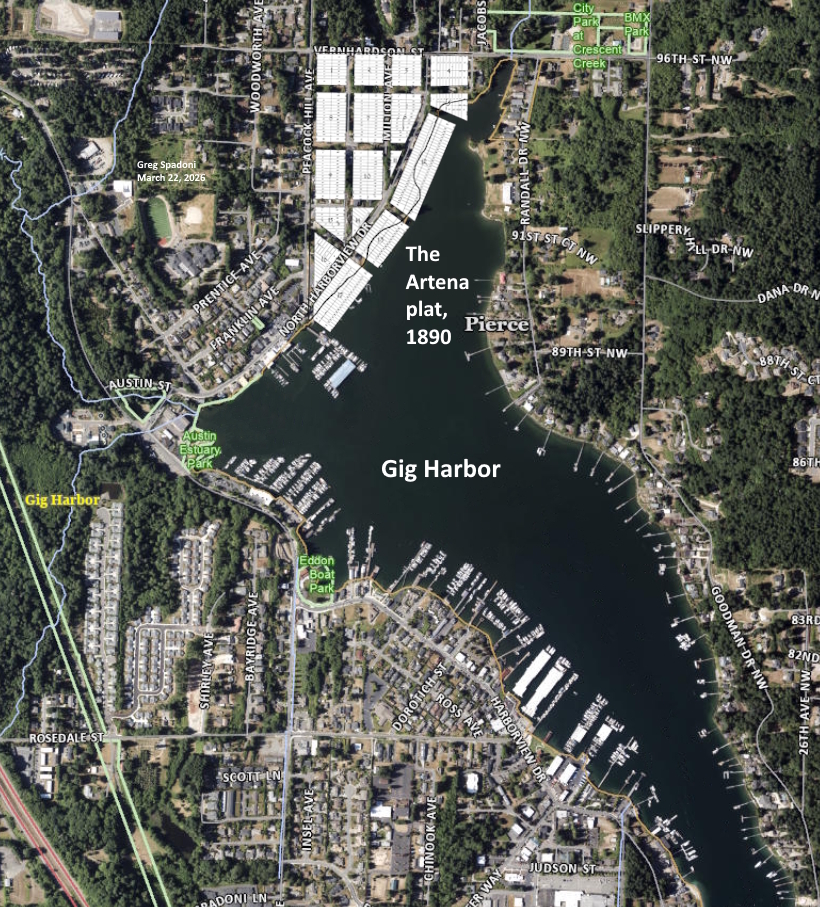
Pierce County Assessor-Treasurer aerial base map.
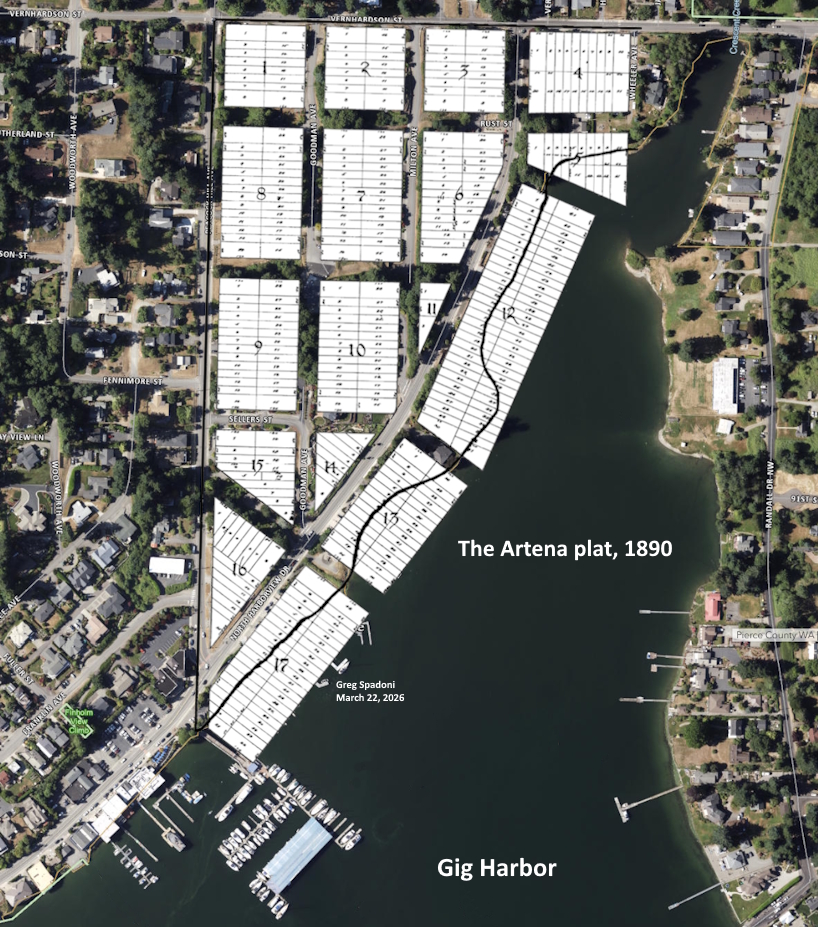
Why individual lots were platted underwater, I have never been able to figure out. One guess is that they were intended to eventually be filled, making dry land. Another possibility is of it being a method by which to own tidelands, as at the time of the recording of the plat, tidelands were not yet available for purchase from the state (they would be within a year or two, however, which was common knowledge at the time). Another guess is that it simply provided more lots to sell — useful or not — increasing profits. Pierce County Assessor-Treasurer aerial base map.
Artena started out as a very ambitious idea that was extremely poorly executed. It was platted as a townsite but no town ever developed.
The brains behind the disaster belonged to Joseph W. Young. He was industrious and hardworking, but unforeseen external events turned against him. He bet everything on his dream and lost it all.
A key geographical link
Joseph Young had the idea that Gig Harbor was ideally located to be the gateway to the Olympic Peninsula. To fulfill that idea, he was behind the organizing of the Artena Land and Improvement Co. in 1890, and he brought to the enterprise vague plans on a grand scale.
Those plans were mentioned in multiple newspaper accounts that summer. The Artena company would “buy, sell, and improve lands in the neighborhood of Gig Harbor, incidentally …” That last word makes it sound like the Artena town plat was no more than small potatoes. The big deal would be “mainly to build and operate a railroad from Gig Harbor to Tacoma by way of the Narrow [sic] and Point Defiance.”
But that’s not all. It would also “promote the harbor for ship building and to develop the surrounding country by building railroads coastward,” meaning across or around the Olympic Mountains to the Pacific Ocean.
Lucian Cook, a Tacoma real estate man and the president of the Artena company, said: “The proposition to make the Narrows, via Gig Harbor, the connecting point between the country coastward and that east of the Sound will, by time, I have no doubt, prove to be a very good one. … For the near future I am of the opinion that a rapid line of steamers plying between Tacoma and Gig Harbor will answer.”
Cook’s vision included the Holy Grail of Gig Harbor-Tacoma transportation, a bridge over the Narrows. “Later I doubt not some plan will be evolved for bridging the Narrows. This would bring the country under consideration within a few minutes or an hour’s ride of Tacoma.”
He was certainly right about that.
Before the formation of the Artena company, Joseph Young bought up — or at least made arrangements to buy — all the waterfront land available in Gig Harbor, and some uplands too. At least some of the arrangements were mortgages executed with no down payments made.
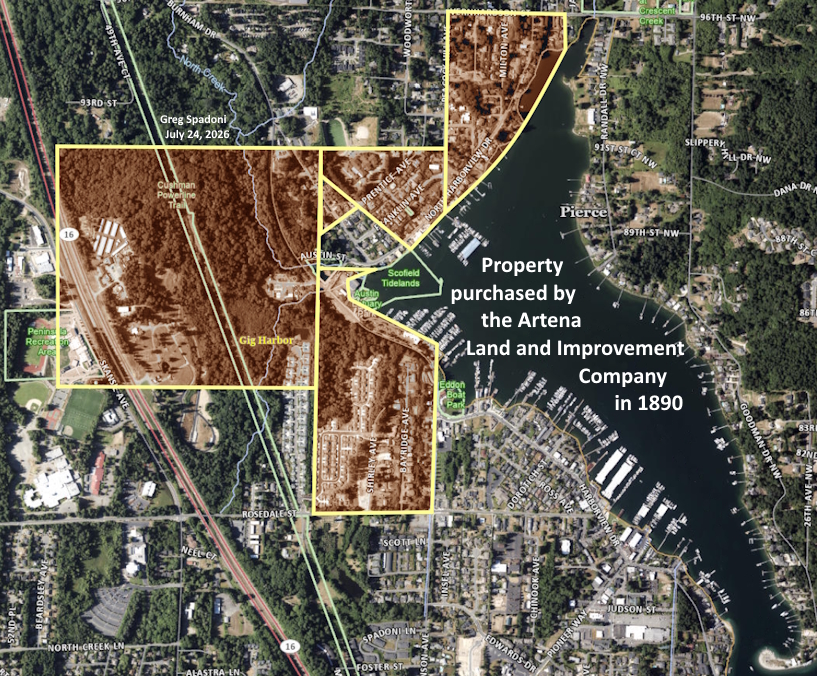
This map shows Joseph Young’s land purchases on behalf of the Artena Land and Improvement Company in 1890. Along with all the property in the shaded areas, it also included a single, unspecified building lot in the original plat of Gig Harbor. Pierce County Assessor-Treasurer aerial base map.
Young then sold most, if not all, his rights to the land to the Artena company when he and others organized it, and the developing began. Sort of.
Gig Harbor’s first business boom
Joseph Young’s and the Artena Land and Improvement Company’s speculation on local real estate had been sparked by Gig Harbor’s first-ever economic boom. In the latter half of 1887, Frank Hall led a contingent of settlers and investors from Albert Lea, Minnesota, to Puget Sound with the intention of going into the lumber business. He chose the west shore of Gig Harbor for the site of a world-class lumber mill, and the north shore for a shingle mill.
By 1890 both mills had been running for over a year, and the future prospects for the Gig Harbor Lumber Company in particular, and Gig Harbor in general, looked very promising. The little sheltered bay was surely going to become an industrial hub on Puget Sound, and the smart money was quick to take advantage. Joseph Young and the Artena Land and Improvement Company represented the smart money.
Gig Harbor’s first business bust
In spite of the ambitions and perceived business acumen of Joseph Young and the Artena company, fortune did not smile on either party. When the Gig Harbor Lumber Company went broke in 1891, ending the prospects for Gig Harbor’s immediate growth and prosperity, the Artena company was unable to develop and market any of the land it had purchased — never mind the grand plans for steamers and railroads — and it, too, went out of business. The only thing of note that it accomplished was accidentally setting two retired passenger steamers on fire when it was clearing and burning building lots it had platted at the northeast corner of the bay. Well, that and completely destroying its investors’ capital.
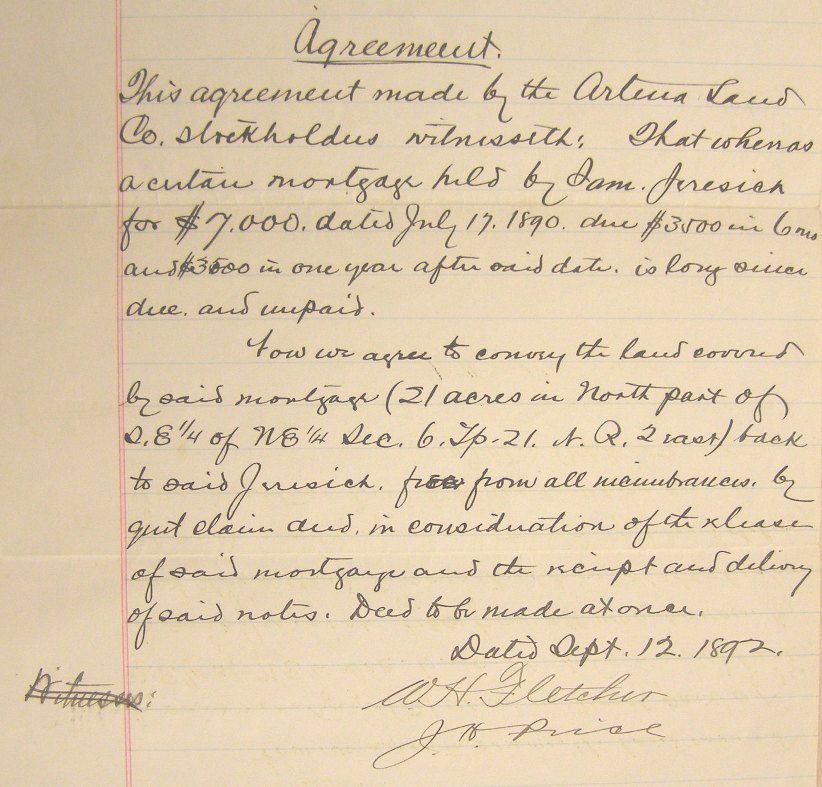
The Artena Company, unable to pay the note on 21 acres at the north end of the harbor it had agreed to purchase from Sam Jeresich — with no money down — ultimately conveyed title to the property back to him. This document is in the collection of the Harbor History Museum.
The smart money turned out to be anything but.
Out of 393 total lots, I was able to find records of only two having been sold in the Artena plat by the Artena company, both in the same sale in 1891.
Unless there were some buyers who did not record their purchases with Pierce County in a timely manner, the rest of the plat sat unsold until the county auctioned it off in pieces over a period of several years to cover unpaid property taxes.
Where did the name come from?
Artena is not an obvious or common name. How did Joseph Young come to use it for his company and a new town?
If his son, Joseph Young, Jr., and several unnamed Gig Harbor residents at the time of Artena’s founding are to be believed — and why wouldn’t they be? They were all living there at the time — Artena was named by Joseph Young, Sr. “after an Indian character in the village” of Gig Harbor, according to The News Tribune in 1926. It was reporting on a get-together of several of the old residents with Joseph Young Jr., who was visiting from Florida.
So, who was the local Native named Artena?
It was all but certainly Artena McKay, the only person known to have been named Artena in the early history of Gig Harbor. She was the wife of Mike McKay (the spelling of their last name may have varied over time).
Artena McKay appears to have been related to Josephine Novak, a well-known Gig Harbor pioneer. (Josephine was sometimes spelled Josephina in her younger years.) It seems very likely that she was either a sister or a sister-in-law to Josephine.
The evidence of such a connection comes from a quitclaim deed purchased by Joseph Young Sr. from Puyallup Tribe member Susana Walla (sometimes spelled Walli) and her immediate heirs. As the only surviving sibling of Jackson Walla (also a member of the Puyallup Tribe), who had once owned the land now occupied by the Harbor History Museum, she was — at least for a time — thought to be his sole heir.
That turned out not to be true, but Young didn’t know that at the time.
The grantors of the quitclaim to Young were listed on the deed as:
Susanna Walli Sole heir at law of Jackson Walli, deceased and Jack Cosgrove and Katie Cosgrove, his wife, Mike McKay and Artena McKay his wife and Josephina Novick, formerly Walli, and John Novak her husband, all claiming through the said Susanna Walli
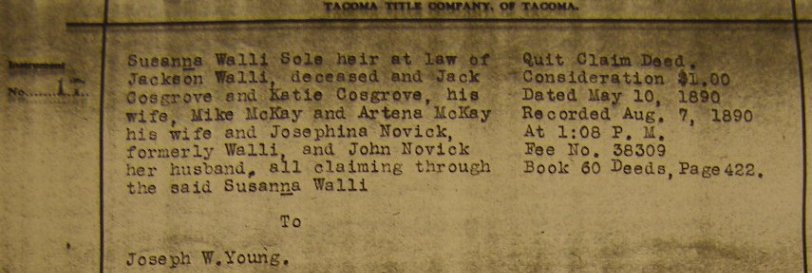
This document, as part of a photocopied transcript of an abstract of title, is in the collection of the Harbor History Museum.
Jack Cosgrove and Josephina (Cosgrove) Novak were children of Susanna Walla. Katie Cosgrove and John Novak were their spouses. Because of the specific wording, all claiming through the said Susanna Walli, the implication of the inclusion of Mike McKay (and with him being mentioned before Artena) is that he, too, was a child of Susanna, which would make Artena a sister-in-law to Jack and Josephina.
Not having the last name of Cosgrove, Mike McKay may have had a different father than Jack and Josephina, which would make him a half-sibling to the other two … unless Artena was a sibling of Jack and Josephine, making Mike McKay the in-law.
The statement claiming through the said Susanna Walli indicates that either Mike or Artena was Susanna’s child, although the possibility of whichever it was having been adopted has to be considered.
Verrrrrry interesting.
Equally interesting is why Joseph Young honored Artena by giving her name to his townsite.
There aren’t many possibilities. She may have been radiantly beautiful, irresistibly charming, or maybe spiritually angelic. Perhaps even an enchanting combination of any two or all three. Whatever her qualities may have been, she obviously made a seriously deep impression on Joseph Young.
No matter the reason, naming the town for a Native was, and remains, very appropriate. For in the early 1900s, Native American artifacts several hundred years old were discovered on some of the waterfront property in the Artena plat. Artena is not simply near a Native American settlement, it was part of one.
Lapse in collective memory
That Artena was named after a local Native was eventually forgotten. In 2020, city leaders believed that nothing within the city limits had been named for any Native of Gig Harbor. That was a big part of the motivation to rename Austin Estuary Park as Austin Park at txʷaalqəł Estuary, as explained in Charlee Glock-Jackson’s Gig Harbor Now article, “City restores Native name to Austin Park Area.”
In reality, a big chunk of the town had been named for a Native, long before Gig Harbor incorporated. And for 136 years the name has endured, though for most of that time without the public’s awareness of its significance.
Correcting the record
Now that the memory has been restored, with a little cooperation from the city, the neighborhood of Artena can be properly recognized as a Native American name.
So, will the city government respond to this historically and culturally important revelation with enthusiasm or crickets?
I have no idea. But that sounds like it could be the Gig Harbor Now and Then Local History Question of the Week, so why not?
Will the city council and mayor of Gig Harbor respond to the historically and culturally important revelation that the neighborhood of Artena was named for a local Native with enthusiasm or crickets?
Actually, I do have an idea. It’s to put money on the crickets.
Silence was the city’s reaction to my revelation of the city’s official date of arrival and my suggestion to name the grass at Skansie Brothers Park Vanderhoof Lawn, so it’s not as if I have nothing to base my cricket bet on.
Next time
The subject of Gig Harbor Now and Then on Aug. 24 will be some of the several-hundred-years-old Native American artifacts that were discovered on waterfront property in the Artena plat.
One thing I don’t expect the next column to have is an answer to today’s question of local history. Not being a resident of Gig Harbor, I don’t follow the progress of the city council. Should they someday actually do something to recognize Artena as being a Native name, maybe I’ll read about it in Gig Harbor Now.
— Greg Spadoni, August 10, 2026
Greg Spadoni of Olalla has had more access to local history than most life-long residents. During 25 years in road construction working for the Spadoni Brothers, his first cousins, twice removed, he traveled to every corner of the Gig Harbor and Key Peninsulas, taking note of many abandoned buildings, overgrown farms, and roads that no longer had a destination. Through his current association with the Harbor History Museum in Gig Harbor as the unofficial Chief (and only) Assistant to Linda McCowen, the Museum’s primary photo archive volunteer, he regularly studies the area’s largest collection of visual history. Combined with the print history available at the museum and online, he has uncovered countless stories of long-forgotten local people and events.