
Community
Two in Tow & On The Go | Shopping for a wish
Reporter’s note: I told myself I’d be cool about this story; that I’d tuck one small, informative detail about a local misconception into an otherwise warm-and-fuzzy holiday heartstrings story and call it “mission accomplished.” But here I am, in these late writing hours, wrestling with the two loudest parts of me: the journalist who believes transparency is everything and the mom-of-two who doesn’t want to take any sparkle out of a good community program.

Community Sponsor
Community stories are made possible in part by Peninsula Light Co, a proud sponsor of Gig Harbor Now.
So here’s where I landed: I hope this story doesn’t overshadow the heart behind what the Gig Harbor Lions Club and their partners are doing for local families this holiday season. Truly.
Their work matters, and it helps real local kids and their families. I support it. But it’s misleading to imply that the information printed on the yellow gift tags hanging from Gig Harbor Lions Club Giving Trees each reflect a specific child’s actual wishlist item. Even if it’s done ever so slightly and with the best intentions, the system is not transparent.
My goal here isn’t to diminish the Giving Tree program, or imply that other Giving Tree programs operate this way. But for Gig Harbor, it’s to help readers understand how this program works so giving to it in the future continues to be a sustainable and long term endeavor.
Shopping for a wish: our experience
In November 2024, the kids and I, along with GHN history columnist and all-around nice guy Greg Spadoni, went in together on a gift donation from the Gig Harbor Lions Club Giving Tree project. The idea is simple and sweet: Pick a tag off the tree; buy the gift printed on it; return the gift to the same business, unwrapped and paired with the tag which is also marked with the child’s age and gender. Lions then gather everything and deliver the gifts to groups that help match the gifts with the kids and families who need them most.
It’s an approachable kind of giving — the type families can do together and an endearing choice when considering which toy drive to participate in.
We weren’t the only ones. According to the club newsletter, the the Lions Club received 3,836 total gifts from its 2024 Giving Trees. Of those, 3,451 unwrapped presents went to the Gig Harbor Peninsula FISH Food Bank, 205 to the Boys and Girls Club at Evergreen Elementary on the Key Peninsula, and 180 stuffed animals went to kids undergoing treatment at Mary Bridge Children’s Hospital in Tacoma.
The annual holiday program is the service organization’s biggest project of the year. Members spend considerable volunteer time preparing for, coordinating and running the effort all before delivering the gifts to other organizations to hand out to families.
Businesses host small decorated trees covered in bright yellow tags. Each tag lists an age, a gender, and one easy-to-shop-for item. For example, one tag might say, “Boy, 14, headphones,” and another says, “Girl, 3, Cocomelon toy.” Those tiny snippets gave us a mental picture, an emotional hook. Humans give more generously when they feel connected. That’s Fundraising 101.
The Lions’ 2025 tree program is going on now for about another week, with trees tucked inside 55 local businesses around Gig Harbor. The group hopes to beat its 2024 total gift count this year. Which is a very cool, very Gig Harbor-style goal.
In fact, none of that is the problem. The issue is within the wording on the tags and signage. The Lions provide a display sign for each tree site with details on how the public can participate. Perhaps I should’ve considered its wording more closely, specifically the part where “special wish” is in quotation marks:
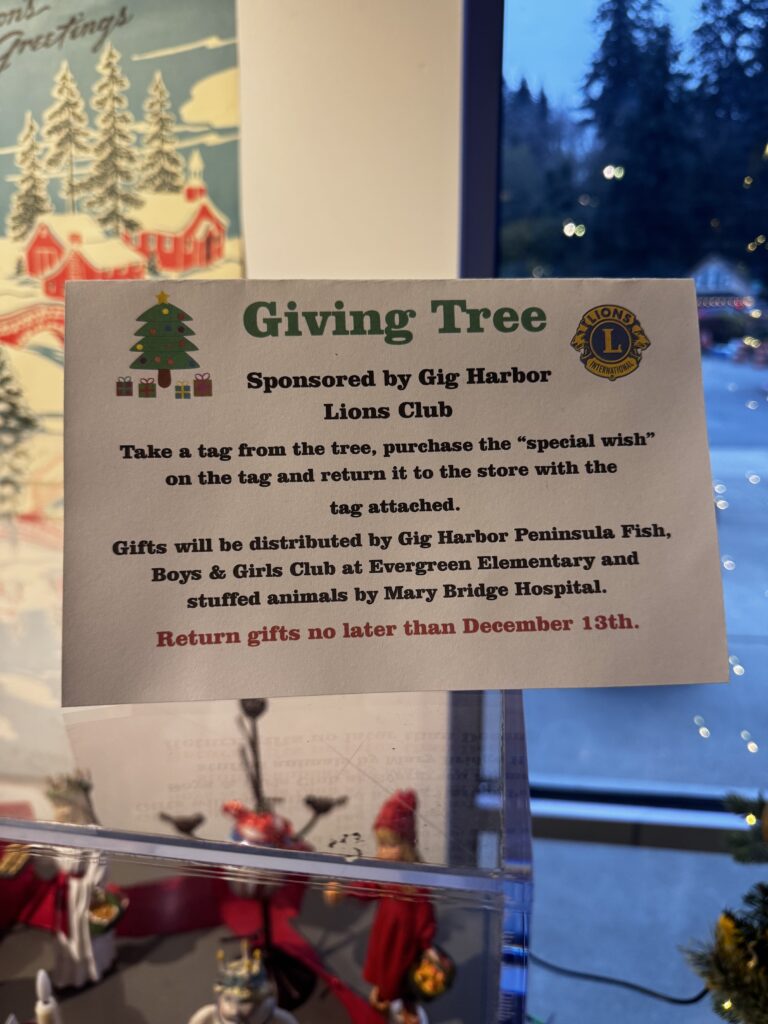
- 2025 Gig Harbor Lions Club Giving Tree program
Standing in front of these trees all over town, decorated all festive and adorned with not just paper gift tags but childhood wishes? How cute is that!? It’s easy to read the Lions Club signage and assume each tag represents a specific child and the one gift they’re really hoping to unwrap this Christmas. The wording really leans that direction:
Take a tag from the tree, purchase the “special wish” on the tag and return it to the store with the tag attached.
It’s subtle, but powerful. And, when it’s paired with the singular language wording choice used on the tags (“Boy, 17” and not “For boys age 17”), the wording implies a specific 17-year-old boy with a specific gift wants that thing and his name was not disclosed for privacy. Nothing on the sign or the tag clarifies that tags are representative of gifts that certain age groups want, or that multiple, identical tags may exist for the same age group, since many kids want the same things.
So the natural conclusion — especially for parents who’ve done similar Giving Tree programs elsewhere — is that each tag equals one real kid, one real wish. And that’s part of what makes the Giving Tree tradition feel so heartfelt: That sense of connecting with a real child you’ll never meet but still get to help.
‘Boy, 17 — Toiletry Kit’
We found that in our 2024 Gig Harbor Lions Club Giving Tree experience, which started simply enough. At the Harbor History Museum’s tree location, just before Thanksgiving, we browsed the tidy rows of yellow gift tags, each listing a gender, age, and one straightforward gift item in typed letters. We picked a tag marked “Boy, 17 — Toiletry Kit.”
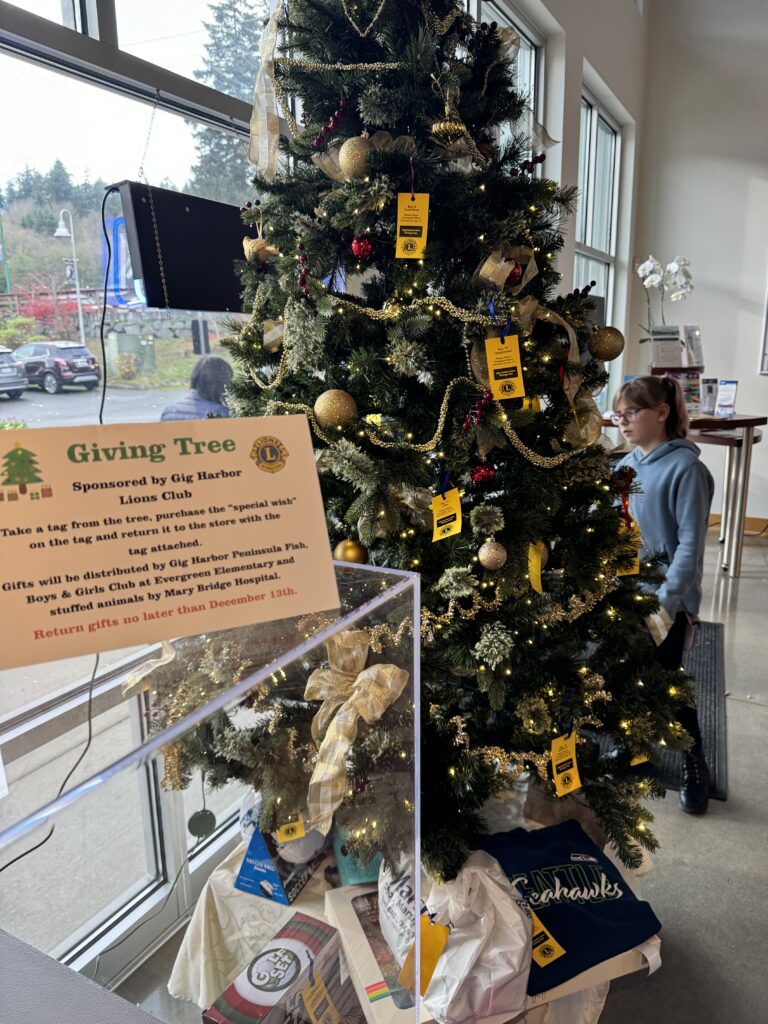
- Clara in 2024 checking out a Gig Harbor Lions Club Giving Tree
It felt like the perfect little mission. We could easily help this teenager and we knew exactly how to do it, which felt satisfying and purposeful. Our crew took the tag straight to Target, bought a bunch of toiletry kit items and a bag (plus a few teen-friendly extras, because, of course we did), and taped that exact tag to the gift before returning it unwrapped and sliding it under the tree. Done and done.
About two days after we’d dropped off the toiletry bag, we walked into Beard Swim Co. off Point Fosdick Drive for Clara and Wyatt’s swim class. It was there that we did the world’s most dramatic double take. “Boy, 17 — Toiletry Kit.” The same tag. Same age, same wording, same everything … somehow hanging on Beard Swim Co.’s Lions Giving Tree:
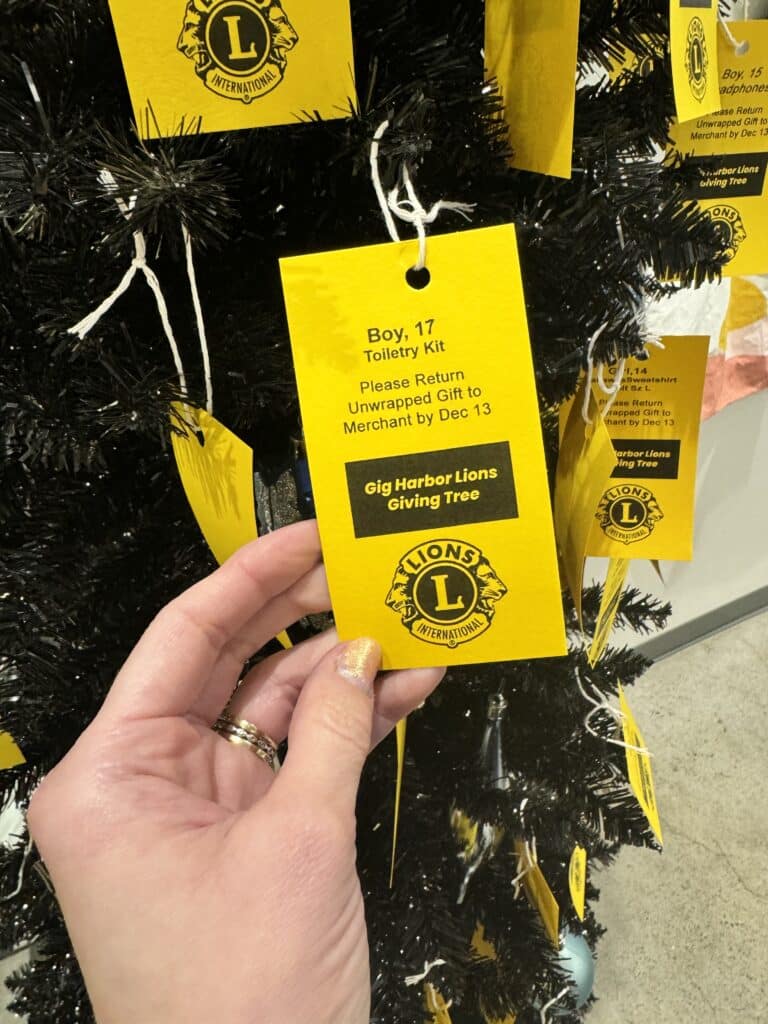
- 2024: Same tag, different location

Several other duplicate tags we’d seen elsewhere were also there. I thought it was so strange. But, it was also a busy holiday week and I didn’t think of the tags again until Dec. 7, when we returned to the Harbor History Museum for a holiday event. Cookies in hand and dashing between craft tables, the kids and I passed our original Giving Tree tag site two or three times … and guess what? “Boy, 17 — Toiletry Kit” was back on it, now making its third appearance. It was the holiday déjà vu we couldn’t unsee.
And it was that third sighting that officially had me thinking, ‘Wait … how does this system actually work?’
A second tag, and then a third
After that third tag sighting, I emailed the Lion’s Club folks some questions. But by then, its Giving Tree program was over for the year. I asked my questions. And those sweet little wish tags? Each implying a specific child alongside their hopes and dreams?
Not literal. The club confirmed the gender, age, and gift item printed on each tag were generic age-appropriate ideas created to help volunteers sort and distribute more effectively.
Gut punch.
I mean, that sense of human connection after fulfilling “Boy, 17, Toiletry Kit”? Of meeting one teen’s very real, very humble wish?
Poof.
Some families, especially those who put quite a bit of effort and intention into the process (solving the mid-aisle mysteries of Dude Wipes “because he might like them,”) well, they might feel surprisingly let down by that information. Because we weren’t just shopping for a toiletry kit. We were fulfilling a story we believed in. And, we trusted the Giving Tree format. We believed the tag meant what it implied: that a singular person asked for a singular thing. And we built a whole family moment around that idea.
I had other questions too
- Do the gift tags represent specific individuals’ actual requests, or are they more generic suggestions meant to encourage donations?
- Why are duplicate tags used at different locations? For example, is there a system in place to ensure the same gift isn’t purchased multiple times?
- If a tree runs out of tags because folks have taken them to fulfill the wishes, is the tree refilled with new tags that are duplicates of previous ones, or are they new requests entirely?
The answers, summed up
- The tags aren’t individual wish lists. Gig Harbor Lions Club reps say the tags don’t represent specific children or personal requests. They’ve always been generic gift suggestions based on age groups.
- FISH Food Bank helps brainstorm ideas for teens, which is why tags might list things like toiletry kits or cozy blankets.
- Local toy stores offer input on what’s popular, and those suggestions also show up on the tags.
- FISH serves more than 800 families at its toy distribution, so individualized wish-matching isn’t practical. In 2024, families could request bigger items, like bikes and have those fulfilled.
- Duplicate tags are intentional. They create multiple copies of each tag — more than 2,000 total this year — and spread them across participating businesses. Tags are put back on trees after gifts are returned because the need is so high that duplicates are necessary.
- Age labels help them fill partner requests such as the age-specific gifts from kids at the Boys & Girls Club at Evergreen Elementary, so having an age on every tag helps them pull appropriate items.
- Lions kept collecting after the official deadline because so many last-minute gifts arrive.
When I told the kids what I’d found out, I’d mostly made peace with it already. I wanted another teaching moment to explain the concept that gift-giving and donating to those who need help isn’t about us. It’s about them.
Our experience, our “family moment” while shopping for them — that’s not what giving is really about. So while our “Boy, 17, Toiletry Kit” wasn’t a “real” Dude Wipes-lovin’ teen, there was someone who needed deodorant and shampoo and a comb. Heck, maybe they even enjoyed smelling like “Mountain Air.”
As much as I liked the idea of buying for one special gift for one special person, getting the truth behind the tags was a good reminder that the Gig Harbor Lions Club Giving Tree program supports hundreds of kids, not just one. And while the ideas behind the tag and gift concept have changed for me, the purpose remained the same. The gift still landed in the hands of a young person, or several young persons, who needed those items.
For our part, the magic of the “one child, one wish” narrative has dimmed a little. But the kids (and big-kid Greg) still got a lesson in empathy. The kindness aspect was real. The usefulness was real. And the impact of helping families needing support is absolutely real.
So maybe next year, the grown-ups will understand the system better and tell their kids:
“Sometimes these tags represent real kids’ specific wishes, but sometimes they’re suggestions. Either way, someone will get this — and it will matter.”
And that’s a message I’m still on board with.

Tonya Strickland is a Gig Harbor mom-of-two and longtime journalist. Now in the travel and family niche, her blog, Two in Tow & On the Go, was named among the 10 Seattle-Area Instagram Accounts to Follow by ParentMap magazine. Tonya and her husband Bowen moved to Gig Harbor from California with their two kids, Clara (11) and Wyatt (9) in 2021. Find them on Facebook for all the kid-friendly places in and around town.