
Business Community Government
Council approves recommended lodging tax allocations
The Gig Harbor City Council voted unanimously to approve grant funding recommendations from the city’s lodging tax advisory committee on Oct. 12.
The Gig Harbor Chamber of Commerce will get the bulk of available lodging tax revenues, while several organizations will receive significantly less than they sought. The disparity will make a significant difference for organizations receiving less than they hoped.
The nonprofit Gig Harbor Film Festival is one. The festival requested $31,500 from the fund for outreach and marketing operations. It will receive $5,000.
Film Festival Board President Tina Shoemaker said the bulk of the festival’s funding comes from sponsorships, corporate support and individual donors.
Shoemaker said in an interview that the lodging tax fund the only grant-like program for which the festival applies.
GHFF leadership believes that “because we do draw so many people from outside the area, we are fully qualified for funding under the program,” Shoemaker said. “However, it’s [the committee’s] responsibility and their decision as to what direction they want to go. I think it’s unfortunate, but it’s a reality. We’ll simply have to go to other sources of funds.”
Money meant to promote tourism
State law requires the city to use lodging tax revenue to support tourism and tourism-related activities, such as marketing and festivals. The law also requires that a committee — composed of representatives from both businesses that collect the tax and organizations eligible to receive revenue — recommend how that money is distributed.
Gig Harbor’s committee includes Chamber President and CEO Miriam Battson; Harbor History Museum Executive Director Stephanie Lile; Clare Dunis, executive director of the Gig Harbor Downtown Waterfront Alliance; and Harbor WildWatch Executive Director Lindsay Stover.
Representing businesses that pay the tax are Best Western Wesley Inn & Suites owner and operator Sue Braaten; Wells Fargo manager Kara Sandvik; Patsy Irwin, who manages the Waterfront Inn; and Maritime Inn co-owner Jannae Mitton.
Starting in 2023, the city contracted with the Chamber of Commerce for marketing and tourism work. Previously, the city’s communications staff handled that work. The Chamber uses LTAC funds to support tourism marketing.
Reworked funding decisions
The committee met twice in September to decide how to distribute the funds. The Chamber originally asked for $520,000 of the available $530,000.
The committee ultimately denied the Chamber its full funding request, but it increased its allocation after reviewing its preliminary recommendations. The final recommendation was $442,000 for the Chamber, up from the previous $379,400.
To do this, the committee further whittled down the money allocated to other organizations.
Under the committee’s original decision made at its Sept. 2 meeting, those organizations would have already received significantly less than they asked for.
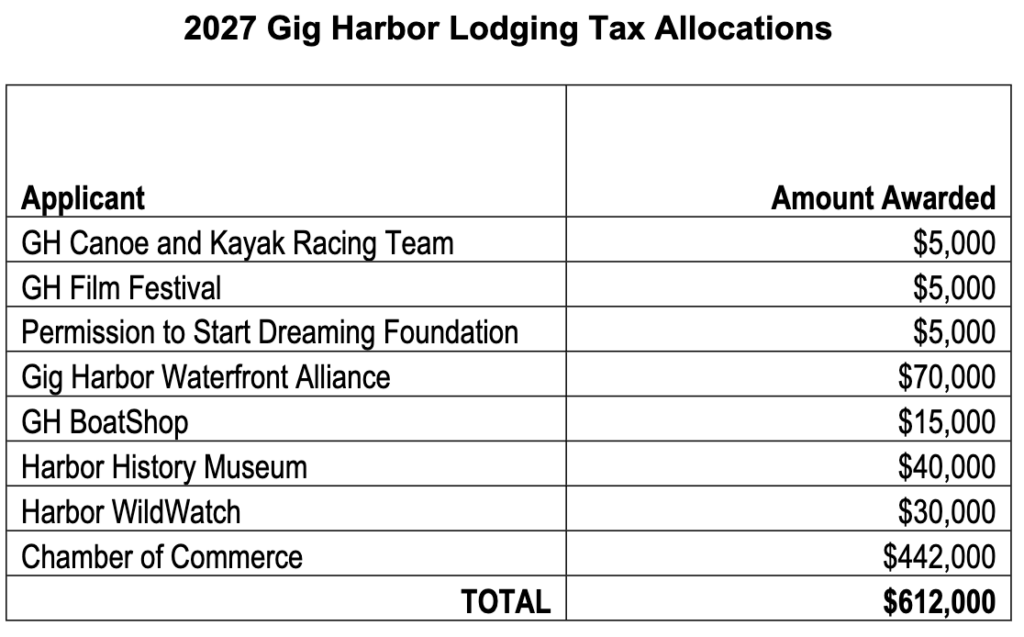
At its second meeting on Sept. 21, the committee cut even deeper.
Members frequently cited the literal letter of the law governing the distribution of lodging tax funds. The law states that organizations receiving lodging tax revenue must demonstrate that they can draw people to a jurisdiction overnight — “heads in beds,” as Stover said at the committee’s July 23 meeting.
Festival-goers from all over
Shoemaker said the Film Festival bought out the Waterfront Inn to provide lodging for people teaching workshops at the September event. It also offered “preferential hotel pricing” for filmmakers.
“And they came from all over the country,” Shoemaker. “I talked with filmmakers from New York, California, Chicago, Connecticut, Seattle, Boston and Portland.”
Shoemaker said the film festival primarily uses lodging tax funds “for that outreach to bring people to Gig Harbor and to promote Gig Harbor as a partner in our film festival.”
She could not cite specific numbers off the top of her head, but this year, “I personally talked to [festival attendees] from Canada, from New York, Chicago, Nashville, British Columbia, Seattle and our region, Connecticut.”
In previous years, visitors came from as far away as China. “So we do draw from a fairly large area.”
Shoemaker also noted that the film festival would have liked better communication about the decision. When Gig Harbor Now spoke with her before the Oct. 12 city council meeting, she was unaware that the film festival’s funding had been cut even further from the committee’s first meeting.
She said she only knew about the committee’s first funding distribution decision from reading the article in Gig Harbor Now.
Still, she said, the festival does not seek grant funding as a primary means of sustainable funding. She expects the festival to continue seeking LTAC funding in future years, “if there’s any fund available, because again, what [the lodging tax fund] is intended to do, as I understand it, is exactly what we’re doing.”
Future allocation considerations
The museum’s Lile, the Alliance’s Dunis, and Stover from Harbor WildWatch voluntarily reduced their organizations’ funding to allocate more to the Chamber of Commerce when the LTAC committee took a second look at allocations on Sept. 21. The Harbor History Museum will receive $40,000, while the Gig Harbor Downtown Waterfront Alliance will receive $70,000. Harbor WildWatch will receive $30,000. The museum requested $50,000, the Alliance requested $100,000, and Harbor WildWatch requested $35,000.
During an Oct. 1 study session in which the council discussed the committee’s recommendations, Dunis highlighted that “[m]arketing can bring someone to town once, but it is the physical experience of our beautiful streets, floral displays, markets, museum exhibits, and district events that drive our 63% repeat visitor retention rate. Protecting funding for our on-the-ground anchors ensures that regional ad campaigns always have an authentic vibrant destination to promote.”
Lile said during this same study session that there is only so much money to go around, and that the committee and city need to “be true to that budget.” She said the process of awarding lodging tax funds was balanced — but the city and committee needed to keep an eye on “how can we keep this balanced, keep things vital and not have everything just go one pot or the other.”
Clearer guidelines
At the council’s Oct. 12 meeting, Lile advocated for clearer guidelines on how the committee should balance allocations between the Chamber, as the city’s destination marketing organization, and nonprofits that meet the funding eligibility criteria outlined in state law. Clearer guidelines would prevent “this back and forth,” she said.
“The funds are very limited. The budget is small. So if you could provide some additional guidance on what is appropriate compared to other communities, that would be very helpful for the future of the commission,” Lile said.
Lile is part of a subgroup of lodging tax committee members who intend to review and recommend changes for future lodging tax grant applications. Sandvik, Dunis, and Stover are her fellow subgroup members.