
Community Police & Fire
Gig Harbor Fire and Medic One ready to show off its new training tower
One might not expect that too much design work goes into a structure built for the express purpose of being set on fire.
But Gig Harbor Fire and Medic One’s new training tower was intricately designed to allow firefighters to simulate the challenges they might experience in the real world. That extends to having multiple stairwells, because different designs require different procedures for dragging hoses up them.
The training tower is part of the fire district’s Training Campus, located on the the fire district’s property at 10302 Bujacich Road. The campus, funded as part of an $80 million bond approved by voters in 2022, is just about ready for use.
Gig Harbor Fire is hosting a grand opening for the training campus from 3 to 6 p.m. Wednesday, June 24. The event will include tours of the facility, a dedication ceremony and a ribbon-cutting. Anyone is welcome at the grand opening.
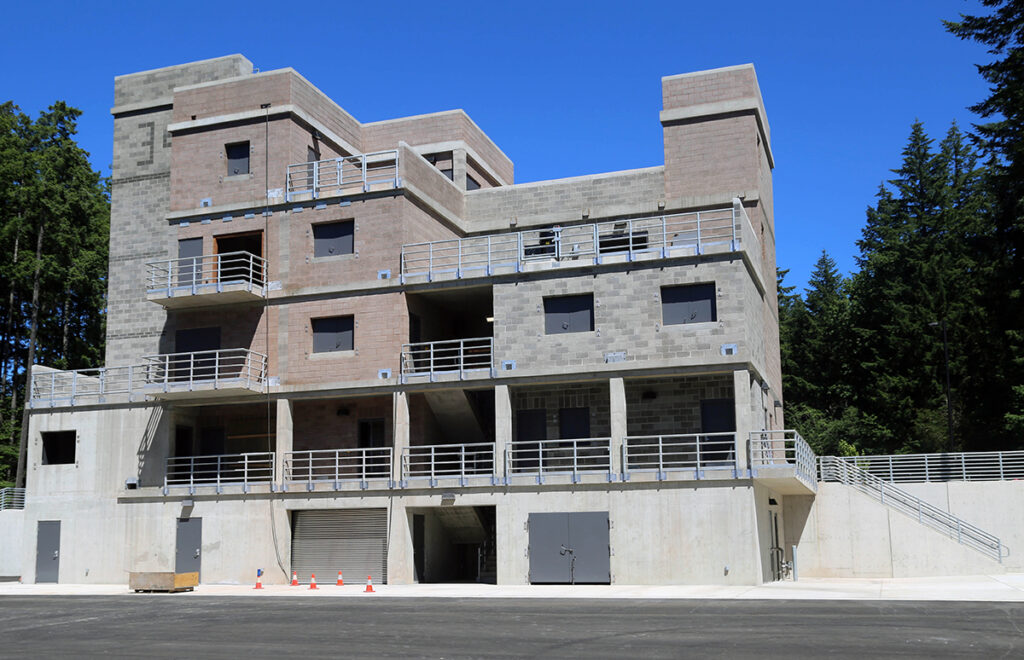
Gig Harbor Fire and Medic One’s new training tower. Photo by Vince Dice
Long-awaited facility
Saying the grand opening of the training campus has been a long time coming is a tremendous understatement.
Last week, Gig Harbor Fire Training Division Chief Scott Corrigan showed off some of the original plans for the campus. They were hand-drawn in colored pencil, had never been digitized and were dated 1993.
The district saved up enough money to begin work on the campus by 2009, but the Great Recession struck. Instead of launching a new capital project, Gig Harbor Fire used its savings to avoid laying off firefighters.
The department finally broke ground on the project in October 2024, after awarding a $14.1 million contract to Pease Construction.
Major construction wrapped up last week, and the first firefighters soon will begin sitting in the campus’s classrooms and practicing techniques in its training tower.
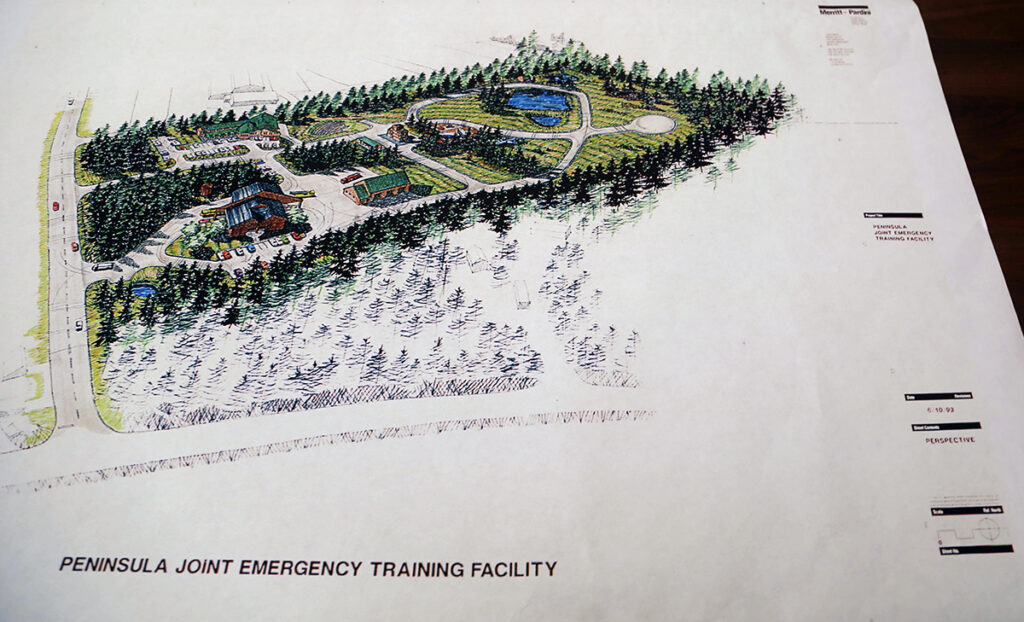
Original, hand-drawn plans for Gig Harbor Fire and Medic One’s training campus, dated June 1993. Photo by Vince Dice
An upside to the delay: Corrigan and others at the district had plenty of time to go over specs for the campus. That included traveling to other departments that have training facilities and asking them what they would change if they could.
“It involved many hours, often sitting alone in a room, looking at drawings until your head goes numb,” Corrigan said. “But it was a labor of love and an honor.”
Support building and training tower
Two structures, the training tower and the training support building, comprise the campus. The concrete-block training tower is for live-fire training and other activities, while the support building includes classroom space, an apparatus bay, offices and more.
Together, the buildings allow Gig Harbor Fire to conduct its own “academies” on-site. Academies can be for new hires, incumbent employees learning new roles, and for firefighters seeking a promotion.
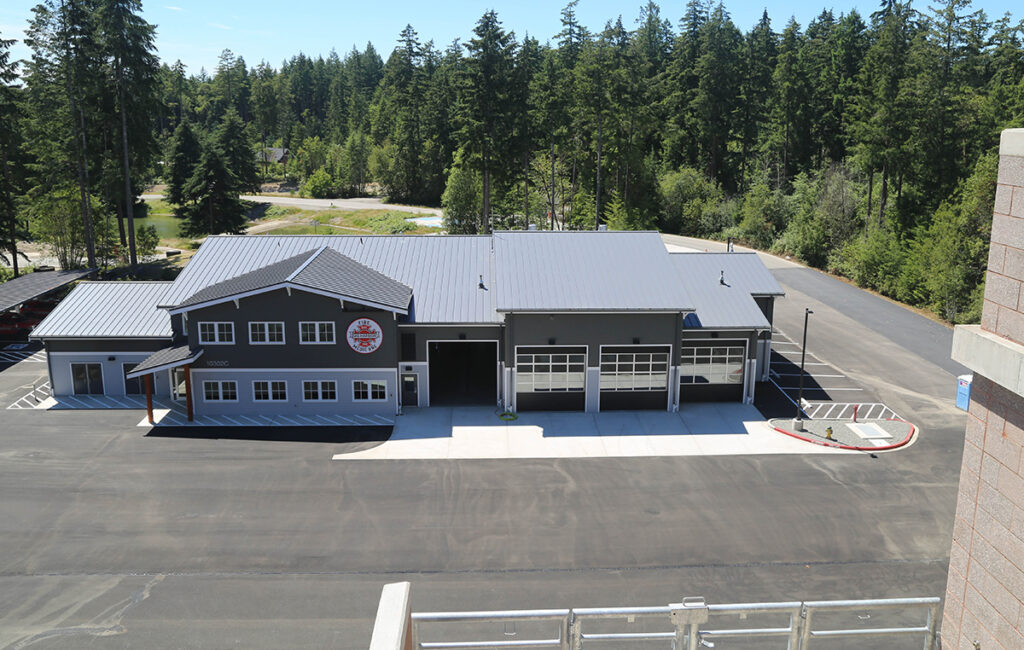
The new Training Support Building at Gig Harbor Fire and Medic One’s campus on Bujacich Road. Photo by Vince Dice
Firefighters must engage in a multitude of ongoing training to maintain certifications, and that can happen on the new campus, too.
When the schedule allows, GHFMO will also make its new campus available for use by surrounding districts. That’s especially valuable in the case of the training tower, both for Gig Harbor Fire and other districts. Until now, live-fire training required a daylong trip to North Bend, in eastern King County, adding travel and overtime costs to the training budget.
Training tower
Corrigan said the training tower “is truly a reflection of our community. It may look like a big square building, but each element reflects one of the challenges in our community.”
That’s where the design work comes in.
Different floors and sides of the building are designed to allow firefighters to train on fighting fires in different kinds of buildings — a single-family home, a multifamily residence (like an apartment building) or a commercial structure.
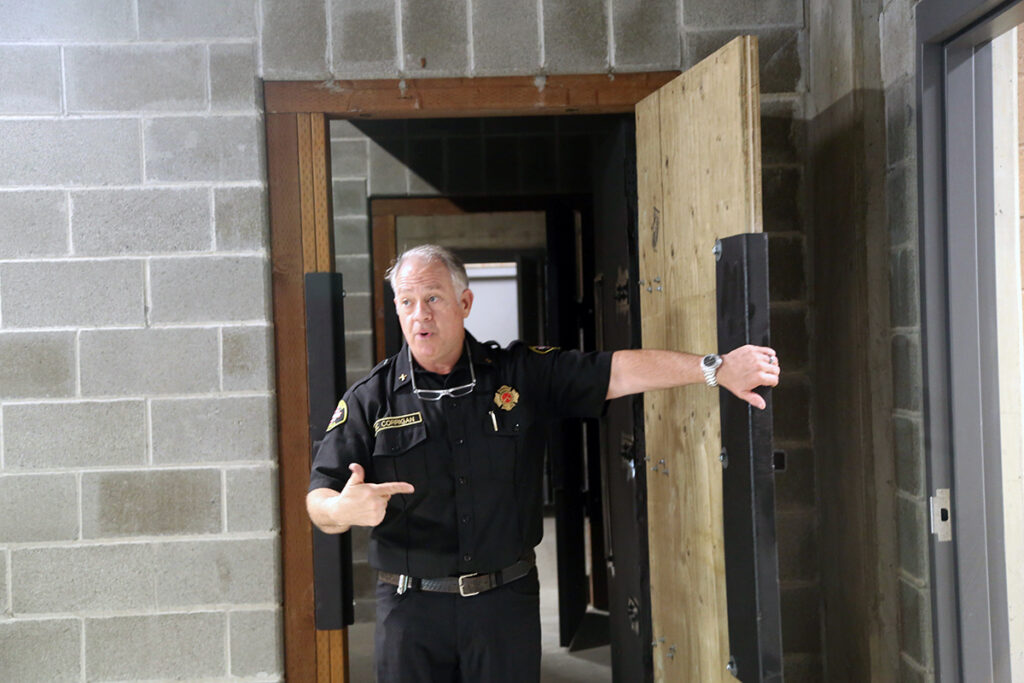
Gig Harbor Fire and Medic One Division Chief Scott Corrigan explains features of the training tower. Photo by Vince Dice
If you walk into the ground floor of the tower from the west, you might think you’re walking into someone’s living room (minus amenities like carpet and furniture). If you walk in from the east, you might think you’re in a small restaurant. They share a kitchen.
Another space is set up for indoor ladder and rope training, allowing a trainer to evaluate beginner candidates without also fighting the weather.
A central hallway on the second floor mimics an apartment or hotel building. “Props” can be inserted to change a room’s layout or to imitate furniture or walls.
A vertical tube runs down the center of the tower, allowing for training in “confined space rescue training.” Balconies can be used to practice evacuating residents from elevated floors.
And it’s all packed into a relatively small footprint, which was by design.
“The original goal was to design a building that would allow as many different training scenarios as possible in a relatively small footprint,” Corrigan said.
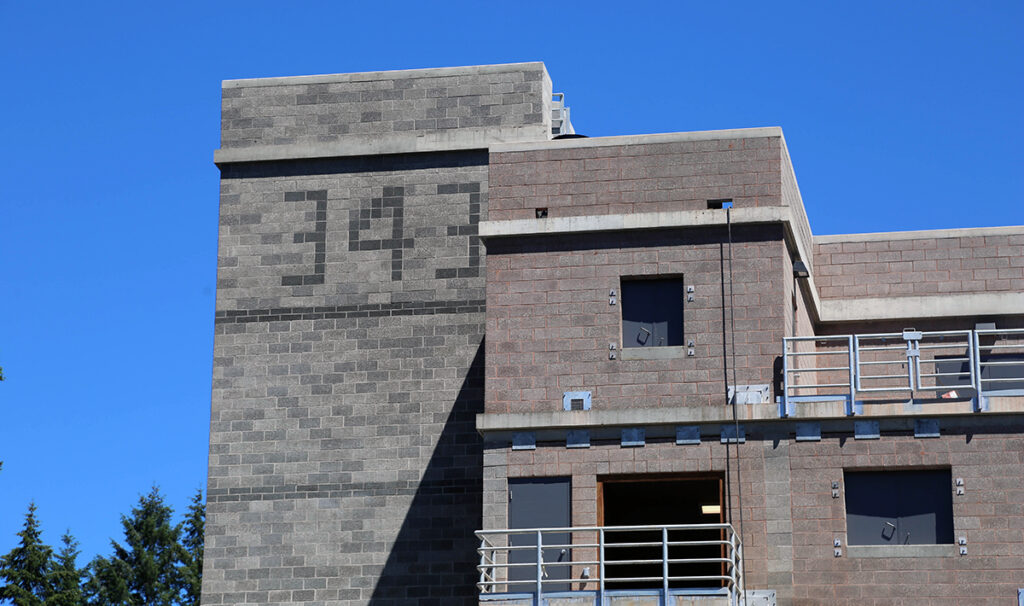
A tribute to firefighters killed on Sept. 11, 2001, on the new training tower at Gig Harbor Fire and Medic One. The number reflects how many New York firefighters died that day. Photo by Vince Dice
Other bond-funded projects
The training campus is far from the only project built using bond revenue.
Contractors have already completed renovations on stations 53 (Fox Island) and 57 (Crescent Valley). Those aging facilities got revamped decontamination areas, seismic upgrades, new dorm space and updates to meet ADA requirements.
The district deemed it more cost-effective to demolish Station 51, on Kimball Drive, and rebuild a state-of-the-art structure.
Demolition wrapped up this spring, and a new Station 51 is now rising in its place. Gig Harbor Fire expects it to be ready in summer or fall 2027.
The district also plans to renovate or rebuild stations 58 (Bujacich Road) and 59 (Artondale), but those projects are farther down the timeline.
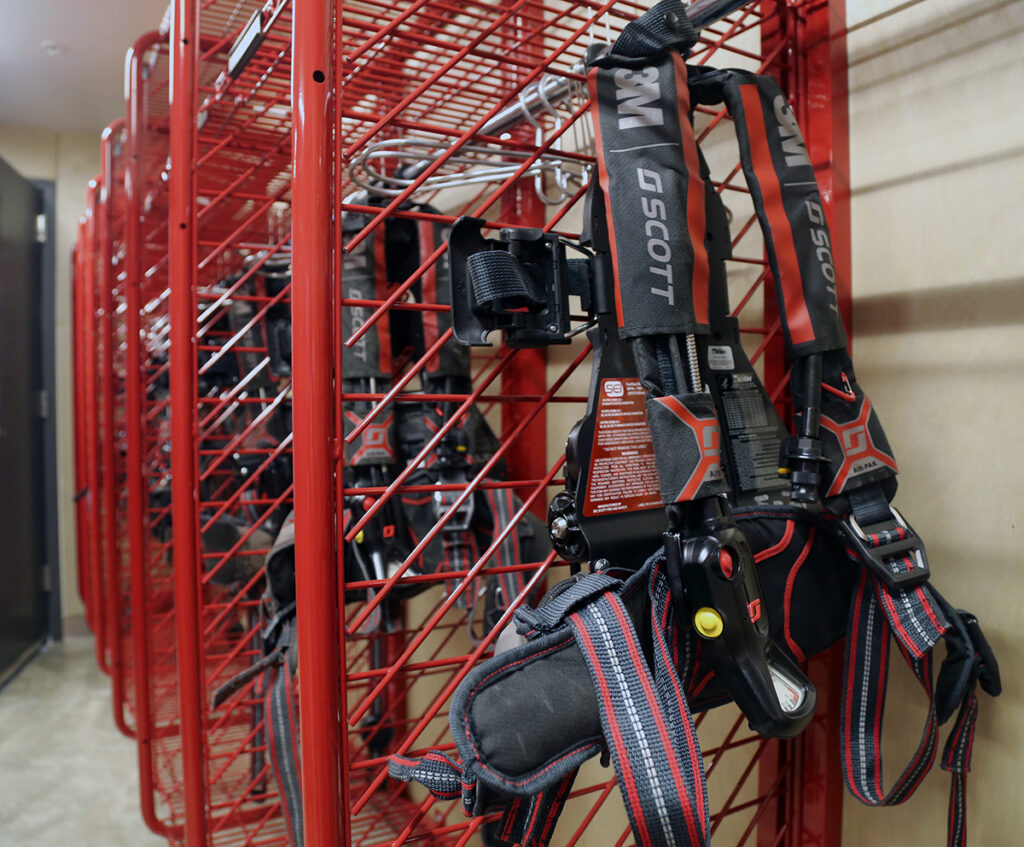
Firefighting gear hangs inside Gig Harbor Fire and Medic One’s training support building. Photo by Vince Dice